The inherent strength of bronze allows animal sculptors to use that quality of the material to create works that are no longer tied down to sculpted tress, hills or rocks. They can present the animal itself with no distractions.
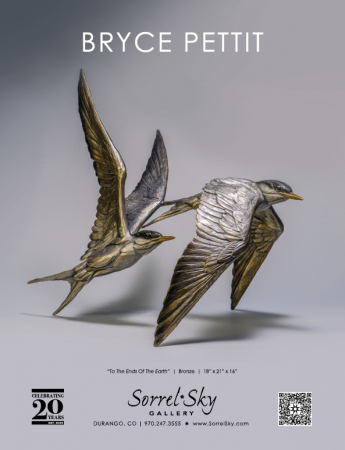
Bryce Pettit’s Critical Angle is simply an eagle and its prey, the sculpture balanced on the tips of the eagle’s wings and the fish’s tail. The title refers to the skill of eagles to spot and capture their food. They perch in a tree or soar high above watching the surface of the water. When they see a fish, they swoop down above the surface and extend their feet and talons into the water to snare the fish. Eagles are only able to lift between 1½ and 3 pounds and sometimes get dragged into the water. Unable to take off from the water they have to make it to shore to set off again. Pettit’s sculpture is the eagle in perfect form.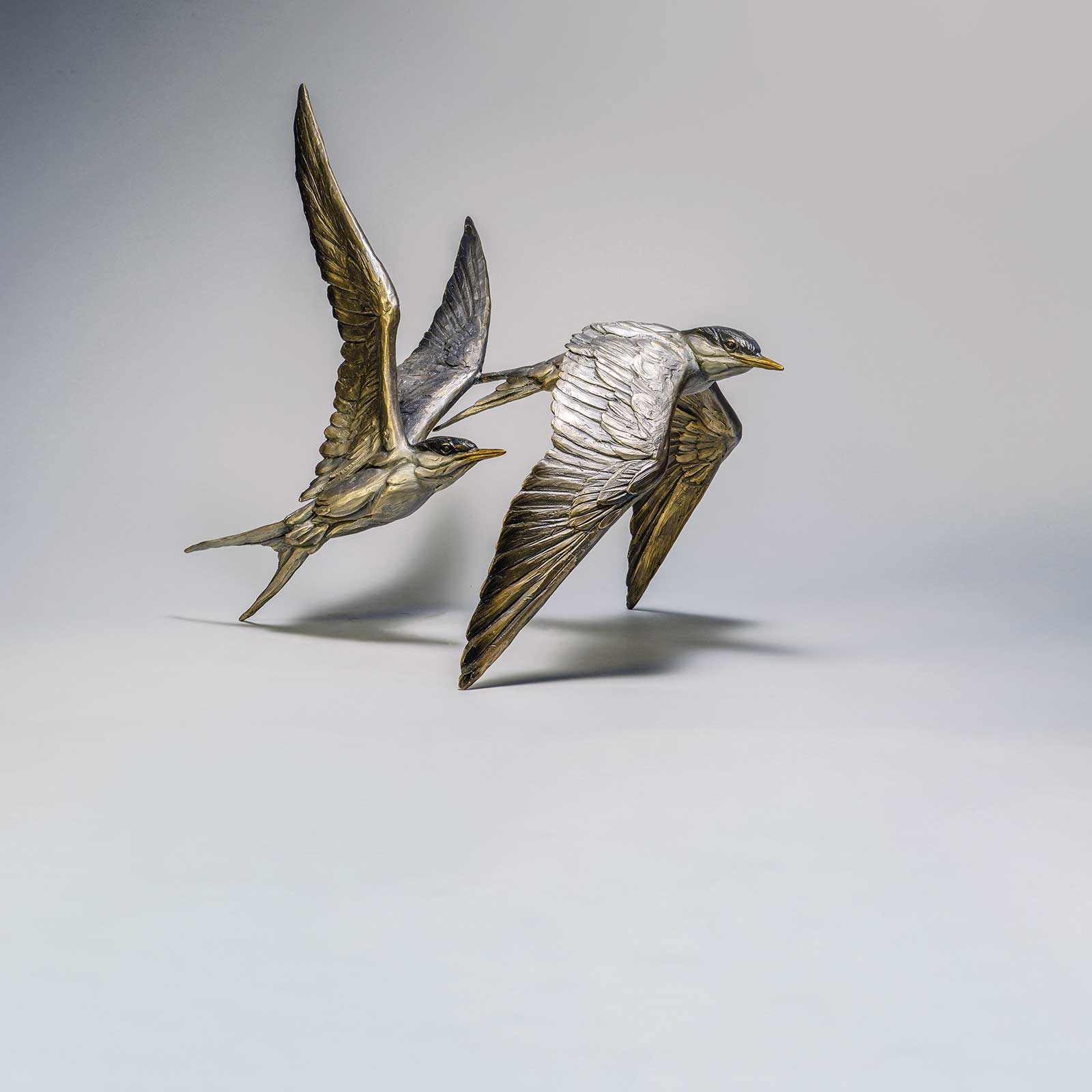 Blue Rain Gallery, To the Ends of the Earth, bronze, ed. of 35, 19 x 21 x 17”, by Bryce Pettit
Henry Beston (1888-1968), author of The Outermost House, was a keen observer of animal behavior. He wrote, “We patronize the animals for their incompleteness, for their tragic fate of having taken form so far below ourselves. And therein we err, and greatly err. For the animal shall not be measured by man. In a world older and more complete than ours, they are more finished and complete, gifted with extensions of the senses we have lost or never attained, living by voices we shall never hear. They are not brethren, they are not underlings; they are other Nations, caught with ourselves in the net of life and time, fellow prisoners of the splendour and travail of the earth.”
Pettit’s eagle is guided by “extensions of the senses we have lost or never attained.”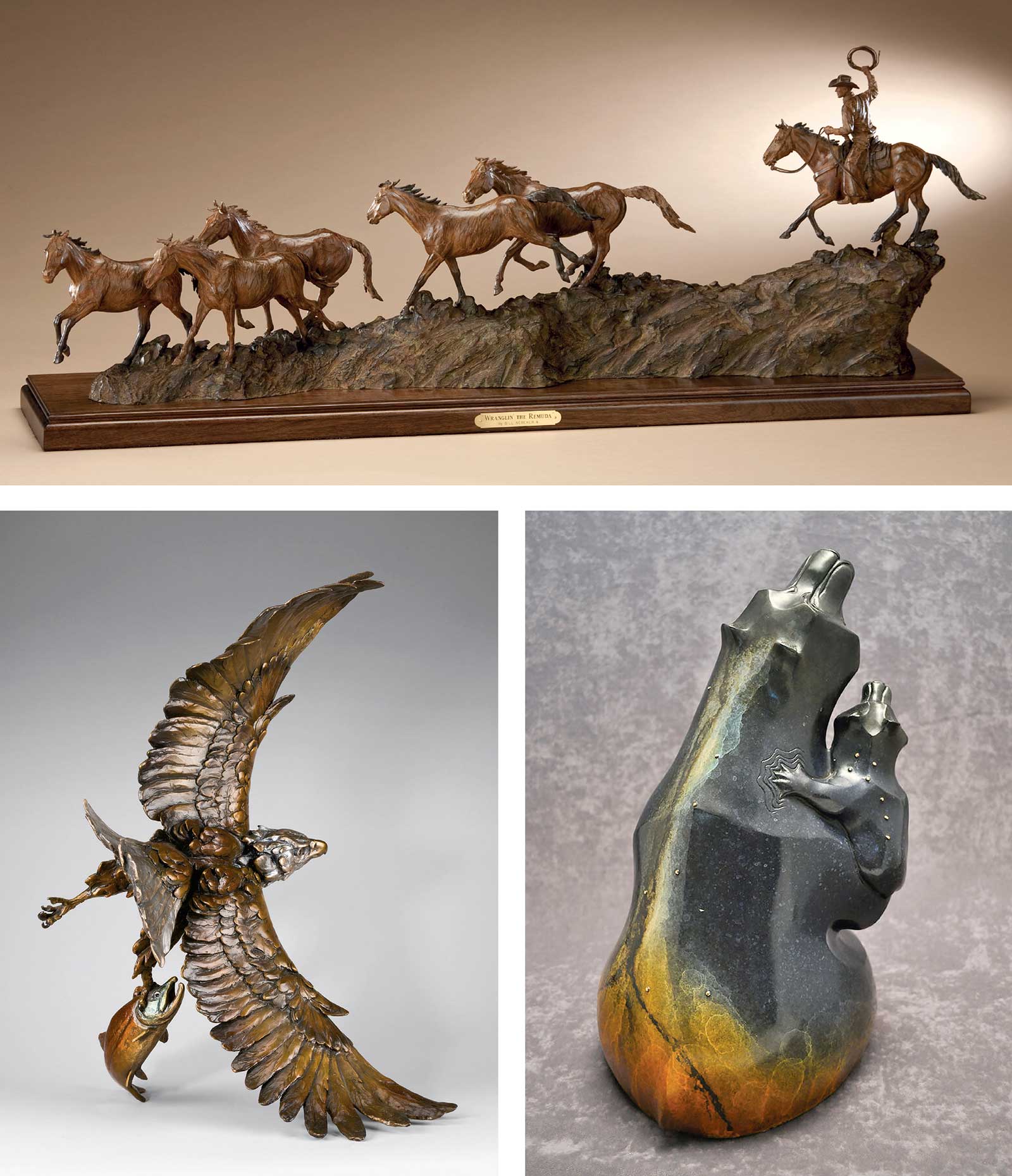 Top: Bill Nebeker, Wranglin’ the Remuda, bronze, ed. of 30, 19 x 50 x 11”. Bottom, from left: Blue Rain Gallery, Critical Angle, bronze, ed. of 30, 22 x 12½ x 17”, by Bryce Pettit; Manitou Galleries, Ursa Major and Minor, bronze ed. of 45, 17 x 10 x 12”, by John Maisano.
The horse has inspired artists for millennia for its grace and its utility. The Greek military leader Xenophone (ca. 430-354 B.C.) wrote, “And indeed, a horse who bears himself proudly is a thing of such beauty and astonishment that he attracts the eyes of all beholders. No one will tire of looking at him as long as he will display himself in his splendor.”
Bill Nebeker grew up on a ranch among all things cowboy. He began by whittling horses and other animals and is now a member of Cowboy Artists of America with two major commissions unveiled in the past two years at the entrance to the Prescott, Arizona, airport and the Prescott Courthouse Plaza. Whether monumental or tabletop-size, his bronzes of horses and riders reveal an intimate knowledge of each. He imagines his sculptures before beginning to apply clay to an armature and then adjusts the materials until they attain a satisfying composition and accuracy.
The Spanish word remuda translates into “exchange” or “replacement.” A remuda in ranching is a herd of saddle-broken horses from which ranch hands choose their mount for the day. On a long roundup, a cowboy may need to change horses several times a day. Wranglin’ the Remuda depicts five horses being pursued by a wrangler with lasso in hand. Nebeker has modeled the horses and rider into a graceful, rhythmic composition with only a minimal base for them to be displayed on.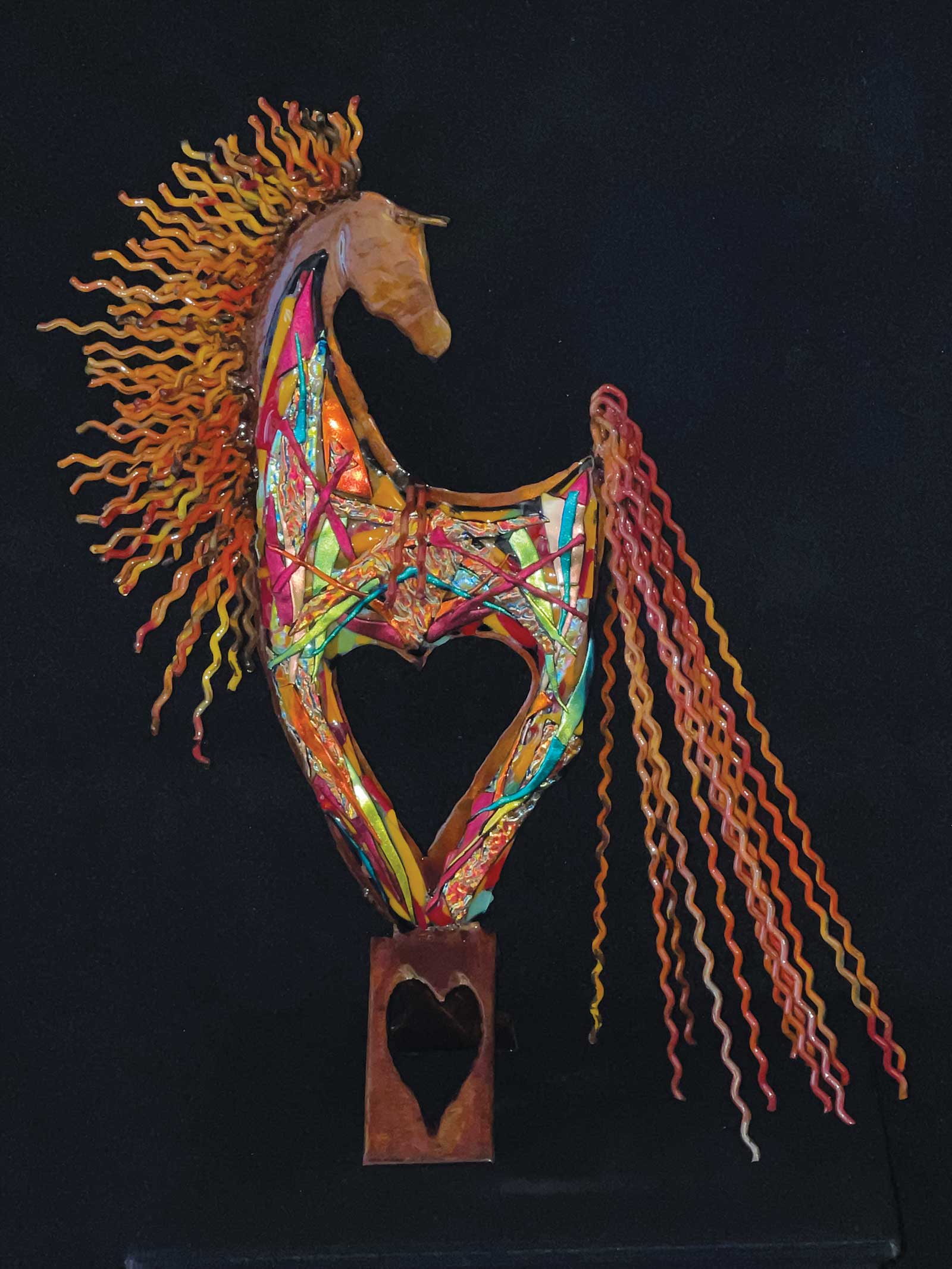 Terry & Marilyn Alexander, Heart of a Horse, mixed media, 29 x 24 x 15”
Continue reading to hear more insights on the Western sculpture genre from prominent artists, galleries and art institutions.
Many of Bryce Pettit’s wildlife bronze sculptures, also mentioned in the text previously, are represented by Blue Rain Gallery in Santa Fe, New Mexico. “Recently, the artist has been exploring balance or counterbalance and how it relates to each sculpture,” says Blue Rain executive director Denise Phetteplace. “This concept is perhaps best showcased in his piece titled To the Ends of the Earth.” Pettit explains of the sculpture, “In the Arctic, terns take on the longest migration of any animal on earth. Every year they fly from the Arctic to the Antarctic continent and back again traveling upwards of 50,000 miles every year. They literally go to the ends of the earth in order to nest and raise their chicks…”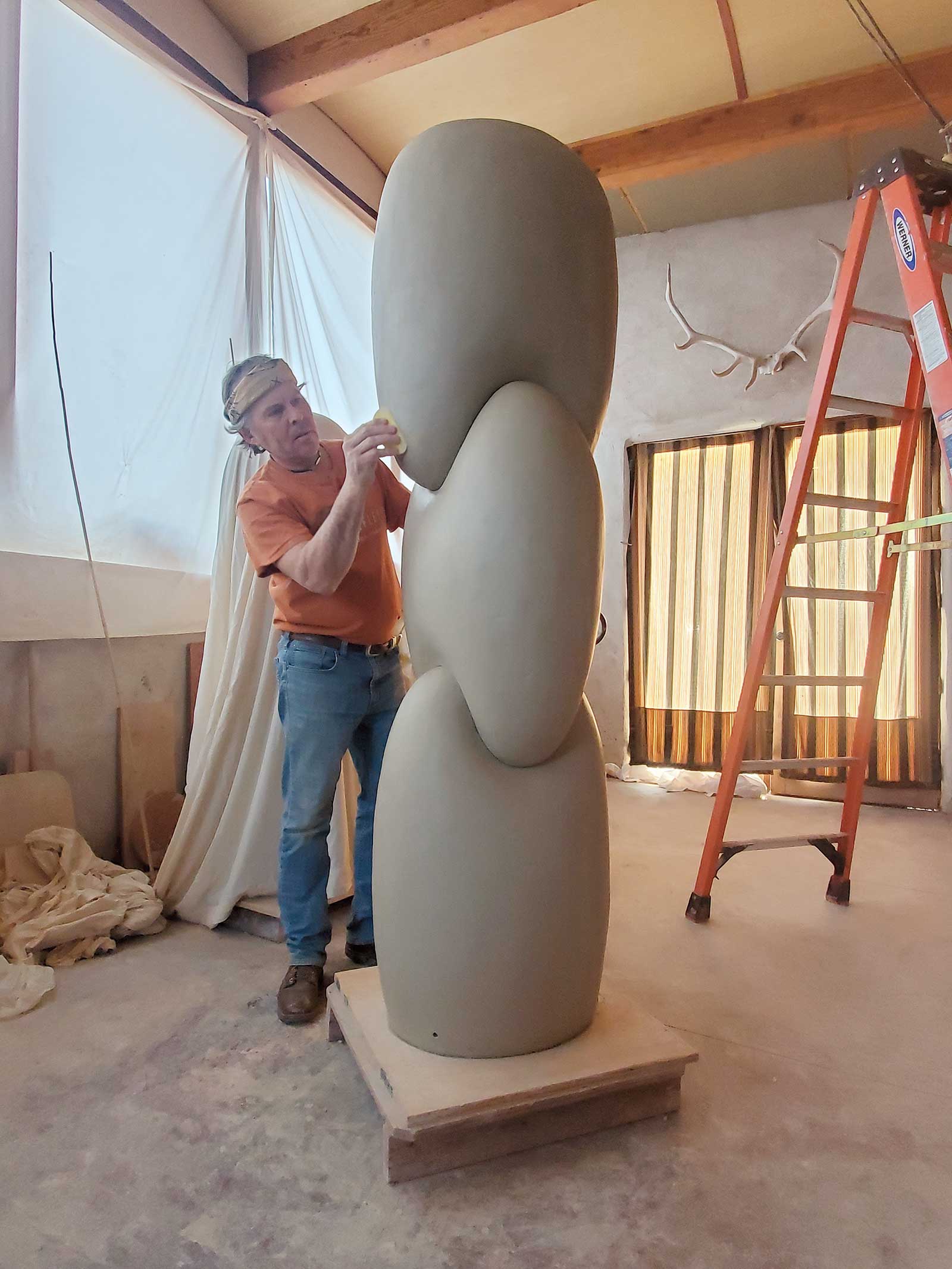 Exterior view of Tierra Mar Gallery with Jarrett West piece.Another sculptural work out of Blue Rain Gallery is The Scythian Steed, a collaboration between glass artist Shelley Muzylowski Allen and beadwork artist, conservator and restoration specialist Angela Swedberg. “This sculpture is made of an elk head taxidermy mount covered in red ochre (natural earth paint), stained brain-tanned deer hide, Italian lamb skin, pre-1900s antique Venetian Italian seed beads, brass tacks and glass,” Phetteplace explains. “It provides a fresh and vibrant twist on taxidermy art.”
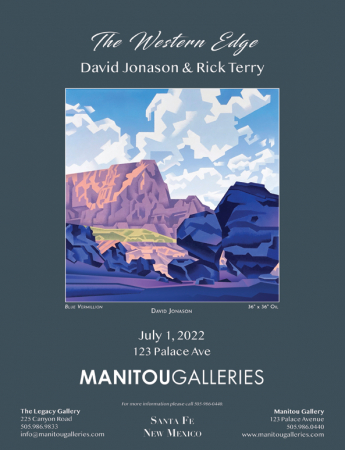
Manitou Galleries is also among Santa Fe’s top art destinations for contemporary Western art lovers. Manitou’s downtown gallery showcases about 50 painters and sculptors, alongside an impressive jewelry collection, which includes pieces by museum-quality Native American and contemporary jewelers. The gallery represents such talents as John Maisano, in works like Ursa Major and Minor, a bronze of a big and little bear. The artist explains, “Ursa Major and Minor, the big and little dipper, is the first star constellation many of us learned about. Represented by the big and little bear, they remain forever together in the night sky looking down upon us. I have translated this star constellation into a momma bear holding her cub. On their backs are raised stars forming the constellations in polished bronze while the stars and night sky appear on their bodies…”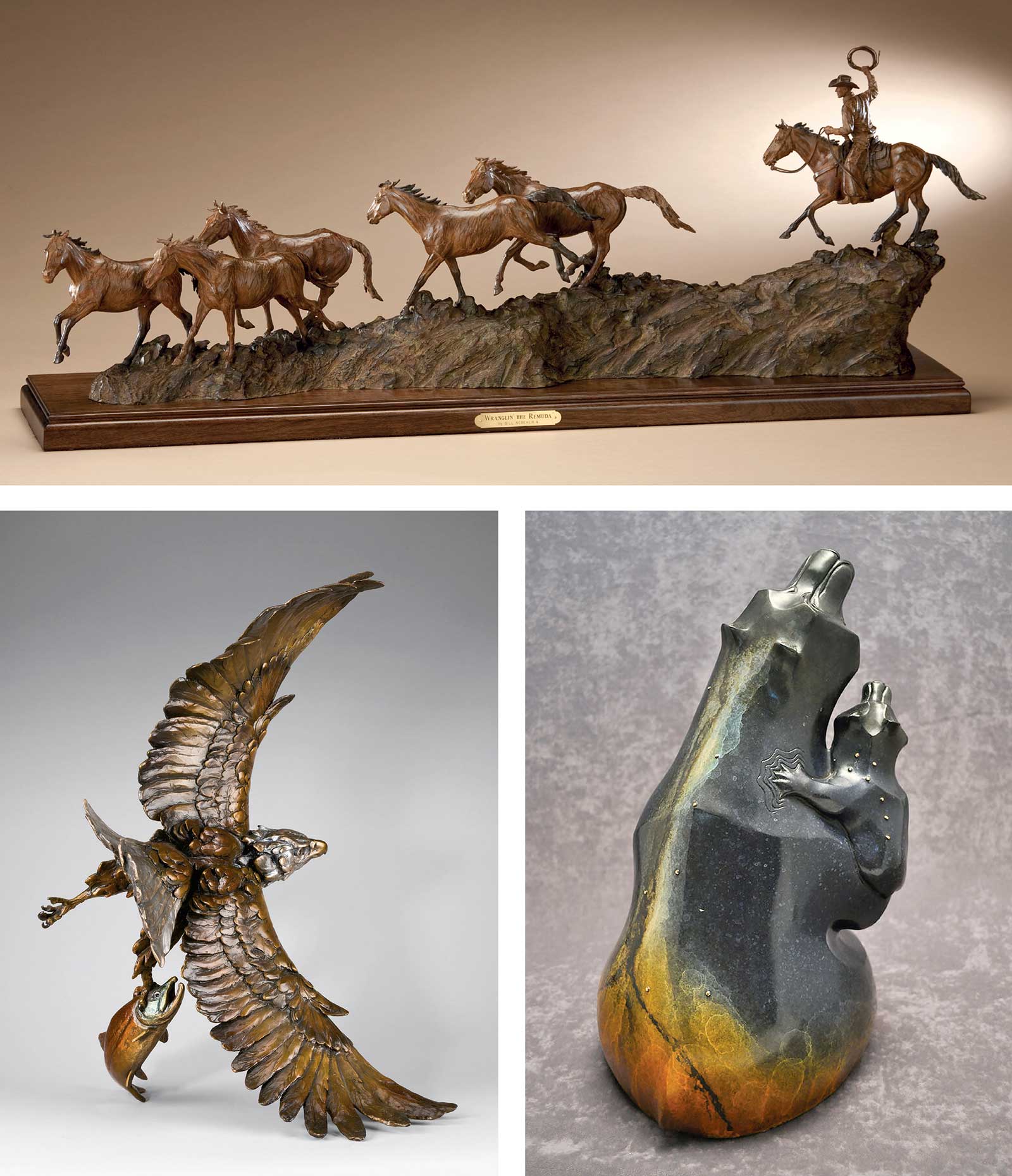 Top: Bill Nebeker, Wranglin’ the Remuda, bronze, ed. of 30, 19 x 50 x 11”. Bottom, from left: Blue Rain Gallery, Critical Angle, bronze, ed. of 30, 22 x 12½ x 17”, by Bryce Pettit; Manitou Galleries, Ursa Major and Minor, bronze ed. of 45, 17 x 10 x 12”, by John Maisano.Also showing at Manitou, Ed Natiya, features extraordinary work like Where the Wild Ones Go. “As I was driving between Albuquerque and Santa Fe,” the artist says, “I looked over toward the Placitas, when I saw a beautiful sight. A group of wild horses were racing across the mesa as the rain began to fall. It was an incredibly moving sight. For Native peoples it would be considered a blessing to see, [and] I know for myself it truly was. Nothing compares to seeing ‘where the wild ones go.’”
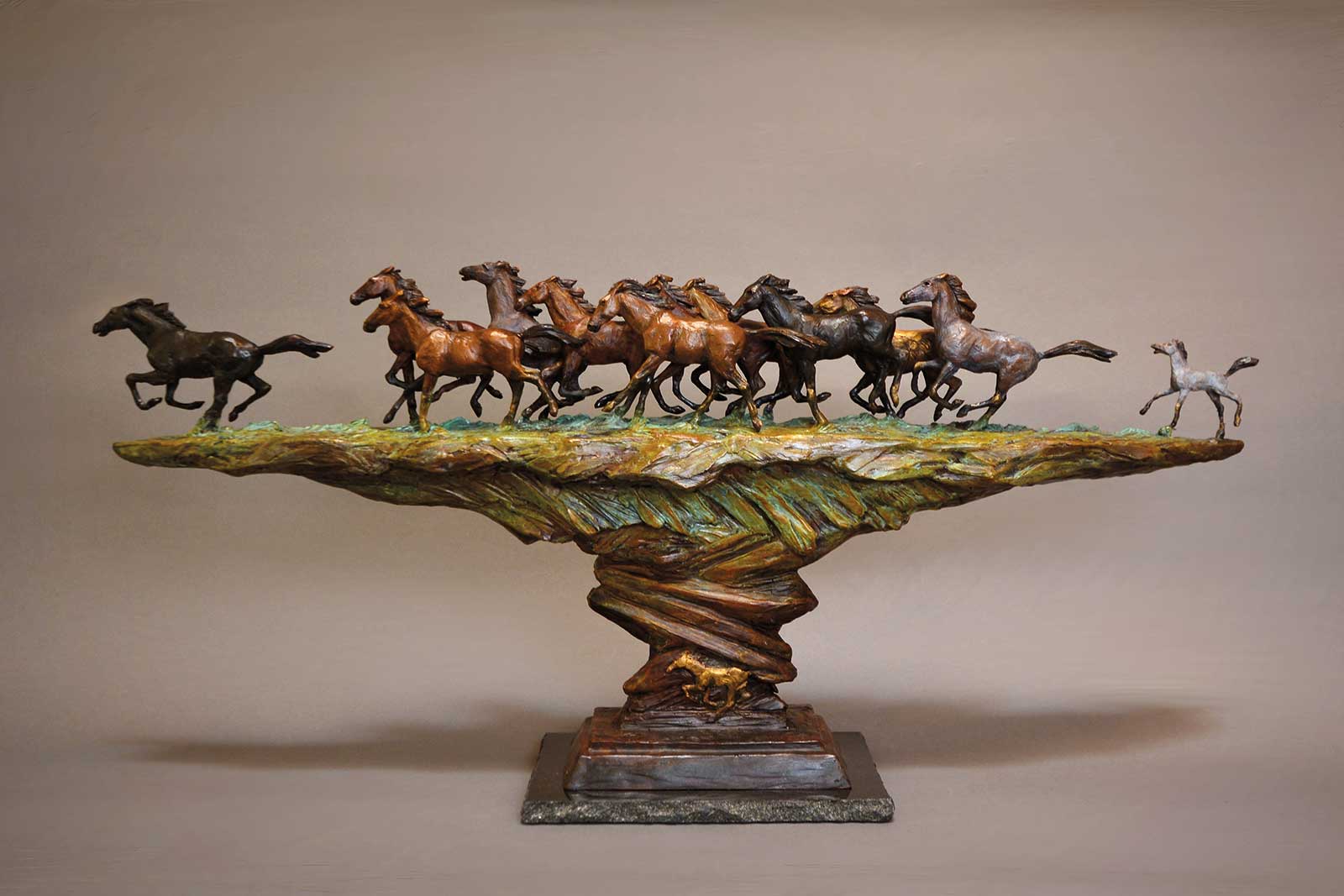 Manitou Galleries, Where the Wild Ones Go, bronze, ed. of 20, 11 x 25 x 3”, by Ed Natiya.
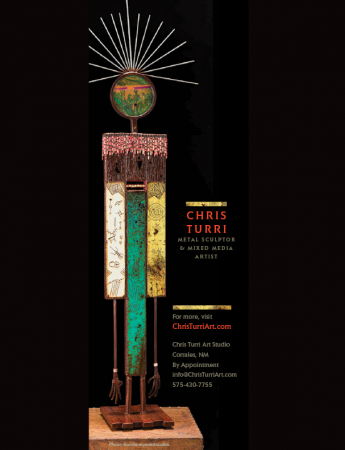
Artist Chris Turri worked with metals in some form for more than 25 years before settling into his nearly 20 years as an accomplished metal sculptor. “Many may see metal as solid and unmoving, but I see metal as fluid,” Turri notes. “Maybe it’s my years as an electrician pulling wire and bending conduit but when I see metals—new and old—I can see them transformed into a work of art…My daily routine puts me into [a] flow so when I go into my studio each morning the metals draw me in. It’s a daily ‘pouring-out’ of ideas. I pick the pieces up and just go. Each piece is unique, there is no mold and I often see a finish that requires manipulating techniques to achieve my vision.”
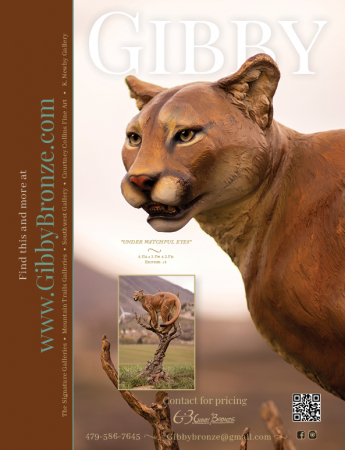
Raymond Gibby creates art that is relatable, whether it is the protective nature of a mother cougar watching over her cubs, the exhaustion of a bear that has been through a lot that day, or the triumph of the bison that overcame the threat of trial ore ever extinction—all themes in work pictured in these pages. “All of these conditions are things that humanity encounters every day,” the artist remarks. “What may be seen from the surface of the sculpture should penetrate deeper into our own emotions.” 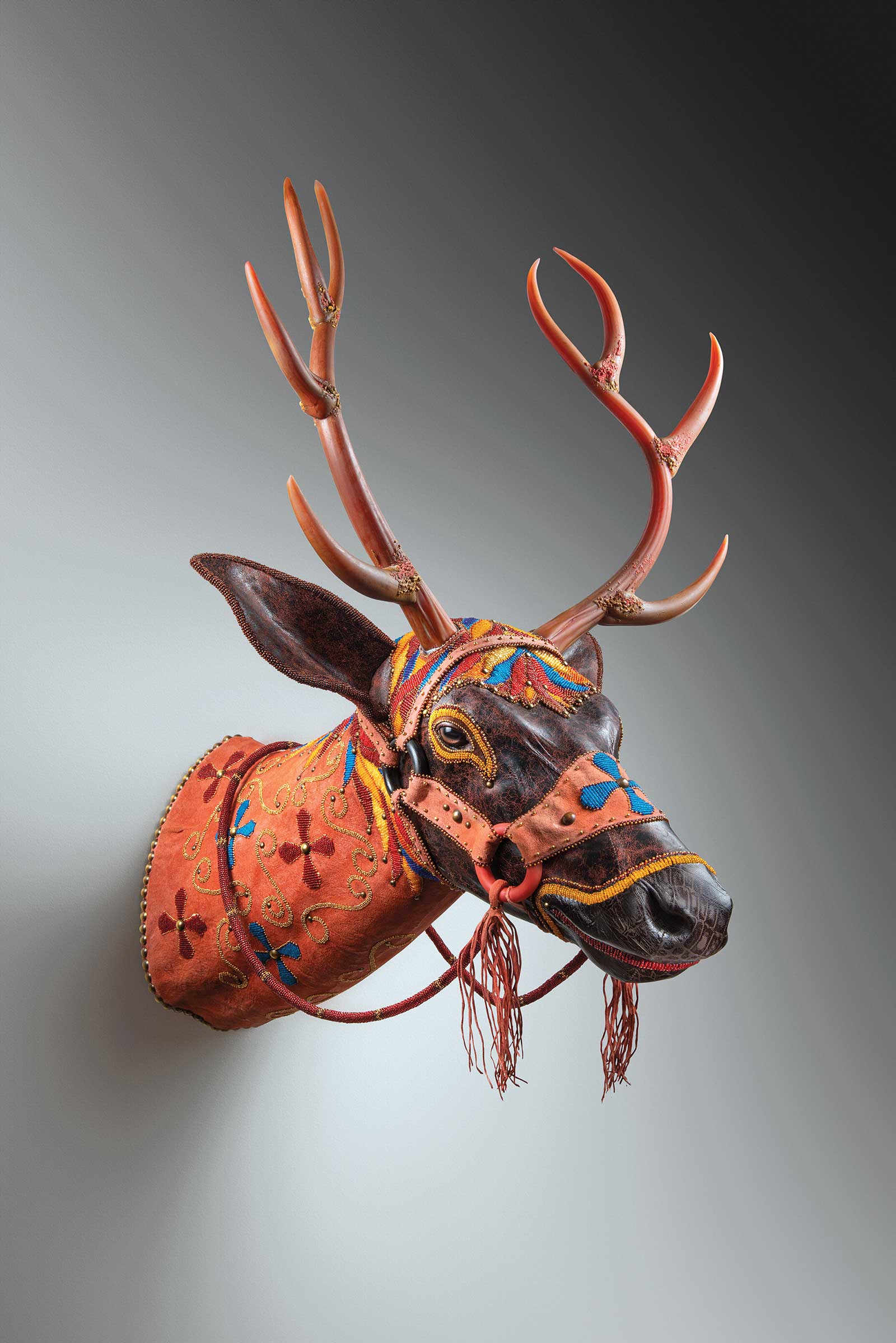 Blue Rain Gallery, The Scythian Steed, elk head taxidermy with mixed media, 29 x 19 x 28”, by Shelley Muzylowski Allen and Angela Swedberg.
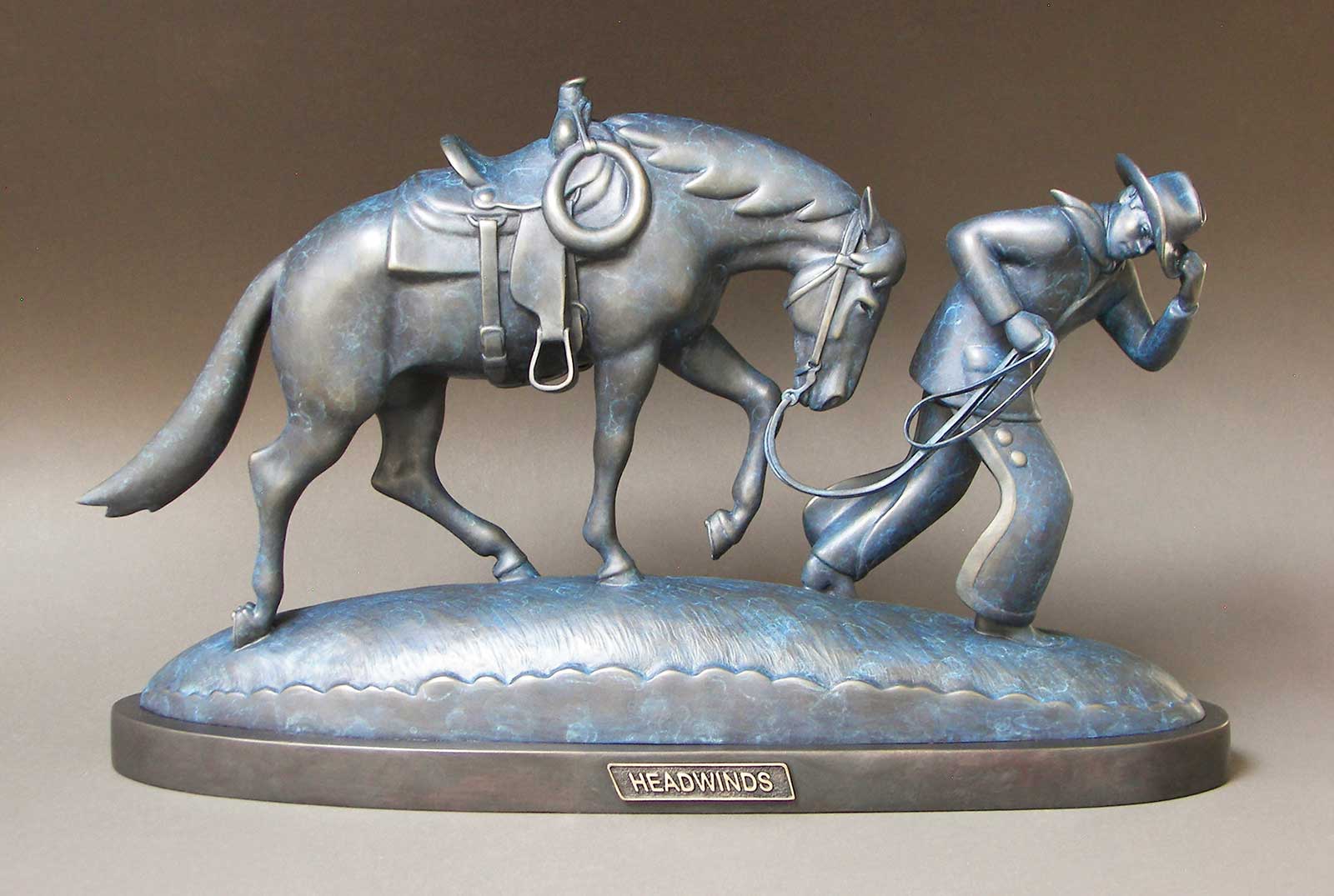 Manitou Galleries, Headwinds, bronze, ed. of 10, 12 x 20 x 6”, by Rick Terry.
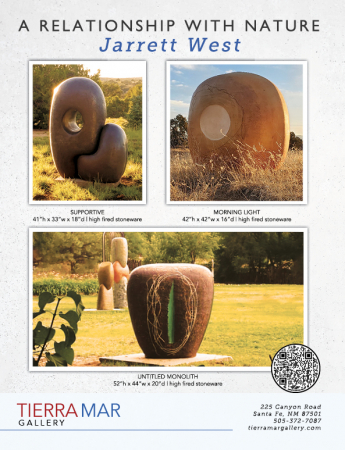
At first encounter with Jarrett West’s outdoor sculptures, one is immediately drawn to the simple forms and their massive scale. “His gestures are grand yet not obtuse in their presentation,” says Tierra Mar Gallery, representing West’s work. “These [pieces] sit beautifully against nature as if they had risen from the Northern New Mexico grasses. West’s time as a rancher in Idaho and Wyoming, and as a builder throughout the American West is quite evident in his work…From the grit of the earth to the burn of the sun, West’s work reveals his relationship with nature. [He also challenges the viewer to honor the history of ceramic creations and envision their possibilities moving into the future.”
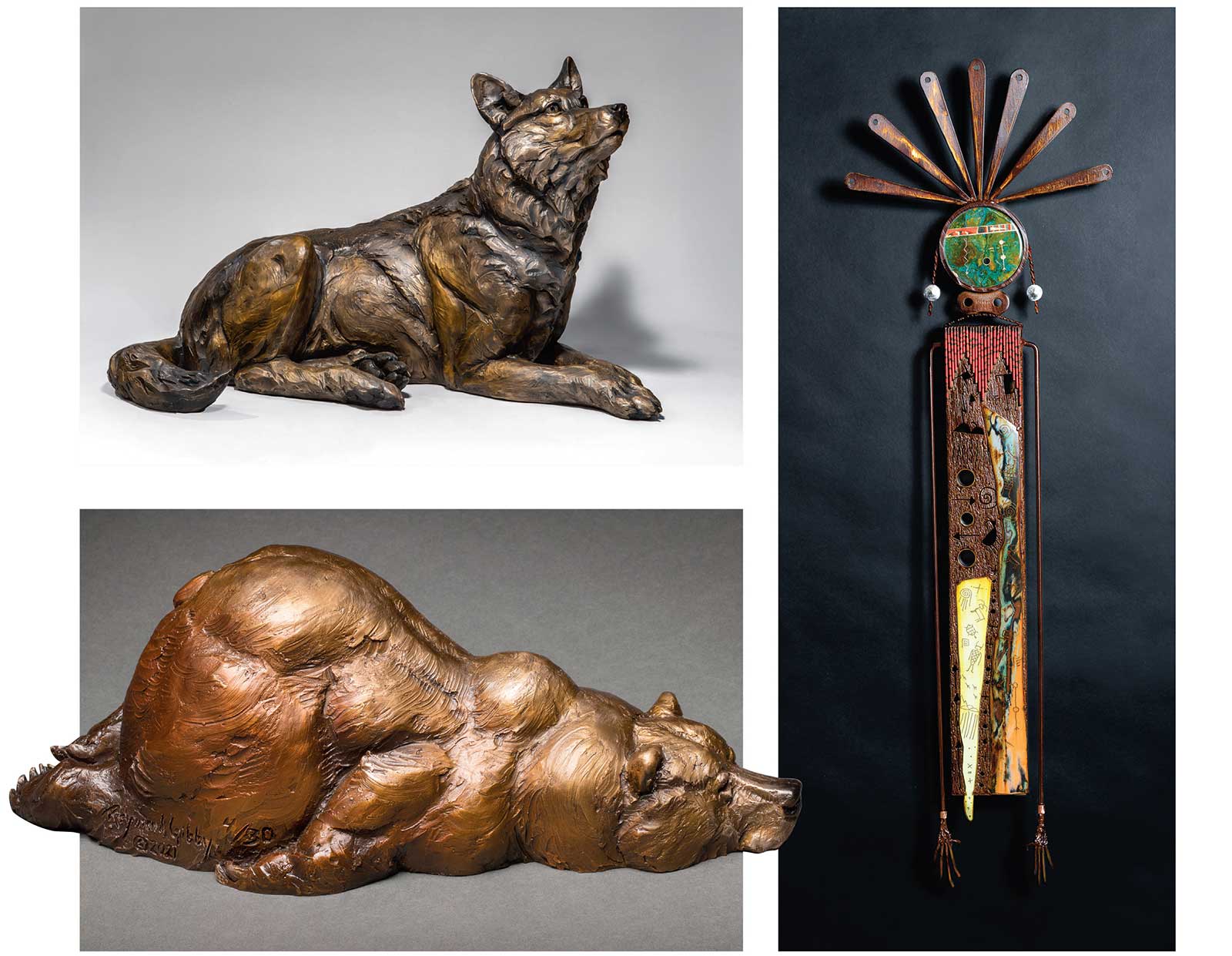 Clockwise from top left: Blue Rain Gallery, Ava, bronze, ed. of 35, 24 x 48 x 24”, by Bryce Pettit; Chris Turri, Story Totem – Wholeness, patina on steel and copper, 42 x 14 x 2”; Raymond Gibby, One of Those Days, bronze, 5½ x 13½ x 6”
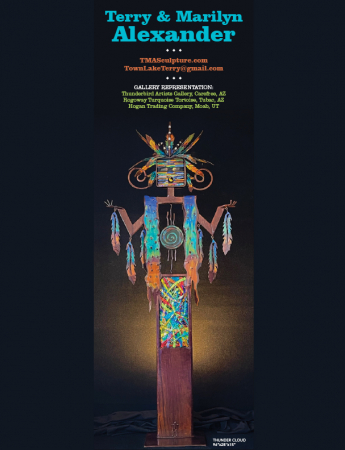
Arizona based steel and glass sculptors, Terry and Marilyn Alexander, capture the spirit of the Southwest with a contemporary, abstract panache. Bold colors achieved with a watercolor paint technique are matched with vibrant fused and dichroic glass, highlighting the rustic patina of raw steel, hammered copper and bright stainless. The synthesis of unlikely materials—strong and fragile, rusted and refined, light and dark, forges a unique, yet timeless tribute to the Southwest desert. 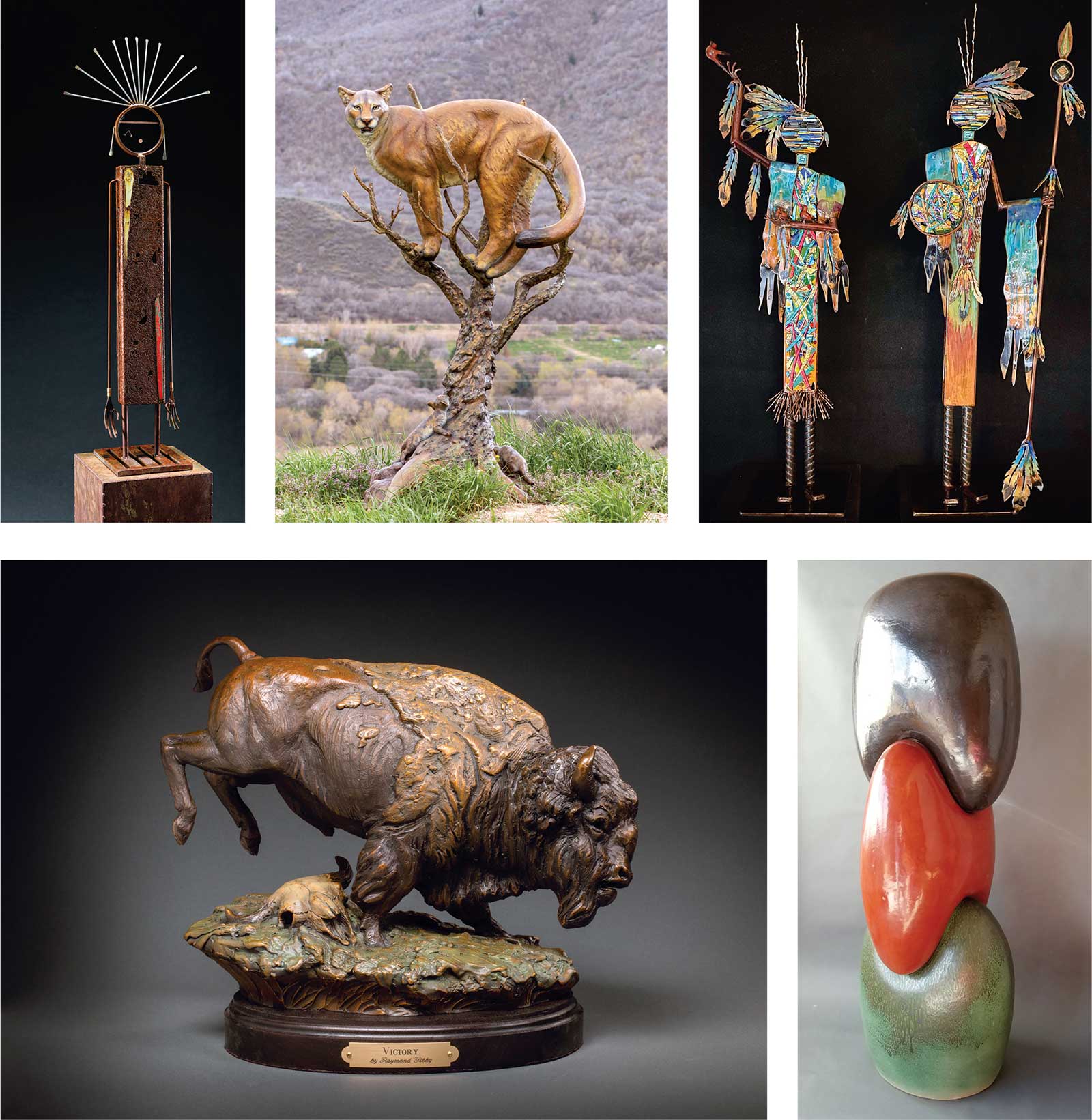 Top, from left: Chris Turri, Kerchief, patina on steel and copper, 39 x 14 x 8”; Raymond Gibby, Under Watchful Eyes, bronze, 6½ x 3½ x 2½”; Terry & Marilyn Alexander, Native Spirits, mixed media, 60 x 23 x 12”. Bottom, from left: Raymond Gibby, Victory, bronze, 14 x 15 x 7”; Tierra Mar Gallery, Untitled, high fired stoneware, 53 x 21 x 21”, by Jarrett West.After pursuing more traditional careers, Terry and Marilyn decided to combine their talents with their love of the Southwest culture. Entirely self-taught, they set about developing this unexpected fusion. Three glass kilns, two welders, plasma cutters, torches and a forge, a 3,200-square-foot studio and thousands of hours later, their work has refined into an instantly recognizable portfolio, not only for its bright inspiring colors but also for its uplifting, spiritual qualities. —
Featured Artists & Galleries
Bill Nebeker
(928) 445-7170, bronzes@billnebeker.com
www.billnebeker.com
Blue Rain Gallery
544 S. Guadalupe Street, Santa Fe, NM 87501
(505) 954-9902, info@blueraingallery.com
www.blueraingallery.com
Chris Turri
Corrales, NM, (575) 430-7755
chris@christurriart.com, www.christurriart.com
Manitou Galleries
123 W. Palace Avenue, Santa Fe, NM 87501
(505) 986-0440, www.manitougalleries.com
Raymond Gibby
(479) 586-7645, gibbybronze@gmail.com
www.gibbybronze.com
Terry & Marilyn Alexander
townlaketerry@gmail.com, www.tmasculpture.com
Tierra Mar Gallery
225 Canyon Road, Santa Fe, NM 87501
(505) 372-7087, www.tierramargallery.com
Powered by Froala Editor