In celebration of the 200th birthday of French artist Rosa Bonheur (1822–1899), one of the most popular and esteemed women artists of the 19th century, the National Museum of Wildlife Art presents Bonheur & Beyond: Celebrating Women in Wildlife Art, which coincides with the museums 35th anniversary. The museum will showcase more than 50 pieces by more than 40 female artists from the musuem’s permanent collection, including a six-piece acquisition of Bonheur’s wildlife depictions.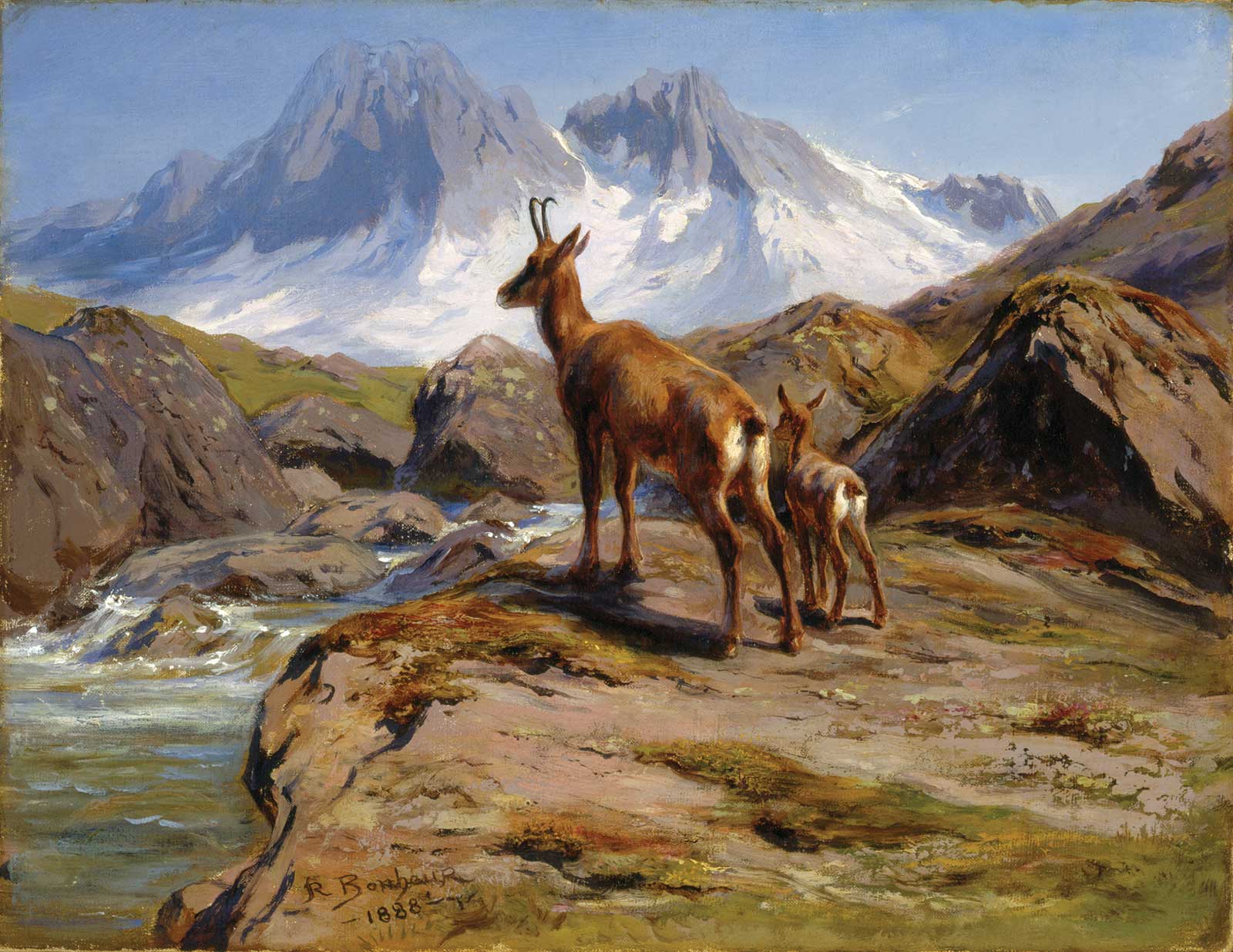 Rosa Bonheur (1822–1899), Chamois Mother and Baby, 1888, oil on canvas, 10¼ x 13¼.” Gift of the 2003 Collectors Circle, National Museum of Wildlife Art.
The museum press release notes that “the goal of this exhibit is to bring awareness to the excellence and importance of female artists.”
“We want to recognize women artists as artists and show that their work is valued,” remarks Tammi Hanawalt, the museum’s curator of art. “The works in this exhibit are remarkable and are significant contributions in art history. And they all happen to be done by women.”
Hanawalt continues, “It wasn’t really until the latter half of the 20th century that women artists started being seriously recognized, but even then, they were still in a separate category than their male contemporaries—considered ‘women artists’ rather than ‘artists.’ Their work stands out in its own right.” 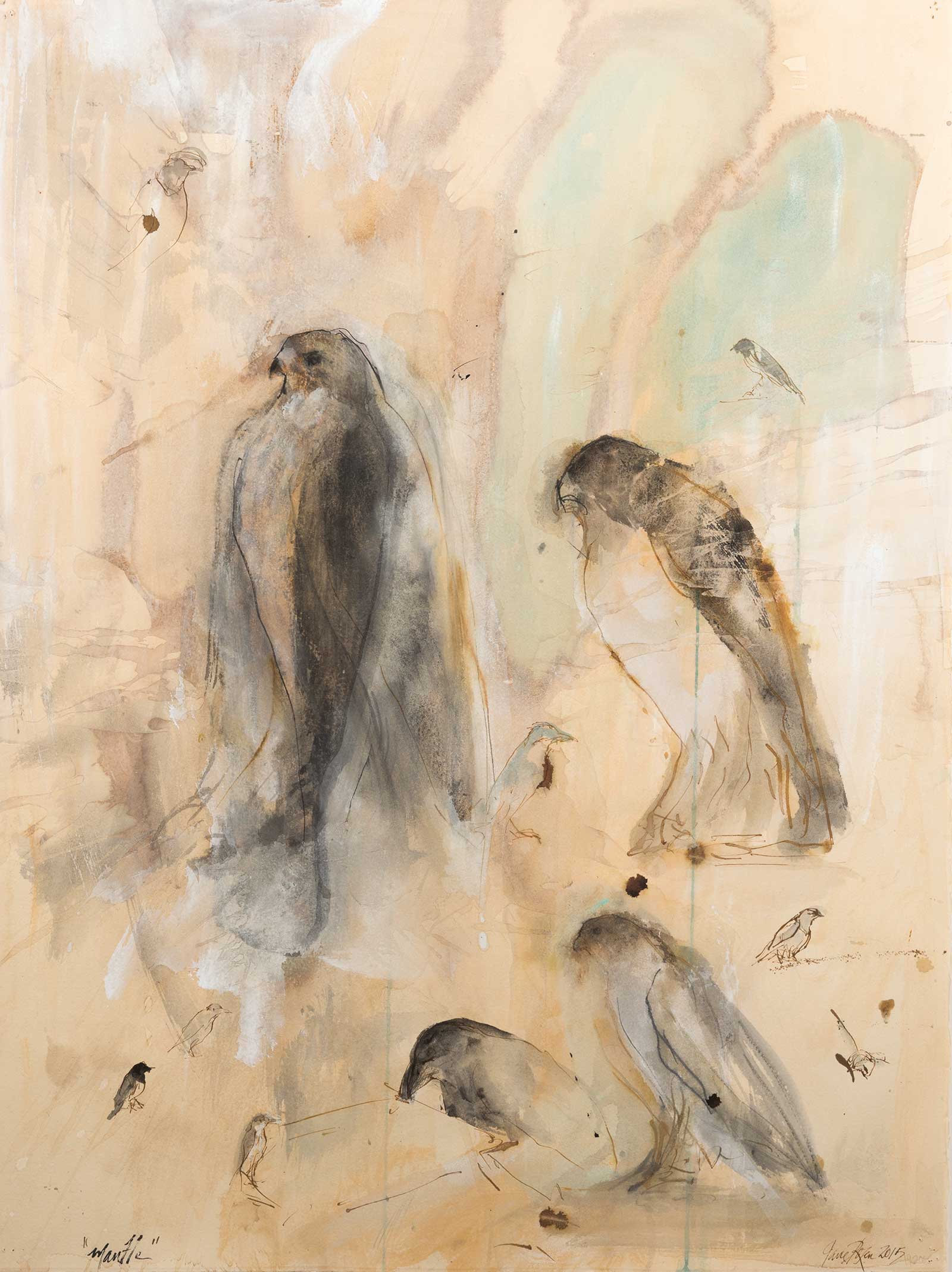 Jane Rosen (1950), Mantle, 2015, coffee, Korean watercolor, ink, 30 x 22.” Gift of the 2018 Blacktail Gala, National Museum of Wildlife Art. © Jane Rosen.
Having achieved popularity and success as a female artist during her lifetime, and in an era that was unfavorable towards women, Bonheur is widely considered an anomaly. She was also infamous for receiving a special permit in Paris to wear pants while she worked at slaughterhouses while studying the shape and form of her animal subjects. “She thought that dresses were a hinderance to her job,” says Madison Webb, director of marketing for the museum. “This enabled her to succeed in a male dominated atmosphere, and it was important to her success.”
While Bonheur is most known for her paintings of cattle and other domestic animals, she also depicted scenes including wildlife. Among the six pieces in the museum’s collection, and displayed during the exhibition, is Bonheur’s Chamois Mother and Baby, featuring two of the agile goat-antelopes surrounded by a mountainous landscape. 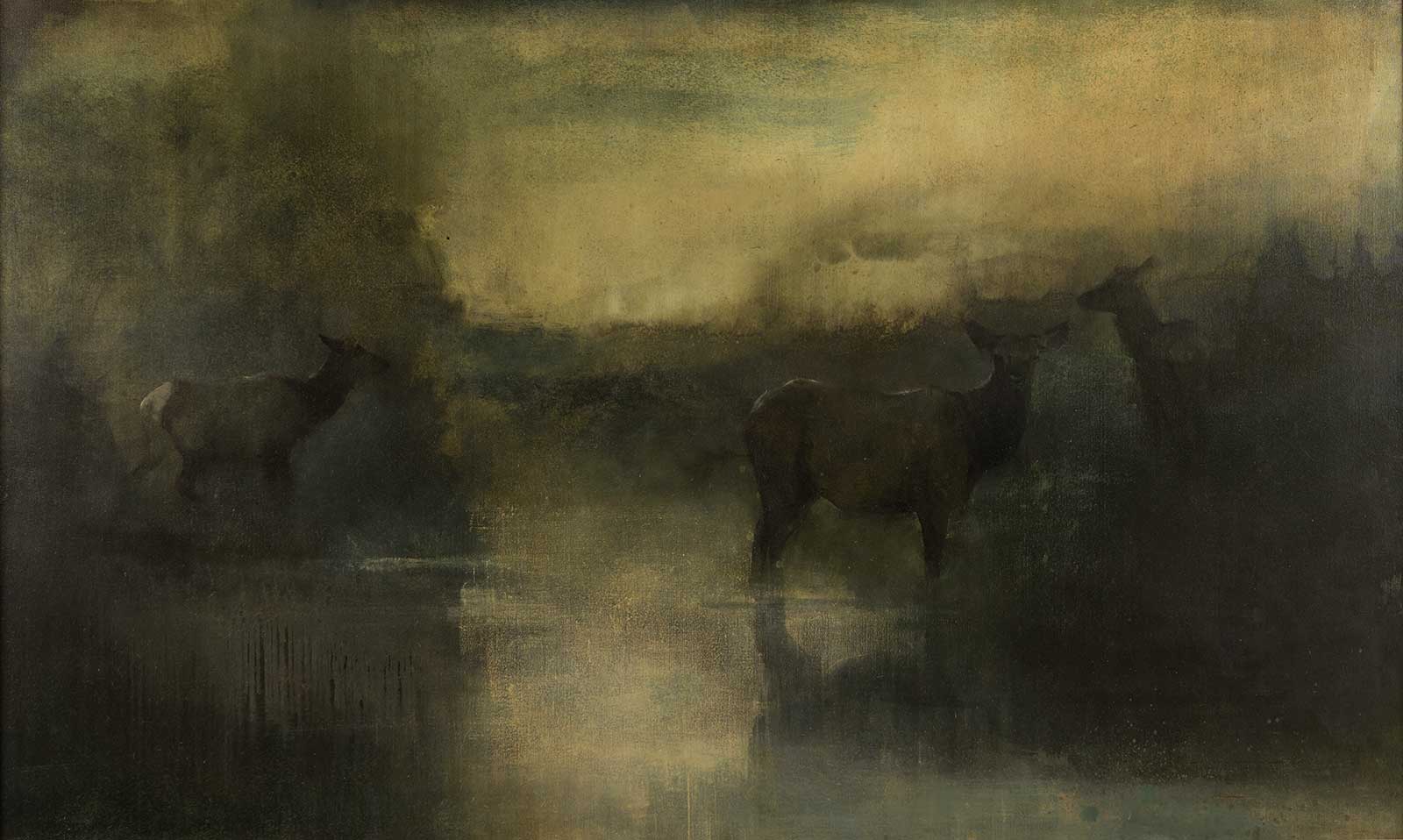 Kathryn Mapes Turner, Three Matriarchs, 2015, oil on canvas, 36 x 60.” National Museum of Wildlife Art. © Kathryn Mapes Turner.
“In this piece we see the bond of motherhood and see a sense of sentimentality,” says Webb, “and we see Bonheur harkening back to the romantic movement. Throughout this exhibition, it’s interesting to look at the way women artists are approaching gender. We see motherhood depicted, matriarchs and the female of the species, which is not the most popular, generally, when you look at wildlife art. It’s usually the moose with horns or a stag or bull that get all the glory but, here, we get the quiet female with baby.”
A focus on the female is echoed in works by other artists in the exhibit, including Three Matriarchs by Kathryn Mapes Turner, which portrays three elk cows. “This shows a contemporary approach to wildlife,” says Webb, “but she’s giving us emotion and a sense of location whereas in Jan Rosen’s Mantle, one of our most recent acquisitions and most contemporary, it’s devoid and abstracted. Turner evokes an atmosphere.” 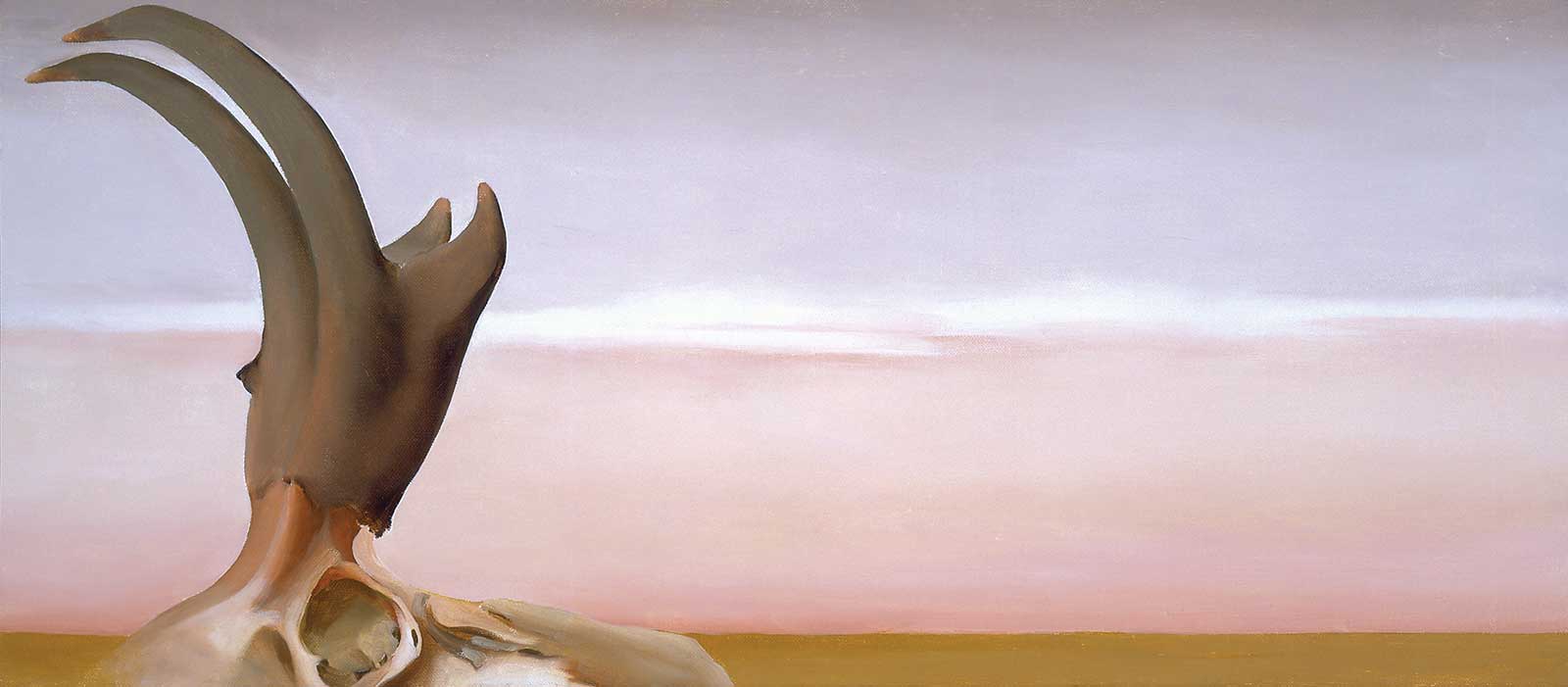 Georgia O’Keeffe (1887 – 1986), Antelope, 1954, oil on canvas with painted metal frame, 14½ x 32¼.” This purchase made possible by donations from Sandy Scott and the Widener Charitable Limited Partnership, with additional assistance from Adrienne and John Mars, Anne and John Marion, Ann and Richard O’Leary, Charles D. Miller, Peggy and Lowry Mays, and the Robert S. and Grayce B. Kerr Foundation, National Museum of Wildlife Art. © 2022 Georgia O’Keeffe Museum / Artists Rights Society (ARS), New York.
Three Matriarchs was inspired from a scene Turner encountered along the Snake River in Jackson, Wyoming. “When she went out to paint this piece,” Webb continues, “she intended to paint the Tetons, but the scene just sort of unfolded and she was so inspired by the elk in the misty river that it willed itself into being…so to speak.”
Another significant highlight in the exhibition is Georgia O’Keeffe’s Antelope, in which an antelope skull is sinking into the sand. “[O’Keeffe] is famous for her skull paintings,” says Webb, “but this one is different because it’s not a straight view and it’s not a cattle skull, which she more famously features. This is wildlife. She also gives us this unique, architectural-like side view.”
Among these highlights will be many additional works by esteemed artists that include Anna Hyatt Huntington, Harriet Whitney Frishmuth, Pablita Velarde and Donna Howell-Sickles. The exhibition will open June 4 and close on August 16. —
Bonheur & Beyond: Celebrating Women in Wildlife Art
June 4-August 16
National Museum of Wildlife Art, 2820 Rungius Road, Jackson, WY 83001
(307) 733-5771, www.wildlifeart.org
Powered by Froala Editor