James Swinnerton (1875-1974) discovered the desert when he was sent to a sanatorium in Colton, California, to spend what was thought to be his last days, suffering the ravages of alcoholism and tuberculosis. He gradually recovered, lived to be 99, and is often called the “Dean of Desert Artists.” He had been a cartoonist admired by William Randolph Hearst who later saw to it that he was settled in the sanatorium. As he recovered, he began traveling around the Southwest by burro and sketching the landscape. He painted the desert from about 1920 to 1965 while he continued to produce cartoons.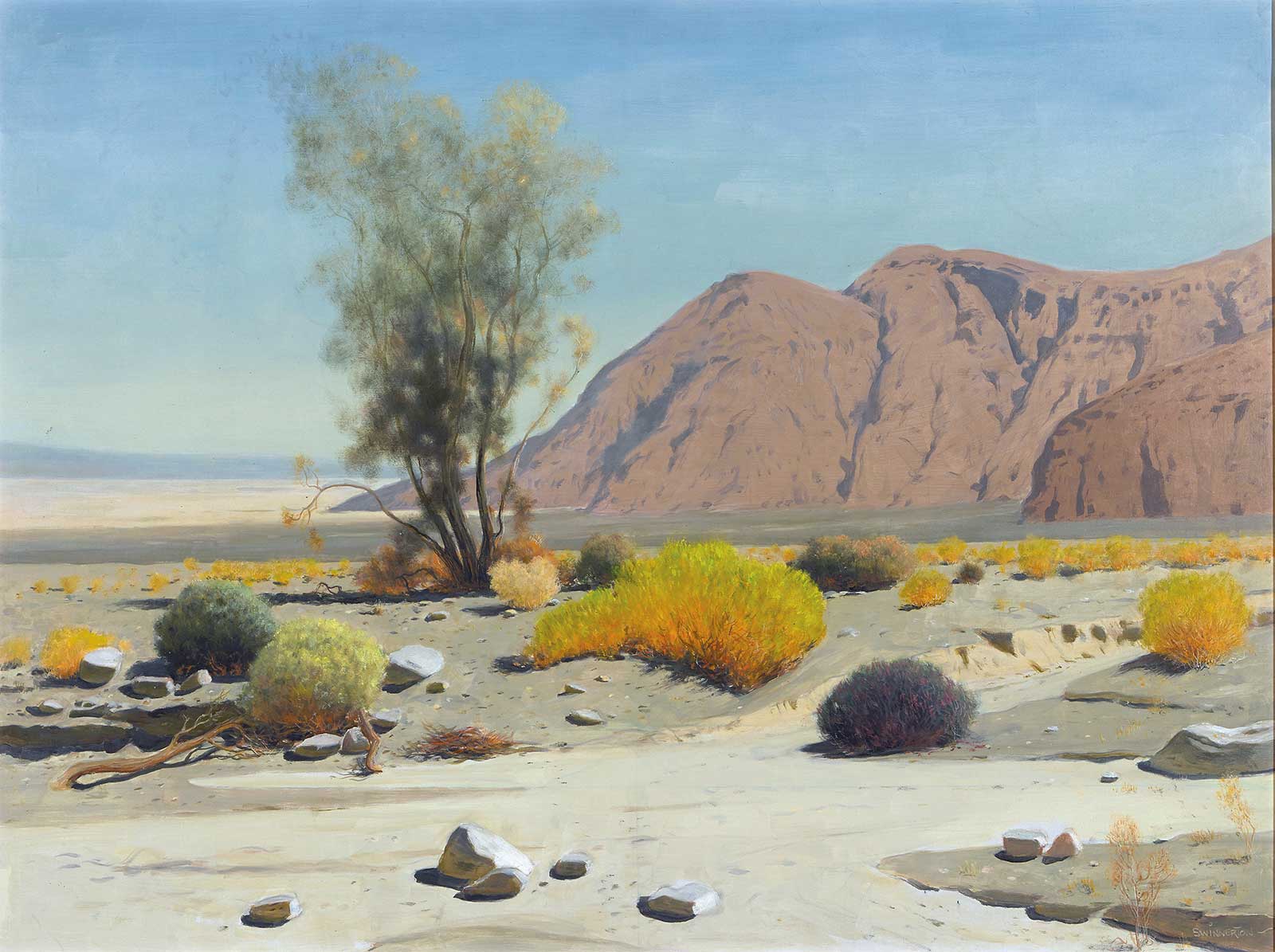 Maxwell Alexander Gallery, Desert Landscape, oil, 30 x 40", by James Swinnerton (1875-1974).
His oil painting, Desert Landscape, illustrates his mastery of the light and atmosphere of the desert. He celebrated what others overlooked, the colors and textures of scrubby desert scenes. “I don’t use many colors,” he wrote. “Two blues, one green, blue black, several reds—I’m finding all the time that it’s how you use them, not the number involved. Light is superimposed on darkness. You can notice that as the day grows long. There are so many parts to a landscape that attention must be paid to all of them. The clouds should float, instead of looking like rocks. The sky should be air, not blue paint. Each bit of vegetation is different; every shrub is an individual. Distance should be muted, the foreground accentuated. When I can accomplish these things, a feeling comes out of that picture—a feeling that goes from hand to hand, from brain to brain, from heart to heart. Then I am on the same wavelength with other people.”
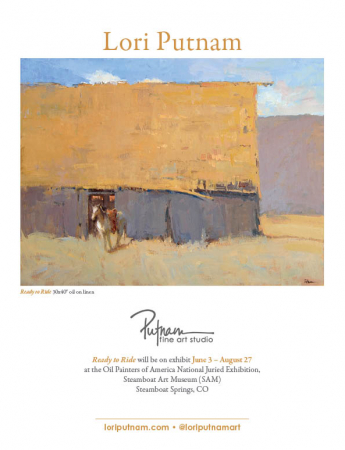
A century later, Mateo Romero takes a different approach to painting the desert. Born and raised in Berkeley, California, he paints with the colorful exuberance of the abstract expressionists and celebrates the surface of thickly applied paint rather than the subdued palette and fine brushstrokes of Swinnerton. His father was from Cochiti Pueblo and was a Santa Fe Indian School teacher and painter. His mother was an anthropologist at UC Berkeley.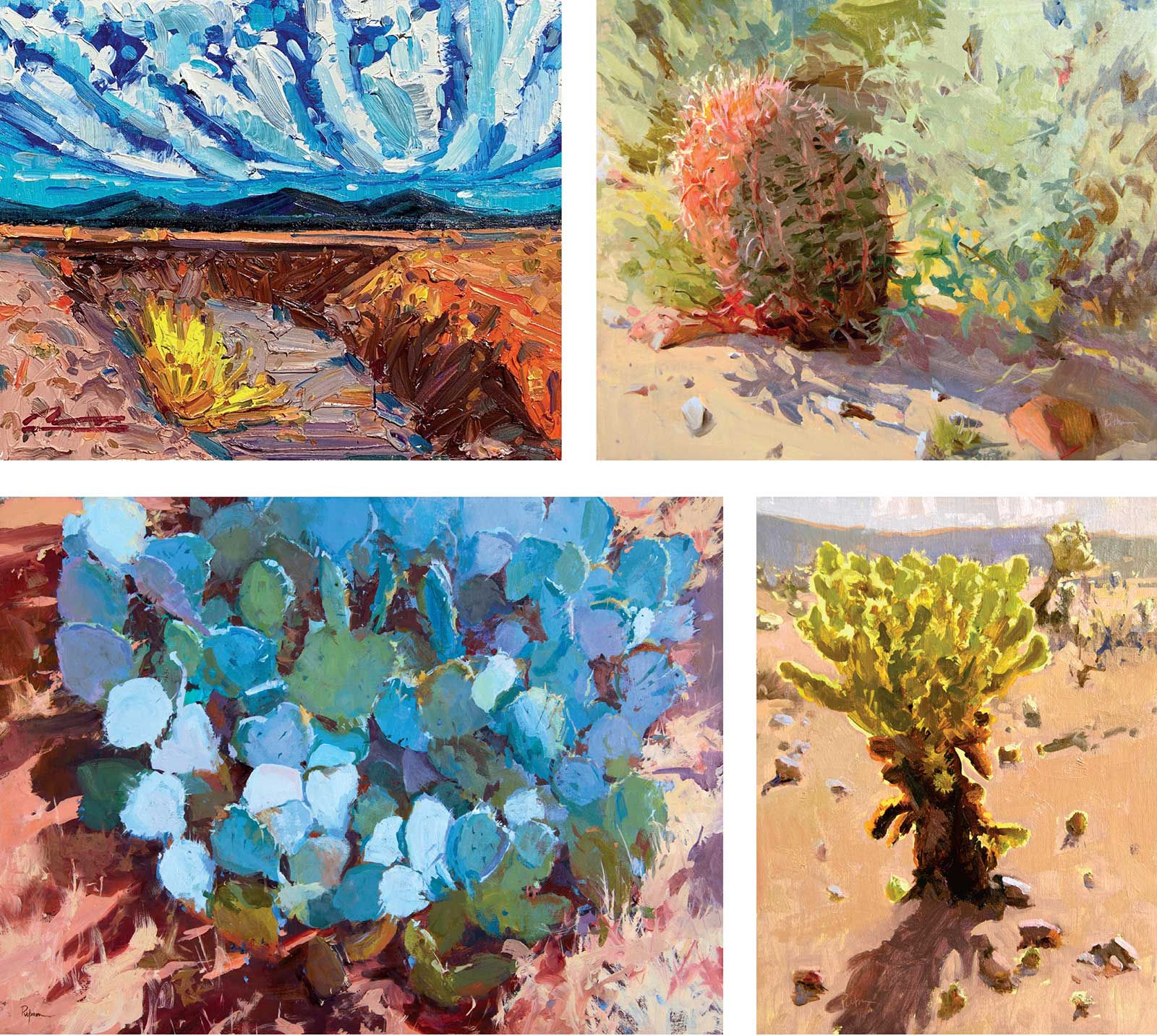 Top row: King Galleries, O’Gah Po’Geh’ Series, oil on canvas, 24 x 30”, by Mateo Romero; Lori Putnam, Barrel of Fun, oil on linen, 20 x 24” Bottom row: Lori Putnam, Blue Paddles, oil on linen, 30 x 40”; Lori Putnam, Jumpers, oil on linen, 14 x 11”
Today he paints the landscape of his ancestral land, O’Gah Po’Geh, “white shell water place,” the Tewa name for the area where Santa Fe, New Mexico, is located. Romero explains, “These paintings reflect a pattern of evolution and change. The images are powerful, imposing, juxtaposed with swirling gestural paint marks and drips. Timeless, archaic elements of Pueblo culture are juxtaposed with contemporary abstract expressionist palette knife and brush work. Overall, the paintings develop a rhythmic, hypnotic, trancelike feeling which is referential to the metaphysical space of the Pueblo and the region.”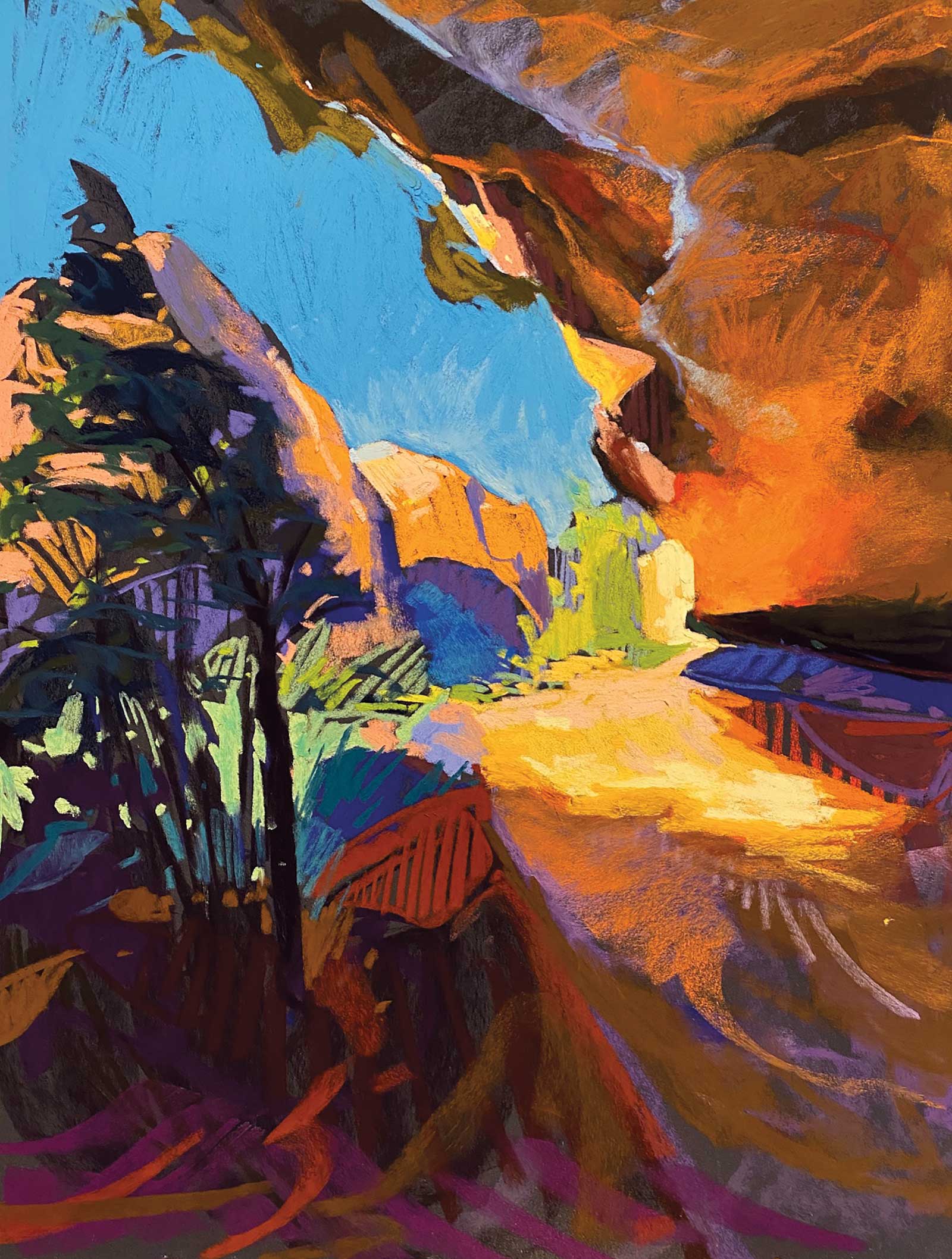 Tara Will, Gold on the Ceiling, soft pastel, 25 x 19"
Swinnerton’s experience of the desert was emotional and visual. Romero’s experience is equally visceral but demonstrates a deep oneness with the landscape, its history and its energy.
Continue reading through this section to hear stories and insights from artists on artwork depicting stunning scenes of canyons and deserts.
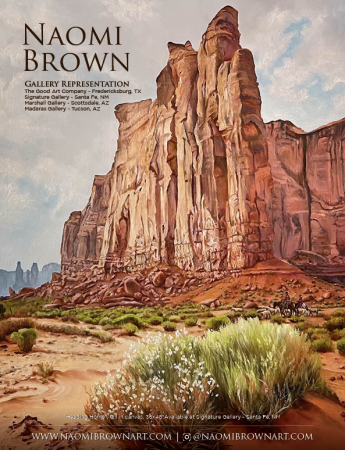
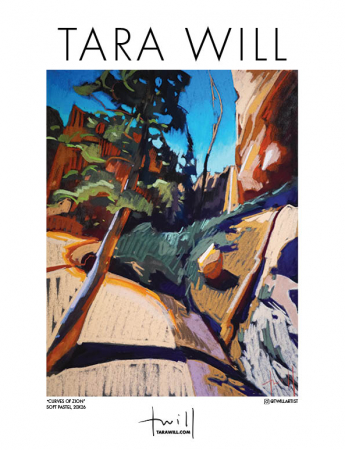
There is an amazing beauty to the iconic, creature-like flora in the desert, and artist Lori Putnam is entranced by it. Painting from a respectable distance and capturing the textures of different cacti on location provided invaluable study for the studio paintings pictured in this section. “Prickly pear cactus come in a variety of species,” she says. “The blue paddles were incredibly enticing (with artwork pictured with the same name), and gave me the chance to showcase my innate sense and love of color. ‘Jumping’ cholla glow when they are backlighted, and that is my favorite way to observe them. It has taken years of outdoor sketching to learn how best to interpret them. The same is true with Arizona’s barrel cactus, with hooked spines which may appear red, pink or orange depending on the light. They are yet another fabulous specimen for an artist who appreciates nature’s often intense colors.”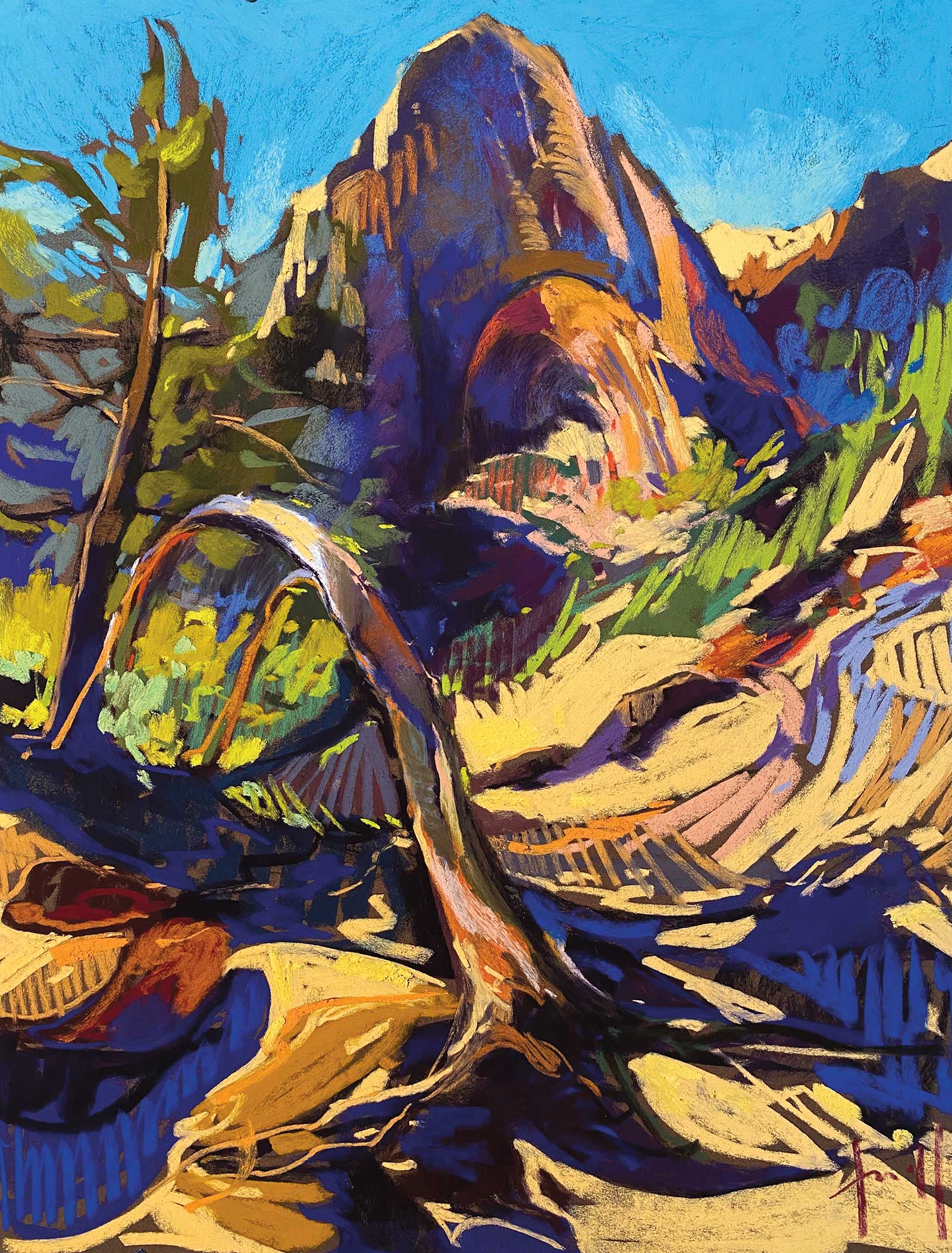 Tara Will, Canyon Overlook Zion, soft pastel, 25 x 19"For Naomi Brown, it’s all about the smell of the fine sand and creosote bushes in the rain, the purple hued mountains in the warm evenings and the quietness of the night. “This is what makes the desert a refuge for the heart,” she says. “Take the time to hear the desert. Listen to the wind go by, the mourning doves cooing as the sun starts to rise, and if you listen carefully at night, you might hear the silent flight of an owl flying by. Listen as the desert sun makes you feel warm and complete and embrace the beautiful display of evening colors as the sun slowly sets. Rejuvenate your soul by taking time to be present and listen to the desert.”
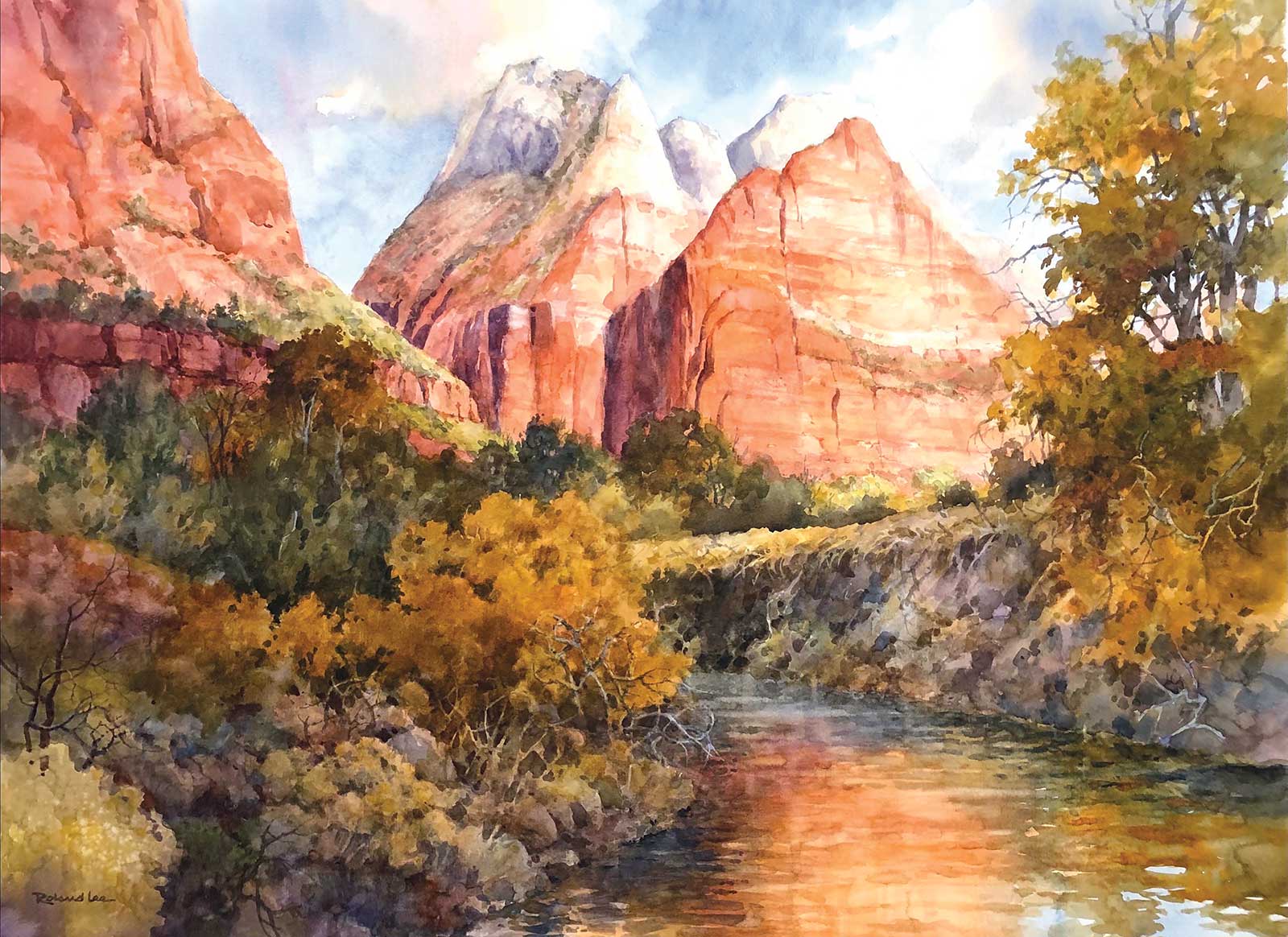 Roland Lee Art Gallery, Zion Canyon Reflections, watercolor, 21 x 29", by Roland Lee
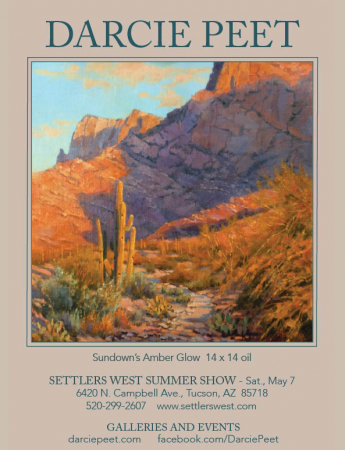
Artist Tara Will notes that her first experience out West came way too late in life. In a 2020 road trip from Jackson Hole to Zion and over to Telluride, opened her eyes to a whole new landscape that was incredibly inspiring. “I love the dry, arid landscape with clean light and warm colors,” she explains. “So contrary to the landscape of my home here in Maryland. Zion is one special place of inspiration for me, Kolob Canyon being my favorite little spot in the northern part of the park. Having done quite a bit of travel for plein air events, I highly encourage artists to go out into the landscape to seek inspiration.” There is something about the abstraction of Will’s work, combined with the palette, that just makes the desert landscape sing. 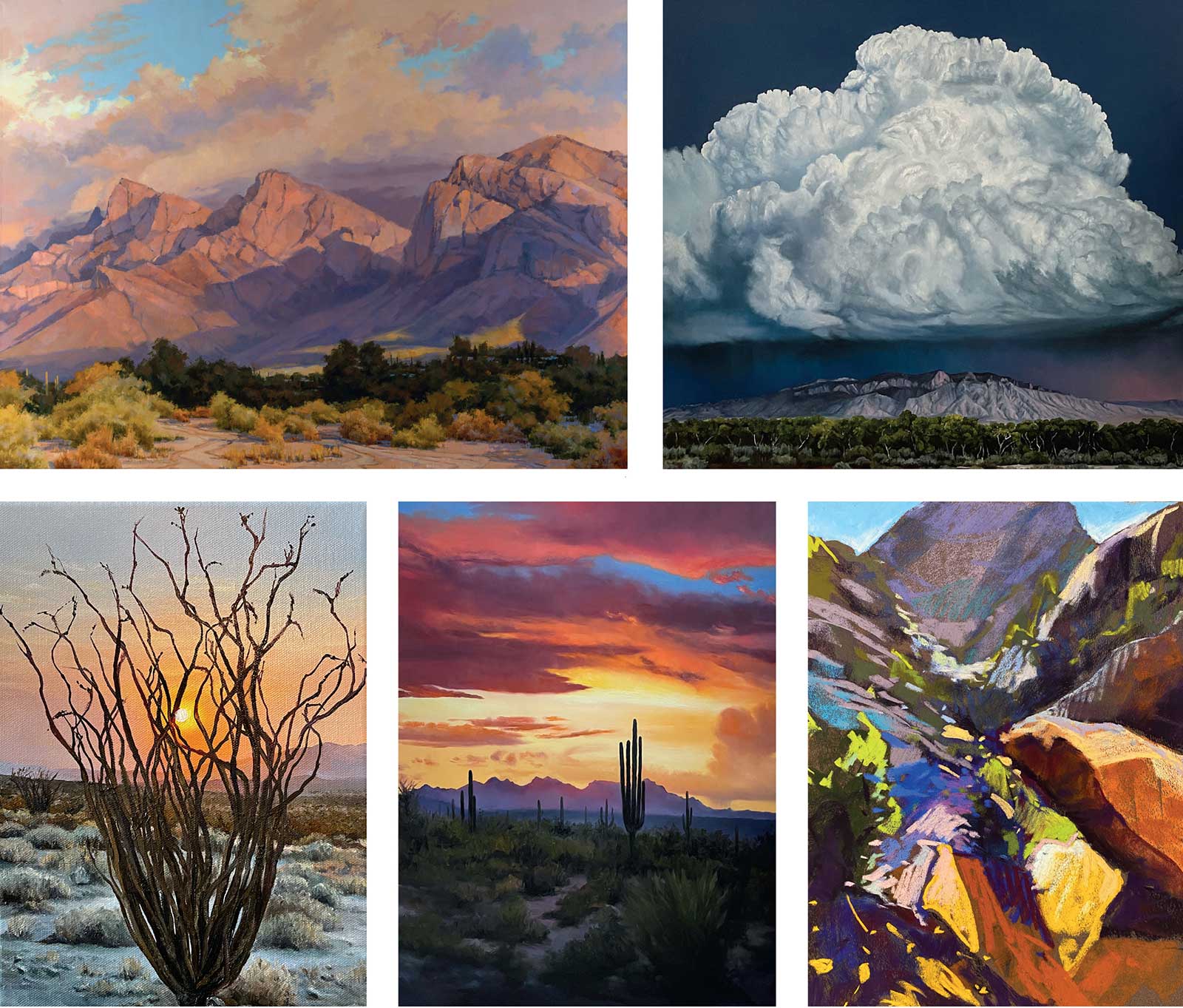 Top row: Darcie Peet, Pastel Desert Dusk, oil, 30 x 40”; Naomi Brown, Land of Enchantment, oil on wood panel, 48 x 54” Bottom row: Naomi Brown, Ocotillo Sundown, oil on canvas, 12 x 9”; Naomi Brown, Saguaro Sunset, oil on canvas, 40 x 30”; Tara Will, Zion Push, soft pastel, 16 x 12”Winter in the desert brings such diversity of weather, moods, atmosphere and color, especially with a storm about to roll in. Even better, and artist Darcie Peet’s favorite, is the late afternoon—close to sunset as the turbulent weather is breaking up and receding. “This time of day, a low, winter sun can create brilliant, bold color so often tied to the desert landscape and sky, yet in contrast, moisture in the air, mist and thinning clouds can thinly veil the distant foothills, canyons and mountains in soft, muted and pastel colors,” she says. “An occasional break in the churning, storm clouds can send dashes of bright sunshine across winding washes, along foothill slopes and saguaro spikes in this setting at the base of Pusch Ridge and the Catalina Mountains on the outskirts of Tucson, Arizona. That’s when I go exploring to see what surprises are in store for paintings to come.”
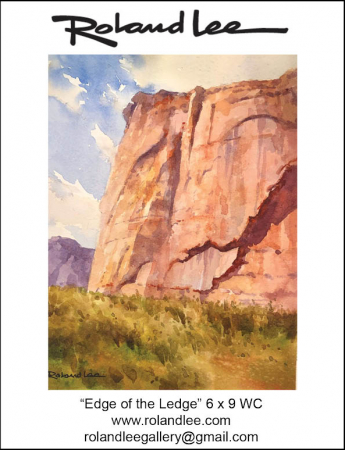
Roland Lee of Roland Lee Art Gallery has been exploring deserts and canyons for 50 years, armed with sketchbooks and paints. The pull of the Southwest tugs incessantly at his heart, soothing it with soft and solitary vistas that speak peace to his soul. “My senses are heightened in the deserts and canyons of the Southwest,” he says. “I have found that wandering the walls and washes always results in an exhilarating feeling of freedom. The dry sandy washes, dusky gray sage and layered mesas bring a refreshing solace. Alternating pageants of light and shadow steadily parade before me, sometimes generating feelings of solitude and serenity, and other times exuberance and awe.” —
Featured Artists & Galleries
Darcie Peet
www.darciepeet.com
King Galleries
130 Lincoln Avenue, #D, Santa Fe, NM 87501
(480) 440-3912, www.kinggalleries.com
Lori Putnam
www.loriputnam.com
Maxwell Alexander Gallery
406 W. Pico Boulevard, Los Angeles, CA 90015
(213) 275-1060
www.maxwellalexandergallery.com
Naomi Brown
www.naomibrownart.com
Roland Lee Art Gallery
165 North 100 East, #8
Saint George, UT 84770
(435) 673-1988, rolandleegallery@gmail.com
www.rolandlee.com
Tara Will
www.tarawill.com
Powered by Froala Editor