Traditional Western art has long sought to embody a longstanding version of the American West: one Americans themselves have passed down and retold through media, public instruction, and arts and culture—namely, a West of rugged independence, pioneer spirit, opportunity, adventure and the inspiration afforded by grandeur. These national values make up the visual foundation for traditional Western art, whose power resides in its ability to recall with nostalgia the founding character and mythos of America in the face of ongoing social change. Traditional Western art represents an enduring desire for continuity, stability and a fixed identity of what it means to be an American.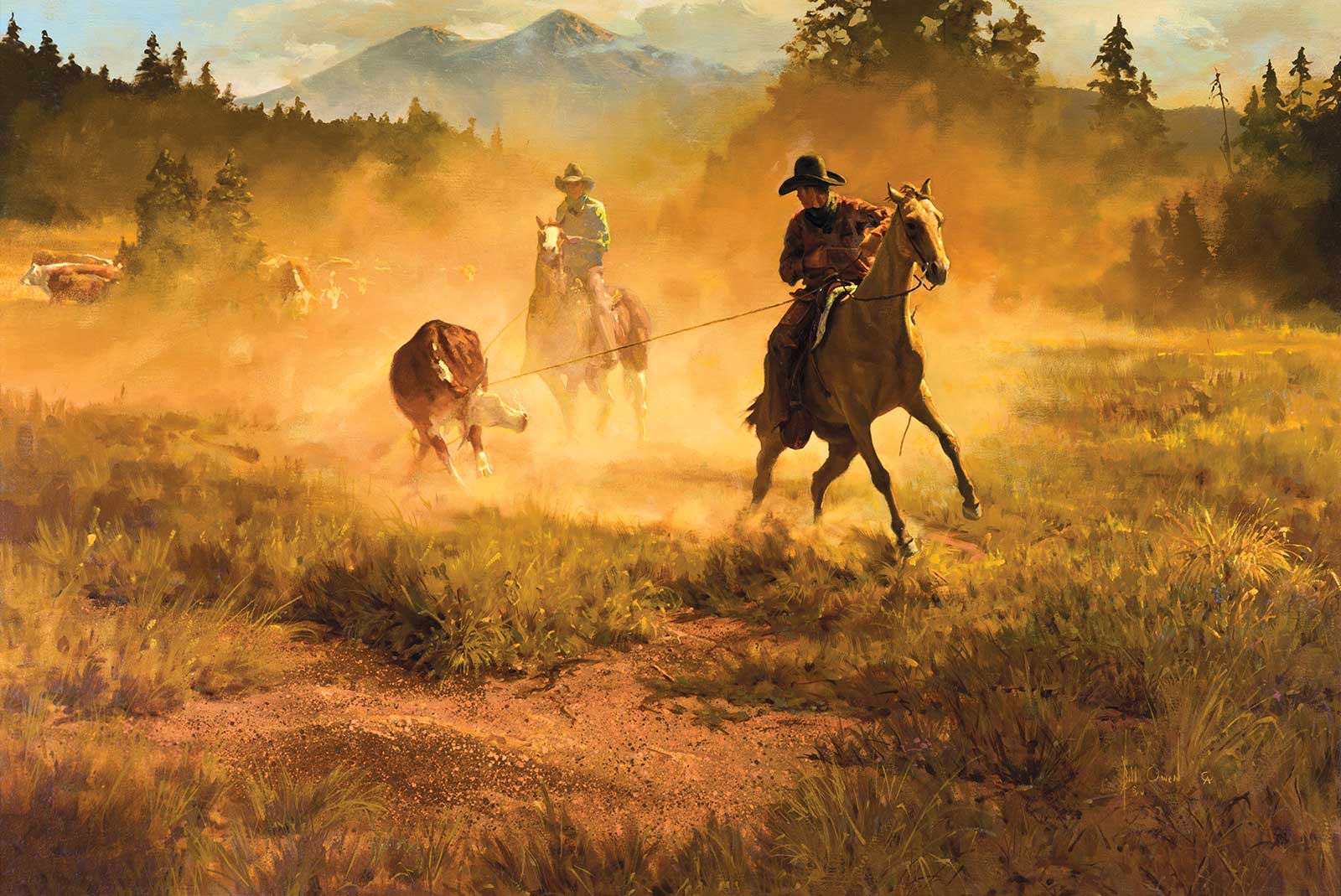 Bill Owen (1942-2013), When the Rope Tightens, 1973, oil on canvas, 24 x 36”. Image courtesy of the Eddie Basha Collection.
In relation to American culture, the Cowboy Artists of America organization derives salience from this version of the West, which resonates for many people today as an invitation toward self-recovery, imaginative play and cultural repossession. As CAA member Kenneth Riley stated in 1989, “You have to admit that the history of the West has a lot of romance in it and it is truly an American experience. Everything in the East is related to Europe in some way, but as I traveled throughout the West and then moved here in 1971, I realized that no place else in the world has experiences quite like those of Indian cultures, the explorers or the pioneers. And all of it is set in such grandiose scenery with open space and light—it’s monumental.” Since the organization’s founding in 1965, the CAA has been a dominant presence in shaping the field of Western American art. In support of their mission “to authentically preserve and perpetuate the culture of Western life in fine art,” the organization not only has grown the number of artists, collectors and galleries interested in the genre, it has refined the parameters of traditional Western art itself.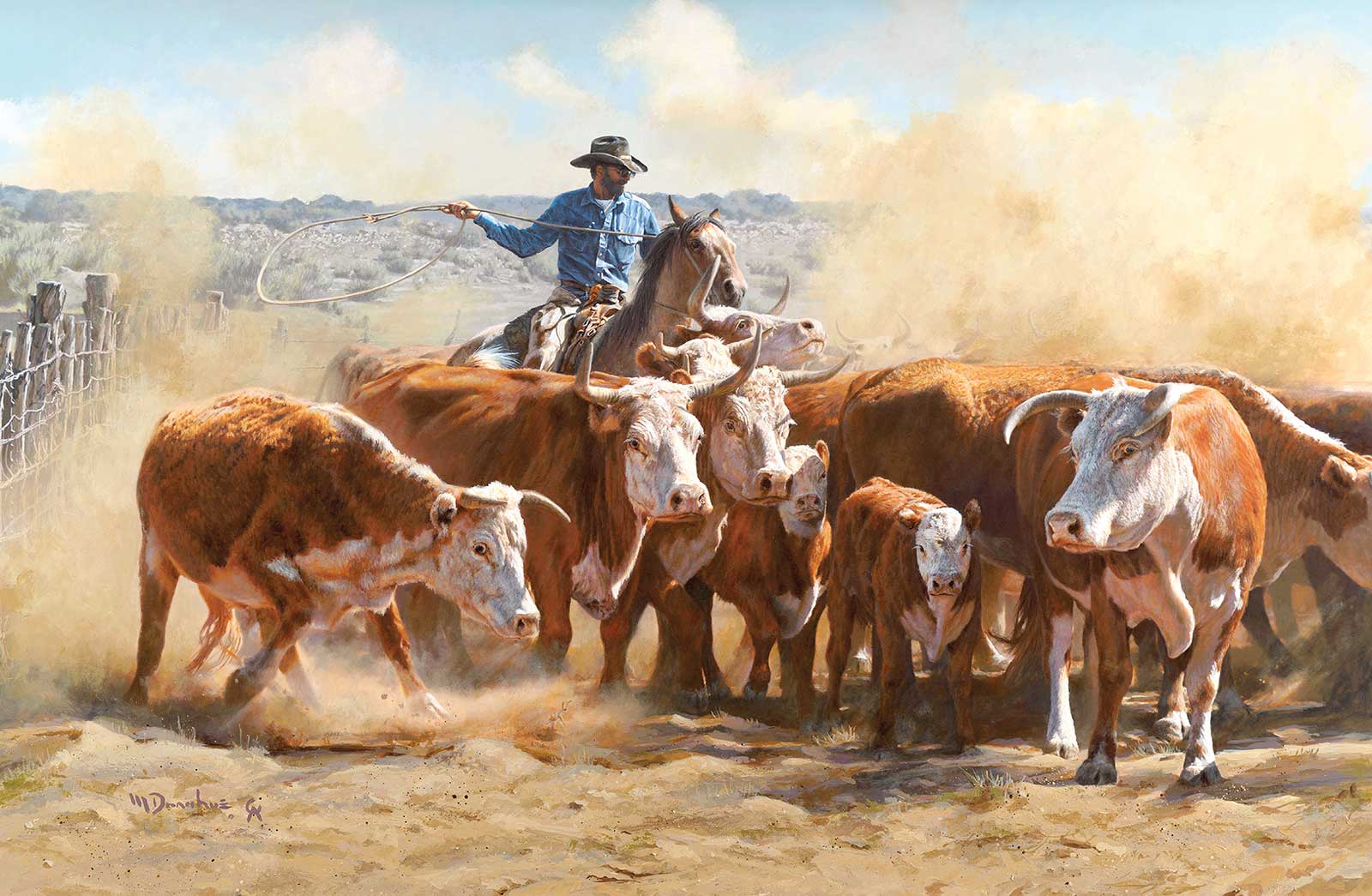 Mikel Donahue, Spring Work on the Cataract, 2019, acrylic on board, 24 x 36”. Image courtesy of the artist.
Western art saw its golden age in tandem with the waning of the frontier and the rise of reservation life, from the 1870s through the 1920s. Artists Charles M. Russell, Frederic Remington, Edward Borein, W.R. Leigh and Frank Tenney Johnson set the standard for traditional Western art and the Western artist. Their detailed and imaginative paintings of the American West’s people and landscapes were filled with nostalgia, romance and narrative realism that defined the look and feel of the genre. From this foundation, CAA members built and maintained an artistic tradition passed down through subject matter, style, thematic underpinnings, documentary integrity and cultural values that served to bind the group together. This artistic tradition allowed them to invoke the historical authority of Western art while pursuing stylistic choices that transformed and adapted the genre to suit the spirit and style of each individual artist.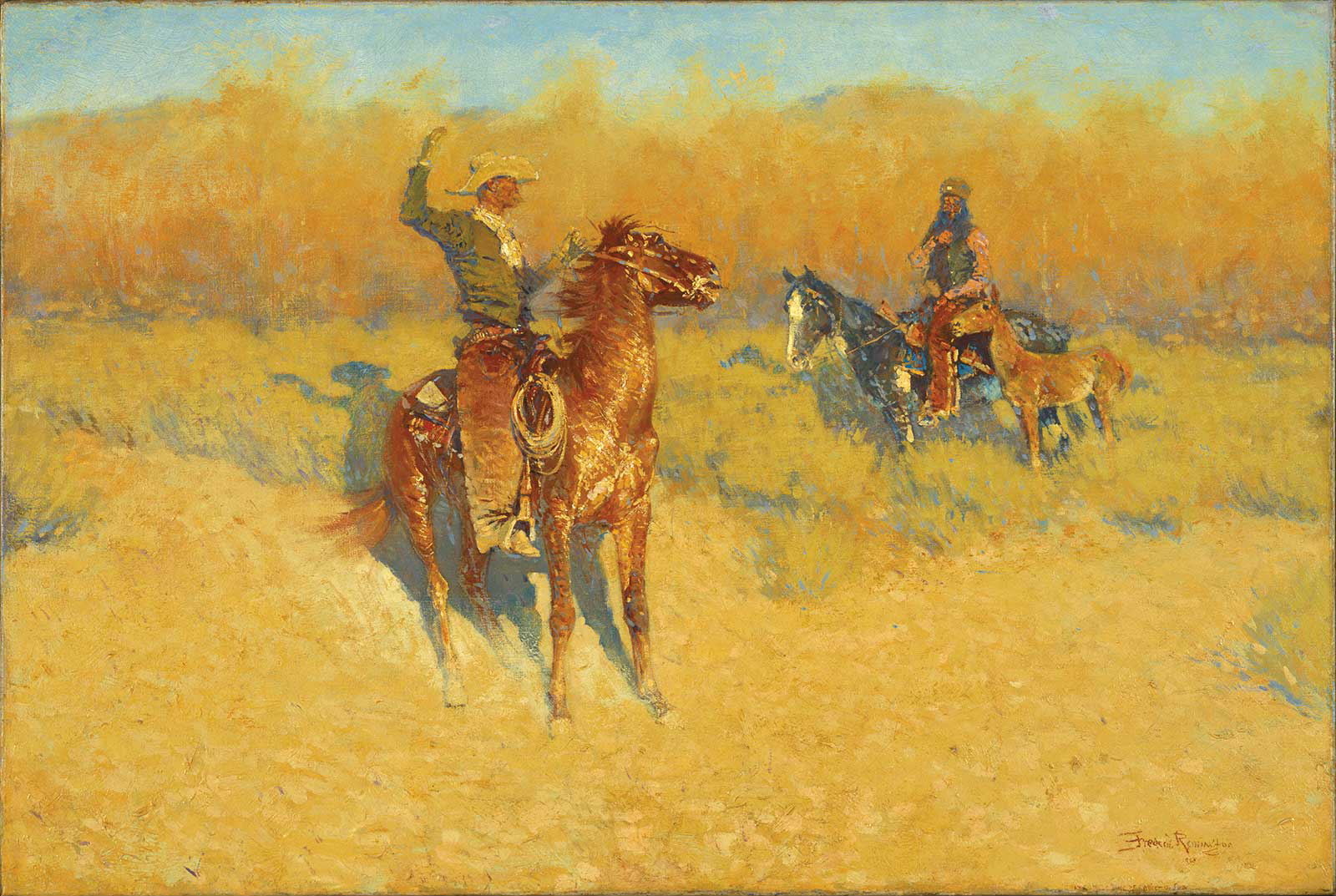 Frederic Remington (1861-1909), The Long-Horn Cattle Sign, 1908, oil on canvas, 27 1/8 x 40”. Amon Carter Museum of American Art, Fort Worth, Texas, Amon G. Carter Collection, 1961.242.
Some of the strongest examples of CAA artwork are those that are in dialogue with deceased artists and other members of the organization. These often precursory artistic voices serve as checks and balances that maintain cohesion and equilibrium between tradition and innovation in traditional Western art. These ties between artists past and present oscillate between expressions of repetition and novelty, experience and history, the individual and the collective, and between creative departure and the longing for continuity in art.
Within this scope, historical scenes such as bison hunts, horse thieving, expeditions and the fur trade are carefully researched and crafted alongside those of the evolving modern West. Comparing works of similar subject matter, Joe Beeler’s sculpture Vengeance, 1999, echoes Remington’s The Cheyenne, 1918, in its depiction of a Native warrior on horseback. Where Remington used texture to create distinction, Beeler instead chooses harmony. Meticulous detail, expressive lines and hard shadow animate the vaquero and his mount in Borein’s Mexican Steer on the Prod, 1917, and in John Moyer’s Making Time, 2002. But where Borein pushed for drama, with large blocks of deep shadow and small frenetic lines that radiate energy, Moyer sought restraint. While less innovative, Beeler and Moyer’s works are well-crafted examples of their tradition.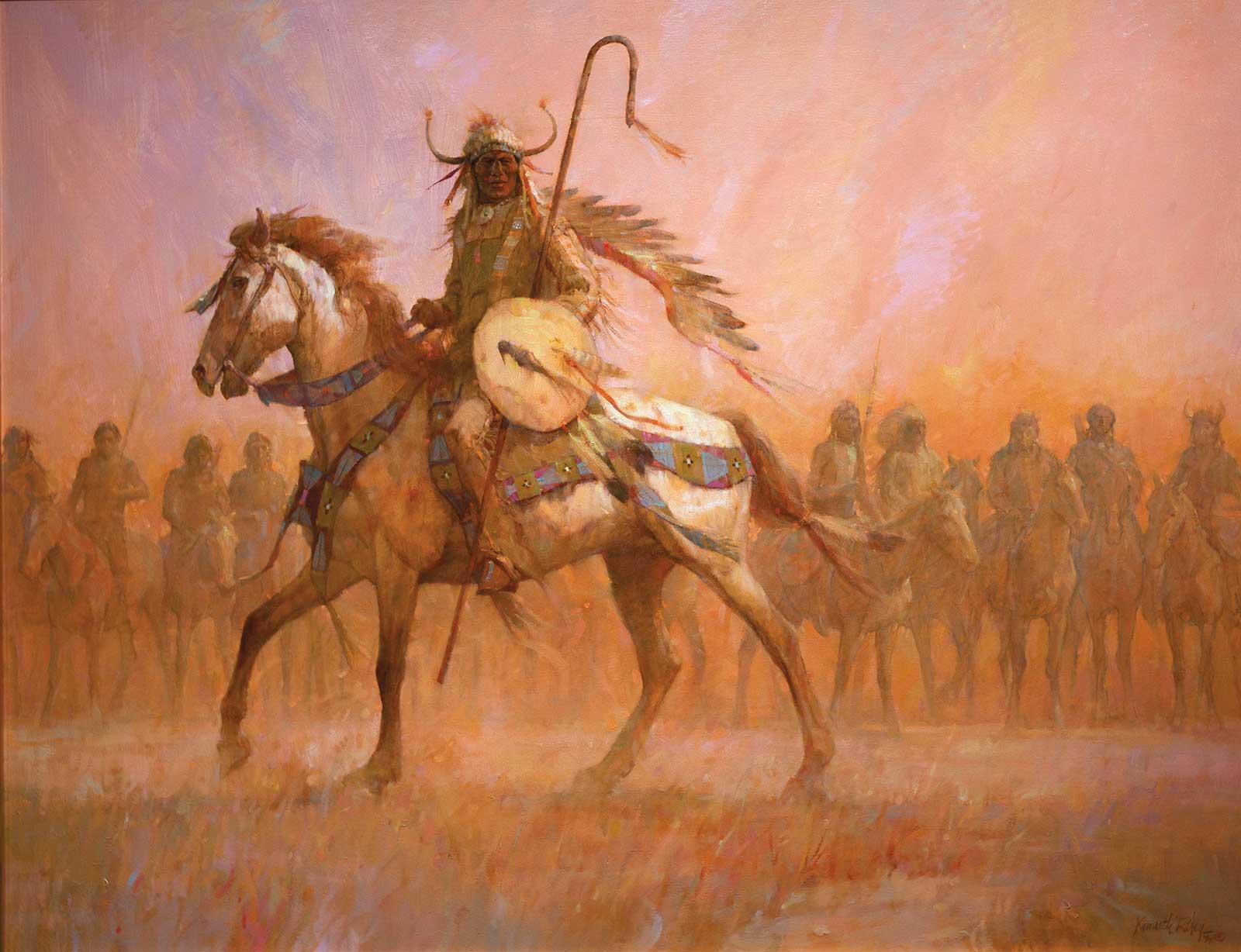 Kenneth Riley (1919-2015), The Challenge, 1989, oil on canvas, 36 x 46¼”. Briscoe Western Art Museum, San Antonio, Texas, Gift of the Jack and Valerie Guenther Foundation, 2015.11.04.
The first CAA member to consistently push the stylistic boundaries of Western sculpture was Fritz White. His art explored subjects covering religion, mythology and folklore. Though few in number, historic works like Russell’s The Spirit of Winter, 1926, and Remington’s Paleolithic Man, 1906, offer precedents for work like White’s Song of the Wolf, 1972, depicting a shape-shifting Native shaman. The bronze’s fluid, impressionist style conveys emotion and reflects the elemental environment and spiritual animus of its subject. White sought to depict the emotional state of the human experience, saying, “There is nothing creative about doing a mounted cowboy, in my opinion. What is creative, however, is conveying how terrible the dust around him is. Or that he’s so damned cold that he can hardly stand it, or that he is miserable because his boots are full of water.” In pursuing similar subjects, Oreland Joe and John Coleman have taken distinct approaches in portraying the interaction between fluidity, spirituality and emotion. Coleman achieves this by amplifying texture and building volume, letting light and shadow enhance his sculptural elements, as seen in works such as Calling the Fathers, while Joe uses geometric forms to achieve balance and impart abstract elements in stone pieces such as Sunrise Blessing.Innovating within a tradition requires that artists make informed departures from that tradition. While a narrative focus has always been a hallmark of CAA artwork, a subset of artists have pursued a color-conscious and design-oriented approach, taking their inspiration from Russell and Remington’s late period and the influence of American impressionism. Remington’s The Long-Horn Cattle Sign, 1908, models this painterly style, showcasing a reduced range of color and value and the shimmering effects of light. Similarly, Howard Terpning’s The Scouts of General Crook, 1982, and C. Michael Dudash’s Spyglass also model these concerns with capturing and reflecting light. Kenneth Riley’s The Challenge, 1989, however, uses a restricted palette and loose brushwork to reflect the interior emotions of the figure, rather than reflect the atmosphere and mood created by the environment. This expressionistic bent in Riley’s art is a modern departure from traditional style.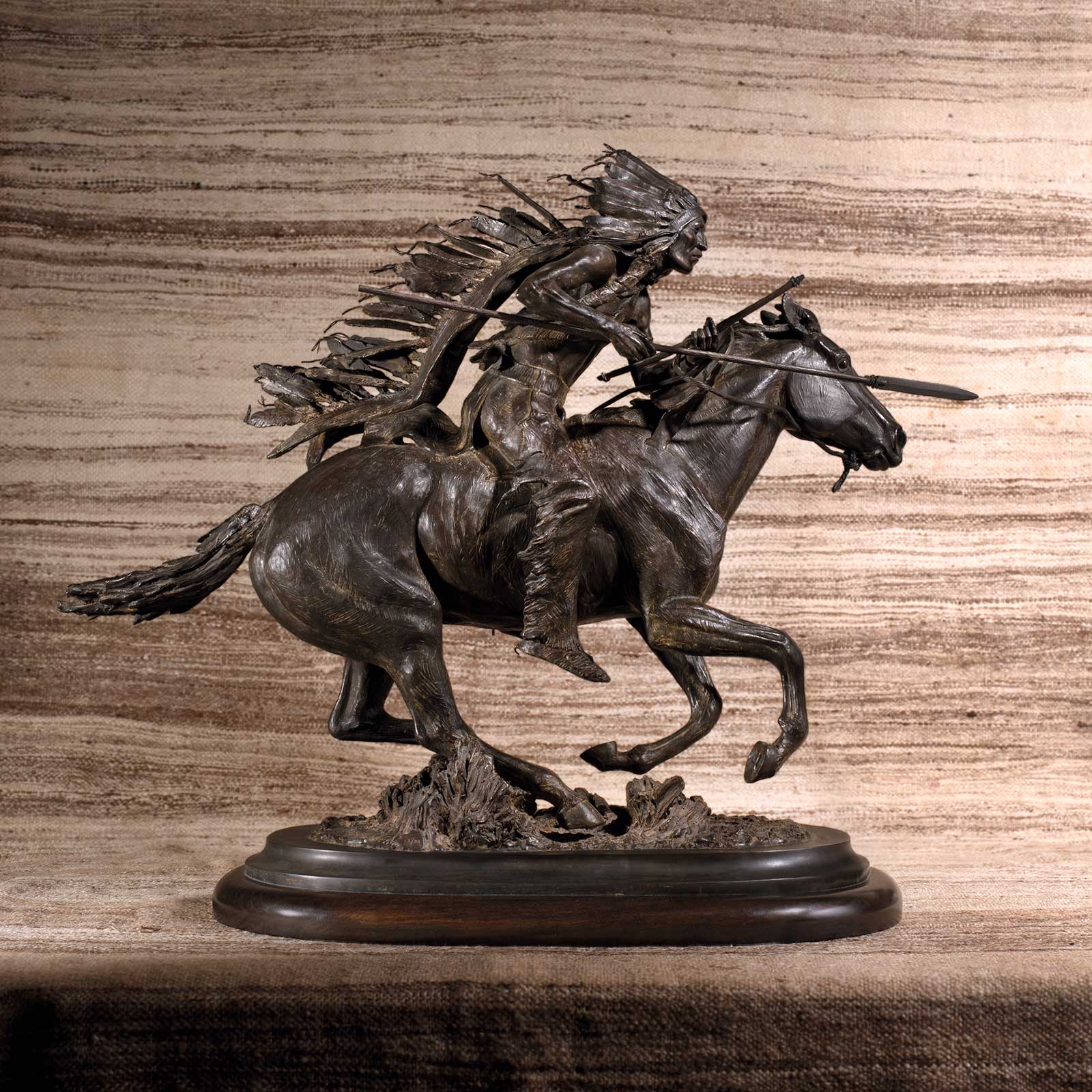 Joe Beeler (1931-2006), Vengeance, bronze, ed. 1 of 35, 28 x 34 x 8”. Image courtesy of the Eddie Basha Collection.
In an example of the modern West, dust, atmospheric light, skillful roping, a rugged landscape and skittish animals unite Russell’s Wild Horse Hunters, 1913; Bill Owen’s When the Rope Tightens, 1973; and Mikel Donahue’s Spring Work on the Cataract, 2019, in their depictions of the working cowboy. In some respects, the years between these works reveals a decline in the level of danger and precarity associated with the job of cowboying and a shifting interest in point of view. Predicament paintings executed at the height of dramatic action and in steep terrain give way to scenes of seasonal range management and daily ranch practice.
One of the first CAA members to dedicate his art to depicting the everyday rural West was Gordon Snidow, who stated, “What I’m trying to do…is to cover the ranching scene as I encounter it, trying to reflect what is being done in my time…My paintings will show the people, types of horses and equipment; and the summation of it all covers an era of our west.” Atmosphere, mood and quiet action are hallmarks of his portraits and genre scenes. Following in his stead are such contemporary members as Donahue, Tyler Crow and Teal Blake. Their philosophical lineage is apparent when comparing works like Snidow’s Eyeing the Catch Hand, 1979, with Blake’s Tularosa Cavvy, 2015. Where Snidow uses a low-key palette and heavy shadow to evoke warmth, Blake instead paints in high key, mimicking the atmosphere of a hot, sun-bleached day. Both works bring to the forefront the poetic elegance of the everyday in their intimate portrayal of working ranch life and cowboy craft. CAA members’ willingness to participate in traditional activities of Western culture strengthens the quality of their art as it stimulates their commitment to living a life like that which fostered their artistic tradition in its earlier era.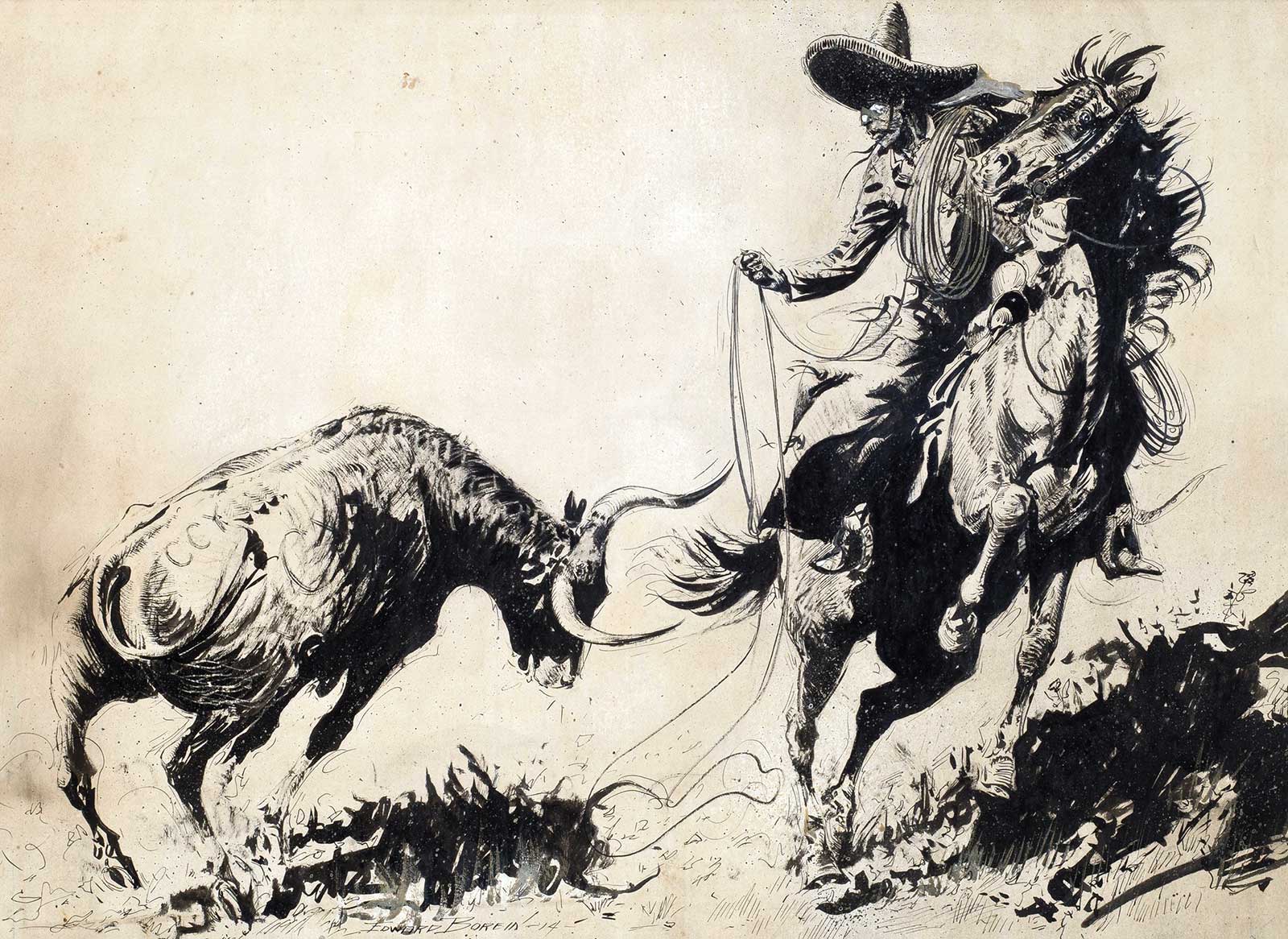 Edward Borein (1872-1945), Mexican Steer on the Prod, 1917, pen and ink and gouache on board, 21½ x 29¼”. Briscoe Western Art Museum, San Antonio, Texas, Gift of the Jack and Valerie Guenther Foundation, 2017.01.15.
In examining the CAA’s objective to ensure authentic representation of Western life as it was and is, one must note that these artists’ depictions of the contemporary and evolving American West have been largely confined to ranching culture and the people who animate the small town rural West. Their images tend to celebrate traditionalism and a communal past that is reflective of a certain subset of Westerners, accompanied by a nostalgia for a utopian, agrarian version of the American West. Because the region is so vast and much of the land remains intact and undeveloped, this West is still palpable for viewers and patrons alike. As Terpning presciently remarked in 1981, “The current interest in our Western heritage is going to be more than just another passing fad, because it’s the story of how our country was pioneered and settled. It’s the only chapter in our history which we can claim as uniquely American.” Through this lens, portraying the vitality of the past can enrich the life of the present.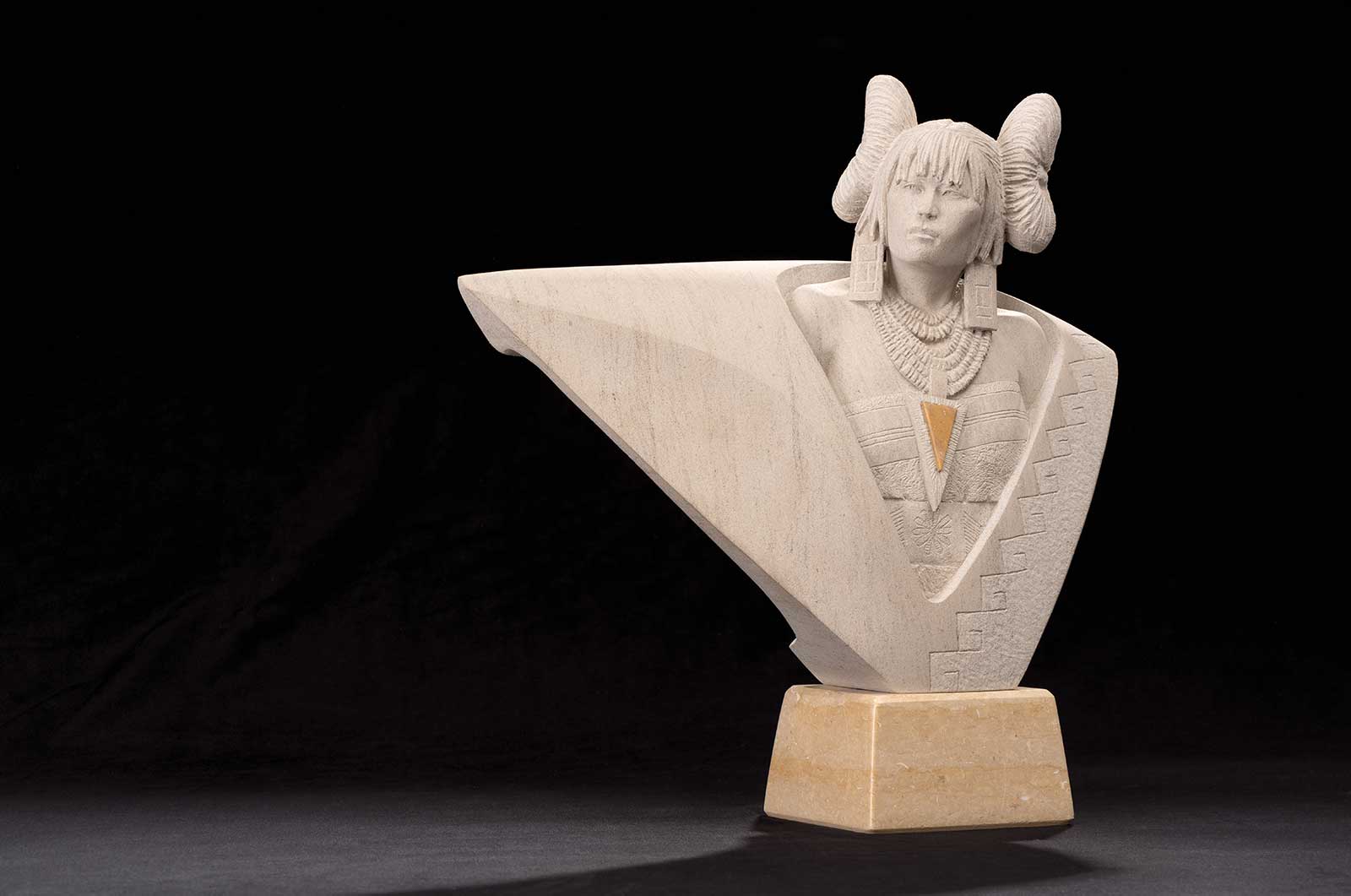 Oreland Joe, Sunrise Blessing, 2010, limestone, 6 x 15 x 17”. Image courtesy of the Eddie Basha Collection.
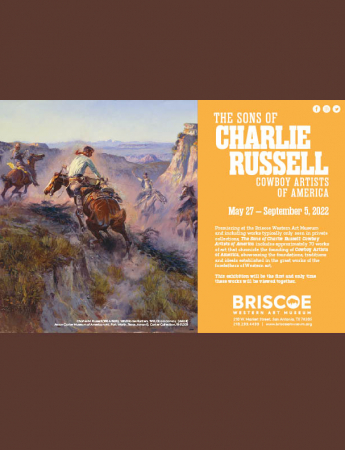
In our day and age, the market for traditional Western art remains strong, though not because it says something meaningful about the multiplicity of stories, the shifting currents between modern life and traditional culture, or the unique adaptive practices that we find in today’s West. Rather, it is because, although the Western experience may be uniquely American, the frontier is universal. It is both real and sentimental. It offers a respite and a reprieve with the understanding that perhaps somewhere out there, some things can remain the same. Tradition can still survive. We can still locate the past in our present. For many, that is still reason enough to hang a Cowboy Artists of America picture on the wall. For their tradition to remain modern, however, the artists of the CAA must invoke the historical authority of their tradition in order to make acts of transformative choice that push the field forward.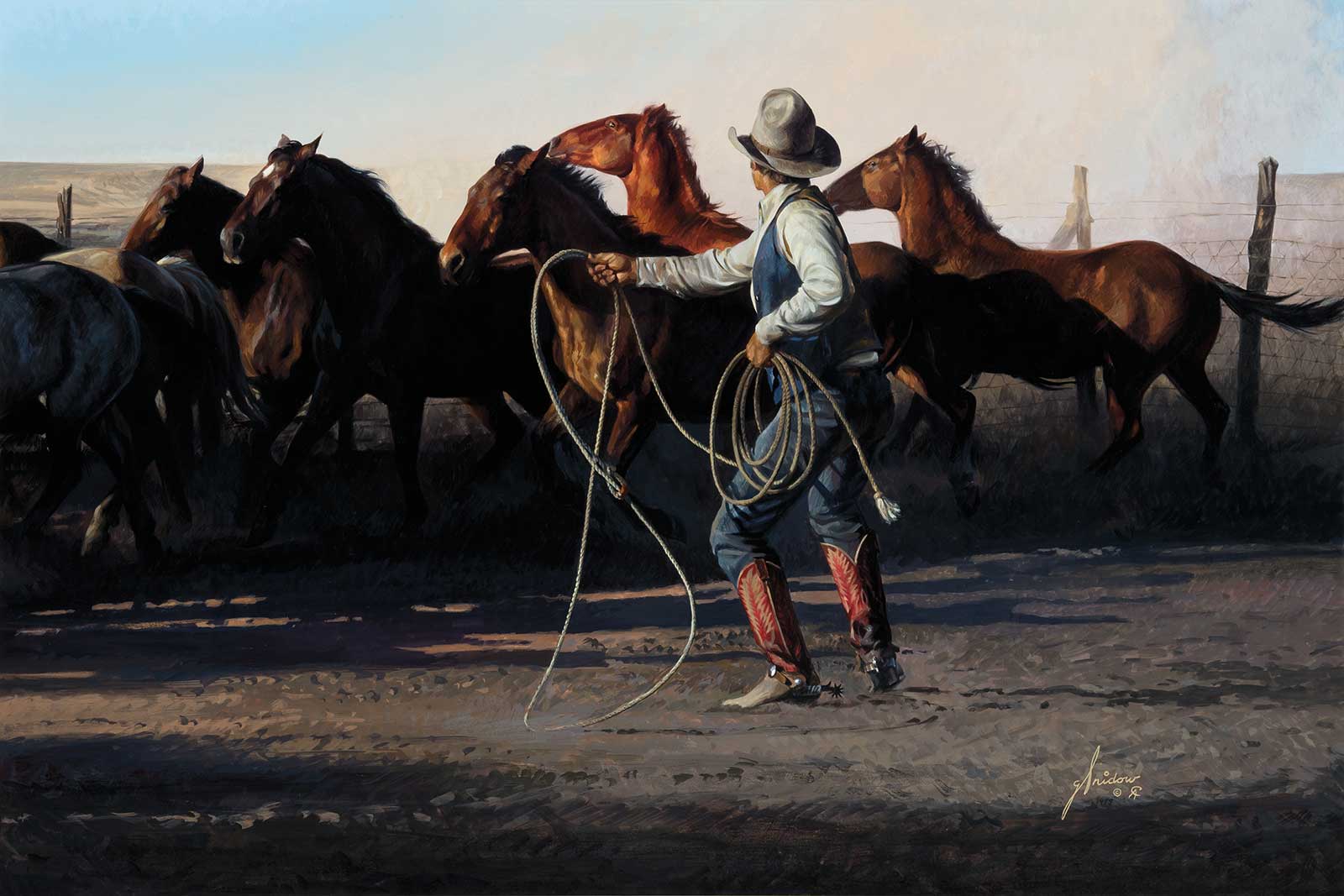 Gordon Snidow, Eyeing the Catch Hand, 1979, opaque watercolor on paper, 24 x 36”. Briscoe Western Art Museum, San Antonio, Texas, Gift of the Jack and Valerie Guenther Foundation, 2017.01.10.Running from May 27 through September 5, 2022, at the Briscoe Western Art Museum in San Antonio, Texas, The Sons of Charlie Russell: Cowboy Artists of America includes 70 works of art encompassing paintings, sculpture, and works on paper, dating from 1890 to the present day, from 40 artists. The 17 lenders to the exhibition include institutional and private lenders from Texas, Arizona, Colorado, Nebraska, Oklahoma, and Georgia, as well as works drawn from the Briscoe’s permanent collection. —
The Sons of Charlie Russell: The Cowboy Artists of America
May 27-September 5, 2022
Briscoe Western Art Museum, 210 W. Market Street, San Antonio, TX 78205
(210) 299-4499, www.briscoemuseum.org
Powered by Froala Editor