Nearly 100 years after the first wagon trains headed West, Helen Lundeberg (1908-1999) painted her interpretation of the experience in a style known as postsurrealism in Pioneers of the West, 1934. The hopes and trials of the pioneers were echoed in the hopes and trials of a country in the midst of the great depression. Lundeberg worked for the Works Progress Administration, a program that employed artists to create art for public spaces. Her pioneers face the future and away from the viewer of the painting. The mountains represent the difficulties of their journey but dissolve into the light—the hope of a new beginning. The figures are monumental, as if possessed of limitless strength and resources. She and her husband, Lorser Feitelson (1898-1978), developed subjective classicism or postsurrealism as an American response to the European surrealist movement. She wrote, “My aim, realized or not, is to calculate, and reconsider, every element in a painting with regard to its function in the whole organization…In contrast to the surrealist program of intuitive expression and subconscious automatic recordings, postsurrealism explores the field of psychological science to create a classic subjective expression. The pictorial elements are deliberately arranged to stimulate, in the mind of the spectator, an ordered, pleasurable, introspective activity.”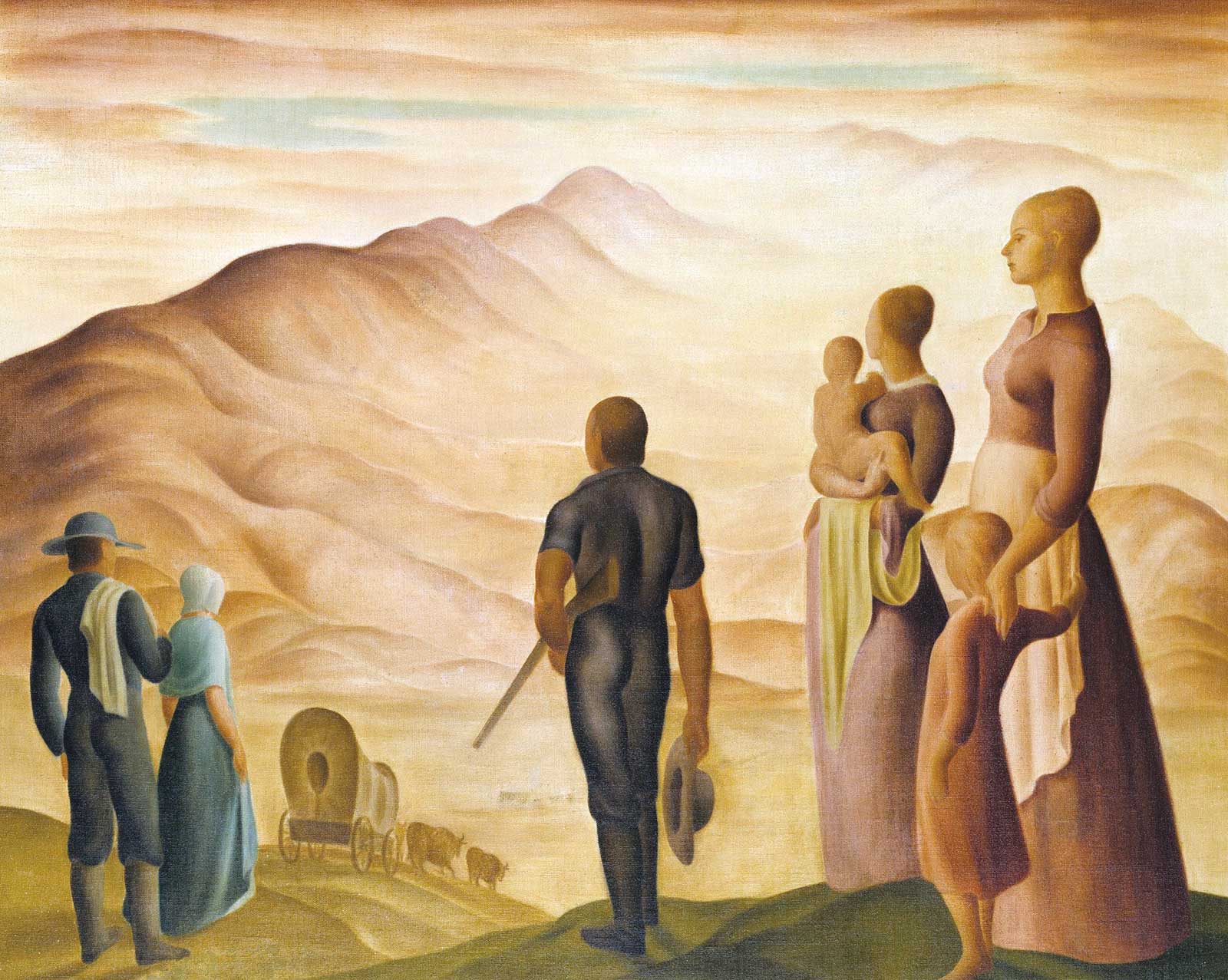 Smithsonian American Art Museum Luce Foundation Center, Pioneers of the West, 1934, oil on canvas, 40 x 50¼", by Helen Lundeberg (1908-1999).
Ed Kucera’s Just Chillin is a realist response to the phenomenon of traveling West. Although there are many stories of the hardships endured, family and social life were sustained, children were born and people died. Two boys and their dog hang out on a wagon untethered from its team of oxen as the wagon train stops for a break. As opposed to Lundeberg’s subjective classicism, Kucera has mastered realistic classicism. His attention to detail and the nuances of light come from intense study of his primarily Native subjects to his study of the chiaroscuro of Caravaggio. 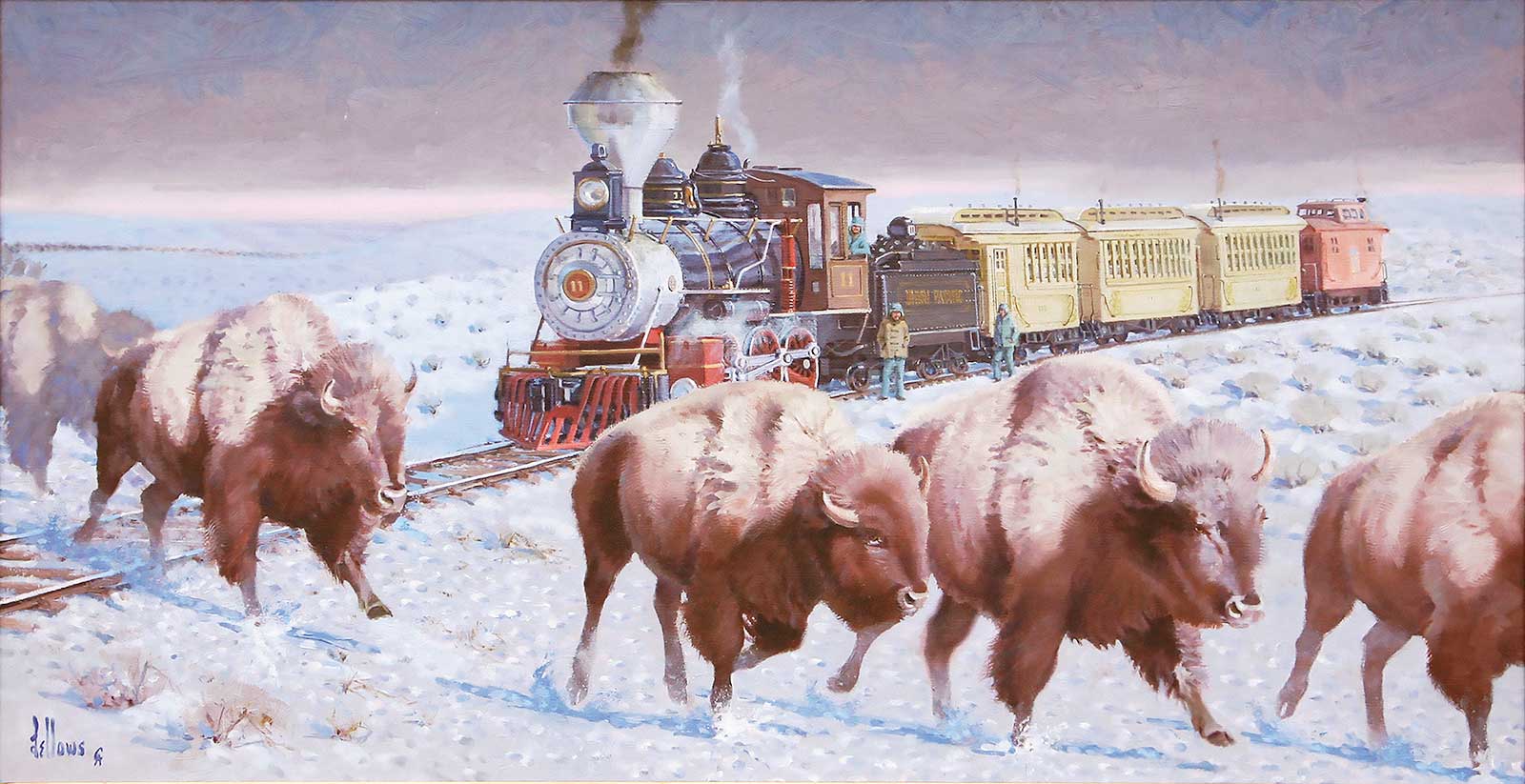 Mark Sublette Medicine Man Gallery, In the Path of the Iron Horse, oil on linen, 26 x 50", by Fred Fellows.
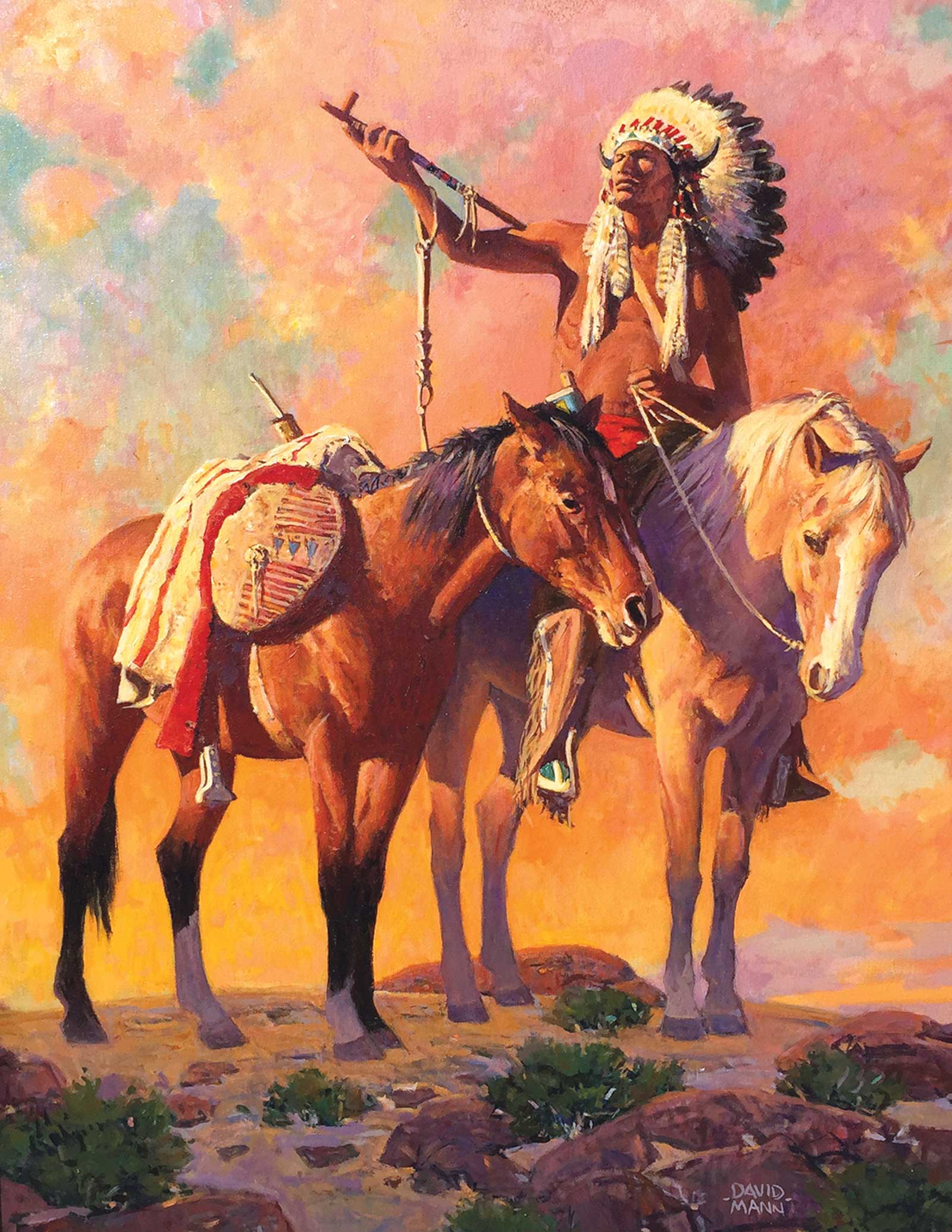 Legacy Gallery, Nomad Tribute, oil, 30 x 24", by David Mann.
The transcontinental railroad was completed in 1869, making travel to the West easier but, initially, still fraught with peril. Among the perils were up to 60 million buffalo who roamed free. When the buffalo crossed the tracks, the train had to stop—sometimes for hours. In addition to being a fine sculptor and painter, Fred Fellows is a history buff. It goes without saying that the buffalo in his painting In the Path of the Iron Horse are accurate, but his research into early trains assured the accuracy of his depiction of the locomotive. Early passenger trains often had wooden benches and were heated by wood stoves as they lumbered across the West at often less than 25 miles per hour. Fellows’ train is stopped in the cold of winter. The locomotive is followed by a car for fuel, a passenger and baggage car, two passenger cars and the caboose providing a sleeping and cooking area for the crew.
Keep reading to hear from artists, galleries and museums on paintings of the Old West. They provide insights and inspirations on the genre while also giving advice on establishing or growing a collection. 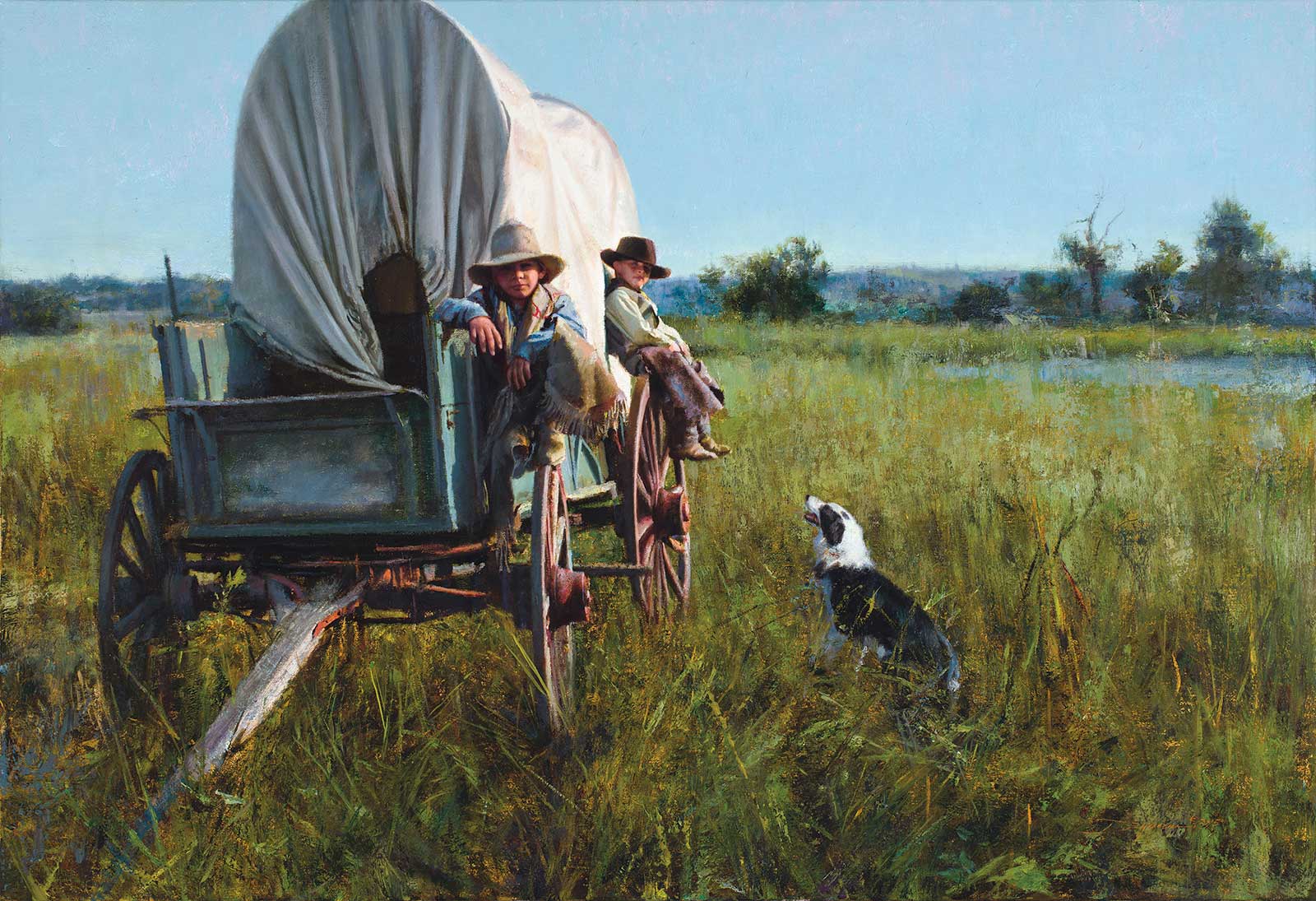 Ed Kucera, Just Chillin, oil, 30 x 48"
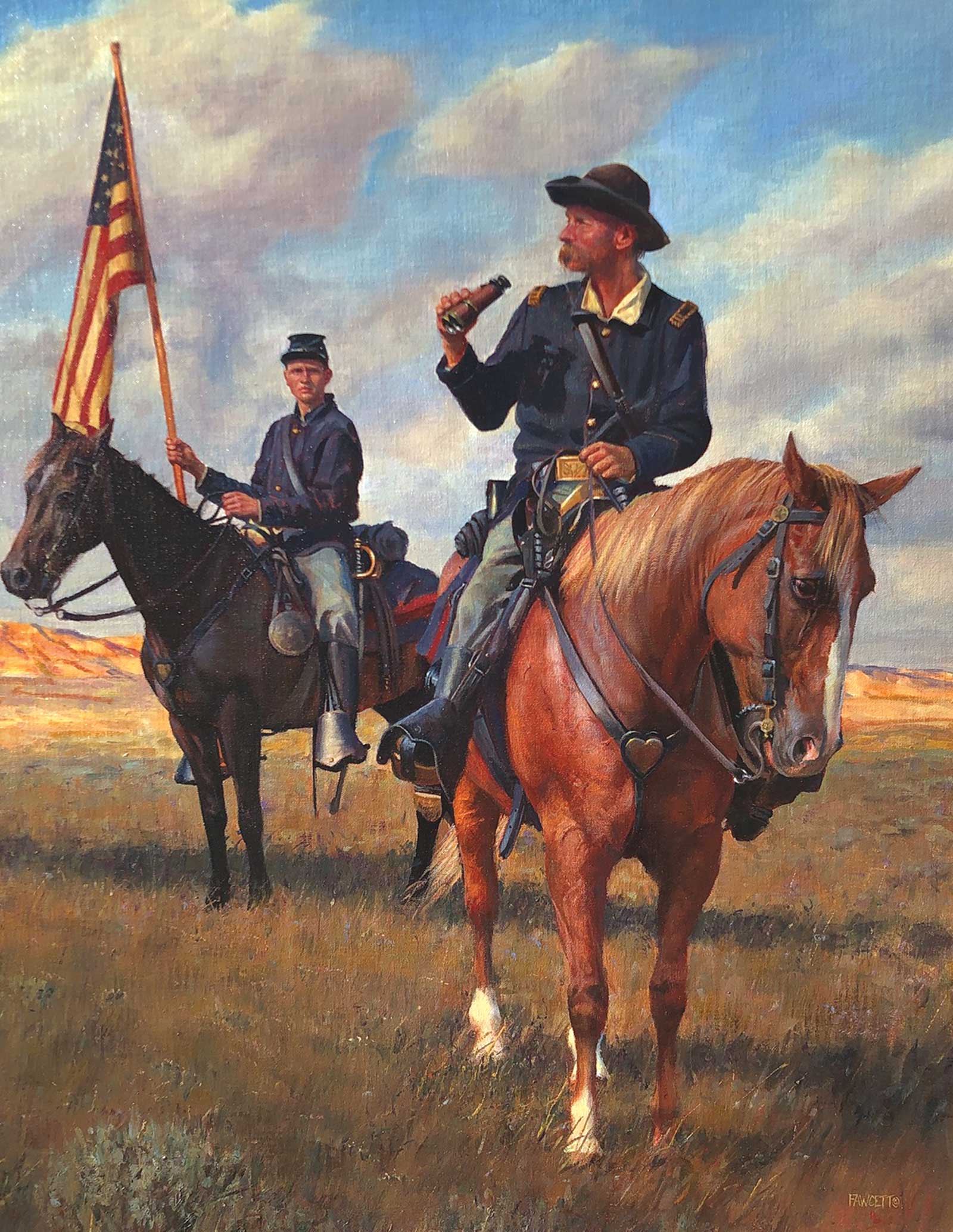 Legacy Gallery, Capt. Varnum’s Reconnaisance, oil, 30 x 24", by John Fawcett.
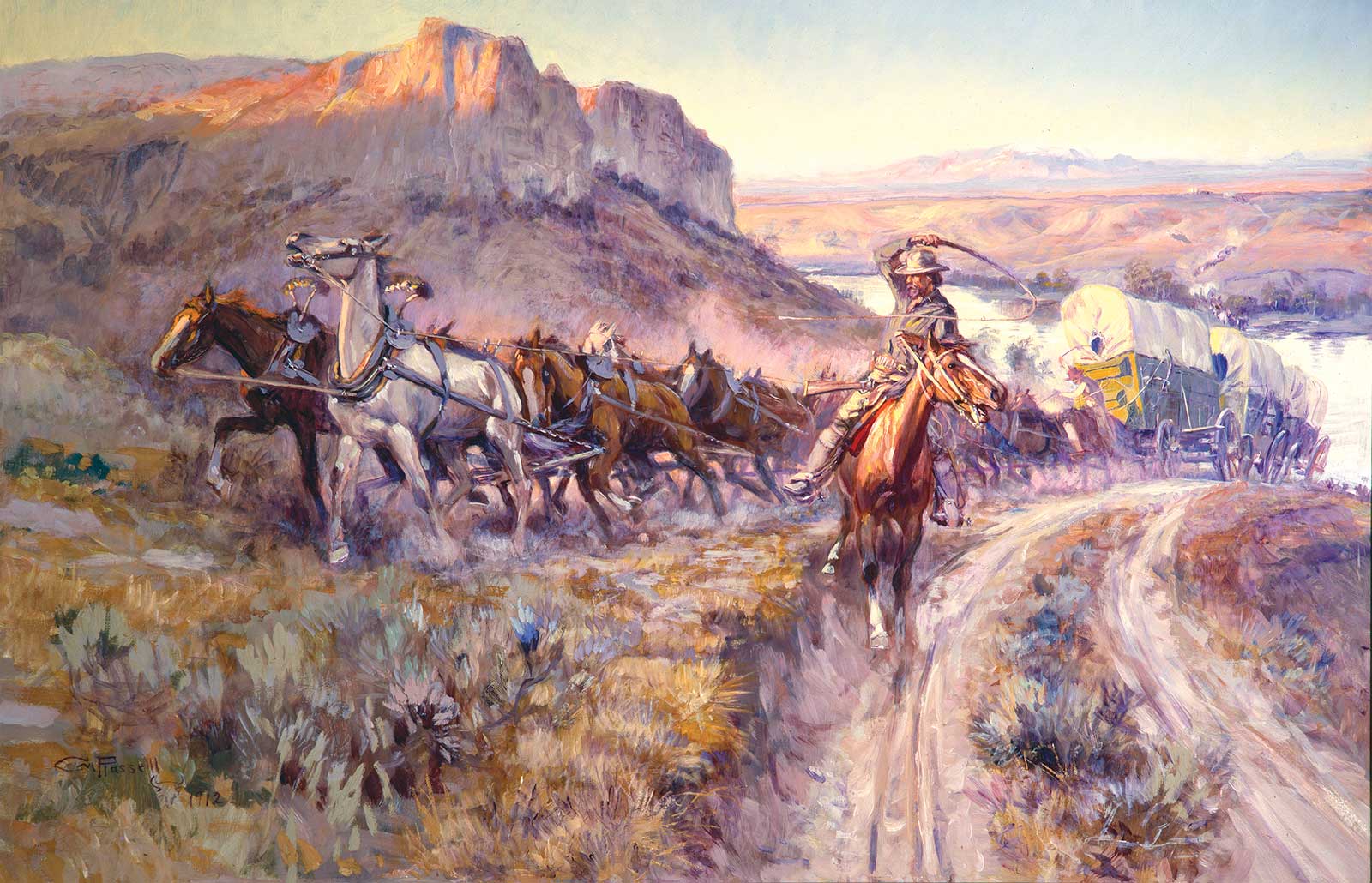 C.M. Russell Museum, The Jerkline, 1912, oil on canvas, 24¼ x 36", by C.M. Russell (1864-1926). Collection of the C.M. Russell Museum, Gift of Fred Birch.At the C.M. Russell Museum in Great Falls, Montana, see works depicting the Old West created by the cowboy artist himself, Charlie Russell. Having lived the life he painted, it wasn’t uncommon for Russell to include his friends in his paintings. In The Jerkline, Russell depicts his friend and wagon master, Johnny Matheson, bringing his outfit up the hill from the Missouri River near Fort Benton. Typically running a team of 14 horses, three wagons and a cart, Matheson frequently hauled cargo between Great Falls and Lewistown (a nine- to 15-day roundtrip journey, depending on weather) and had the traditional fierce temper and profane tongue of a freighter. Russell treasured Matheson’s rough-hewn ways, his wealth of experience and especially his stubborn resistance to change. The C.M. Russell Museum offers virtual tours of select galleries so everyone can experience the West through C.M. Russell’s eyes.
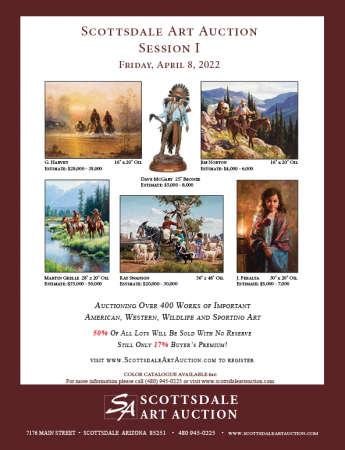
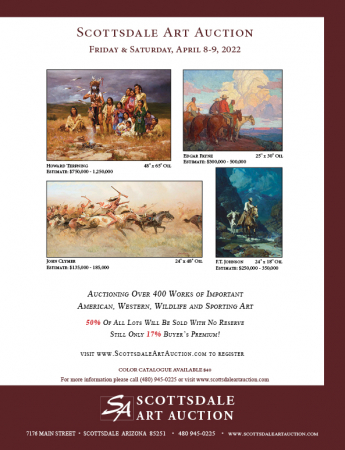
Legacy Gallery has several esteemed artists that focus on painting the Old West. This includes David Mann and work like Nomad Tribute, and John Fawcett with pieces like Capt. Varnum’s Reconnaisance. Brad Richardson, owner of Legacy Gallery, is also a partner in the Scottsdale Art Auction, which also presents many works featuring scenes of the Old West. One work in their April 2022 sale is John Clymer’s Crazy Horse. 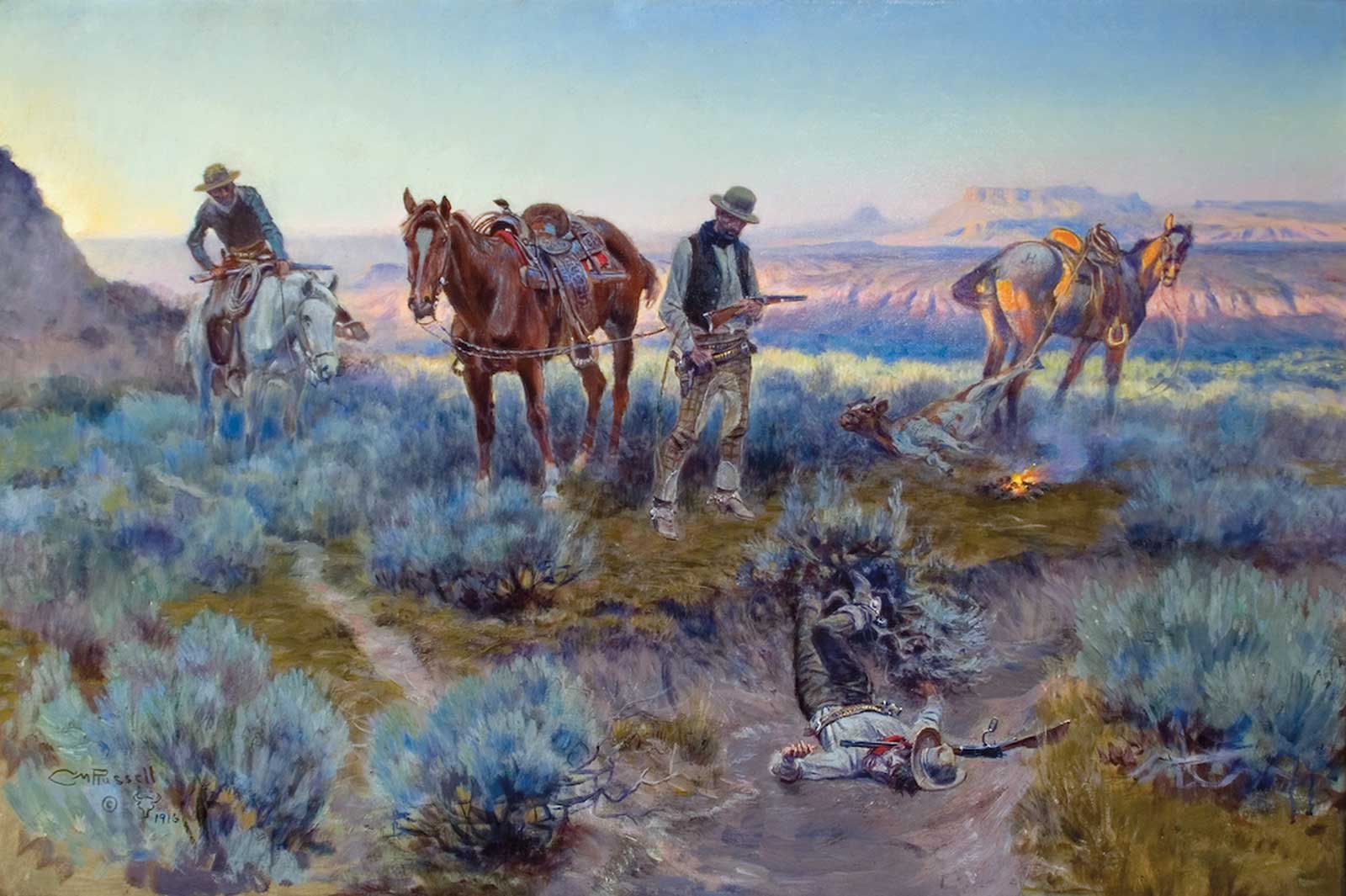 C.M. Russell Museum, Paying the Fiddler, 1916, oil on canvas, 24 x 36", by C.M. Russell (1864-1926). Collection of the C.M. Russell Museum, gift of Mr. and Mrs. William H. Moore.
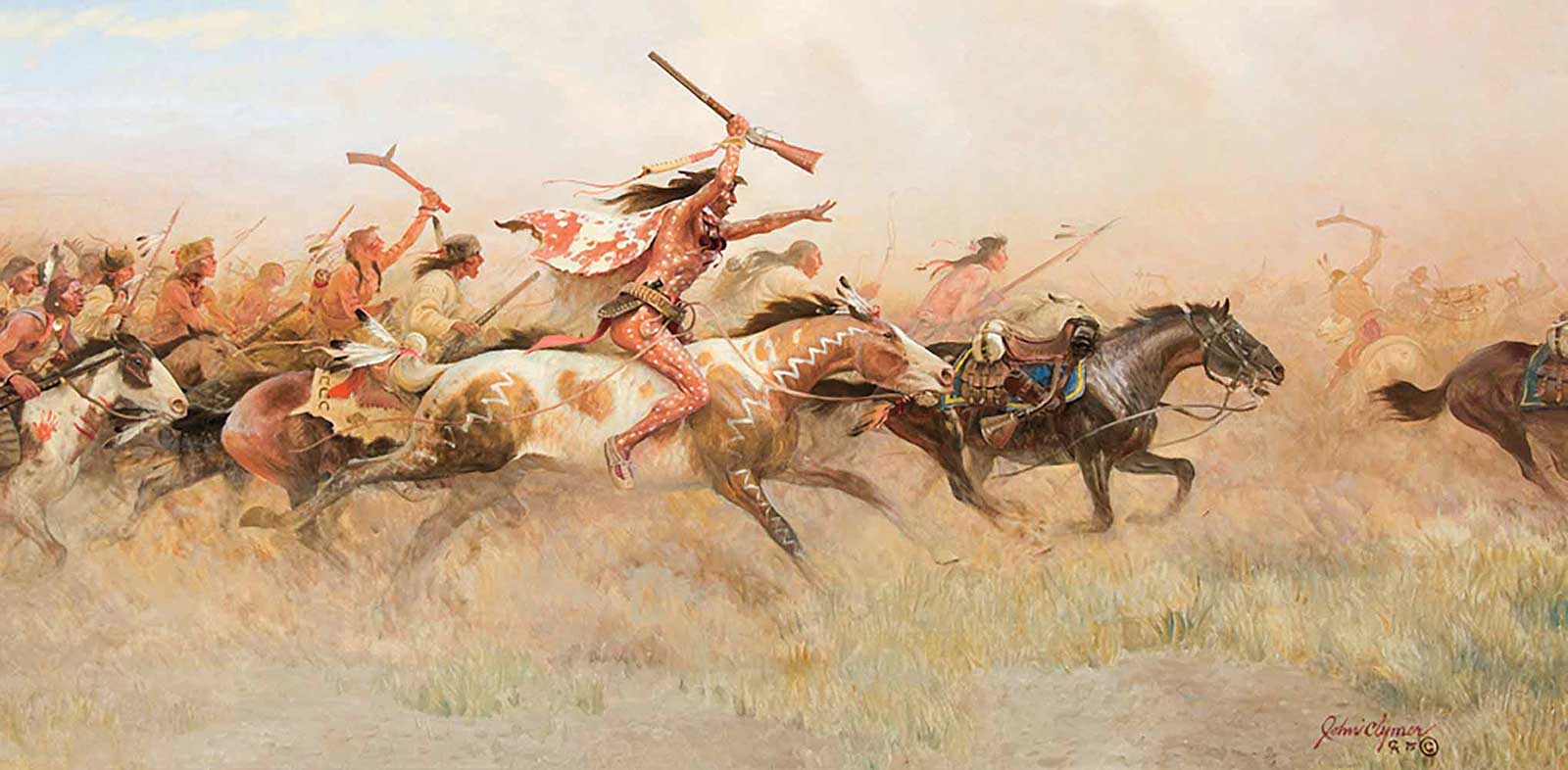 Scottsdale Art Auction, Crazy Horse, oil, 24 x 48", by John Clymer.
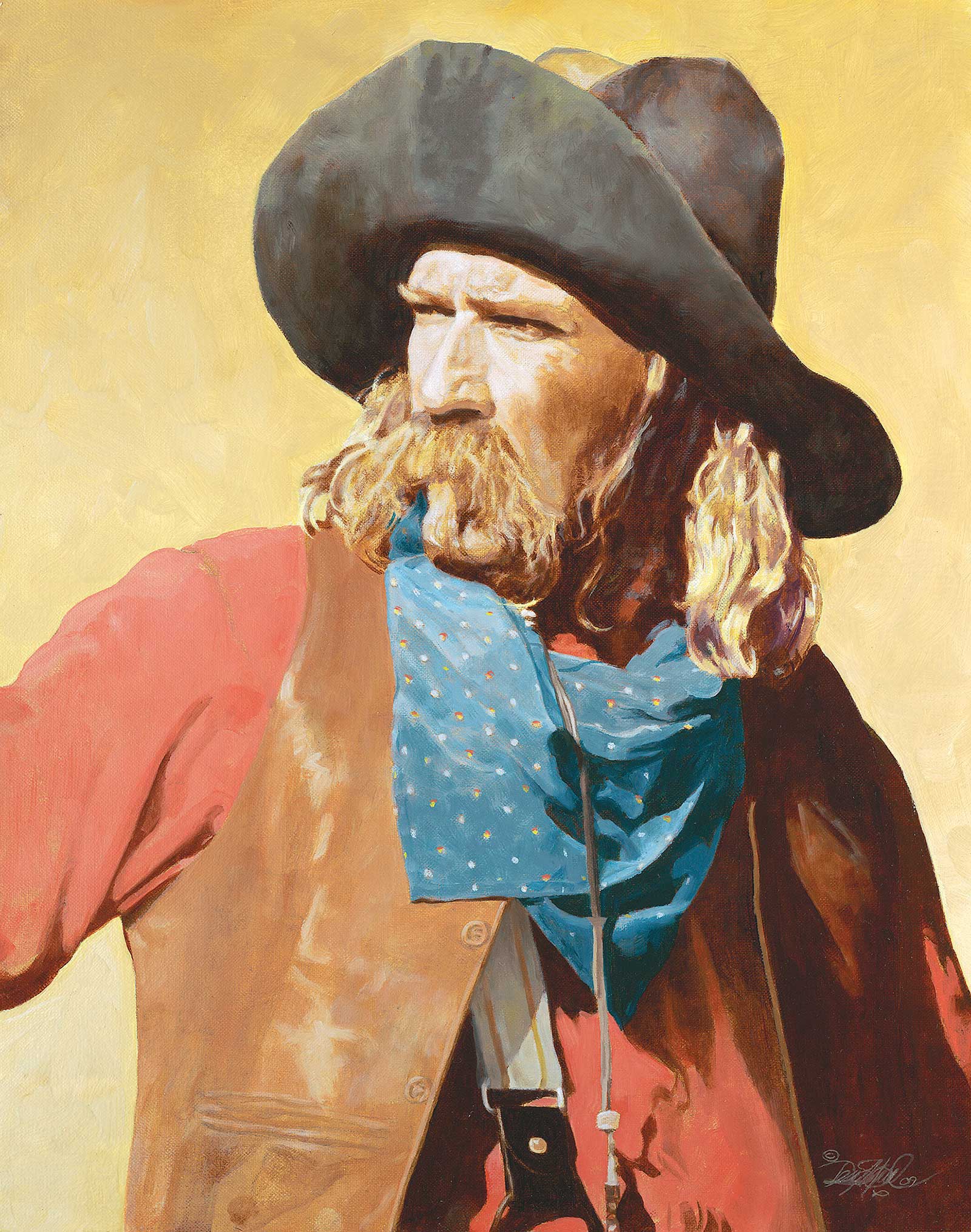 Den Schofield, Yellow Sky, oil on canvas, 20 x 16"
“Dozens of horses and figures, intense action and a panoramic-like composition—Crazy Horse has many of the masterful attributes that would appear in John Clymer paintings throughout his distinguished career,” reads the auction catalog. “The 1975 work—showing Lakota warrior Crazy Horse at the Battle of the Rosebud on June 17, 1876—would also have historical grounding…Author Walter Reed noted the significance of the work in John Clymer: An Artist’s Rendezvous with the Frontier West: ‘At the Rosebud fight Crazy Horse was said to have painted his body with hailstones and to have painted zigzag lightning marks on his pony. He wore also a red calfskin cape with the white spots that resembled hailstones. Leading the charge of his followers armed with guns, bows and war clubs, he holds his Winchester rifle aloft like a lance.’ While the Native American fighters and their horses are given prominence in the painting, Clymer does paint one foreshadowing indicator of how the battle will end: In the center-right of the painting, right in front of Crazy Horse, is a riderless U.S. Army horse.”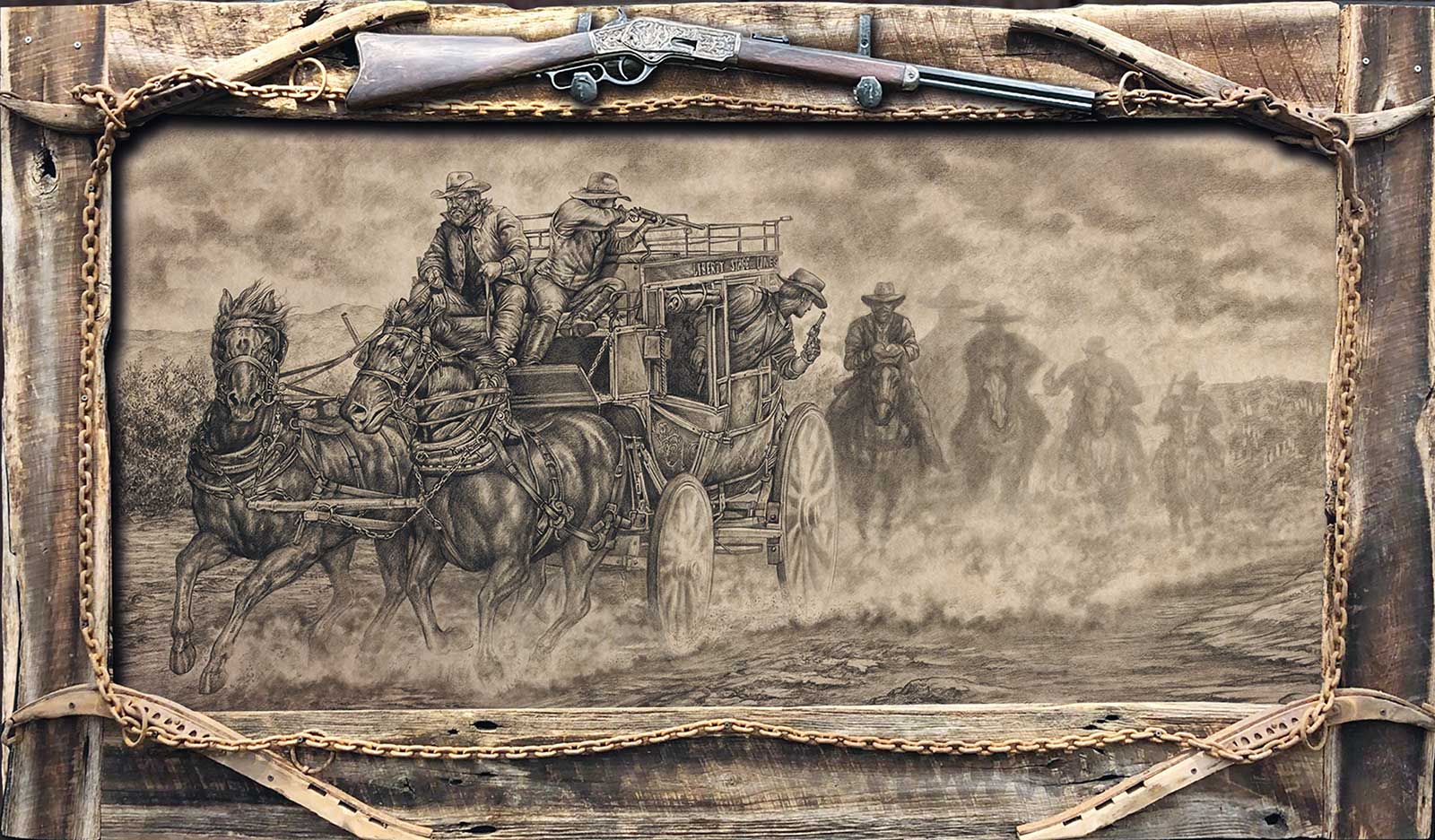 Monte M. Moore, In Pursuit of Liberty, framed metal print and artist-built frame, 48 x 85"
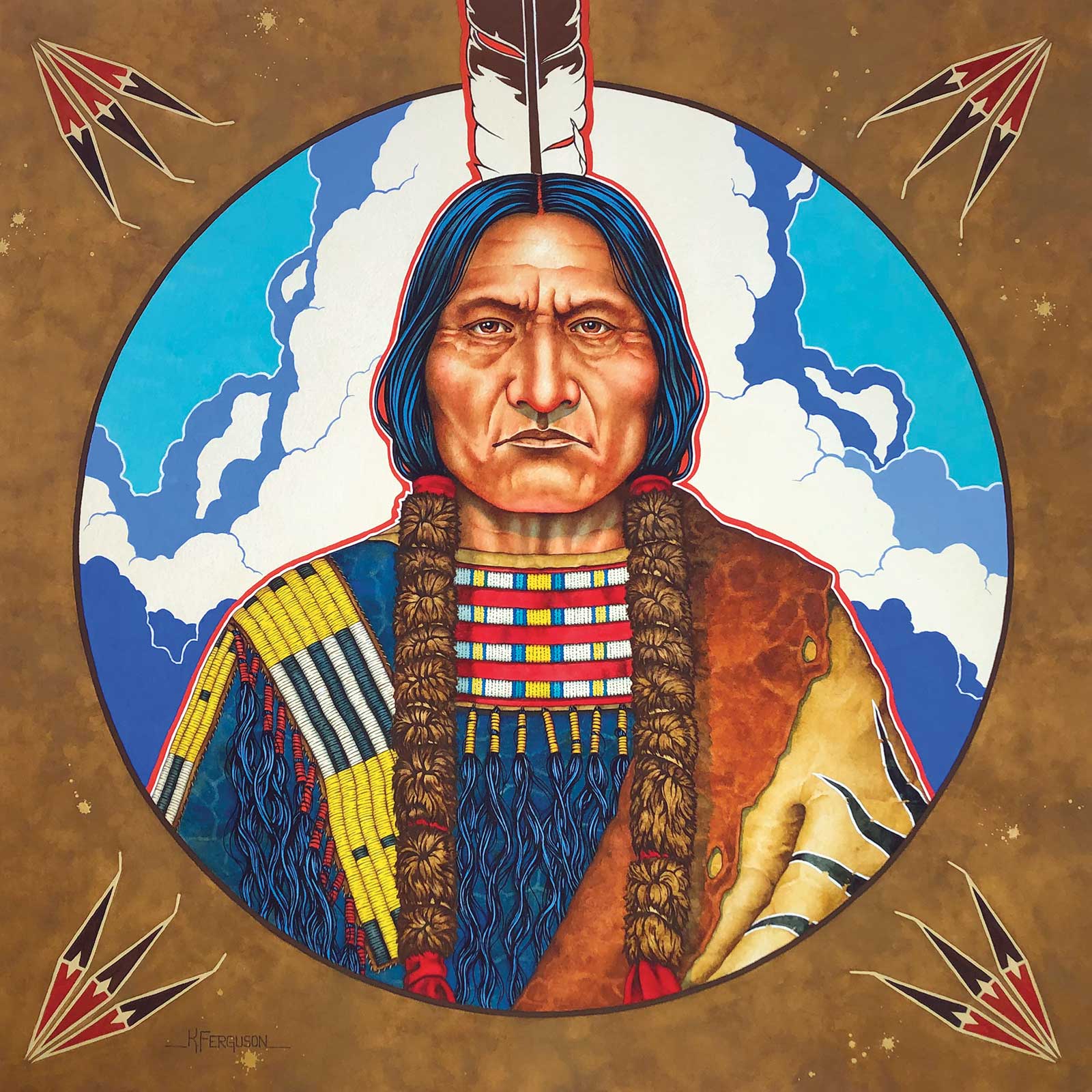 Kenneth Ferguson, Sitting Bull (Tatanka Iyotanka), watercolor on gouache, 24 x 24"
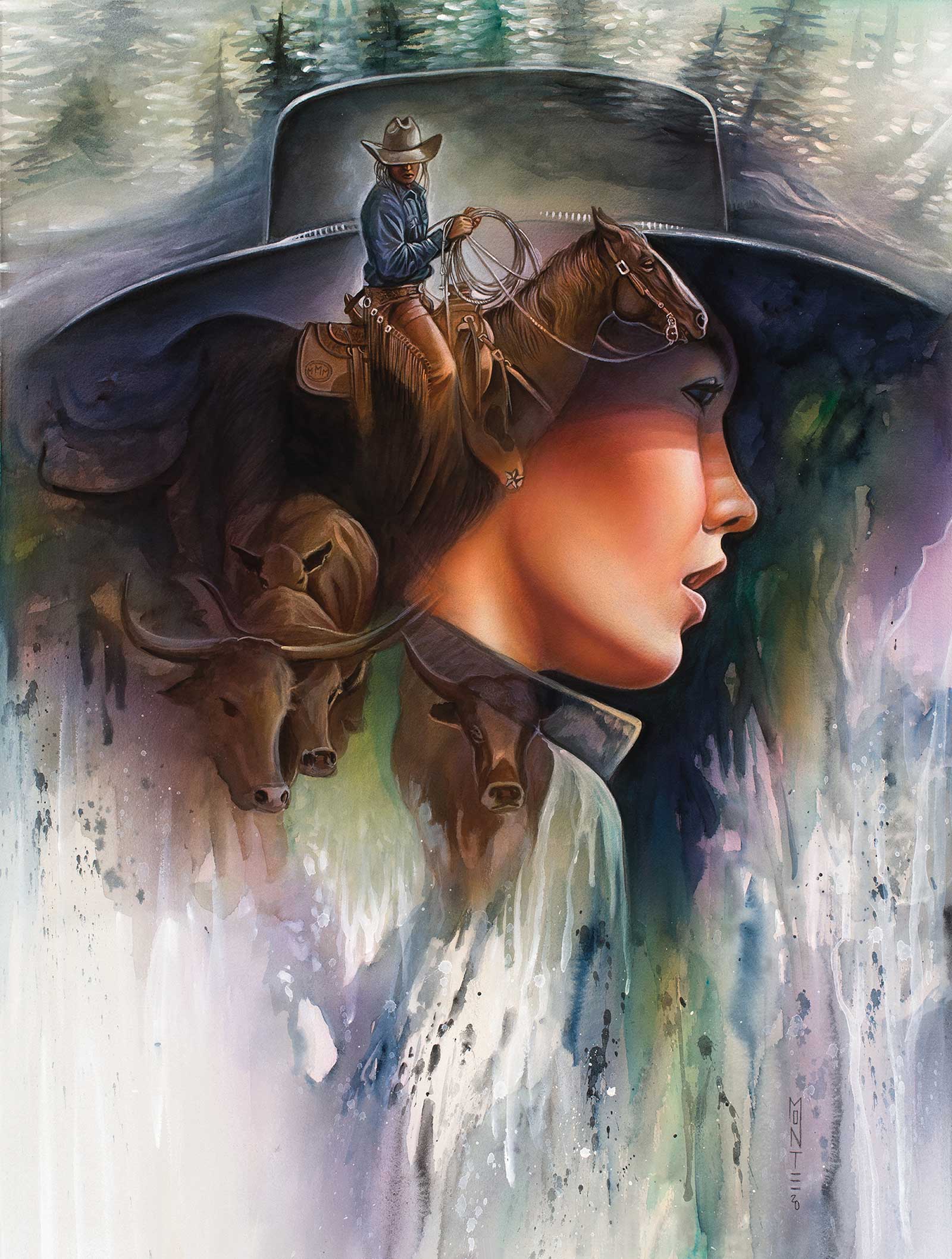 Monte M. Moore, On the Trail, mixed media watercolor, 24 x 18”
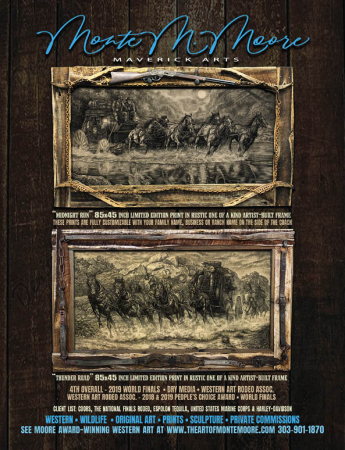
During the last 25 years as a full-time professional illustrator, artist Monte M. Moore has enjoyed working for companies such as Lucasfilm, the National Finals Rodeo, Jose Cuervo, Harley-Davidson and many others. “More recently I have felt the desire to create artwork for the Western and fine art fields, and return to my family’s ranching roots which stretch back over four generations,” says Moore. “Having grown up on a 30,000-acre cattle ranch and working alongside my family, I hope to create new works that are connected to the traditions of ranching, agriculture and even the Western films I grew up with as a child. My goal is to bring my existing skill sets and those I hope to add to my repertoire, to create lasting images that help tell and preserve the history of the West.”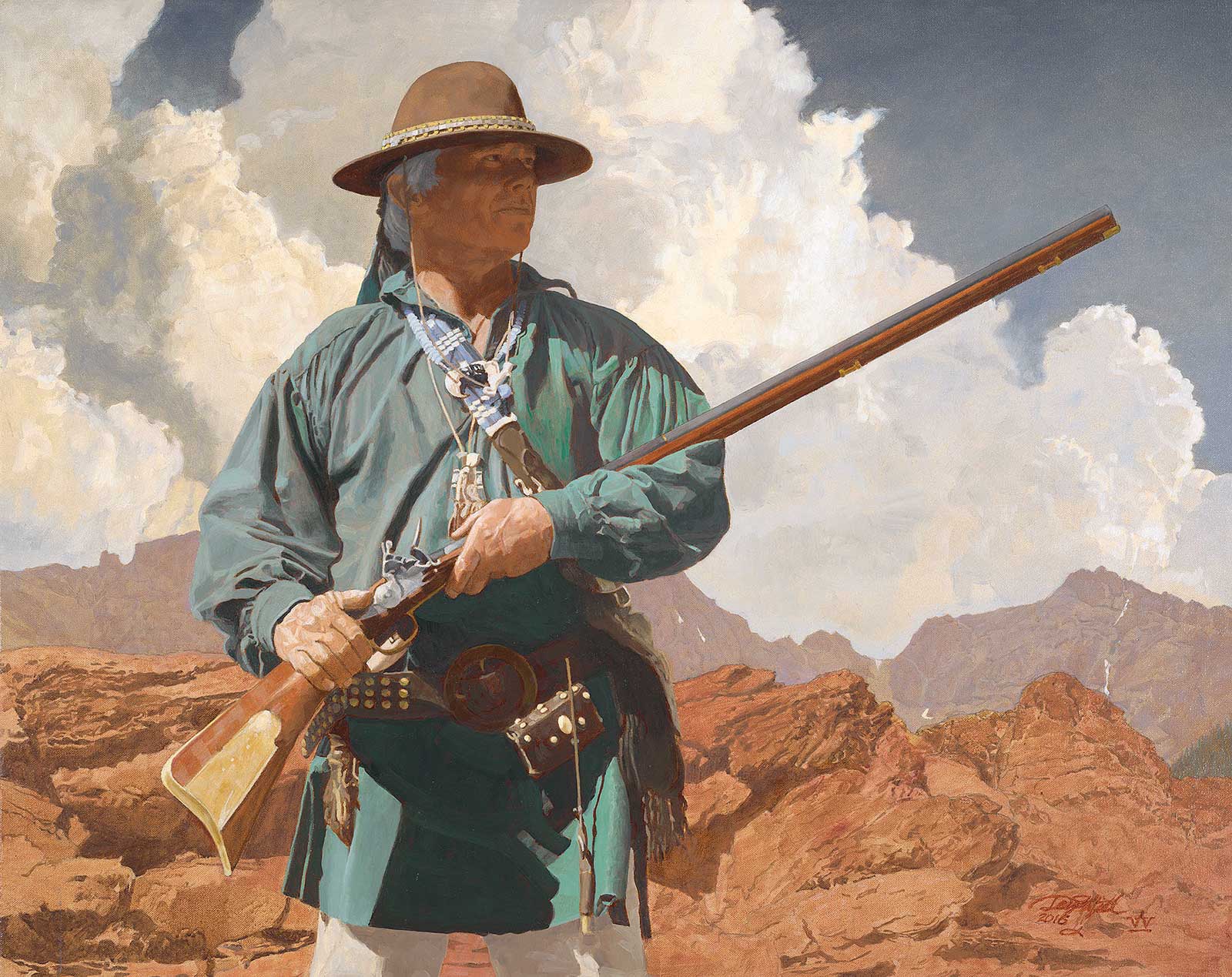 Den Schofield, A Far Land, oil on canvas, 24 x 30"
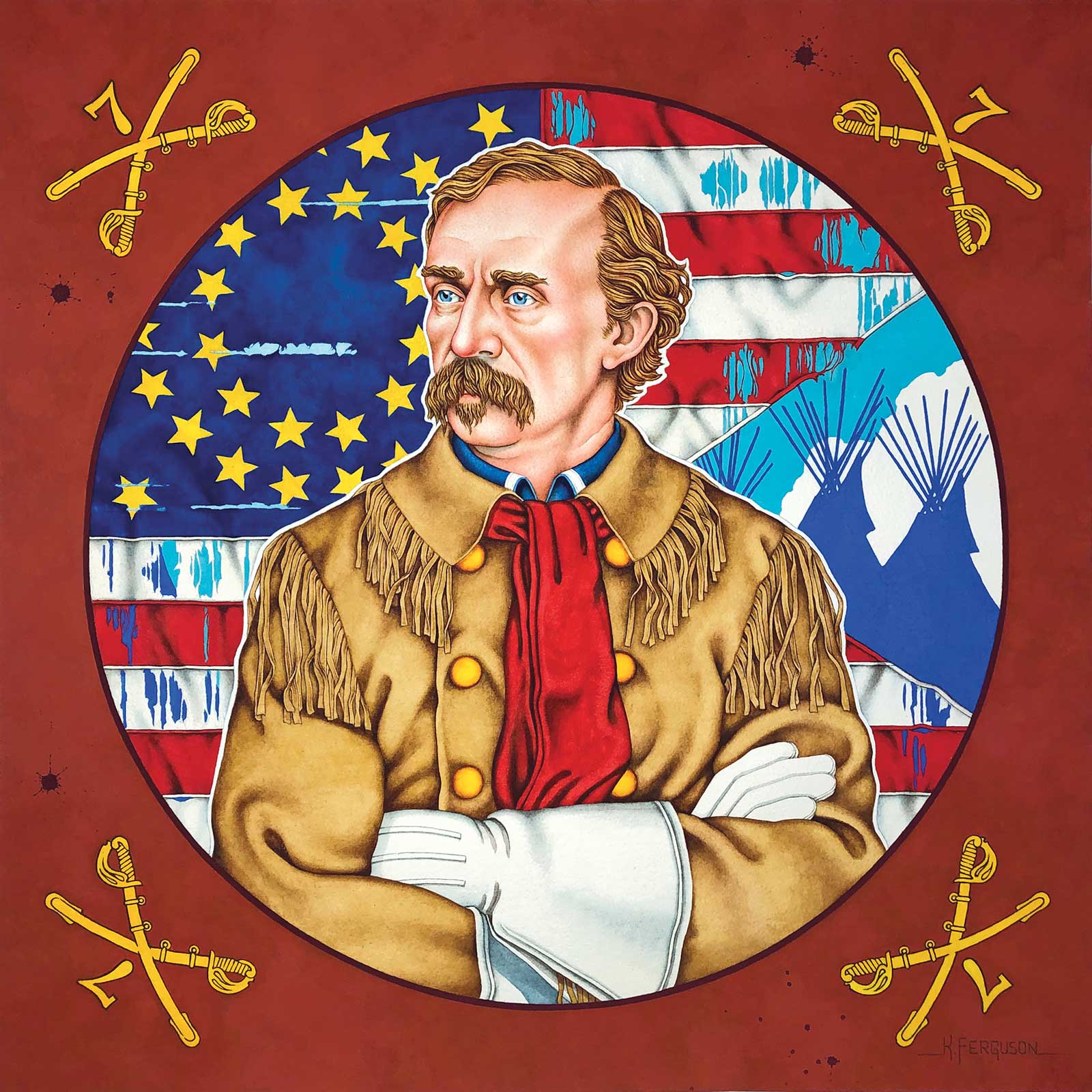 Kenneth Ferguson, Tattered Glory (George Armstrong Custer, 1876), watercolor and gouache, 24 x 24"
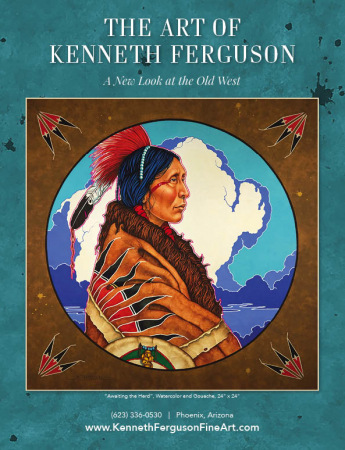
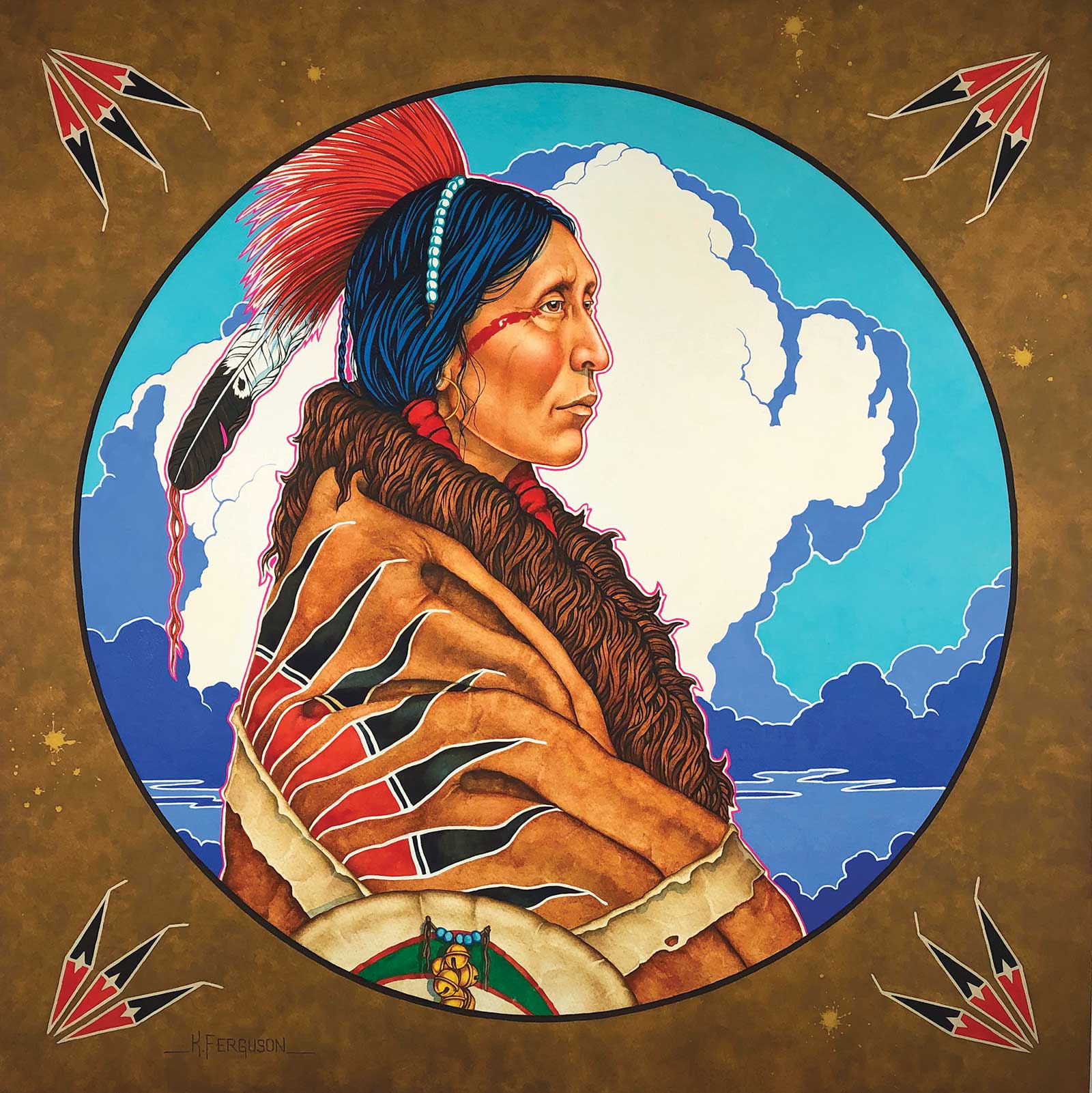 Kenneth Ferguson, Awaiting the Herd (Kiowa, Southern Plains, 19th Century), watercolor and gouache, 24 x 24"
Born and raised in Philadelphia, Den Schofield is a graduate of the Philadelphia College of Art. He has a love of history, which indicates why his work focuses on the 19th century. Schofield has travelled around the country and developed an appreciation for the wide-open spaces and big mountains of the American West. Trained as an illustrator, Schofield developed a demand for historical subjects. He was published both nationally and internationally, and he is hoping to break into the business of fine art painting in significant pieces like A Far Land and Yellow Sky pictured here.
Kenneth Ferguson is a 21st-century artist inspired by the historic past. Much of his work falls within the parameters of the Old West. “It’s an era that certainly presents a great array of subject matter for an artist to paint,” he says. “It’s also a time greatly buried in myth. While researching for painting possibilities,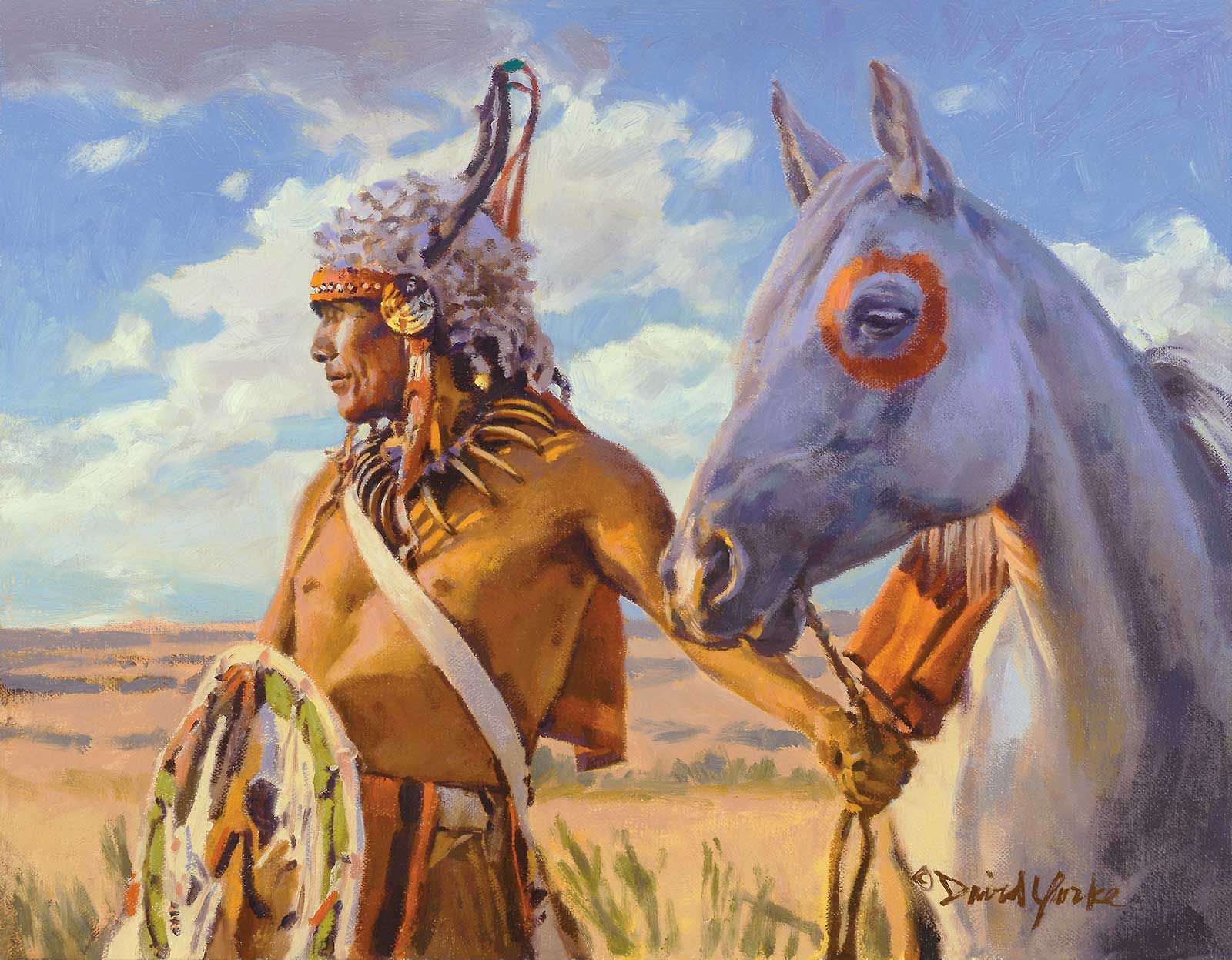 The Plainsmen Gallery, When the Land Was Free, oil, 11 x 14", by David Yorke.
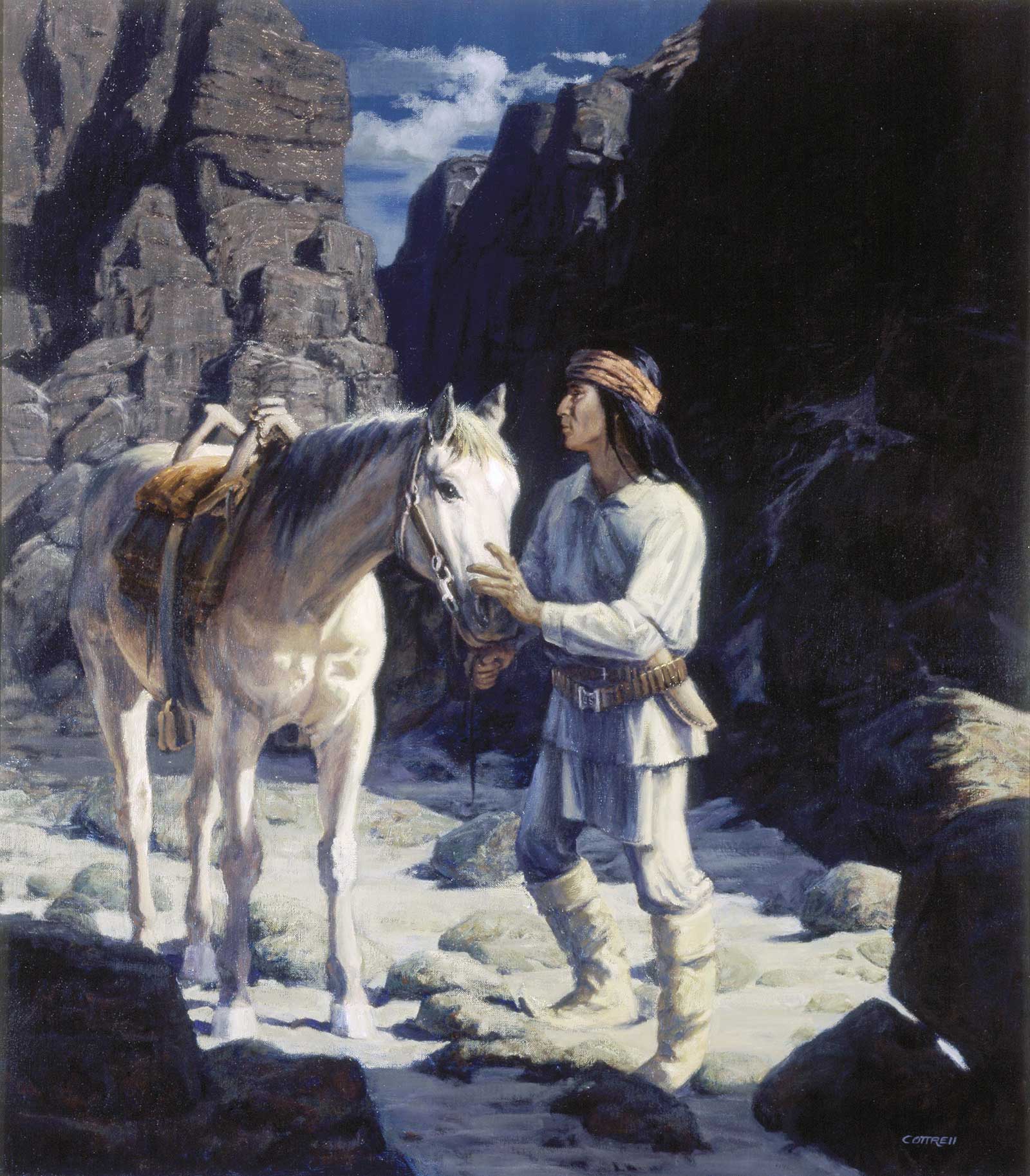 Sheila Cottrell, Canyon Echoes, oil, 36 x 24"
I find it fascinating how often fact is subverted by fiction. Because of the vastness of the era, I prefer to limit my subject matter to areas in which I already have acquired a good base of knowledge. I’m not one to depend on models and photoshoots, but prefer to do my own research, which I greatly enjoy, and compose a painting using many sources and my own artistic eye.”
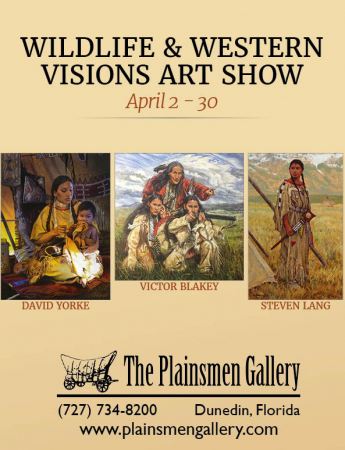
The Plainsmen Gallery represents nationally collected artists Victor Blakey, Steven Lang and David Yorke, whose vibrant, realistic oils bring the Old West to life. Collectors are drawn to their vivid paintings depicting the people and culture of proud Native Americans, mountain men, cowboys and settlers. When the Land Was Free by Yorke, portrays a moment of tranquil introspection—a time just prior to the conquering of the West. “At that time, the land had no distinct boundaries, except for those set by the needs of each tribe for hunting while they inhabited it,” says gallery representatives. Searching for the Enemy, by Blakey, was inspired by the Apache scouts that were often employed by the U.S. Army during the Apache wars due to their expert tracking ability.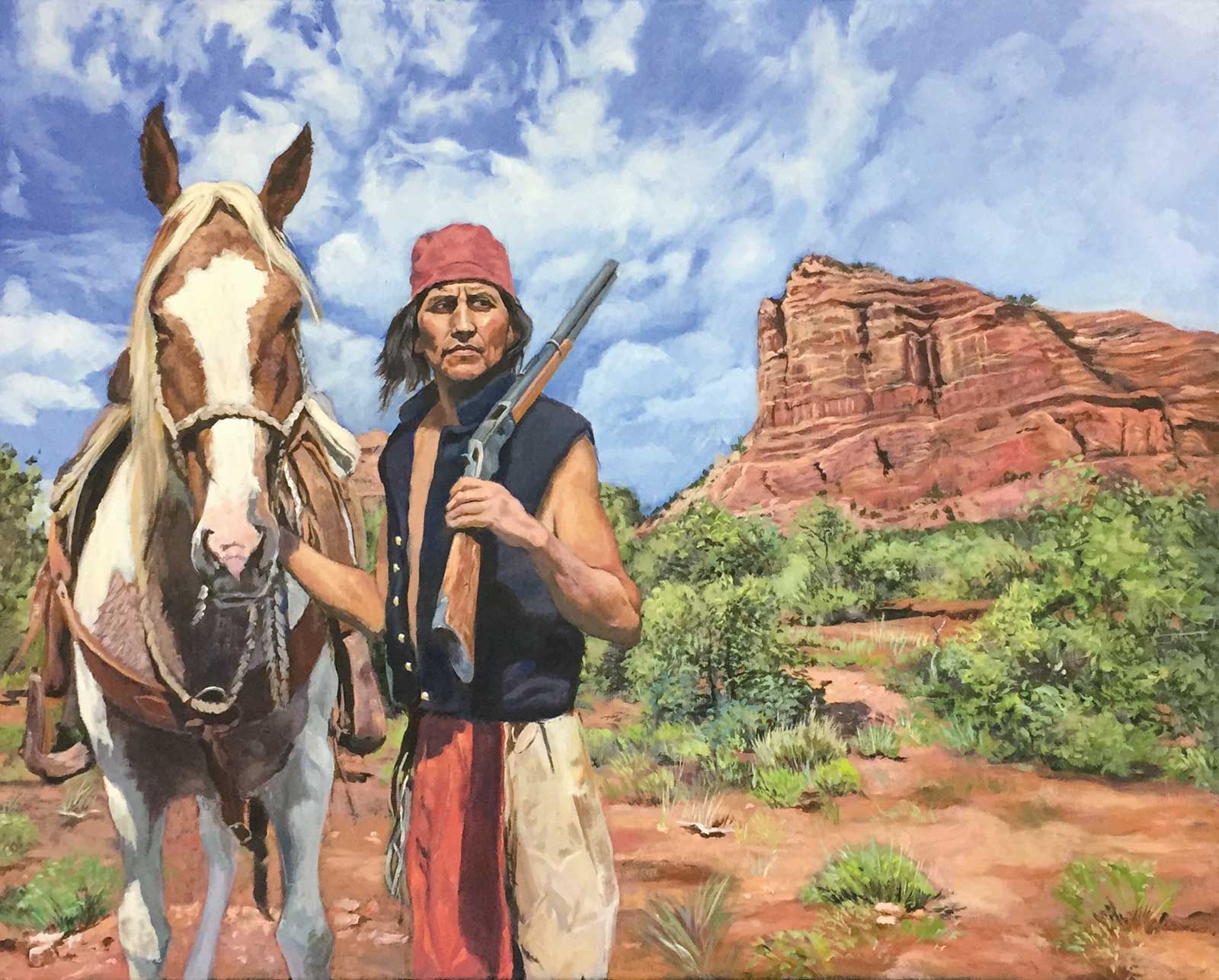 The Plainsmen Gallery, Searching for the Enemy, oil, 24 x 30", by Victor Blakey.
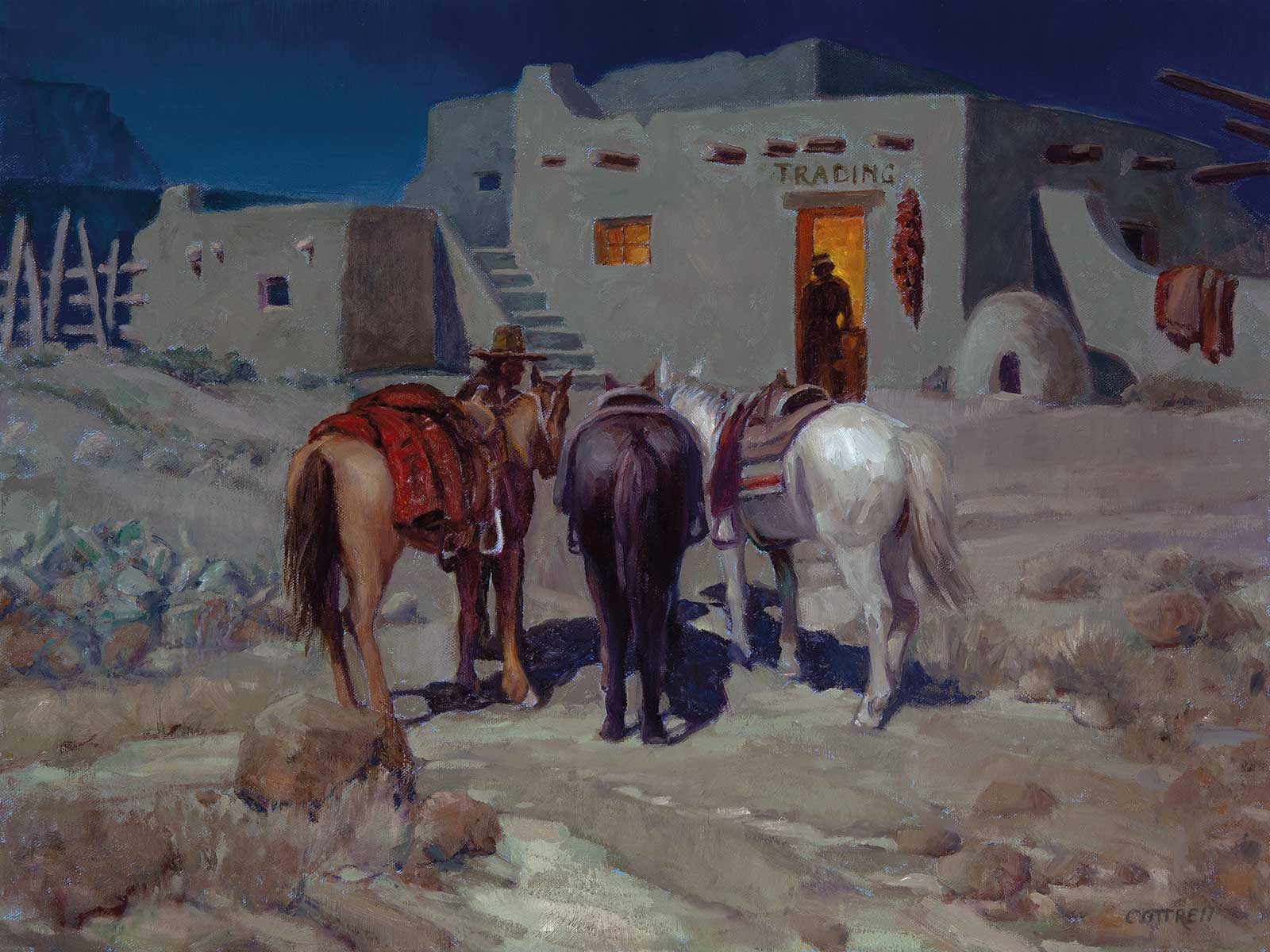 Sheila Cottrell, Trading Post, oil, 18 x 24"
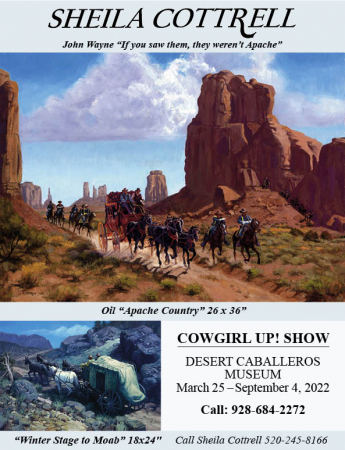
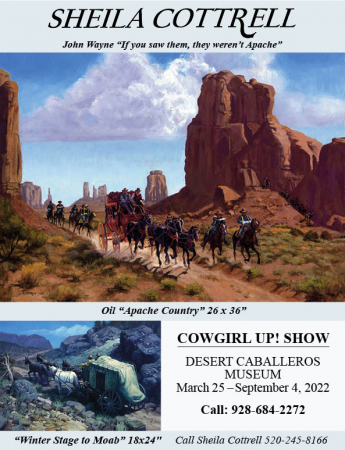
Artist Sheila Cottrell’s pioneer family was fourth-generation Texan before moving on to Arizona by wagon train in 1900. They settled in southeast Arizona, set up homesteads and freighted ore between mining towns, ran the Wells Brothers’ Overland Service, operated one of the Indian trading posts and quarried stone for the historic Gadsden Hotel in Douglas, Arizona. R. G. Wells became a deputy sheriff in Tombstone and had numerous run-ins with horse thieves and rustlers. “Growing up,” says Cottrell, “my family spent much of our time exploring the Chiricahua Mountains there, which had once been Apache country…I’ve always felt an affinity with the Apaches and have spent many hours researching their history and culture.”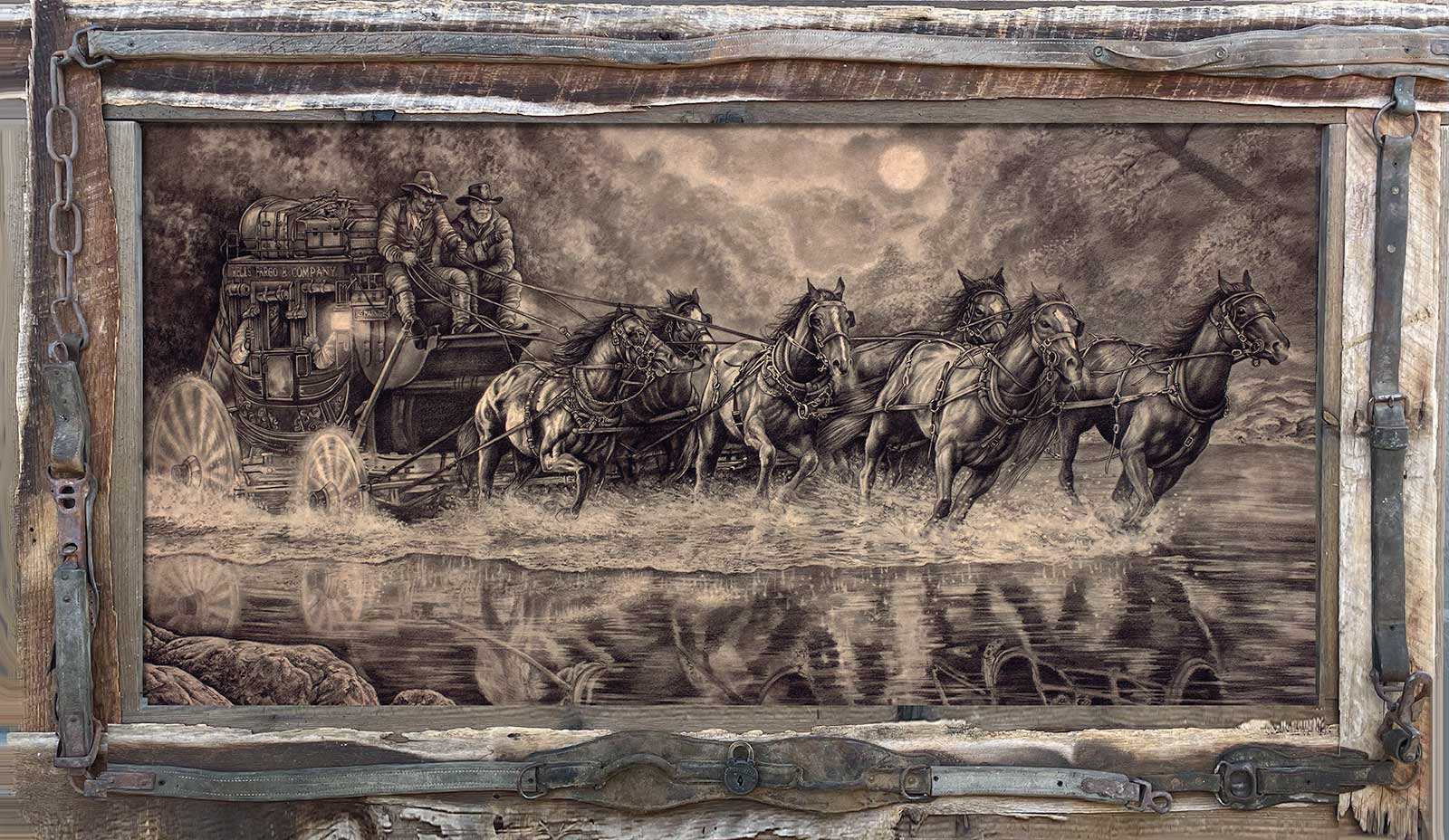 Monte M. Moore, Midnight Run, framed metal print and artist-built frame, 48 x 85"
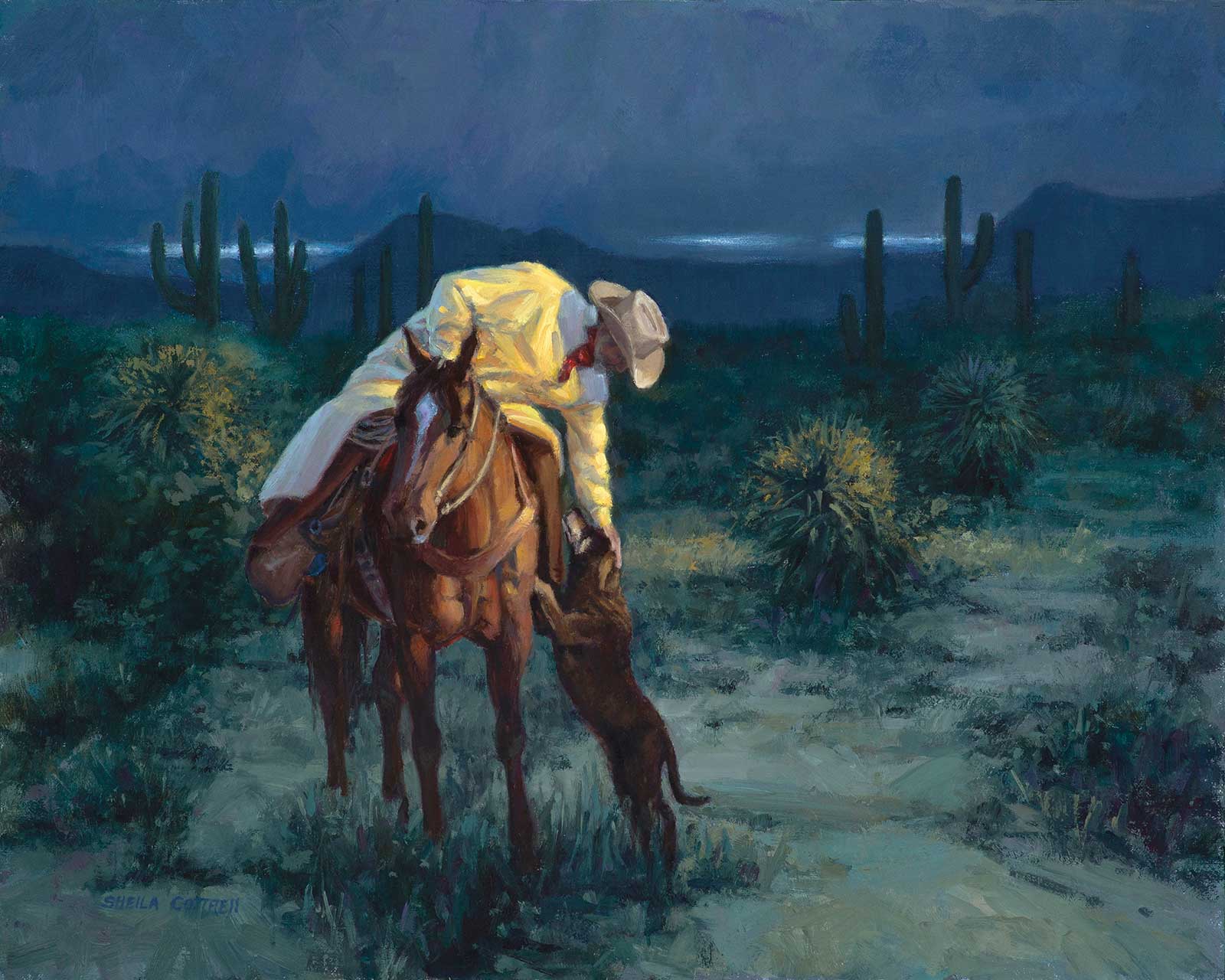 Sheila Cottrell, Partners, oil, 20 x 24"
Cottrell continues, “I believe a painting must have a strong visual impact from a distance but also something more for the viewer to discover up close. Just for the fun of it, over the years, I’ve hidden Apaches in paintings. Collectors were always tickled to find them, sometimes not until they had the painting hung at home.” —
Featured Artists & Galleries
C.M. Russell Museum
400 13th Street North, Great Falls, MT 59401
(406) 727-8787, cmrussell.org
Den Schofield
denschofield@gmail.com, www.denschofield.com
Ed Kucera
www.kucerafineart.com
Kenneth Ferguson
(262) 374-2984, www.kennethfergusonfineart.com
Legacy Gallery
7178 Main Street, Scottsdale, AZ 85251
(480) 945-1113, www.legacygallery.com
Mark Sublette Medicine Man Gallery
6872 E. Sunrise Drive, #130, Tucson, AZ 85750
(520) 722-7798, www.medicinemangallery.com
Monte M. Moore
(303) 901-1870, montemmoore@gmail.com
www.theartofmontemoore.com
www.mavarts.com
Scottsdale Art Auction
7176 E. Main Street, Scottsdale, AZ 85251
(480) 945-0225, www.scottsdaleartauction.com
Sheila Cottrell
sheilacottrell@aol.com, www.sheilacottrell.com
Smithsonian American
Art Museum Luce Foundation Center
8th and G Streets, NW, Washington, D.C. 20004
(202) 633-7970, www.americanart.si.edu/visit/saam/luce
The Plainsmen Gallery
2141 Main Street H, Dunedin, FL 34698
(727) 734-8200, www.plainsmen.com
Powered by Froala Editor