George Catlin (1796-1872) was born in Wilkes-Barre, Pennsylvania, and went west with General William Clark to explore Indian Territory. He eventually visited nearly 40 tribes and produced more than 500 paintings while assembling a large collection of artifacts. Many artists of the American West collected artifacts not only for their beauty but to assure the accuracy of the paintings they made in their studios. Catlin’s portraits even impressed the French poet and critic Charles Baudelaire when Catlin showed his “Indian Gallery” in Paris. “M. Catlin has captured the proud, free character and noble expression of these splendid fellows in a masterly way,” Baudelaire wrote.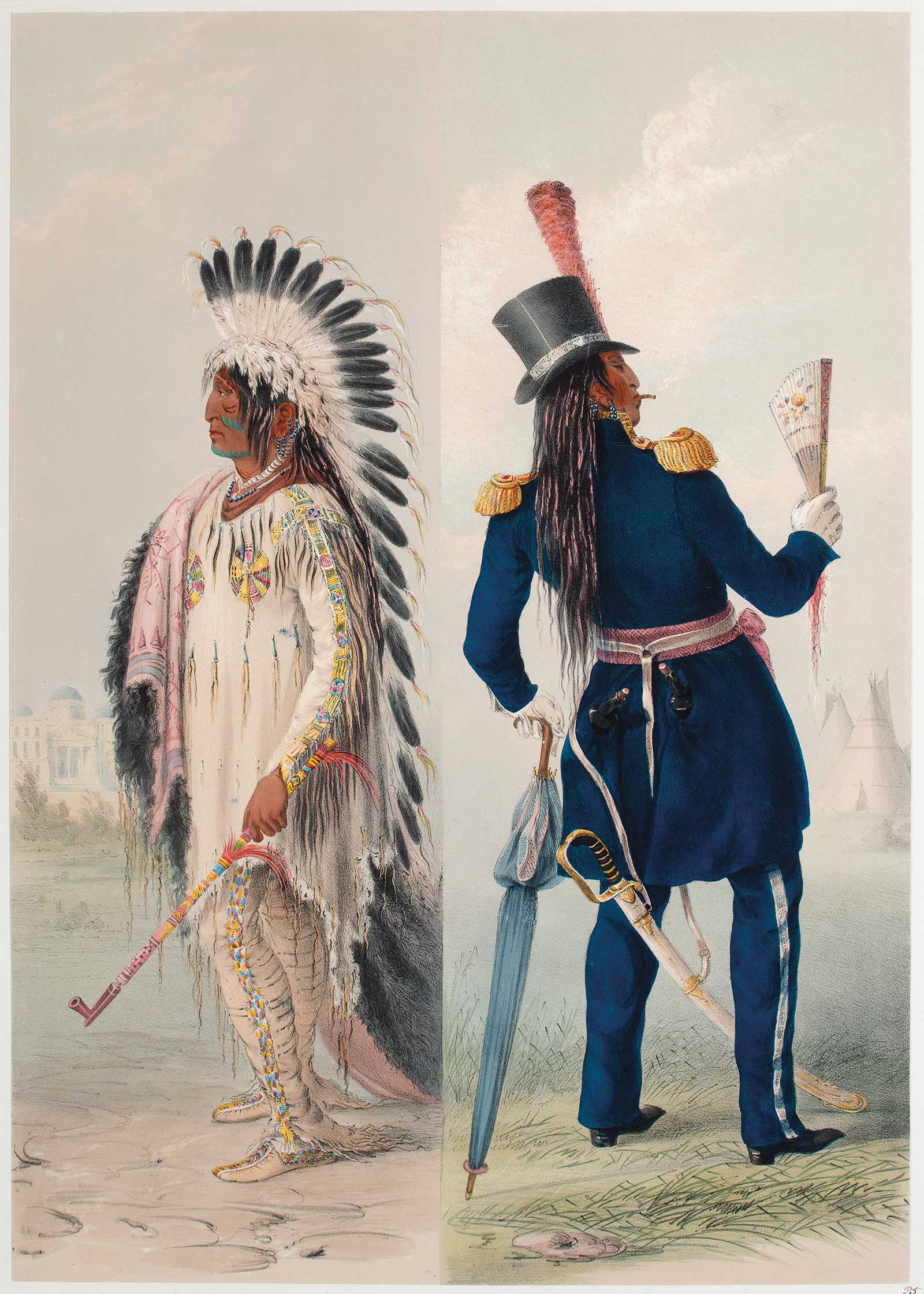 Wi-jún-jon, An Assiniboine Chief, 1844, hand-colored lithograph, Plate 25 from the North American Indian Portfolio. Heard Museum Collection. Gift of Laura and Arch Brown.
In 1844, he produced a portfolio of 25 hand-colored lithographs for Catlin’s North American Indian Portfolio. The Heard Museum in Phoenix presents the lithographs in the exhibition, George Catlin on Indigenous Land through April 24. The prints are a recent gift of Laura and Arch Brown.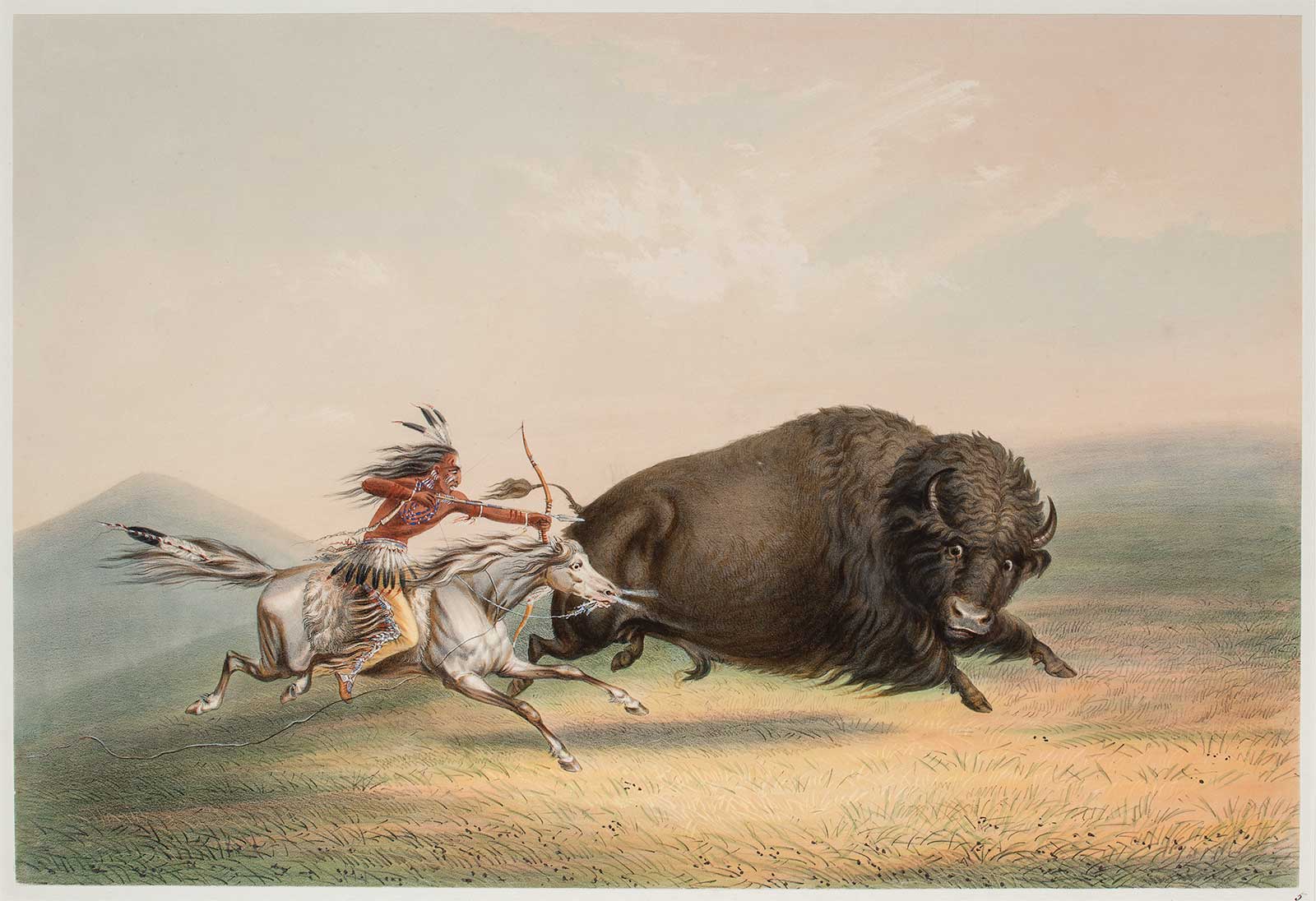 Buffalo Hunt, Chase, 1844, hand-colored lithograph, Plate 5 from the North American Indian Portfolio. Heard Museum Collection. Gift of Laura and Arch Brown.
Catlin is known for his respect for the Indigenous people he met and painted. He describes Wi-jún-jon, An Assiniboine Chief: “[He] was a warrior of the Assiniboine, young, proud, handsome, valiant, and graceful. He had fought many a battle and won many laurels. The numerous scalps from his enemies’ heads adored his dress, and his claims were fair and just for the highest honors that his country could bestow upon him, for his father was head chief of the nation. This young Assiniboine, the Pigeon’s Egg Head was selected by Major Sanford, the Indian agent, to represent his tribe in a delegation which visited Washington city under his charge, in the winter of 1832.”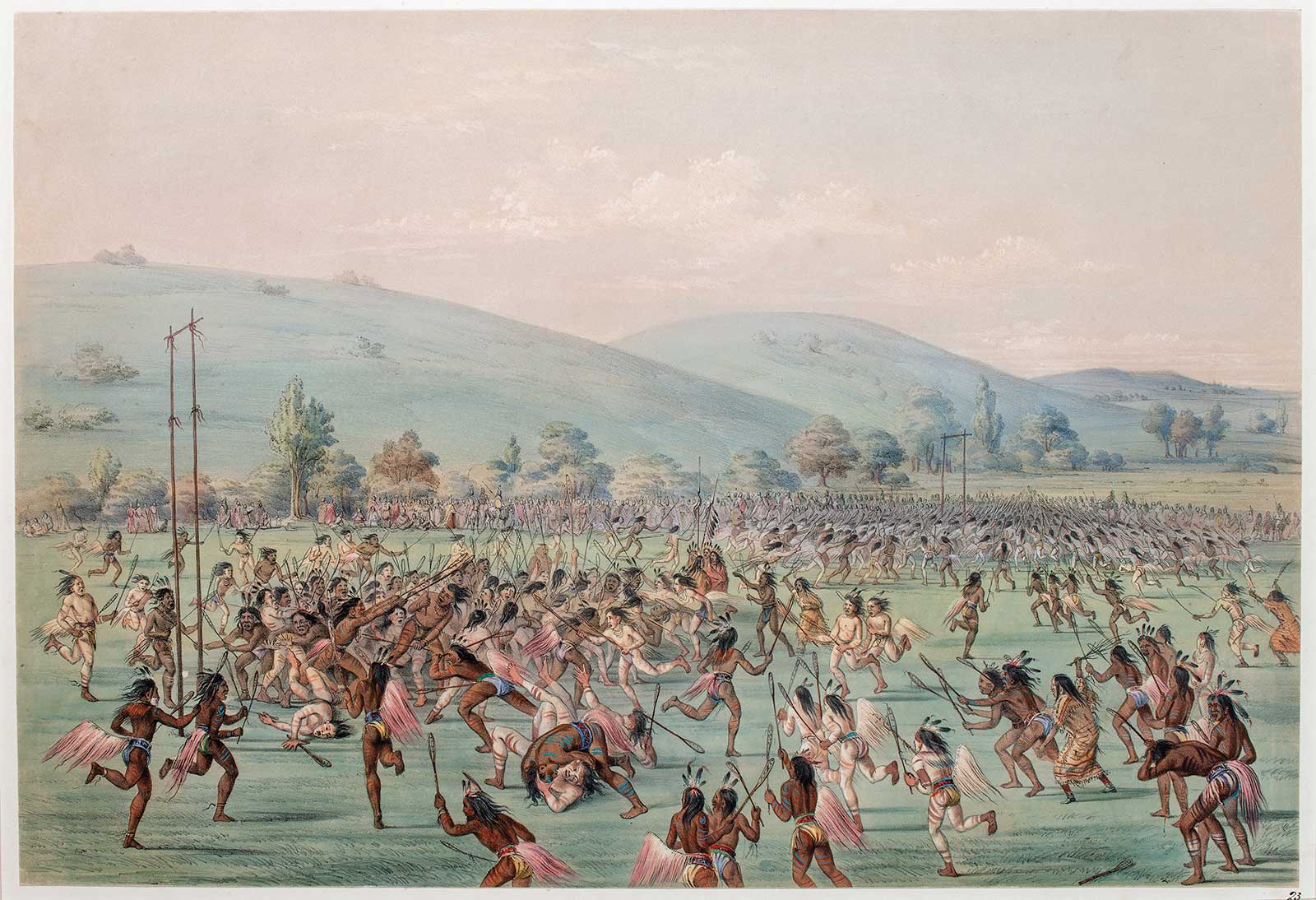 Ball Play, 1844, hand-colored lithograph, Plate 23 from the North American Indian Portfolio. Heard Museum Collection. Gift of Laura and Arch Brown.
Wi-jún-jon’s encounter with Washington was less than positive. Catlin writes, “In offering this illustration to the reader, I am representing to him a faithful delineation of the resemblance of an Assiniboine Warrior, in the flowing and classic costume of his country, as he appeared on his way to the city of Washington, faithfully contrasted with the uncouth plight in which he returned to his tribe the next season, after one year’s teaching in the school of civilization: and in the following narrative, a faithful account of its melancholy and fatal results.” Wi-jún-jon was considered a liar and an imposter when he related his stories of the wider world and was murdered.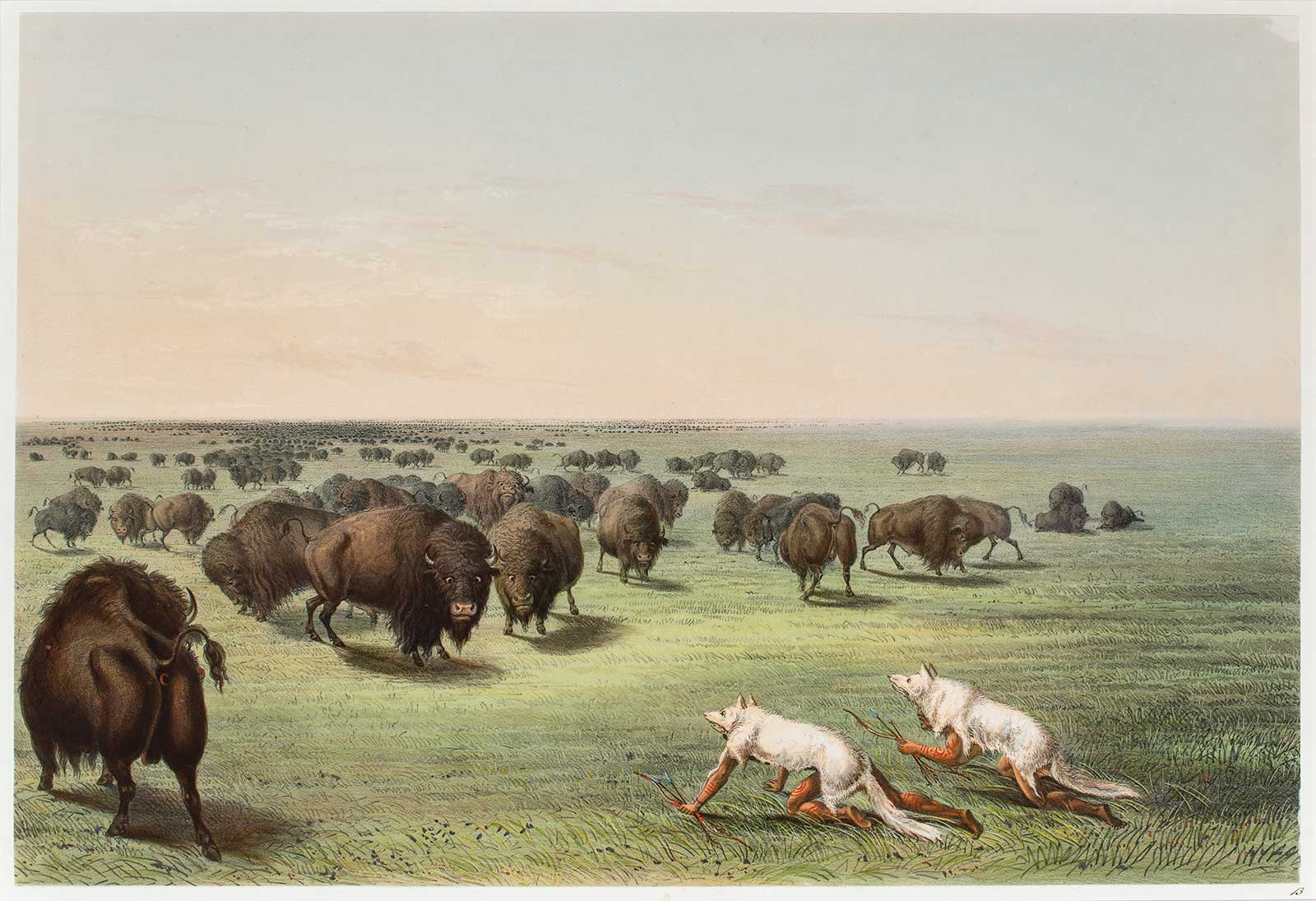 Buffalo Hunt, Under the White Wolf Skin, 1844, hand-colored lithograph, Plate 13 from the North American Indian Portfolio. Heard Museum Collection. Gift of Laura and Arch Brown.
Catlin had seen several tribal chiefs in Philadelphia and resolved, “the history and customs of such a people, preserved by pictorial illustrations, are themes worthy of the lifetime of one man, and nothing short of the loss of my life shall prevent me from visiting their country and becoming their historian.” —
George Catlin on Indigenous Land
Through April 24, 2022
Heard Museum, 2301 N. Central Avenue, Phoenix, AZ 85004
(602) 252-8840, www.heard.org
Powered by Froala Editor