
When settlers encountered the vast plains of the West, they thought they were seeing a pristine, untouched landscape. In fact, they were witnessing the result of thousands of years of nature’s own management as well as that of Indigenous people. Fires caused by lightning and people burned off the grasses and accumulated debris as well as young trees that would eventually have taken over the landscape. Native grasses, whose roots can go down 12 feet, survived the fire and were nourished by the nutrients it released.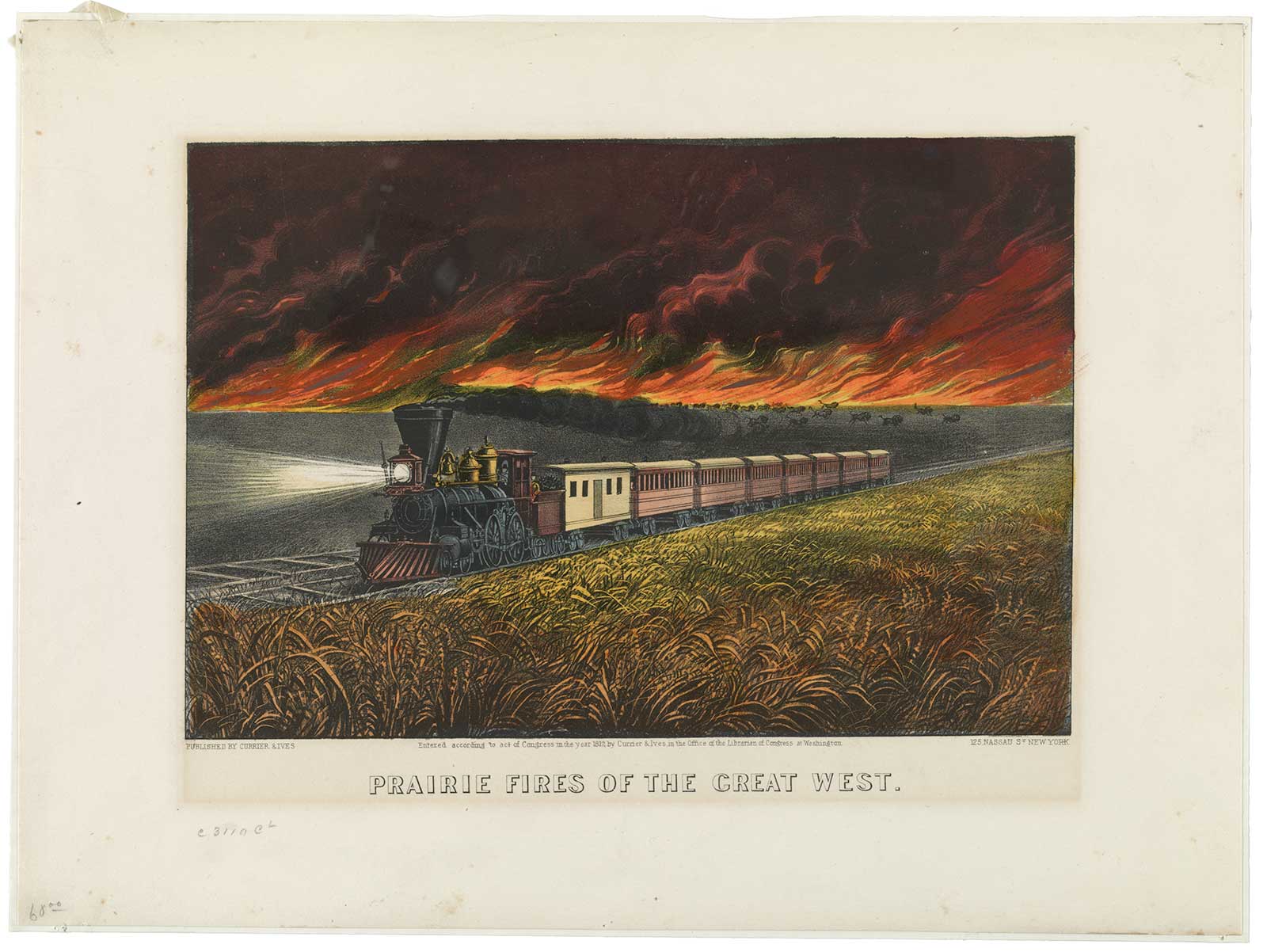 Currier & Ives, Prairie Fires of the Great West, ca. 1872, hand-colored lithograph, 12½ x 17”. Library of Congress, Washington, D.C.
New growth nourished herds of buffalo and other animals. Indigenous people learned to selectively burn to replenish the land and to use fire to direct buffalo when they were hunting.
In 1872, the printmaking firm of Currier & Ives produced a hand-colored lithograph, Prairie Fires of the Great West, featuring a locomotive with a freight car and seven passenger cars racing across the prairie ahead of a fire while buffalo flee in the background.
Louis Copt grew up near the Flint Hills of Kansas where there has been human habitation for 13,000 years. Early settlers couldn’t farm the rocky soil but, observing the herds of buffalo, began raising cattle on the nutrient rich grasses. Copt returned to the prairie after a summer of study at the Art Students League in New York to begin painting the prairie in all its seasons, particularly the spring burn off.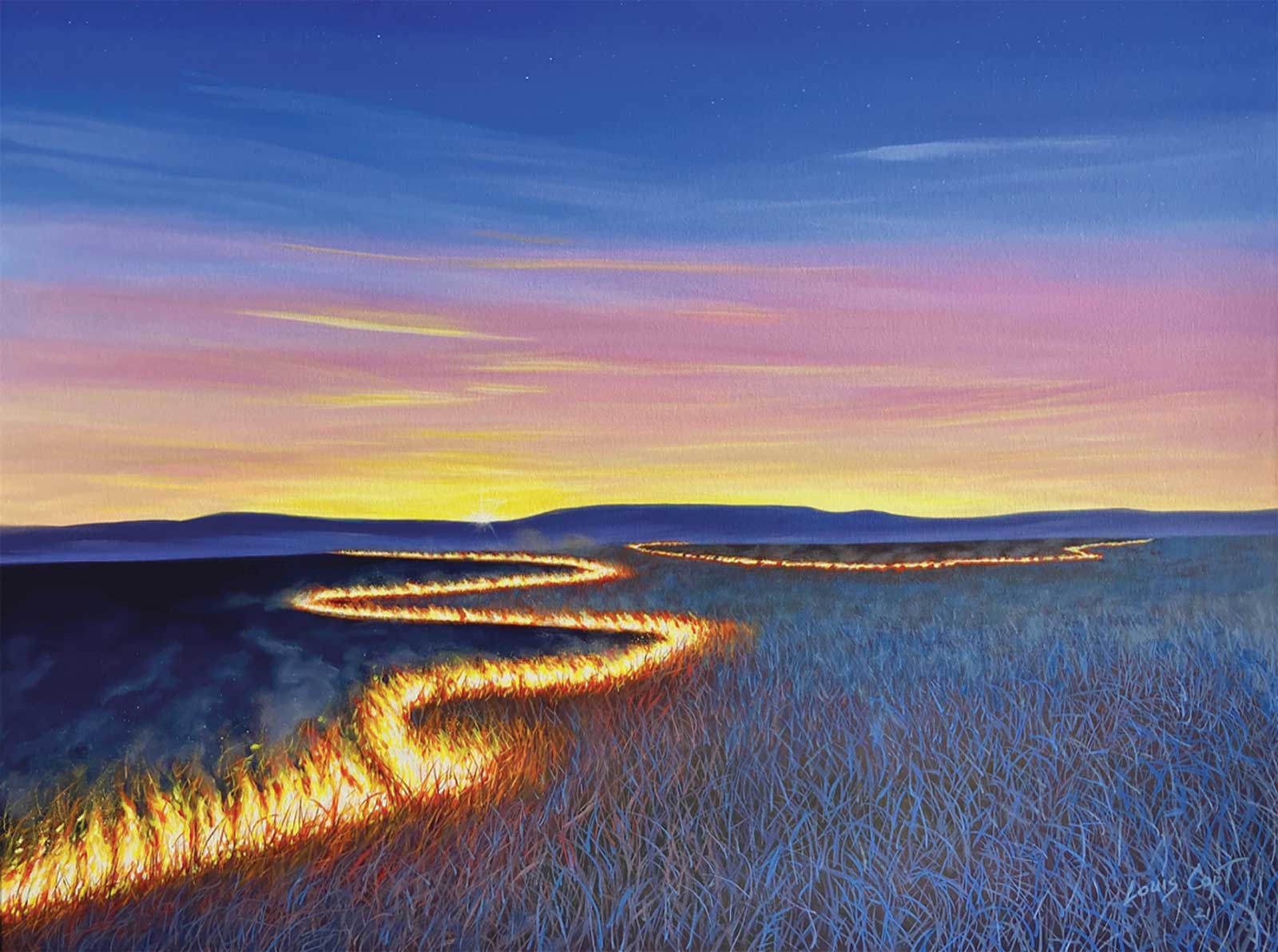 Louis Copt, Flames at Night, oil on canvas, 30 x 40”. Courtesy Reuben Saunders Gallery, Wichita, KS.
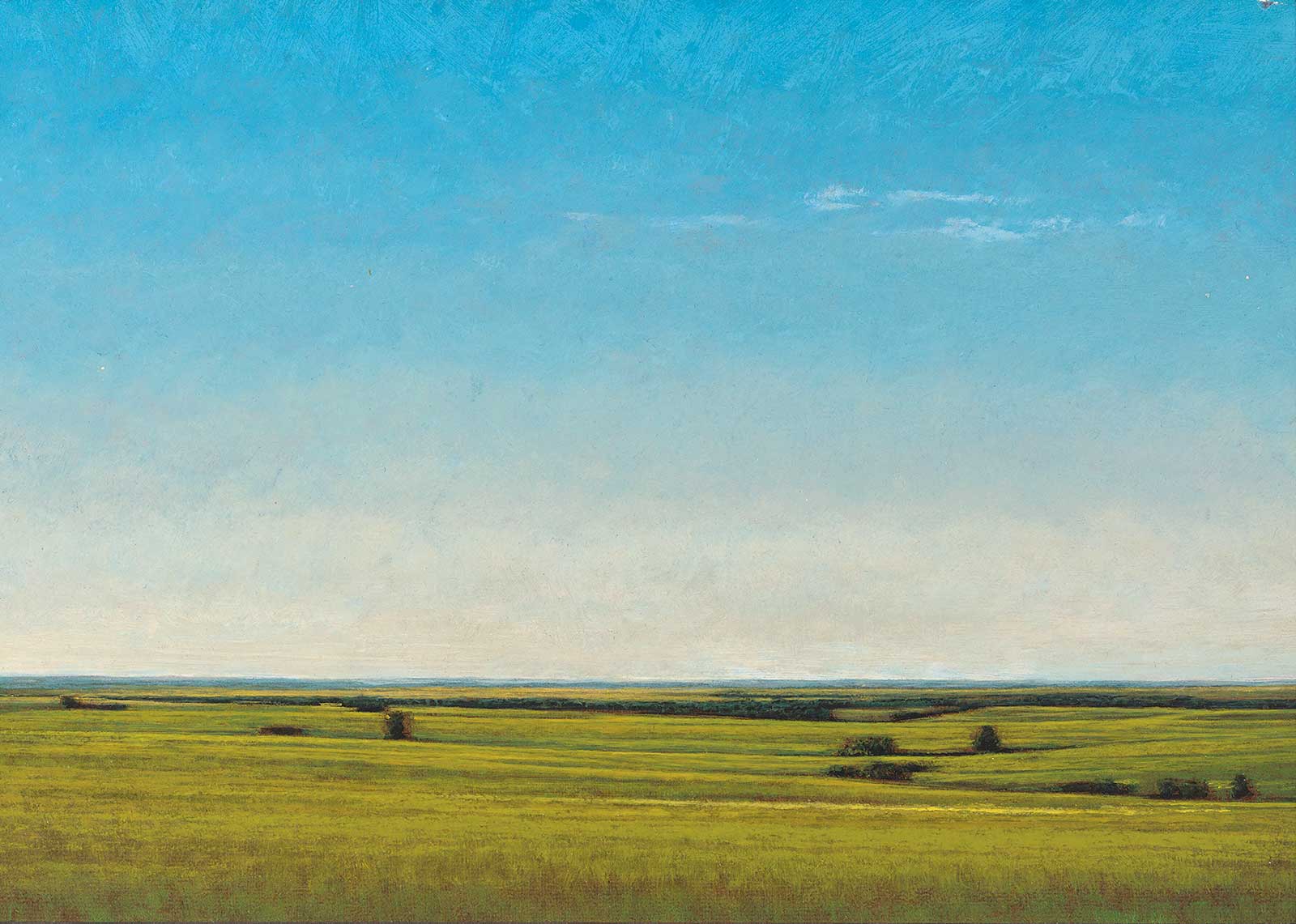 Jeff Aeling, Late Afternoon Near Salina, KS, oil on panel, 10 x 14”. Courtesy Gallery Victor Armendariz, Chicago, IL.
Flames at Night depicts the flames spreading across the prairie, renewing it for another season. The fierce flames advance in elegant arcs across the plain, burning the dried grass to the ground, leaving scorched earth that will bloom again as the setting sun offers the promise of a new day.
Philip Juras paints the diversity of prairie plant life enabled by burning as well as the diversity of its topography with rolling hills descending to flowing rivers and wetlands. He paints the remnants of the vast prairies while reminding us that the scenes are really not pristine remnants but, rather, managed restorations that have rooted out invasive species and nurtured the natural vegetation. He produced 54 paintings for the 2021 exhibition and book, Picturing the Prairie: A Vision of Restoration. Juras writes, “The blooms of pale beard tongue, rose vervain, and columbine appear among the spring foliage of Fults Hill Prairie. Eastern Redcedars cling to the edge of the limestone cliff where they can, for the most part, escape the prescribed fires that maintain this hill prairie. Spring flooding along the Mississippi River has inundated Kidd Lake below.”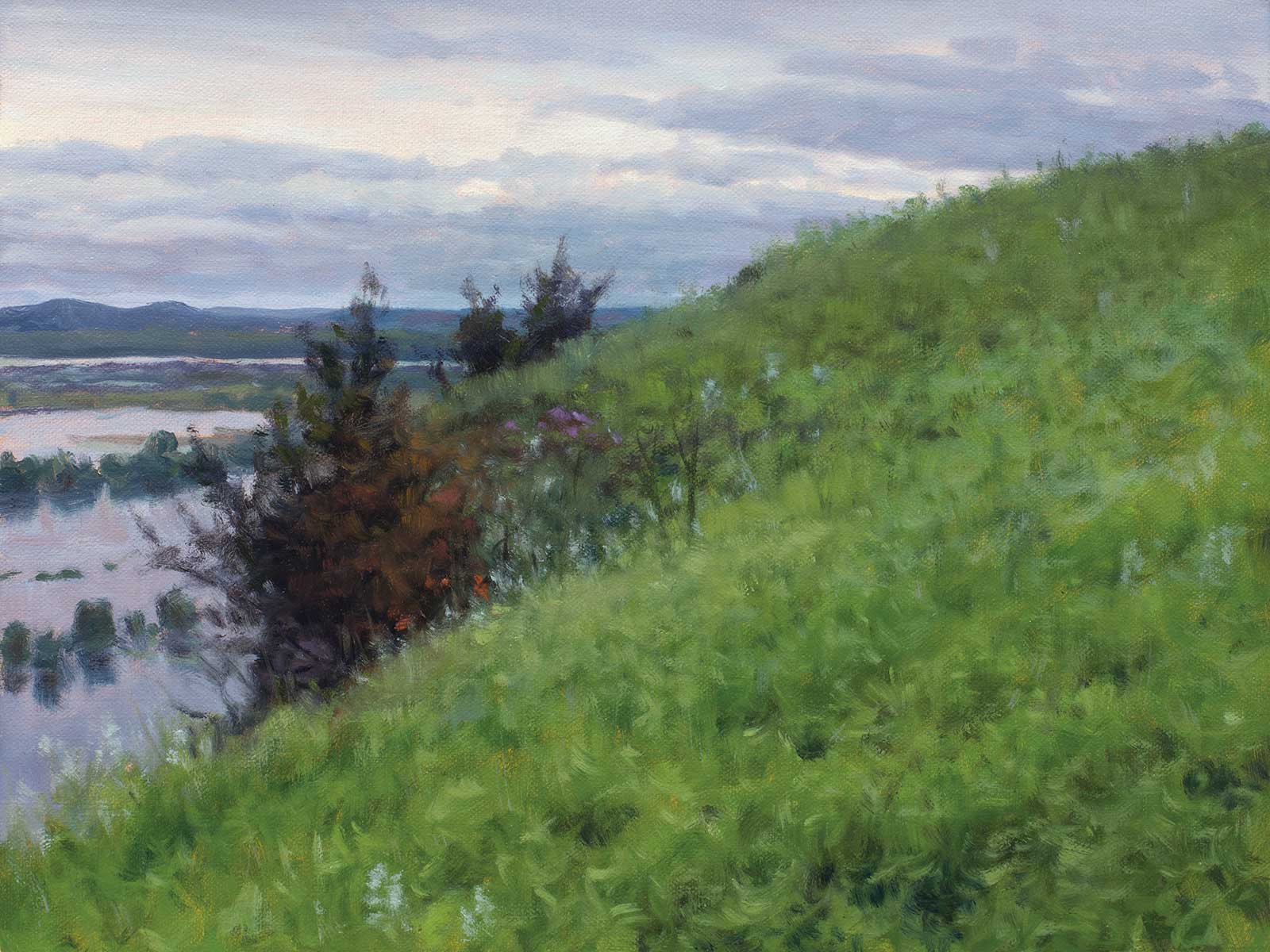 Philip Juras, Clifftop Verdure, May 9, 2019, Fults Hill Prairie, Monroe County, Illinois, oil on canvas, 9 x 12”. Courtesy the artist.
Pam Ohnemus celebrates what is not immediately visible when you look out on the prairie. In her painting, Midday, she focuses on the flowers and grasses. Andrew Wyeth wrote, “I love to study the many things that grow below the corn stalks and bring them back to the studio to study the color. If one could only catch that true color of nature—the very thought of it drives me mad.”
Ohnemus writes about her work, “Macro and microenvironments fill my paintings, engaging the viewer in their detail. Even while painting tranquil scenes, I achieve active color sensations by layering color over complementary underpaintings. My paintings express delicate sensations through subtle texture and natural pattern.
“Prairies have been reduced to isolated fragments that require conservation and preservation. Less than one-percent of the pre-settlement tall grass prairie remains…The tall grass prairie is an irreplaceable tapestry of plant and animal life. I paint dynamic compositions of Midwest prairie remnants so that the viewer can appreciate and see the need of their preservation before they are lost forever.”
The open prairie is depicted by Jeff Aeling in his painting Late Afternoon Near Salina, KS. He recalls the writings of Ralph Waldo Emerson who wrote about what Aeling observes as “the hugeness of nature and its lack of interest in what human beings do.”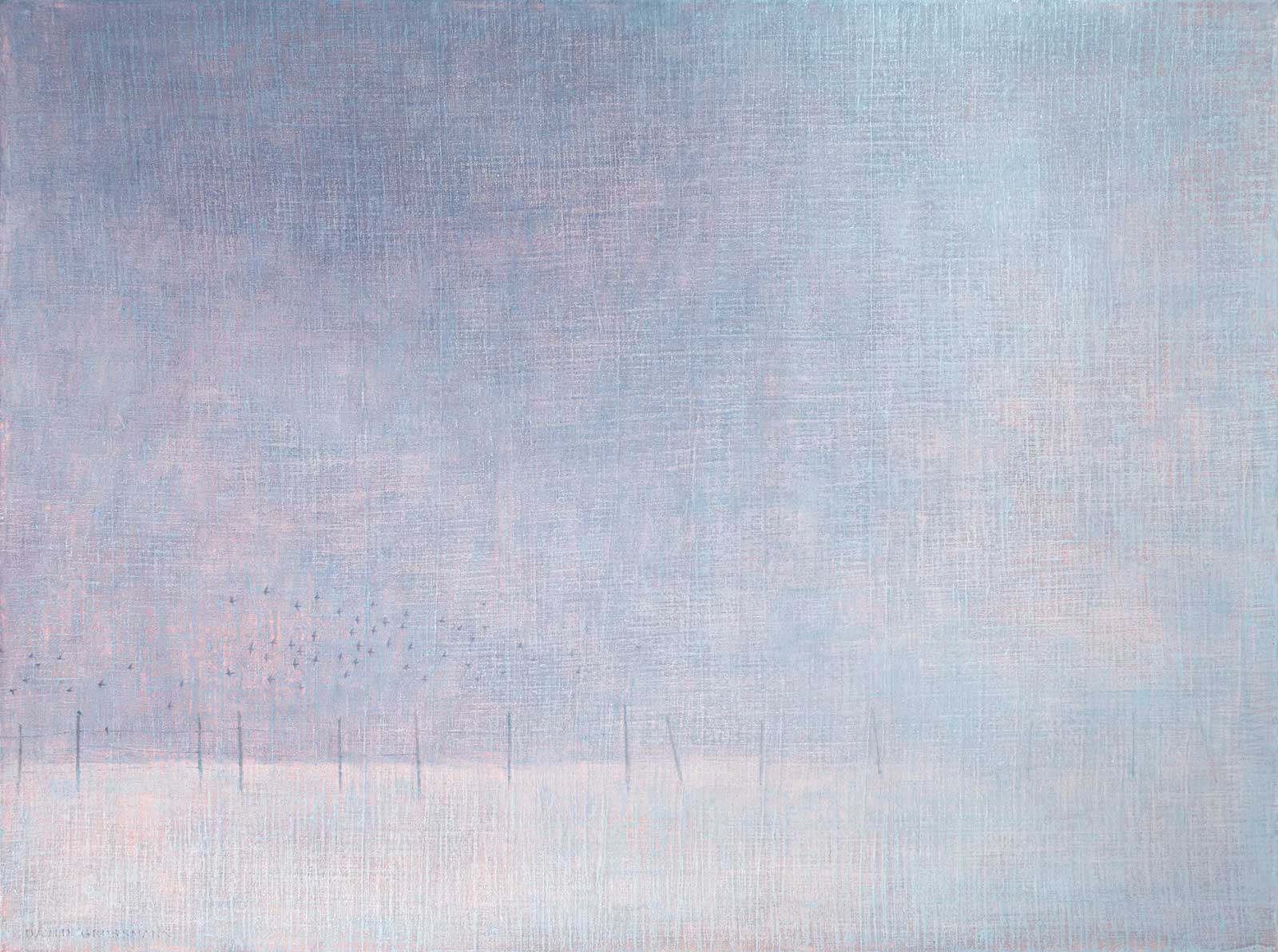 David Grossmann, Winter Fence, 2021, oil on linen panel, 18 x 24”. Courtesy Gallery 1261, Denver, CO.
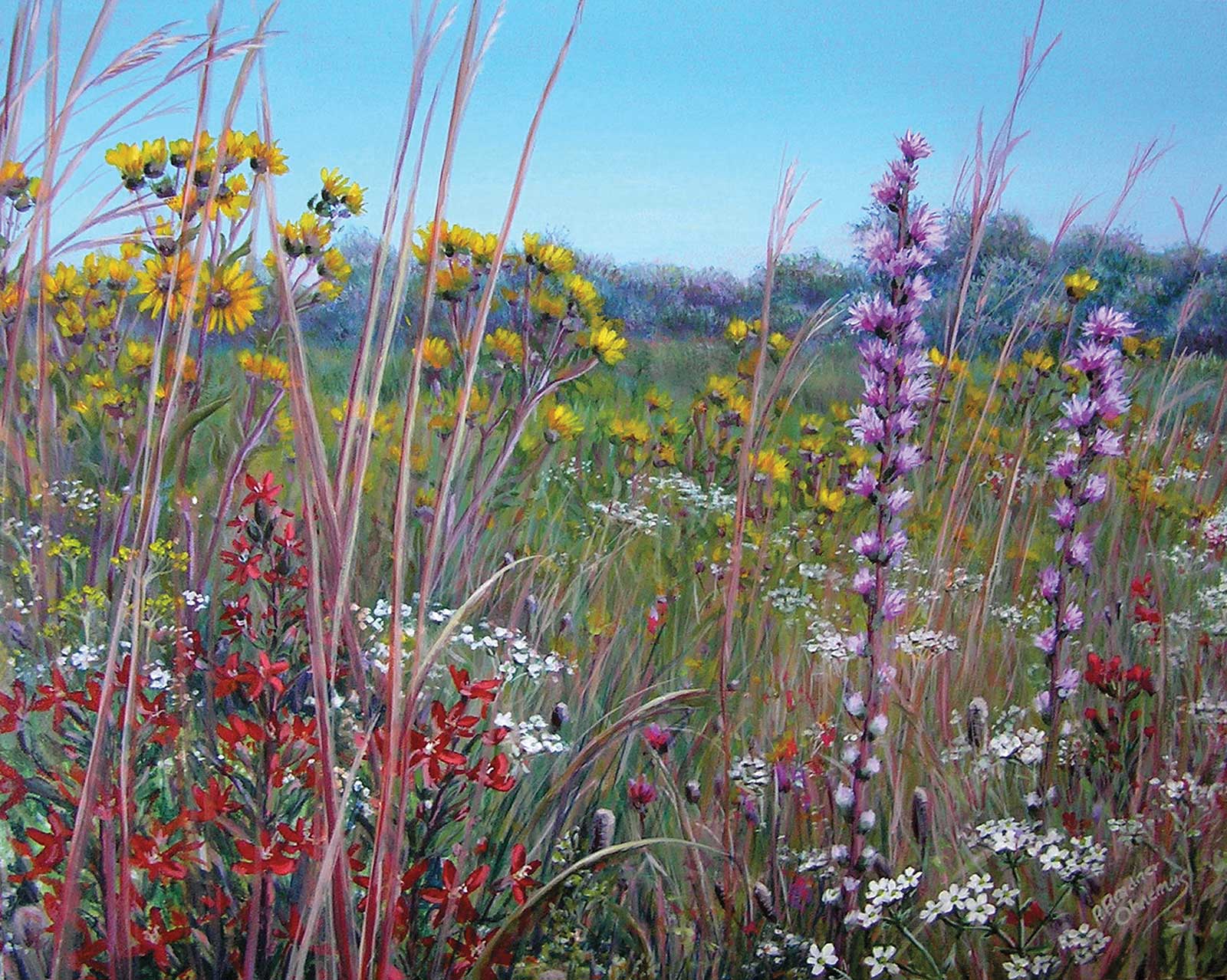 Pam Ohnemus, Midday, acrylic, 16 x 20”. Courtesy Beréskin Gallery and Art Academy, Bettendorf, IA.
Aeling paints not only what early settlers saw as a “sea of grass” but the vastness of the skies above it and the varieties of weather they both endure. He says, “I love the spare, the austere, those places where you have a strong sense of the hugeness of nature and a feeling for what is beyond what is immediately visible.”
Summer rain and winter snow nourish the roots of prairie plants. In heavy rain and snow, the details of the landscape disappear among the water and vapor. In David Grossmann’s Winter Fence, the fence and a flock of birds are the only discernable forms—a frozen moment in the life of the landscape.
In Specimen Days, Walt Whitman wrote, “As to scenery (giving my own thought and feeling), while I know the standard claim is that Yosemite, Niagara Falls, the Upper Yellowstone and the like afford the greatest natural shows, I am not so sure but the prairies and plains, while less stunning at first sight, last longer, fill the esthetic sense fuller, precede all the rest, and make North America’s characteristic landscape.” —
Powered by Froala Editor