In 1970, Billy Schenck found himself at the corner of 14th Street and Lexington Avenue in New York City. It was there, in a shabby little shop not far from Union Square, where the then-rising painter would discover rows and rows of filing cabinets, each one filled with movie stills. As many as 2 million images were stored there, many of them from Western movies, all of them categorized and cross-referenced. For Schenck, who had been captivated by Sergio Leone’s “Spaghetti Westerns” a few years earlier, the shop was Shangri-La, Xanadu and El Dorado all in one.
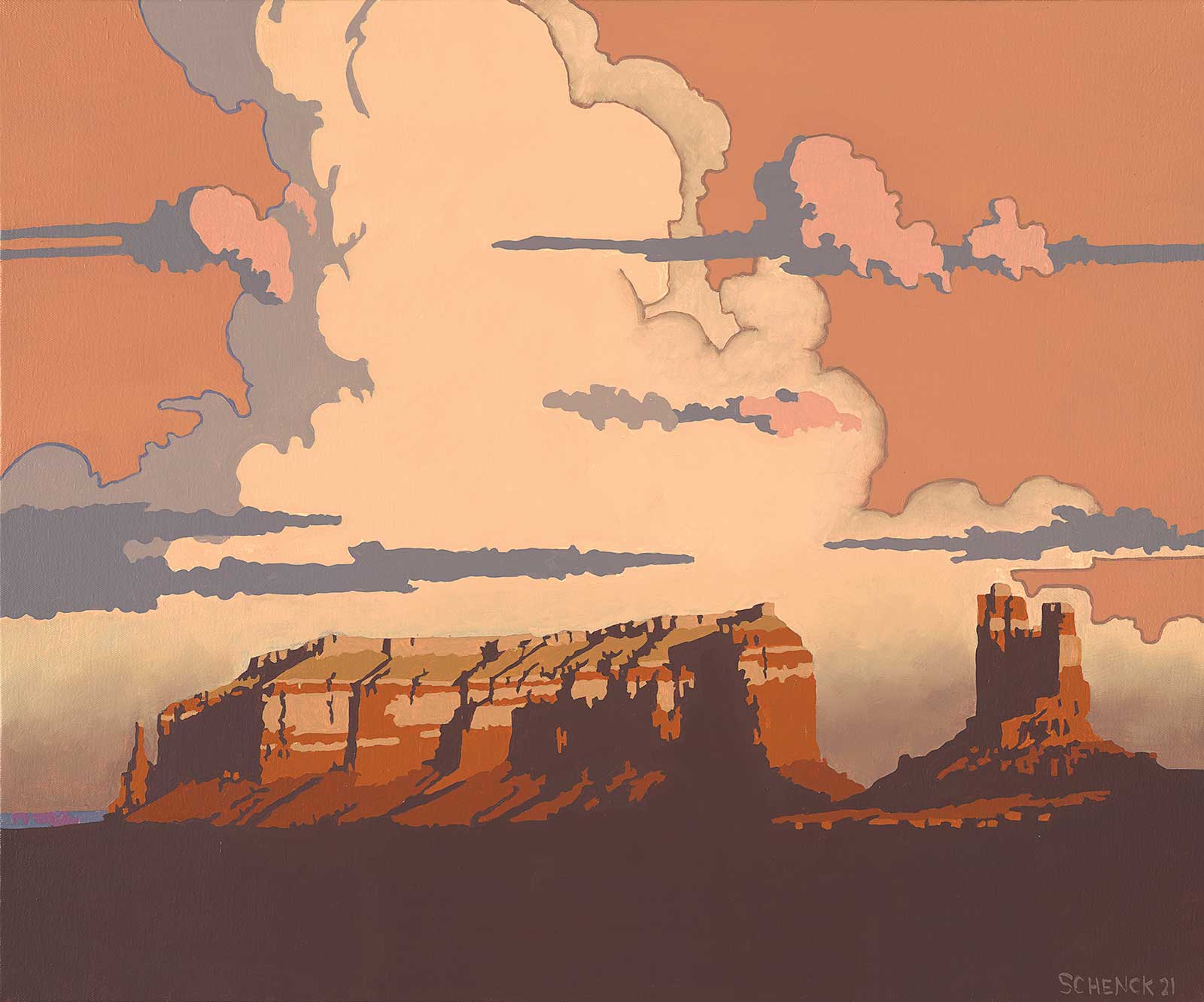 Douglas Mesa, oil on canvas, 20 x 24”
Some of Schenck’s earliest Western works would soon follow, as well as his first show in 1971 and his first Western prints in 1972. Fifty years since then, Schenck is still going strong, and he’s still marching to the beat of his own drum. Asked how he’s lasted so long in a genre that often defaults to longstanding traditions, Schenck says one word: “Authenticity.”
“I was once told I was the most authentic person someone had ever met. To me that was the highest compliment, because every detail is a reflection of my vision and personality. And it speaks to my work ethic; I have the propensity to do everything extremely well or not at all—I just don’t do anything half-assed,” he says from studio in Santa Fe, New Mexico. “Ultimately, honesty and authenticity gets you more credibility than anything else.”
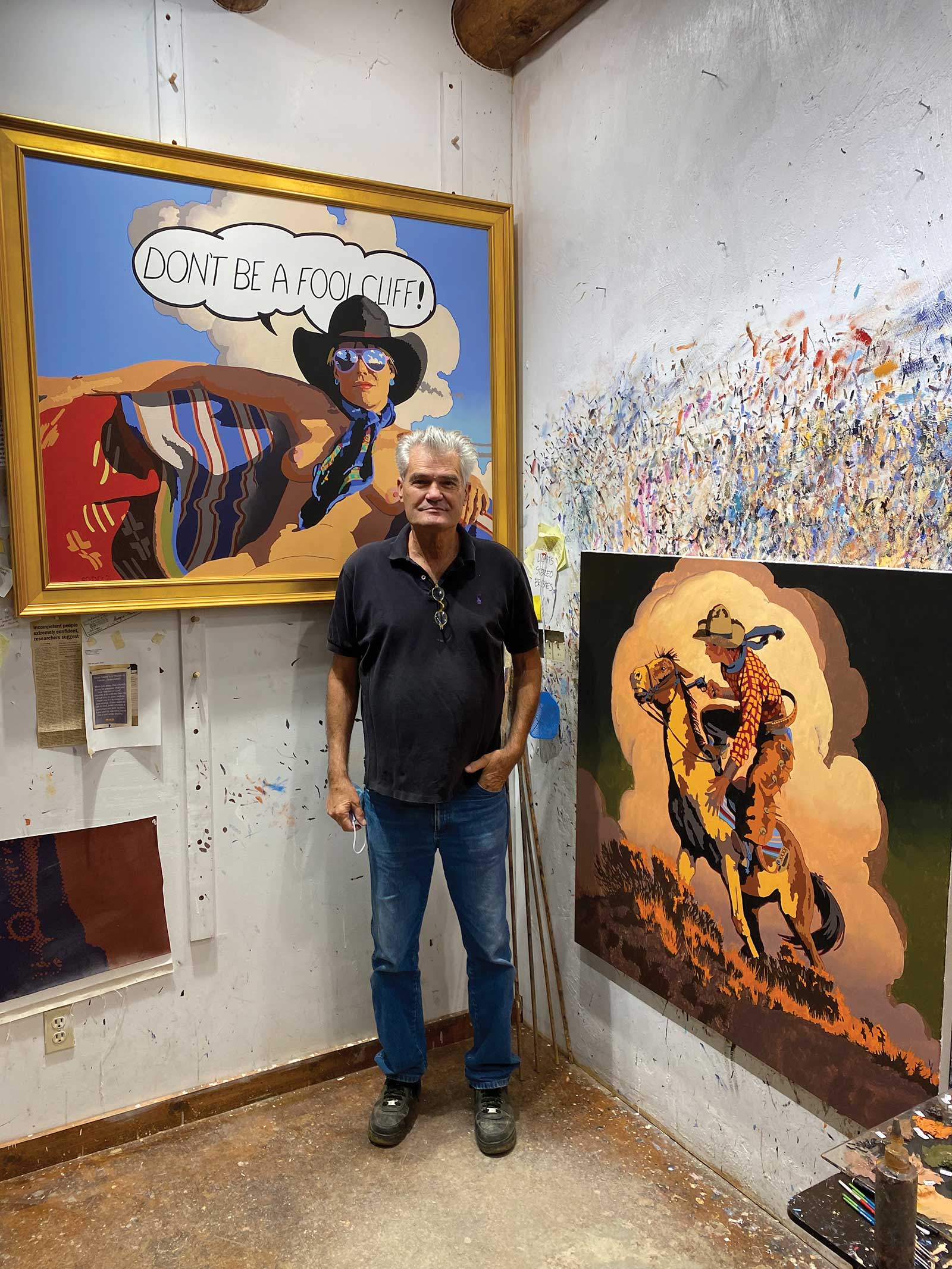 Billy Schenck in his studio in Santa Fe, New Mexico.
That honesty part is something he takes to heart, especially when it comes to his methods as a painter. Schenck has always been transparent about his methods, some of which are controversial in Western art. For starters, he borrows heavily from cinema, including those beloved film stills. He also uses a studio assistant to layer in parts of some paintings after he’s started them. And finally, he uses a projector to merge together elements of his work on his canvases, whether it’s old photos he took of Monument Valley or Hollywood press photos of Gary Cooper drawing down on gunfighters in High Noon. These aspects are rooted in the history of Pop Art, Andy Warhol, New York City and other elements from Schenck’s past, and they are often frowned upon by Western purists.
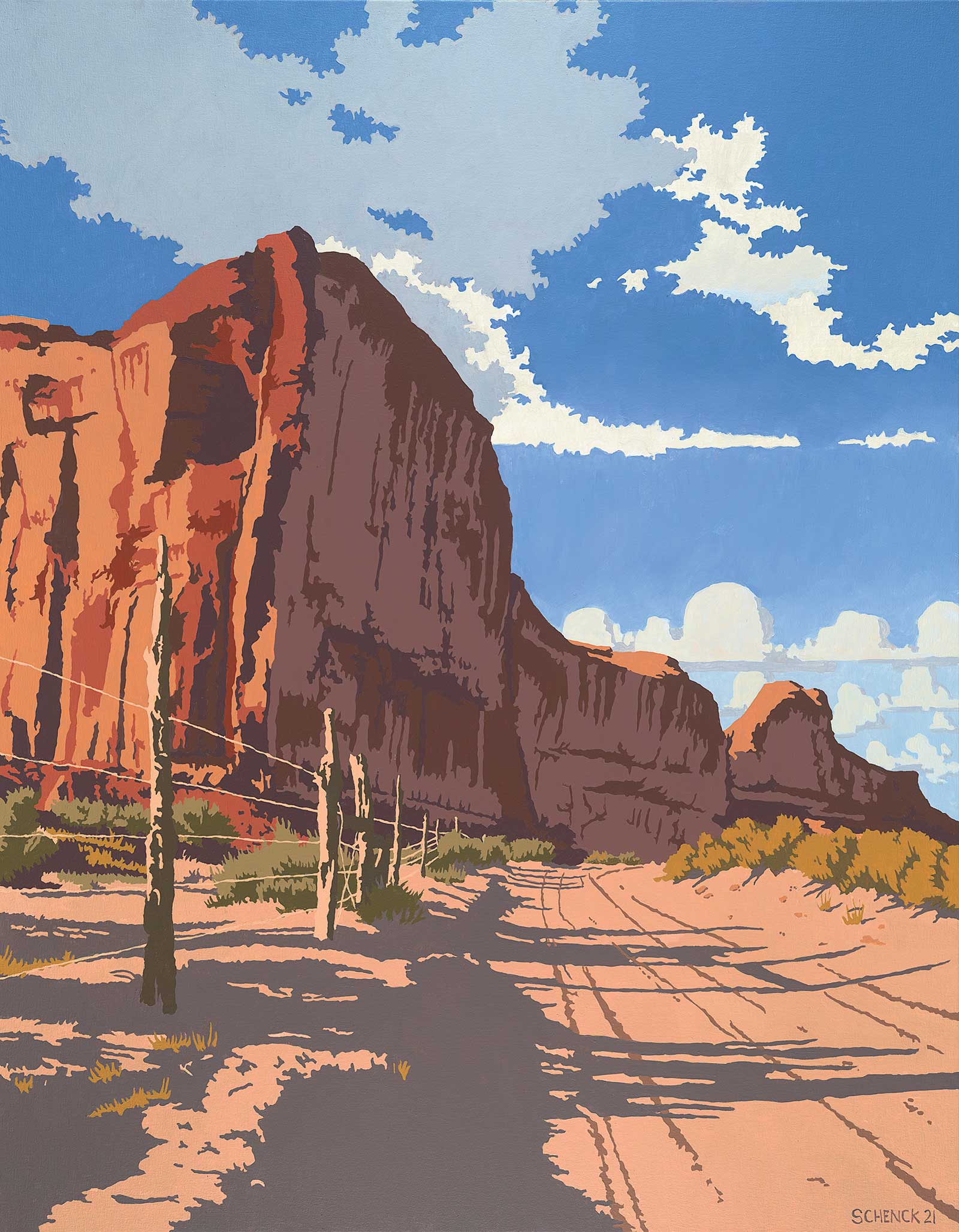 Highway to Shonto, oil on canvas, 34 x 45”
“Some of the shows don’t really allow projected imagery. Of course, some of the artists use it but they don’t admit to it,” Schenck says. “I did a lecture at the Autry [Museum of the American West] and I remember saying that photorealism was a real thing…it was a school that happened and with it the projector. And yet, when I use a projector I change all kinds of stuff and make the work my own. But the more conservative elements of the art market, they don’t want me in certain shows, so doors are closed to me.”
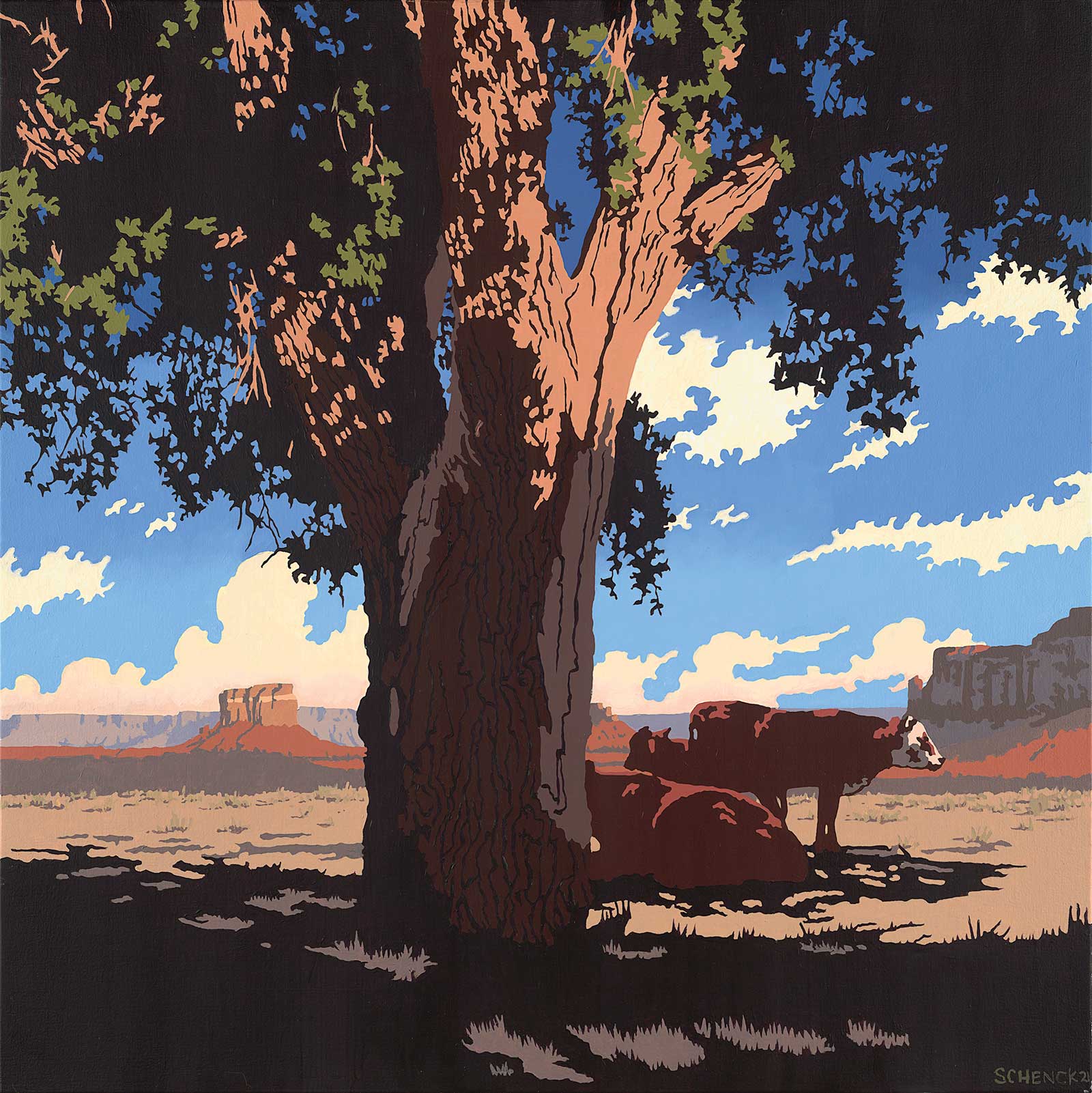 Caution - Hot Cows, oil on canvas, 30 x 30”
Also controversial are some of his subjects, which range from peaceful scenes of the desert to outright assaults on viewers’ perception and understanding of the West. Schenck has a punk spirit about it all, the Sid Vicious of the Cowboy art world, but that’s not to say he doesn’t hold Western imagery—even iconography, which he regularly paints—in high regard. He does, but he also wants to mash your buttons, and he does so with glee. “I want my work to be absolutely unfiltered and without barrier. I’m going to drag Western art in new directions whether it likes it or not,” he says. Over the course of 50 years the artist has touched upon unspoken truths and painted taboo subjects, from cowgirl nudes and Native American genocide to the fallacy of Manifest Destiny and the commodification of the West. Some of it is tongue in cheek, some of it with a hint of sexual innuendo and some of it is wonderfully absurd, including his caption paintings of Geoff, Cliff, Claire and other hapless cowboys who dispense wisdom in ridiculous scenarios designed to poke holes in the myths of the Old West. One reads: “But you have to trust me. I’m a white man.” Schenck adds: “I’m totally OK with using people’s prejudices against them.”
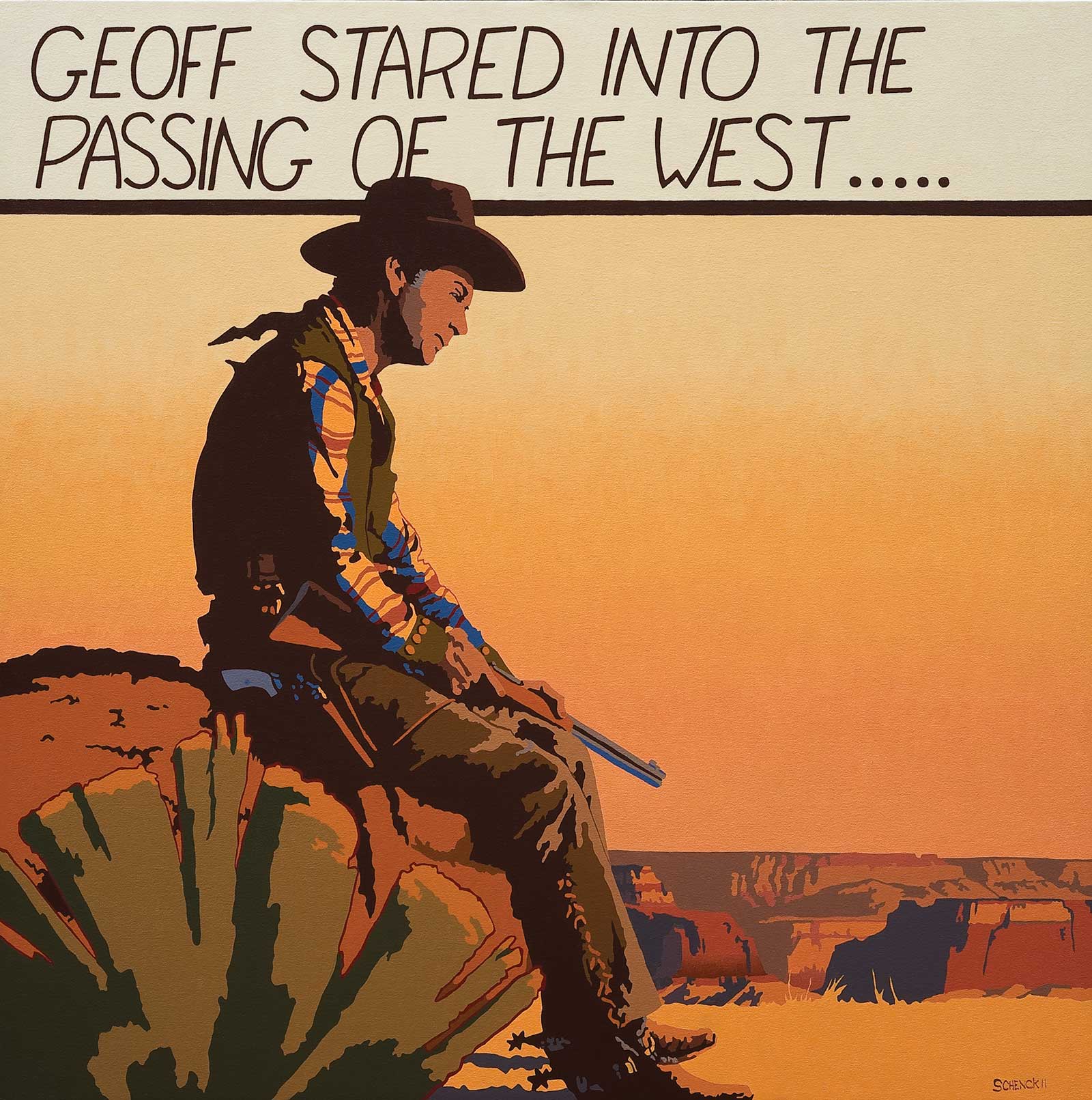 Geoff Stared, 2011, oil on canvas, 40 x 40”. Courtesy of the Artist. On view at the Southern Utah Museum of Art.
And yet, as often as the artist drops bombs on America’s traditions, he is also quite romantic about the West and its ability to captivate people. He’s one of the rare artists who can pull off satire, wit and dark humor, and then turn around and do these magnificent desert scenes without an ounce of sarcasm—his love of these places and their power is sincere and genuine. “Obviously, I’m in love with the West, and I do have this romantic attachment to the genre,” he says. “That’s why I like to turn it on its ear so often…because I do care for these places and the people.”
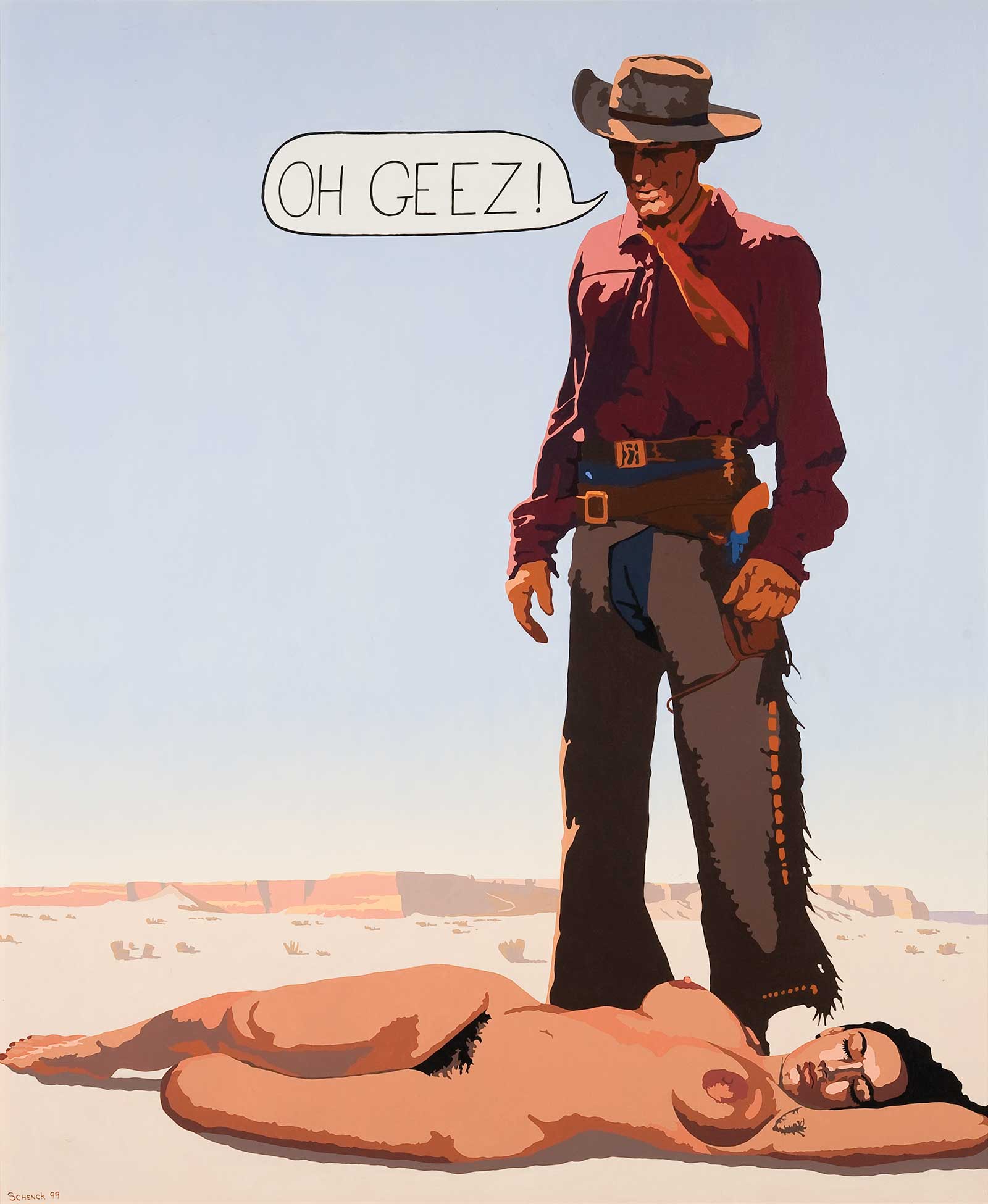
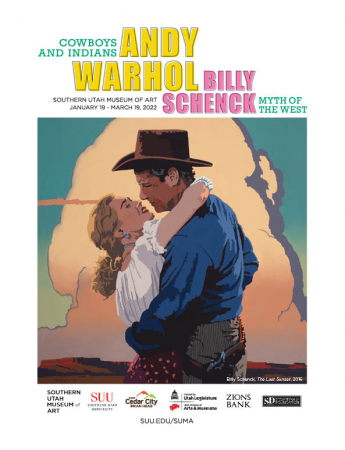
Schenck fans will have an opportunity to see both sides of the artist, the romantic side and the bomb-dropper, at two new Utah shows. Opening January 19 at the Southern Utah Museum of Art in Cedar City is Billy Schenck: Myth of the West, which opens with its companion exhibition, Andy Warhol: Cowboys and Indians. The exhibition will highlight all aspects of Schenck’s career, from the provocative to the reverential imagery.
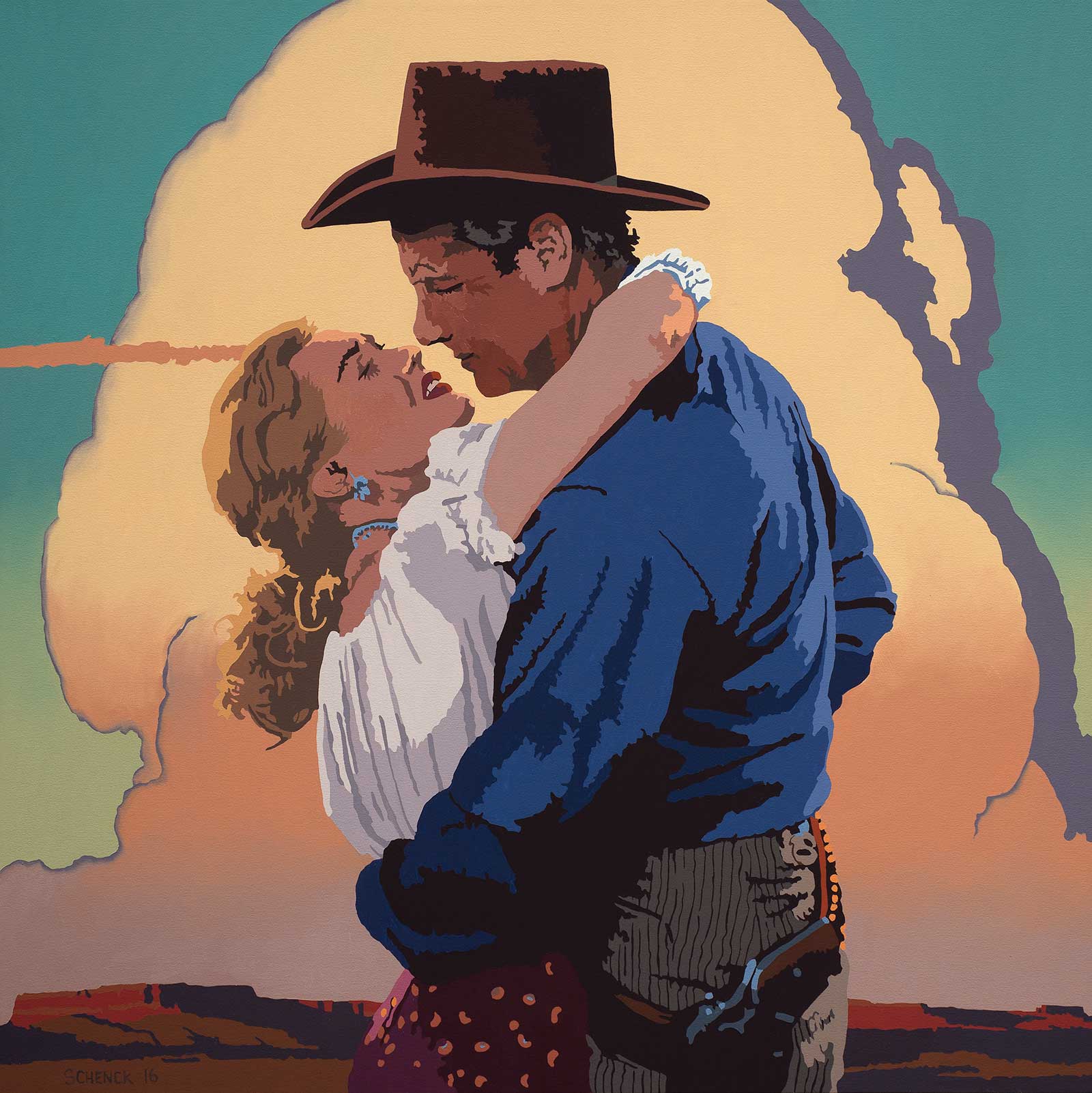 The Last Sunset, 2016, oil on canvas, 40 x 40”. Courtesy of the Artist. On view at the Southern Utah Museum of Art.
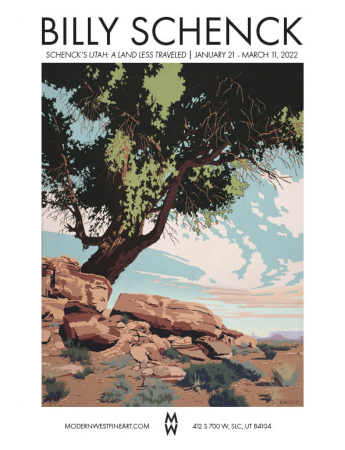
And then on January 21, Modern West Fine Art in Salt Lake City will unveil the solo show Schenck’s Utah: A Land Less Traveled, the artist’s first all-landscape solo show in his 50-year career. Shalee Cooper, director at Modern West Fine Art, says Schenck’s work is timeless and also vital to the genre of Western art. “What’s so compelling about his work is that it transcends mediums. He is capturing the essence of the West in a way that is uniquely his own with his paint-by-numbers style. He uses photography and composes his ideas with his imagery. He’s pushing painting to the next level,” Cooper says. “What we’re seeing more is that he’s also blending his palette now more than ever, and he’s continuously developing as an artist. He’s as relevant now as ever, and he’s still moving the needle.”
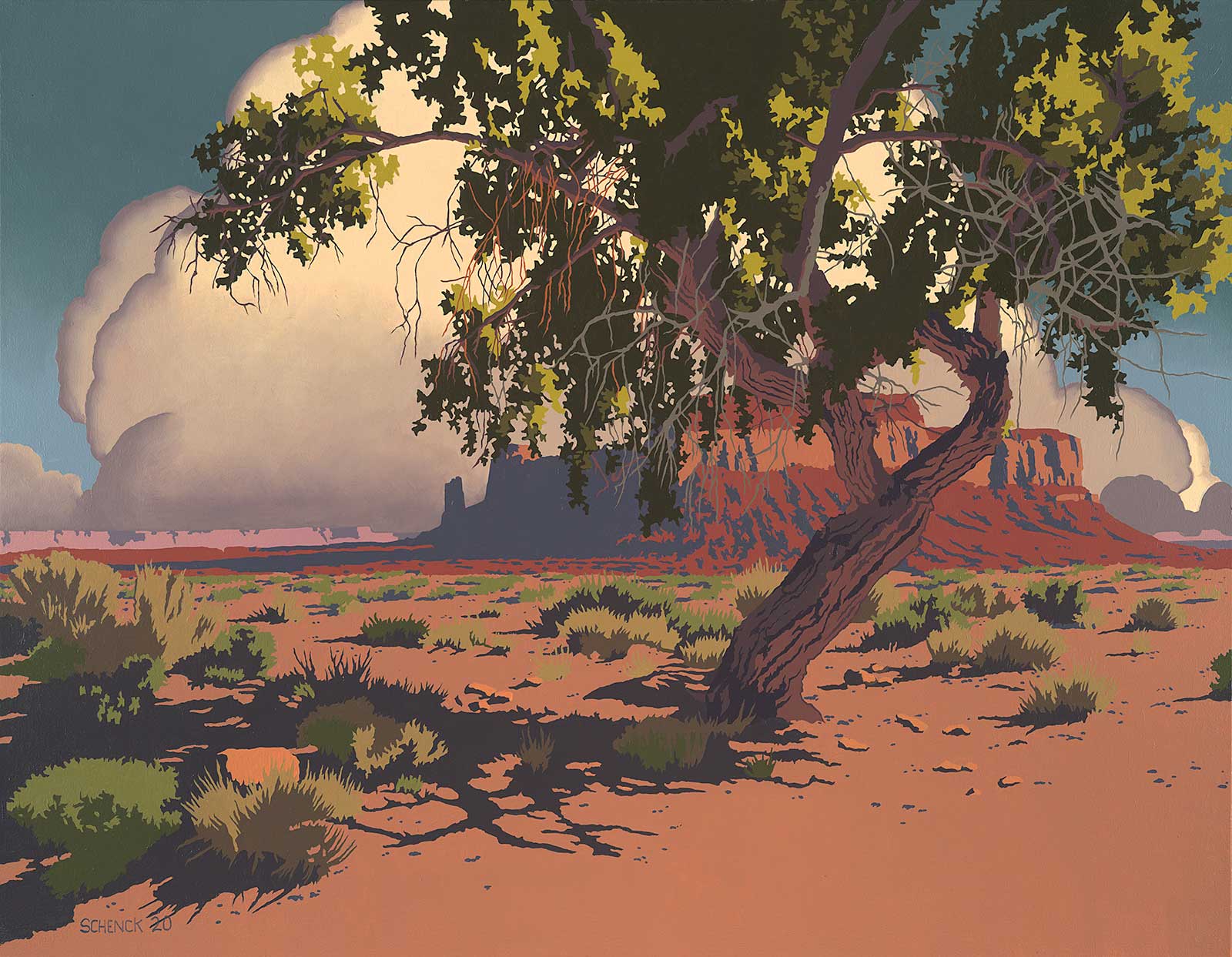 Arizona Skies, oil on canvas, 35 x 45”
And Schenck certainly still feels relevant, especially judging by the furious pace of the work from his studio. Back in August 2021, he was painting for the Salt Lake City show, but also painting for his other galleries, including Blue Rain Gallery in Santa Fe and even overseas galleries. His studio, which sits across a courtyard from his home, is filled with his work, as well as shelves of books and vinyl records, and stacks of CDs that tower upward. He doesn’t use an easel, so Schenck just hangs his canvases on a studio wall, which is often holding three or four works simultaneously. There on a table is the object that gets some art fans so riled up—his slide projector. Around it are several carousels filled with slides, presumably a mixture of his own photography and Hollywood stills. Across the courtyard in his home, Schenck walks the various rooms and proudly calls out to his own collection, which is vast and exceptional. The works that have passed through his hands include pieces by Frank Tenney Johnson, Maynard Dixon, Oscar E. Berninghaus, E. Martin Hennings, Joseph Henry Sharp and even contemporary painters such as Logan Maxwell Hagege, Ed Mell and G. Russell Case. And the paintings just scratch the surface: Schenck collects pueblo carvings, pottery, weavings and he has a truly magnificent collection of Thomas Molesworth furniture.
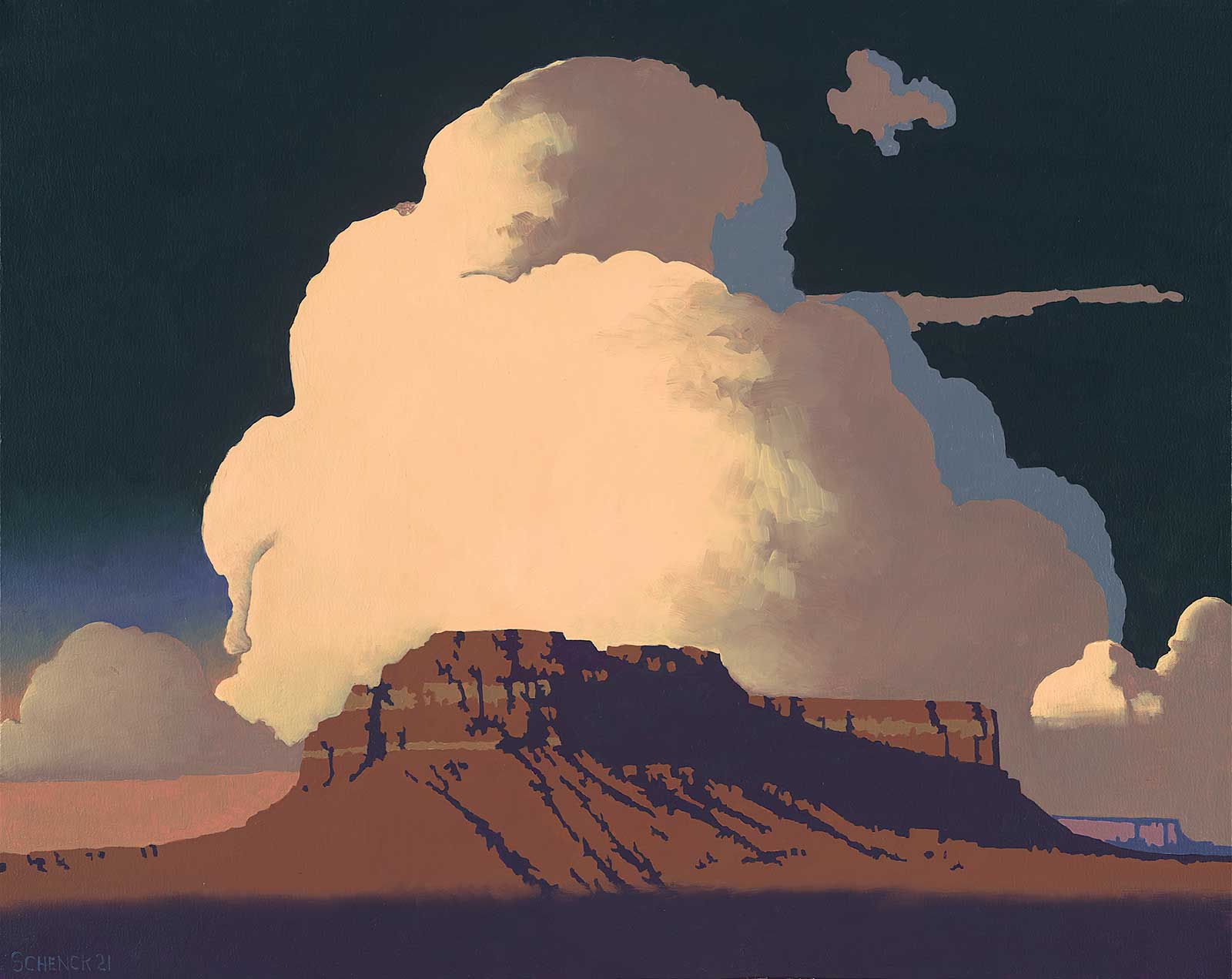 Late Day Monsoons, oil on canvas, 24 x 30”
Even as he lampoons aspects of the culture, it’s evident the maverick artist cares deeply about the American West and the history that has come before him. “I do take it very seriously. I’m not a loose cannon in that regard,” he says. “I see myself slowly getting more and more people to convert to my way of thinking. I may lose some people here and there, but as an artist you have to be fearless and you have to know that some people will be offended. Nothing risked is nothing gained. And it’s clear at the core of my soul that I’m a risktaker, and challenging people is taking the best kind of risks.”
Powered by Froala Editor