Editor’s Note: This is an excerpt from a forthcoming book on Clark Hulings
Clark Hulings made his home in Santa Fe. His collector base was centered in the American West. His friendships with Western artists like John Clymer, Tom Lovell, Robert Lougheed, and numerous others, and his membership in the first class of the National Association of Western Artists are all stong arguments for his inclusion among painters of the American West. Further, Hulings’s first gallery—Grand Central Gallery in New York, had long represented some of the finest Western artists. W.R. Leigh, for example, who had only passed away in 1955, just a few years prior to Hulings’s acceptance. Even further, Hulings did provide cover material for a few paperback oaters in his salad days as an illustrator.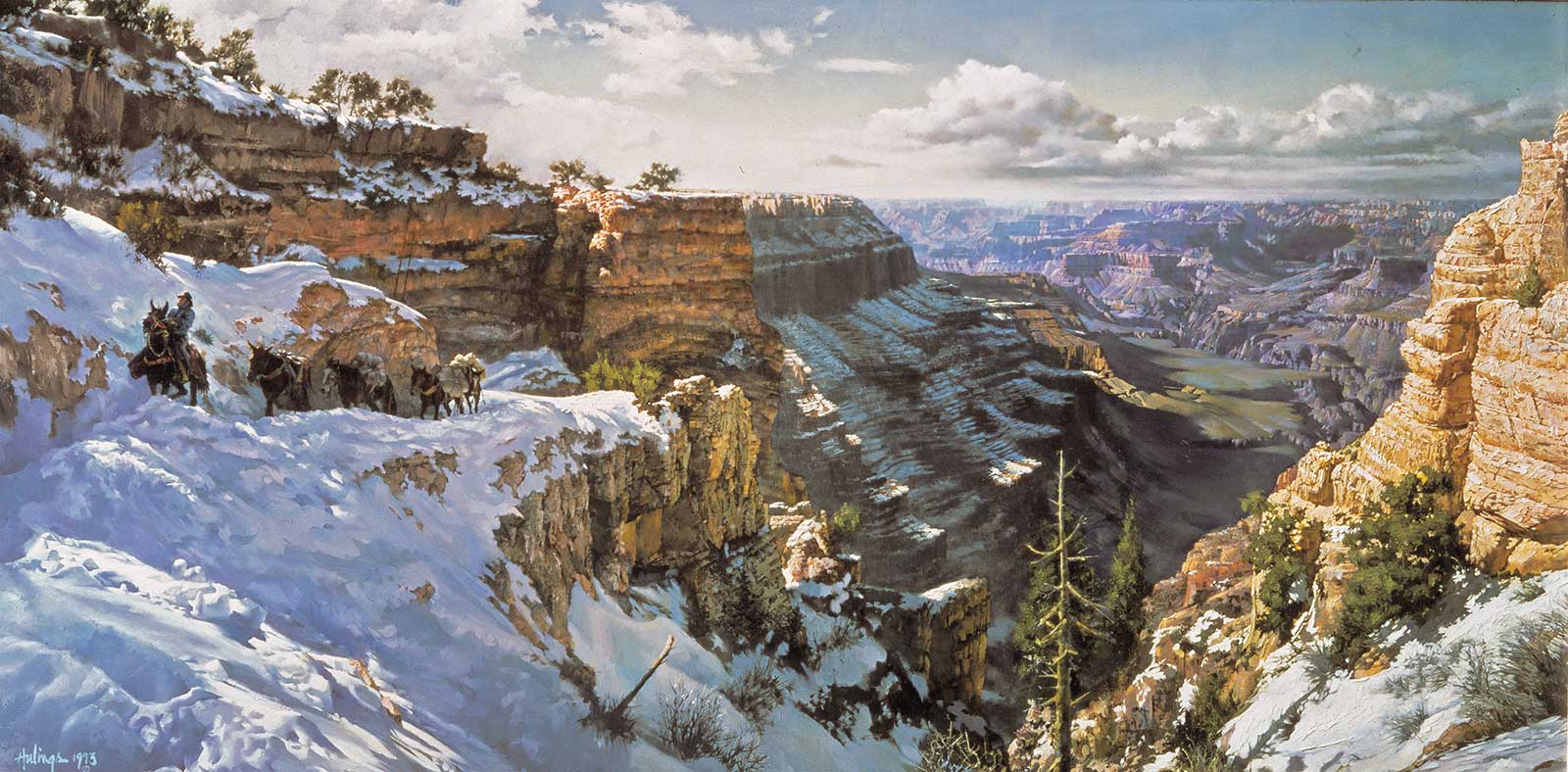 Clark Hulings (1922-2011), Kaibab Trail—Winter, 1973, oil, 27 x 54”
And yet, according to his daughter, Elizabeth, Western and Southwestern subject material only accounts, astonishingly, for some 10 to 20 percent of his oeuvre. The fact is that the overwhelming majority of Clark Hulings’s paintings depict people and places in Europe, Eastern Europe, Scandinavia, the Near East, North Africa, Mexico and Central America, and the American South.
But Clark Hulings packed a lot into the Western arroyo of his work, saying a great deal about the West not only in his hymns to the beauties of the Grand Canyon and the vast antiquity of the Western landscape, but also about the representations of people in Western Art, and his place, as he saw it, in the genre.
Case in point. NAWA, the National Association of Western Artists, was organized at the National Cowboy and Western Heritage Museum in Oklahoma City to replace the Cowboy Artists of America (CAA) exhibition, which had moved its base of operations. Like the CAA, NAWA intended to shine a spotlight on artists working in the American Western tradition of Frederic Remington and Charles M. Russell but broadened to include landscapes and other subjects germane to the Western states. Painter Paul Calle encouraged Hulings to join and Hulings set his sights painting something to enter—and maybe even win—what would become the first ever Prix de West Invitational.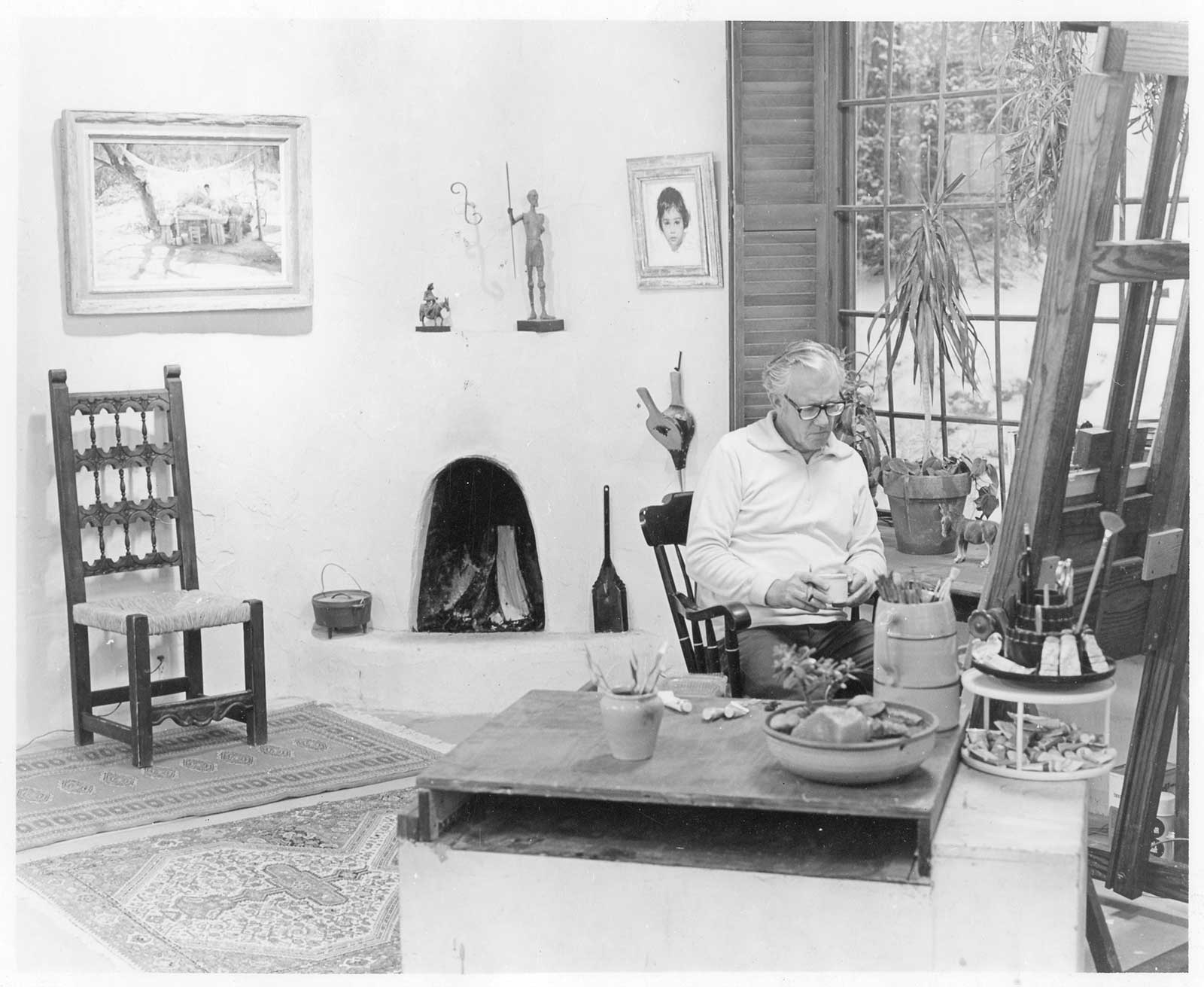 Clark Hulings in his studio.
The artist’s thought process here is of exceptional value, for despite NAWA’s vow to expand the range of acceptable subject matter, Hulings did not consider himself a painter of the Cowboy and Indian past. Shifting from Remington and Russell to the equally esteemed Western landscape tradition of Thomas Moran and W.R. Leigh, Hulings decided to paint the Grand Canyon.
Now, this wasn’t Hulings’s first rodeo with the Grand Canyon. As Hulings himself wrote, “In 1967, the United States Department of the Interior, with the help of the Society of Illustrators, embarked on a project to have paintings made of all the National Parks. It fell to me to paint the Grand Canyon.” Hulings wanted—and, amazingly, got—a new tool, a helicopter, to offer a new view of a pack train, but, as he says, the contraption “spooked the mules.” Ultimately, Hulings spent several days of exploration of the South Rim on foot and several fine paintings.
On to the next NAWA problem. Many artists, including Hulings contemporaries like Wilson Hurley—who would also become a NAWA member and enter the first Prix de West—painted the Grand Canyon. Solution: Paint the Grand Canyon in winter, snow-covered. Hardly anyone one did that. And Clark Hulings, as you will see as you flip through these pages, was a truly gifted painter of snow. You can see how snow challenged him and how he rose to that challenge, seeing and painting how white snow white isn’t and noting the many colors that light and shadow paint on its blank canvas.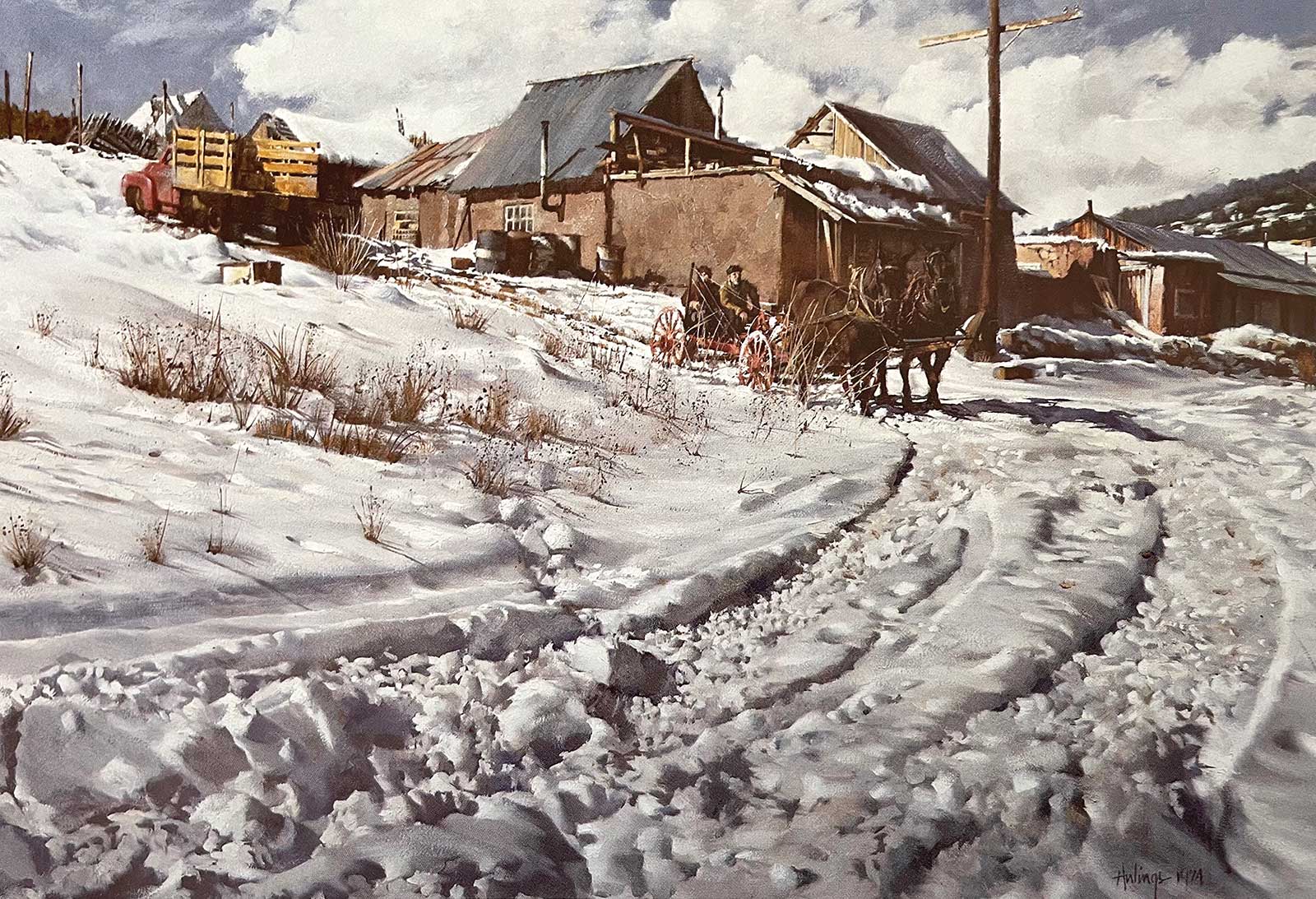 Clark Hulings (1922-2011), Lower Colonias—Sled in the Distance, 1974, oil, 24 x 36”
Outcome: Kaibab Trail—Winter, the first winner of the NAWA Prix de West in 1973, hangs to this day in the National Cowboy & Western Heritage Museum. Winning that award opened Hulings, as he hoped, to a whole new set of collectors, many of whom came to appreciate the full—non-Western—range of his practice.
Kaibab Trail features a small cowboy with a pack mule train—a dude ranch hand, perhaps transporting dirty laundry, according to the artist’s daughter Elizabeth—heading down the trail. The diminutive Westerner clings to the edge of the canvas, looking as though Hulings might push him, his horse, and his mules right out of the gorgeous snowy landscape he’s painted. It’s something you might expect to see in a Thomas Moran, a figure for scale that makes the grandeur all the grander. More important for Hulings’s developing aesthetic, this isn’t a depiction of a then in the Western past—it’s now. The artist’s now. The viewer’s now.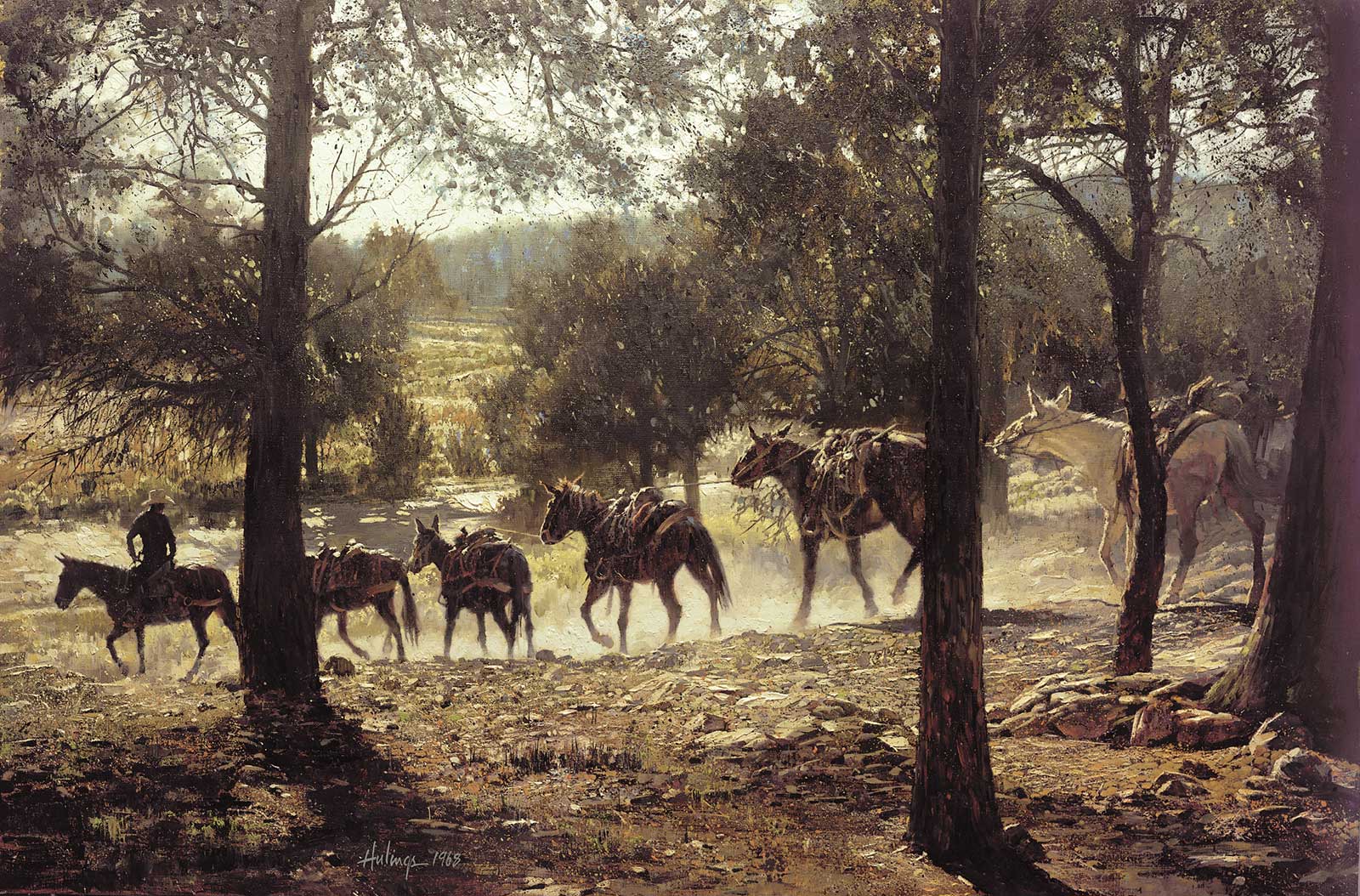 Clark Hulings (1922-2011), Pack Train, Grand Canyon, 1968, oil, 22 x 30”
Other snow paintings followed with similar hints at anachronisms and destabilized time. In Lower Colonias, for example, you note the power line and the prominent wheel ruts in the snow that lead to the old pickup parked at the side of the house. You know then that you’re being taken on an excursion, a jaunt, almost a theme park ride, into the past, along with the couple in the buckboard. Ten Below—Taos removes the human element from the harsh elements altogether. This aspect of Hulings’s American West is Nature with a capital N—snow you can hear crunching, dust and dirt you can taste, waves of brilliantly-hued rock dropping and receding to infinity.
Given his interests, it’s hard to imagine Hulings not finding the ancient Indigenous peoples of the Southwest an endlessly intriguing subject for his brush, as so many others had. And perhaps his interest in the presence of the past, in places where the past persisted, resiliently, even in the face of modernity and progress, sent him searching elsewhere. Perhaps he wanted the ghosts he painted to be palpable and real.
In fact, the approach that Hulings takes in his work, and the effect that approach has on the viewer, turns out to be in diametric opposition to the intention and practice of most, if not all, of the artists of the American West. Clark Hulings depicts a present that looks like the past in an ancient medium made contemporary through technology: photography, projection and digital manipulation. Hulings relied on photographs he himself took, often used a projector to outline his compositions, and, in his later years, taught himself enough Photoshop to allow him to add and move elements in his compositions as he conceived them.
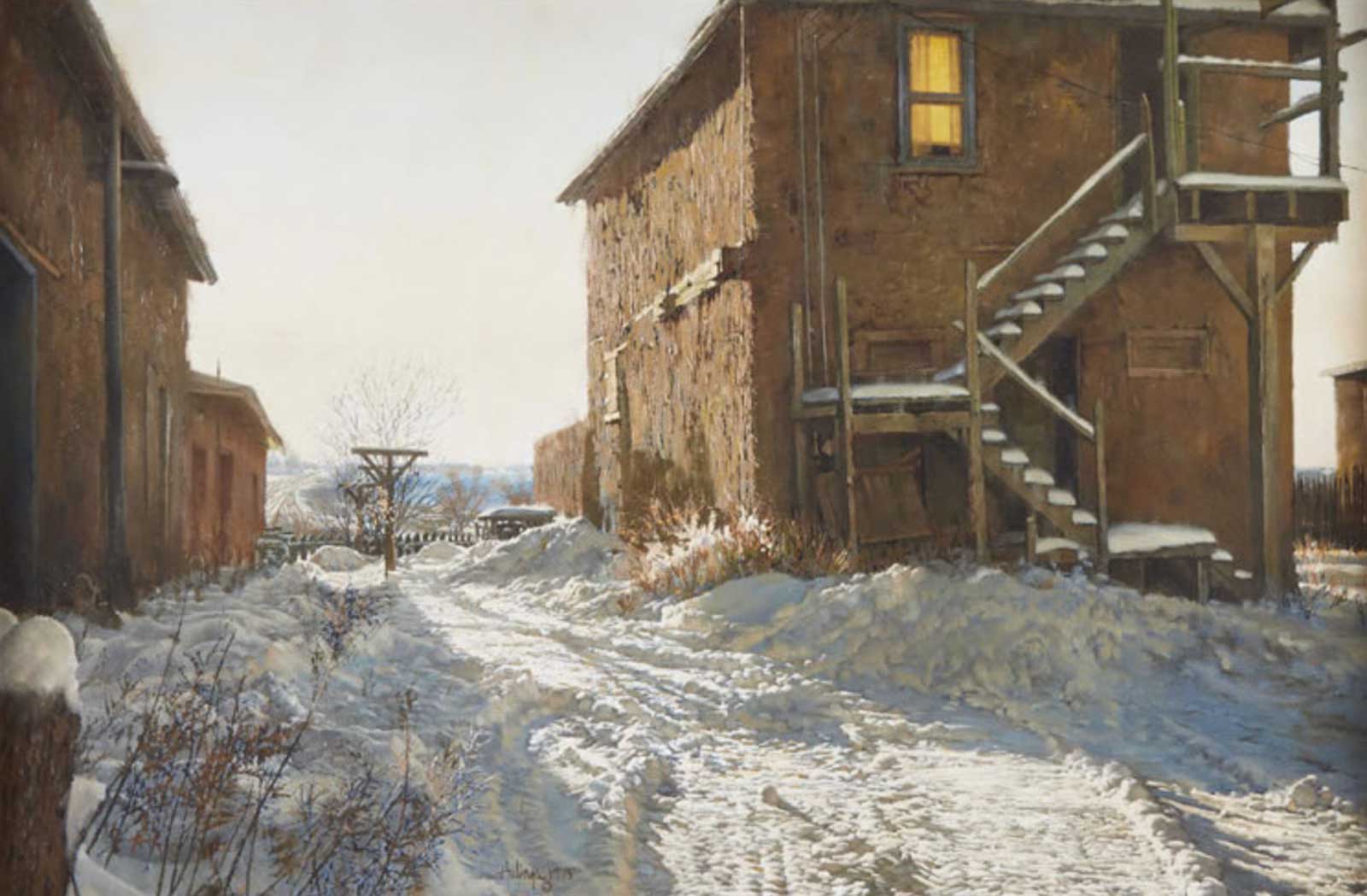 Clark Hulings (1922-2011), Ten Below—Taos, New Mexico, 1974, oil, 24 x 36”Not, perhaps, at first, but after careful and repeated study—certain things tucked into a Hulings painting jolt you into the present, releasing all the ghosts and layers of the past from the scene. Hulings destabilizes the viewer deliberately, forcing a reckoning with tensions on a historical level. This looks like then, but it’s now. What are my choices here? Do I believe it? Is this real? Was it ever real? What does it look like now? Are these people happy? Is the painting a call to action, to make them happier, wealthier, more modern? Do they want to be left as they are? Can I appreciate the painting as beautiful? Can I feel nostalgic looking at it, even if it’s a nostalgia for a world I never knew? None of these responses are wrong, but all are projections, speaking more to the viewer’s views on life than to anything the painting means to say.
In contrast, think about the vast majority of the contemporary artists of the American West. What comes first? Authenticity. Are the costumes correct? Are the guns right for the era and place depicted? Is that what a chief would have worn? What about the saddles? The tack? The contemporary artist of the American West finds a suitable model or photographic reference in order to depict a past that no one alive can actually verify. If you think about that model’s day job or major in Japanese Literature, or if you know or hear from someone who does know, or pretends to, that that rifle couldn’t have been in that mountain man’s hands in 1845, the illusion is shattered. In order to succeed, the Western artist must transport you back, through the time machine of a painting or sculpture, without any anachronistic bugs.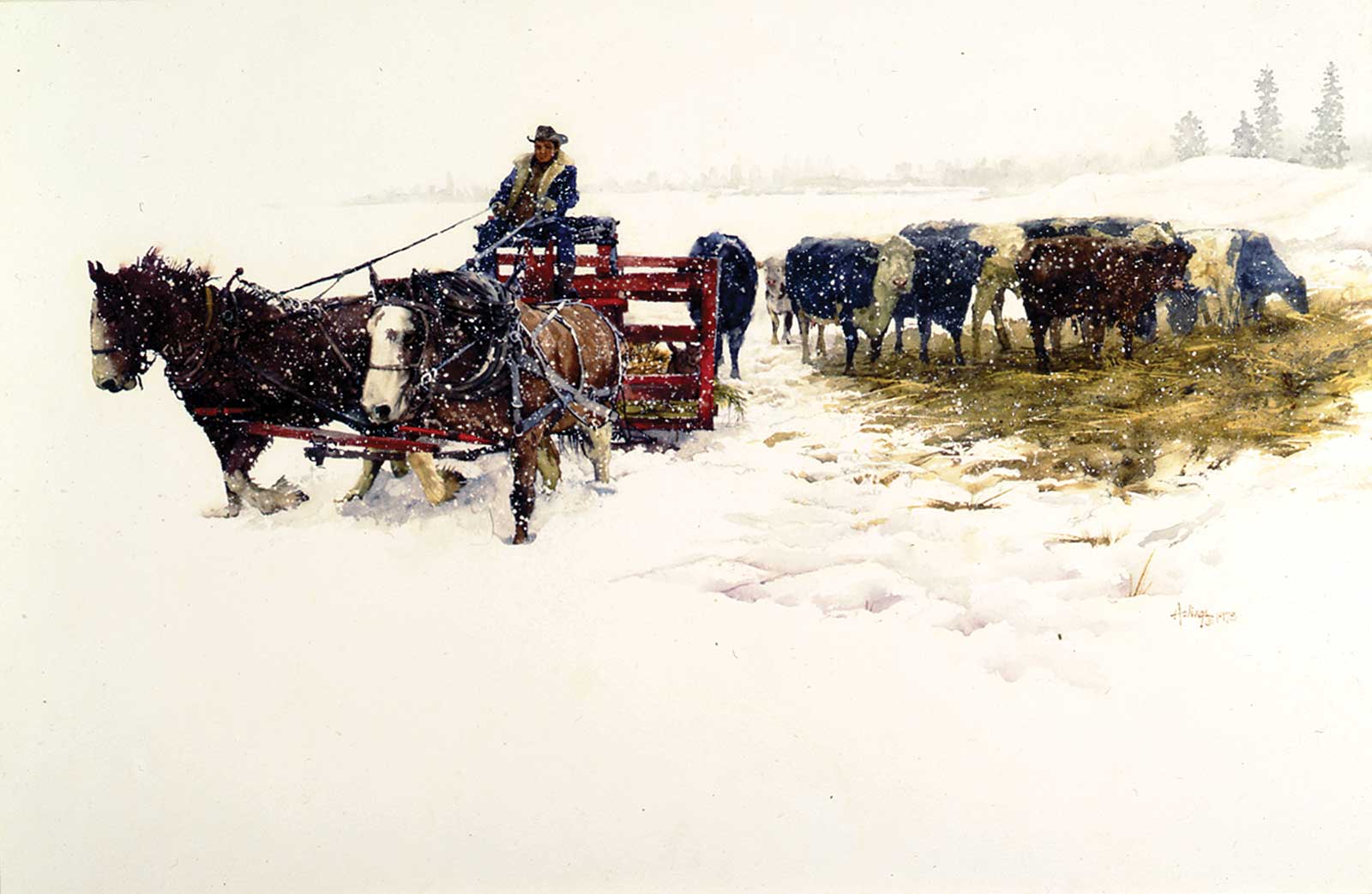 Clark Hulings (1922-2011), Montana Winter, 1978, watercolor, 20 x 30”
The artist of the American West creates an illusion in order to sustain it; Clark Hulings creates an illusion in order to subvert it.
First, let’s consider a classic painting of the American West, Over the Pass, by Carl Hantman, a contemporary and friend of Clark Hulings who also, as we saw in an earlier chapter, proctored some of the Life Drawing classes Hulings took at the Art Students’ League of New York. The narrative in Over the Pass is straightforward: a line of Northern Plains Indians moves between mountain ranges, trying to stay ahead of a steel gray, oncoming snow storm. The costumes are varied: red robe, wolf headdress, beaded war shirt, buckskins. We don’t know where they are going or where they have been. The paint quality is what keeps us looking; it swirls and moves, sculpting the drifts into something approaching a dreamscape.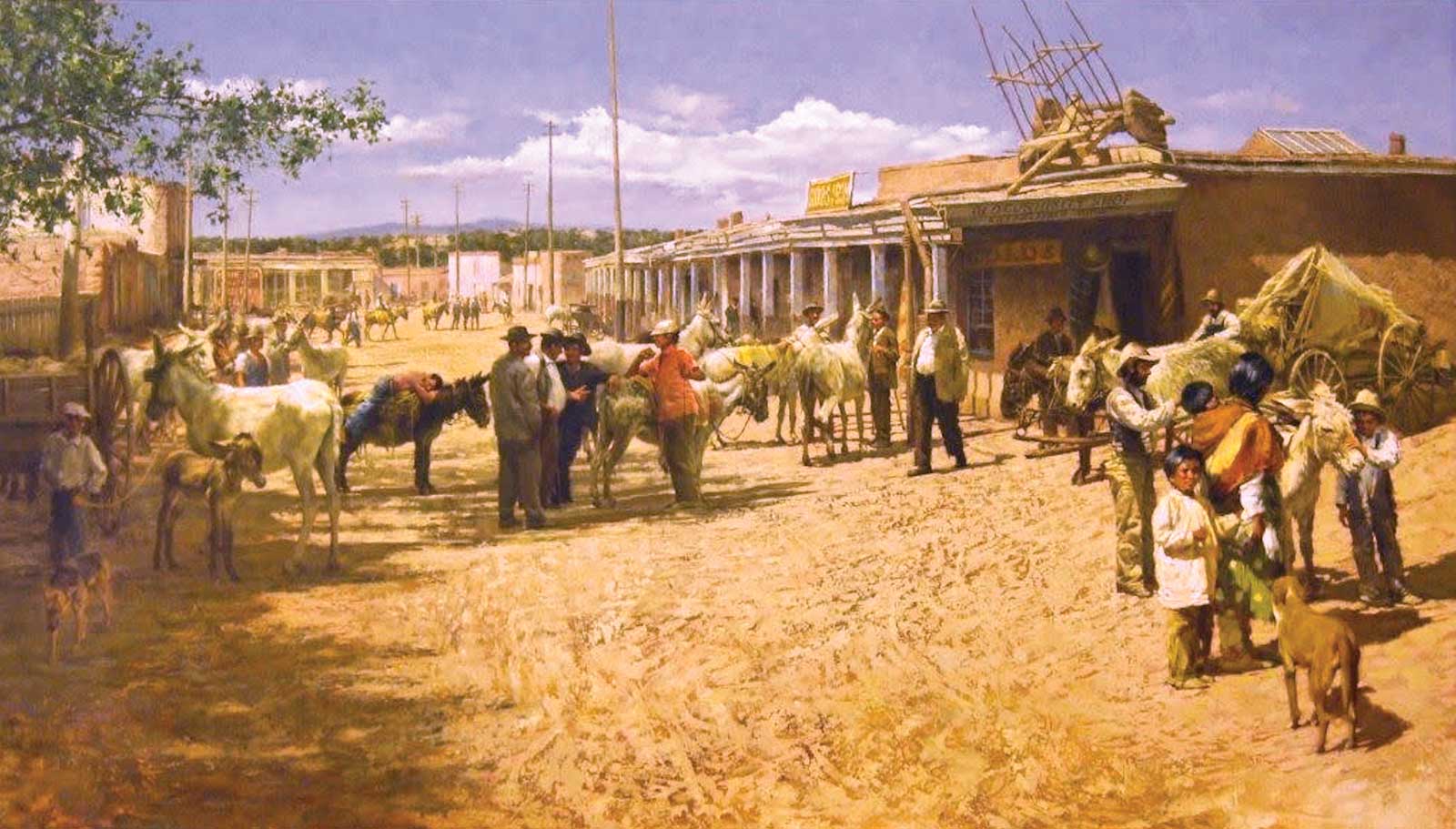 Clark Hulings (1922-2011), Impressions of Old Santa Fe, 1978, oil, 48 x 60”
The effect of Over the Pass is impressionistic, intended to put you there, even if there isn’t precisely on any map. More importantly, the painting is intended to put you then, at that time, in the artist’s idea of the Old West.
Then consider Impressions of Old Santa Fe. The painting seems, at first, to be in line with more traditional Western works. Jake Gold’s Old Curiosity Shop, with its cart on the roof, looks much as it did in its heyday around 1900 in Impressions. Take another look at what the people in “Old Santa Fe” are wearing—the golf cap and pink shirt on the man at center are a giveaway—and you see that Hulings is playing with time, compressing Santa Fe’s past and present. But Impressions of Old Santa Fe provides more than a clue to Hulings’ relationship with the Indigenous Southwest; it offers an an answer: Hulings had great disdain for painting people in costume. As ancient as a setting may be, as traditional as a way of life may be, Hulings insisted on painting people as they are, in their here and now.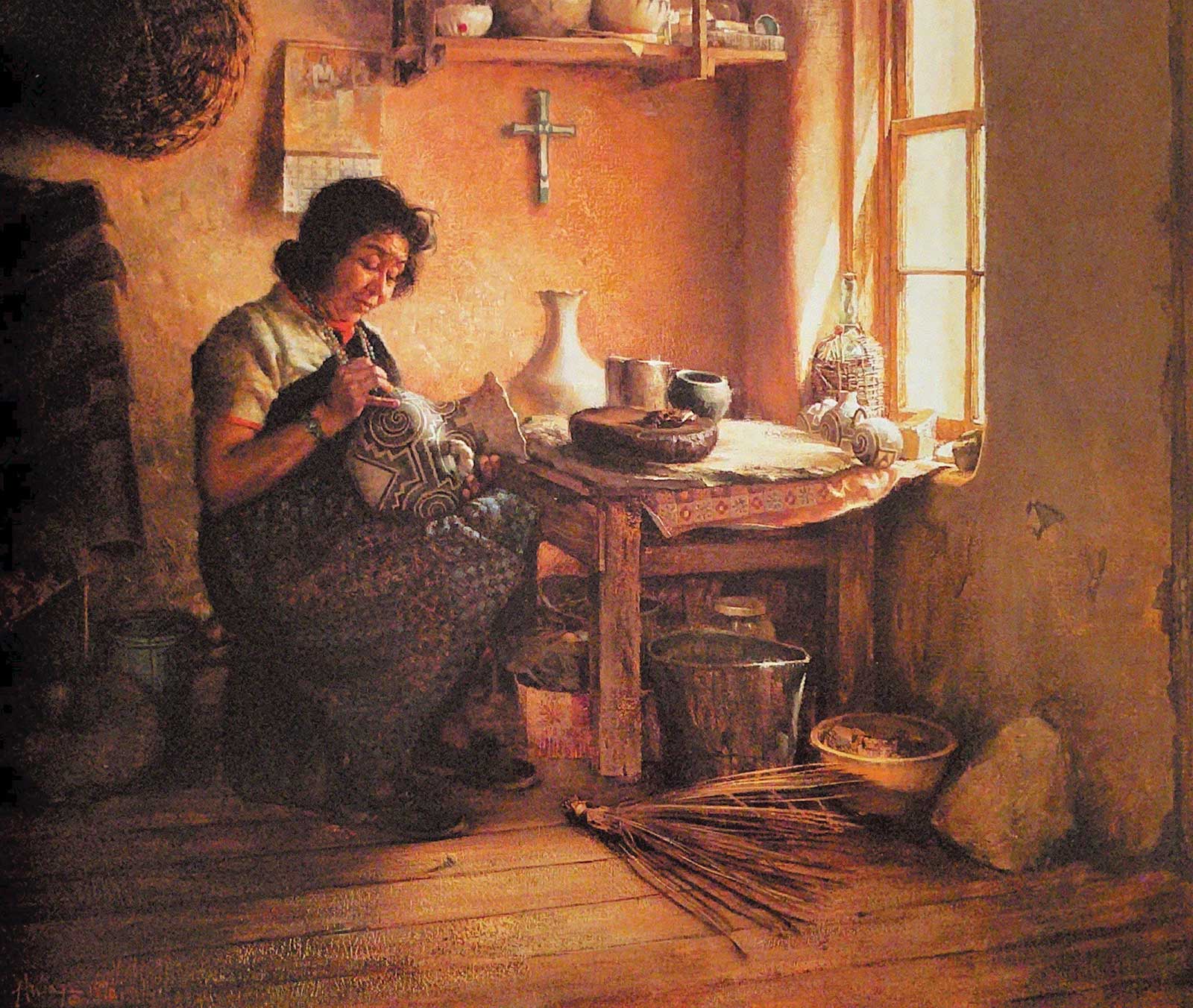 Clark Hulings (1922-2011), The Acoma Potter, 1976, oil, 24 x 30”
In The Acoma Potter, Hulings perhaps comes closer to the conventions of American Western painting than anywhere else as he tries, gently, to crop modernity out of the life of the sitter, potter Juana Leno. Hulings wrote, “With what I hoped was tact, I explained that I wanted to record something a bit more traditional, even historical, and that I needed a rustic setting.” The artist is relieved when Leno’s old studio—one she no longer uses—and her work clothes suit the “traditional, even historical” effect he seeks. Still, as is customary, Hulings cannot allow himself to allow us to be swaddled in some imagined and imaginary past. The crucifix looms, a reminder of changed times. The calendar on the wall, which looks like one of those issued by the Santa Fe Railroad—often featuring Native American artworks by, among others, Taos Society member E.I. Couse—informs us that this is not the distant past in the pueblo. Christianity has taken hold and artists have already been here, layering their mythologies on top of the pueblos and their peoples.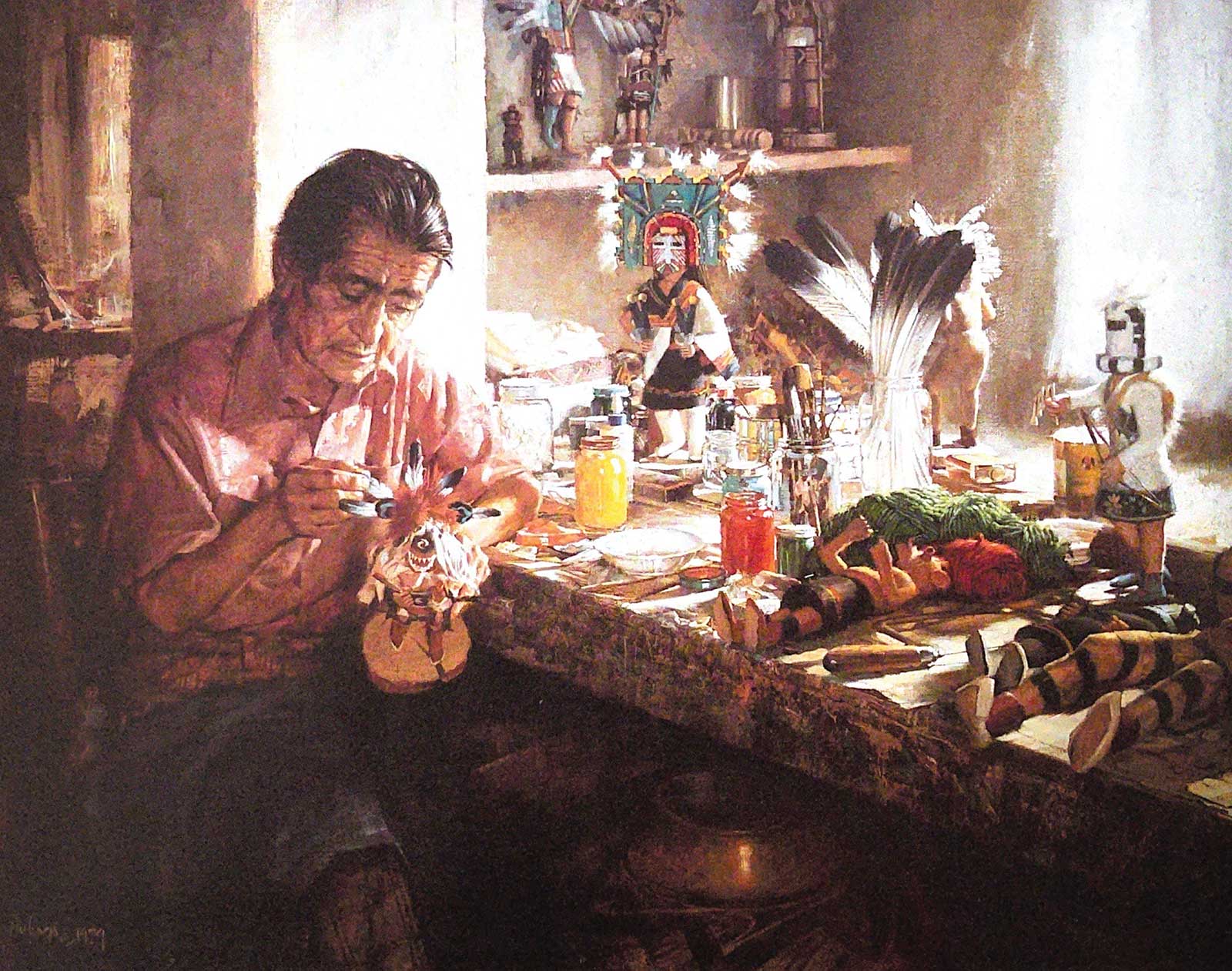 Clark Hulings (1922-2011), The Kachina Doll Maker, 1979, oil, 28 x 36”
Kachina Doll Maker, where Hulings pays tribute to a painting he saw in Russia, Avram Arkhipov’s The Mask Maker, closes the circle of time. Hulings finds congruence between the Russian artist’s theatrical masks and Hopi artist George Pooley’s Kachinas, yet it’s worth wondering why Hulings didn’t find inspiration in paintings of Russian icon painters at work—there are many of them. But the parallel between the theatre and the Kachina (now called Katsina) Cult, a performative religion with ceremonies tied to the seasons and hundreds of spiritual beings, each of whom is a character with a part to play in the ritual, is especially apt. The present is the theatre where the presence of the past plays out. In the American West according to Clark Hulings, the present is all there is, and it’s more than enough.
+++
James D. Balestrieri is the proprietor of Balestrieri Fine Arts, specializing in arts consulting, sales, research and writing. He is currently the writer-in-residence for the Clark Hulings Foundation, as well as estate and collections consultant for the Couse Foundation and communications manager for Western Spirit: Scottsdale’s Museum of the West. He was director of J.N. Bartfield Galleries for 20 years, worked with Scottsdale Art Auction for 15 years and has written more than 150 essays for various art publications.
Powered by Froala Editor