When Harriet Schreiner was growing up in the suburbs of Los Angeles, she went on a field trip to the Southwest Museum of the American Indian. “I was overwhelmed,” she recalls. “The art collection was extensive, beautiful and carried a lot of meaning. I remember the docent conducting the tour was so knowledgeable and enthusiastic about the art. I decided right then, ‘Someday I want to be a docent!’” Many years later after retiring from a successful career, she became a docent at the Palm Springs Art Museum. When she and her husband Karl moved to Santa Fe, she became a docent at the Museum of International Folk Art. Karl jokes that Harriet had the interest in art and it transferred to him.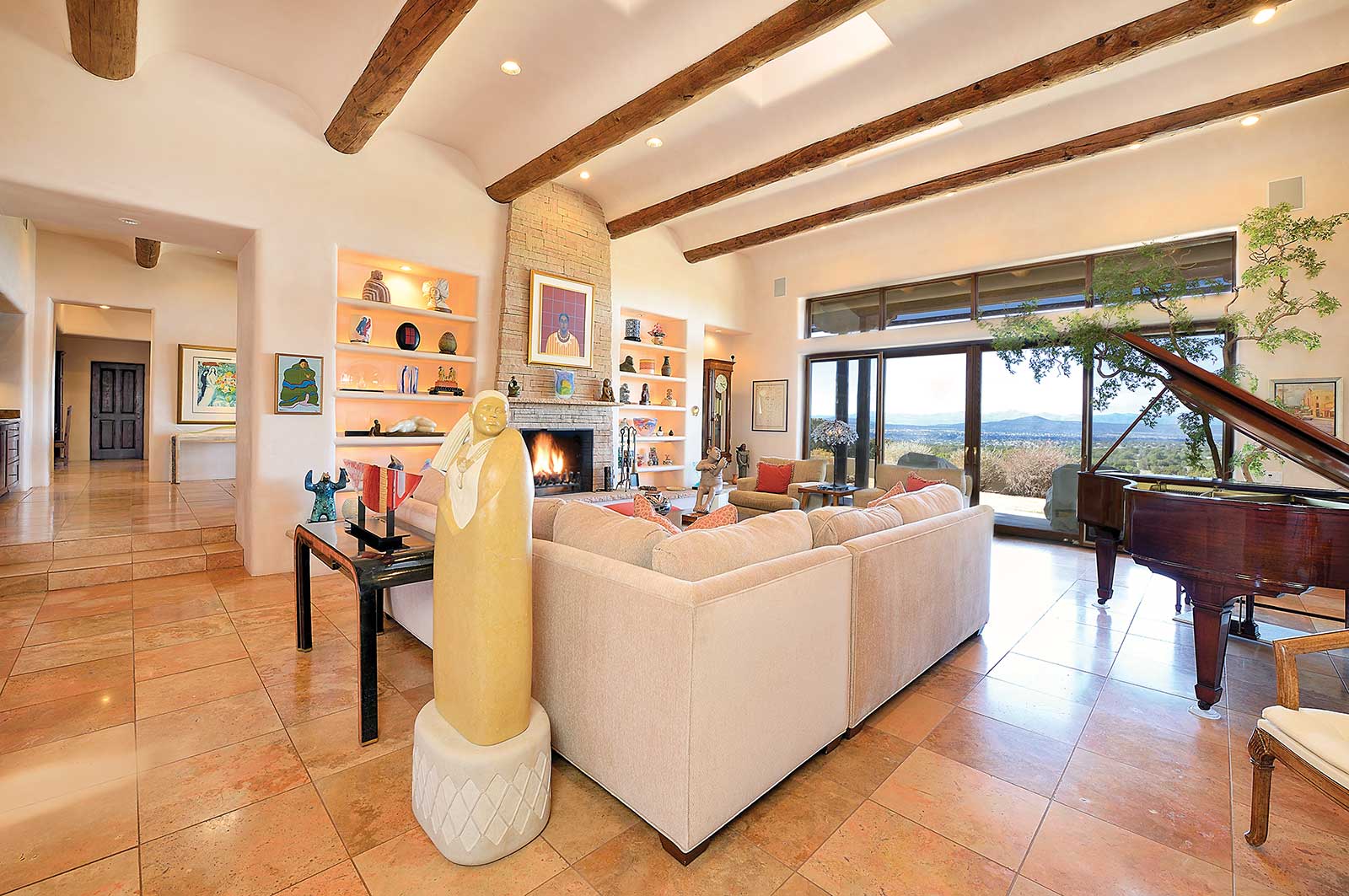 In the foreground is a stone sculpture by Rick Nez (Navajo). Next to it is a glass sculpture by Markian Olynyk. To the left of the shelves are limited edition tiles by R.C. Gorman (Navajo, 1931-2005). A painting by Nivia Gonzalez (1947-2017) hangs over the fireplace. Other works are by Felipe Castañeda, Frankie Lucero, Rebecca Tobey, Allan Houser (Chiricahua Apache, 1914-1994), Marvin Toya, Adrian Wall (Jemez) and Gregory Lomayesva (Hopi/Hispanic).
Harriet recalls buying her first work of art, a piece the couple still have in their collection, at a traveling art show at Sears. “My first job was at Sears in Pasadena which was in an upscale area of the San Gabriel Valley. The actor, art collector and art historian Vincent Price, contracted with Sears home office to hold a traveling art exhibition and sale of works of art from his collection for a few days in the store. I was in commission sales in the store and became part of the team to sell the art at the show. Price held a comprehensive training session on the basics of art, took us through the collection and made us familiar with each piece of art and the artists in the show. I saw a signed Picasso lithograph that I really liked but I couldn’t afford. I then opened my first charge account at Sears and purchased the piece.”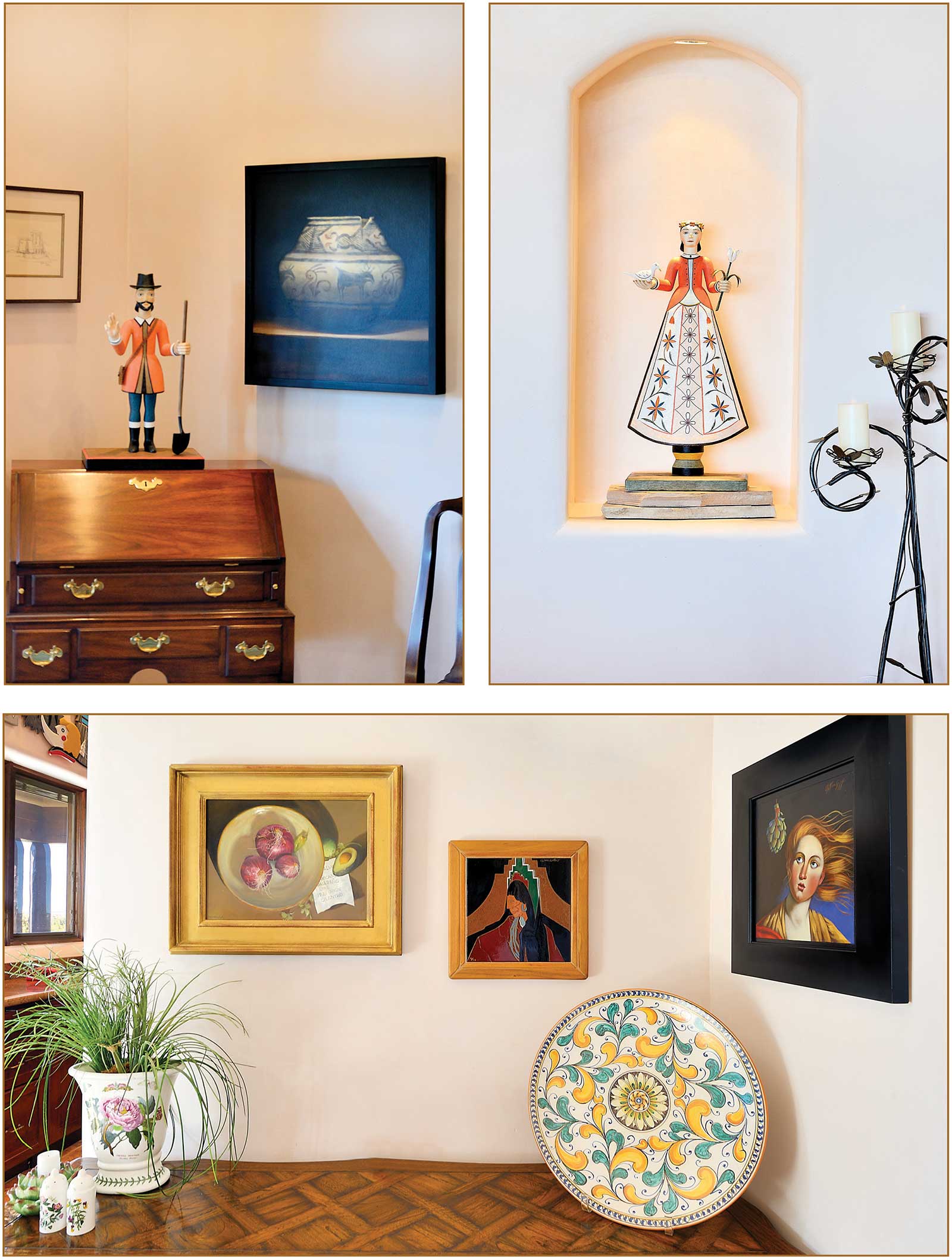 Top: A pair of wood church sculptures by Robert Cardinale. Bottom: Roseta Santiago’s Guacamole hangs next to a tile by Amado Peña (Pascua Yaqui). A painting by Kathleen Kinkopf is on the right.
Harriet and Karl say, simply, “We buy what we really like.” What they really like runs the gamut of the rich multicultural artistic heritage of Northern New Mexico, art of the Southwest, and art they have purchased on their world-wide travels.
Visitors to their home in Santa Fe are greeted in the driveway by Proud Sheep, a sculpture by Jill Shwaiko, “We saw her sculpture at her gallery in nearby Madrid and took a liking to her subject matter,” Harriet explains. “We thought it would look good outside our home, and it would be welcoming to our guests.” Jill brought the sculpture to the Schreiners’ home and helped them determine its placement. They then went to the rock yard to purchase the rock it sits on to complement the sculpture.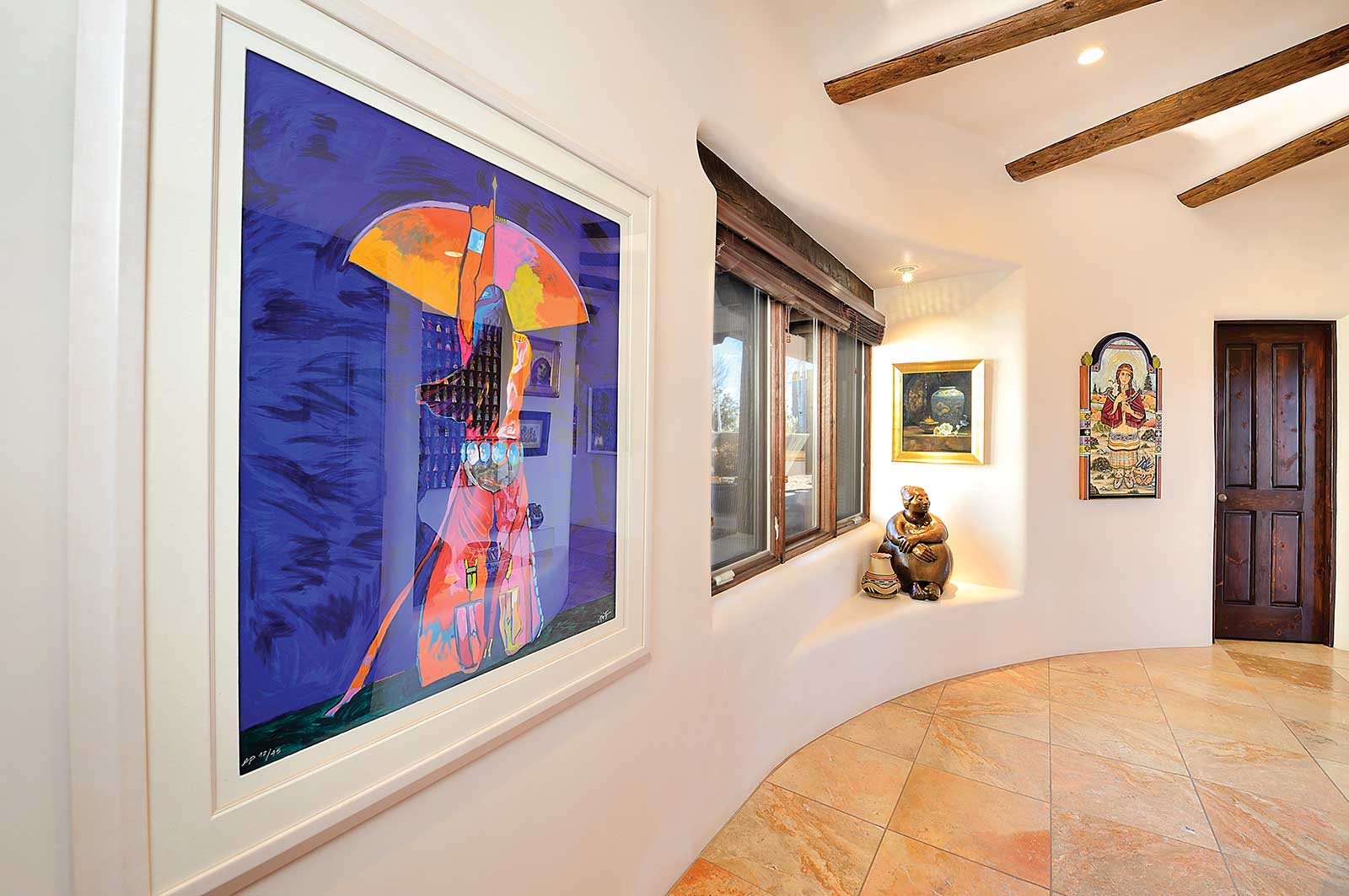 Plains Archer by John Nieto (Mescalero Apache/Navajo, 1936-2018) is on the left. Roseta Santiago’s Tibetan Teacup hangs above Martha Pettigrew’s bronze sculpture Esperando. A pot by Cavan Gonzales (San Ildefonso) is next to the Pettigrew. Arlene Cisneros Sena’s painting of Kateri Tekakwitha, the first Native American Catholic saint, hangs next to the door.
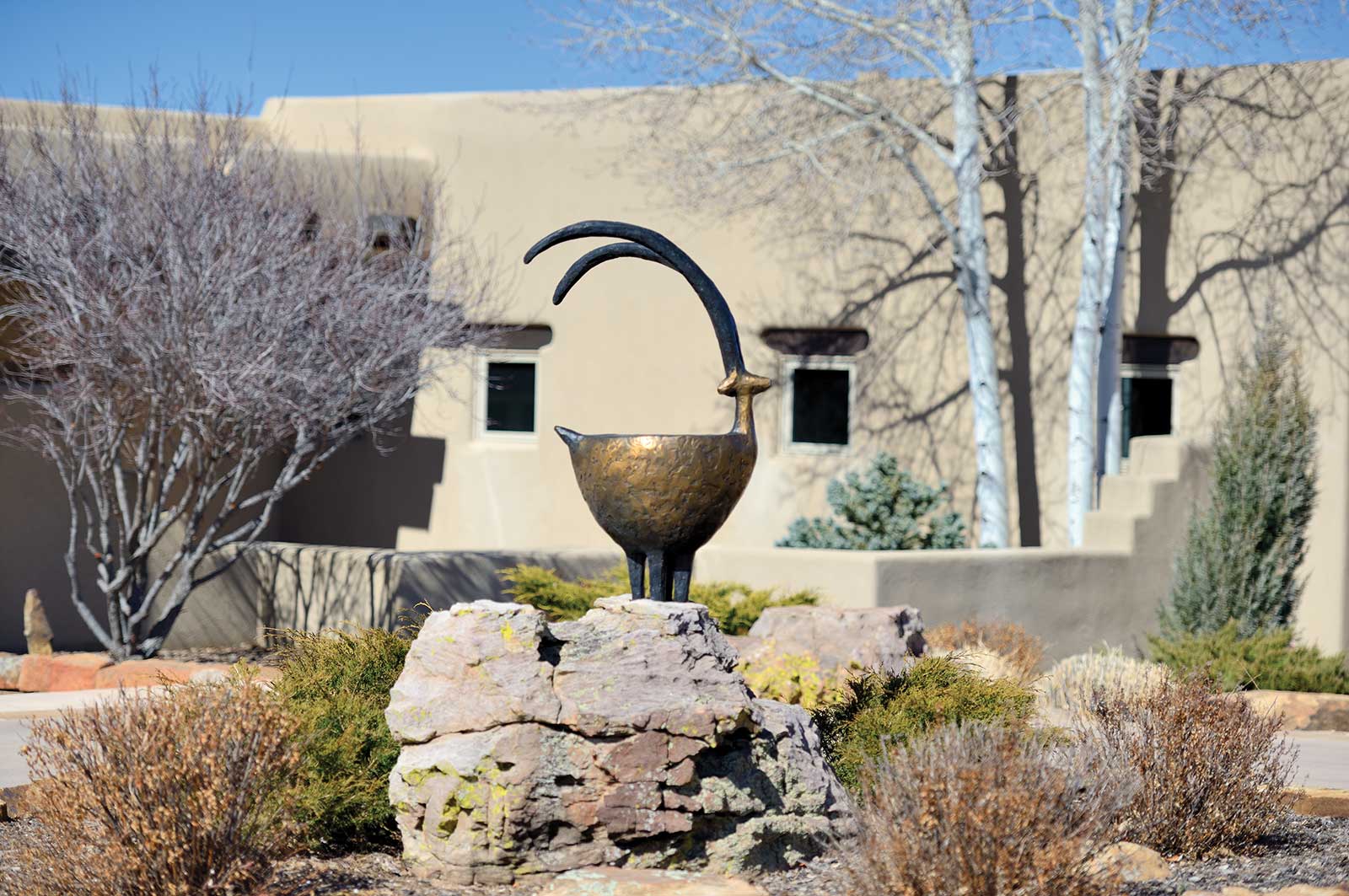 Jill Shwaiko’s bronze sculpture Proud Sheep greets visitors to the Schreiners’ home.
In 2012, Karl asked the board of the Santa Fe Symphony, of which he was a member, if he and Harriet could stage a fundraiser called Painted Violins to raise money for the symphony. They distributed 54 violins to invited noted artists who turned them into works of art in their own distinctive styles. The artists were predominantly from New Mexico and the Southwest, however Richard Whiteley, an important glass artist from Australia created a cast glass violin. They displayed the violins in their home and invited the artists to bring their collectors to view them. The gala and auction was a huge success, and the results made this event the largest fundraiser in the symphony’s history.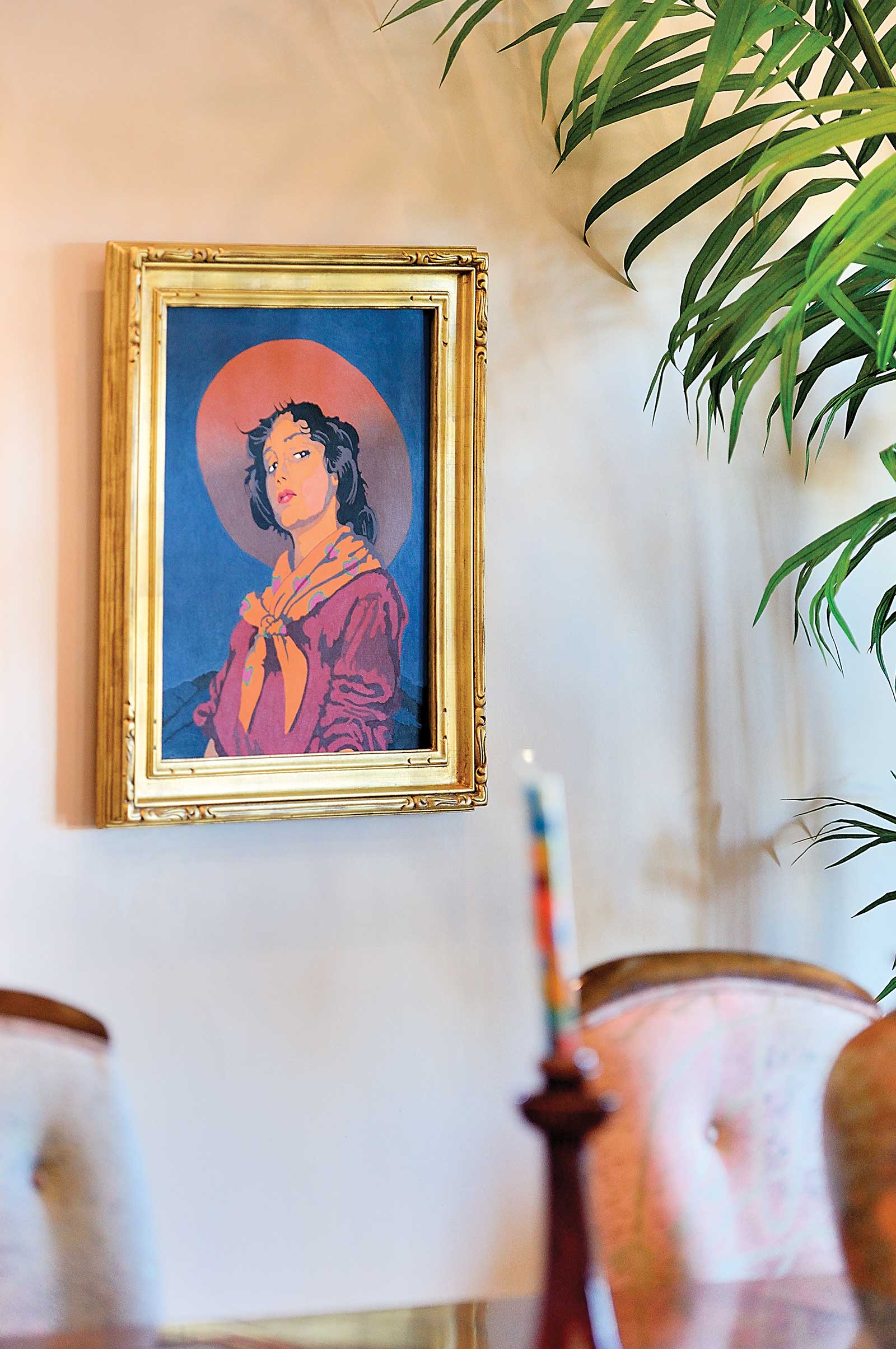 Billy Schenck’s painting is based on a vintage cowgirl poster.
They bid on Jim Vogel’s Serenade of the Deadly Nightshade which joins another Vogel piece in their collection. “Some of the artists only painted or decorated the front of the violin,” Harriet notes, “but Jim painted the entire violin, carved the hand on the finger board, and carved the leaf on the chin rest. We have it displayed so it can be turned to show both sides.”
There is another violin in their collection, a clay sculpture by Roxanne Swentzell (Santa Clara) called The Smallest Violin. They purchased the sculpture in a gallery in Arizona, and subsequently ran into Roxanne at the Heard Museum Guild Indian Fair & Market. They asked her about the inspiration for the piece and she replied, “My husband thought I whined too much and imitated of someone playing a tiny violin.”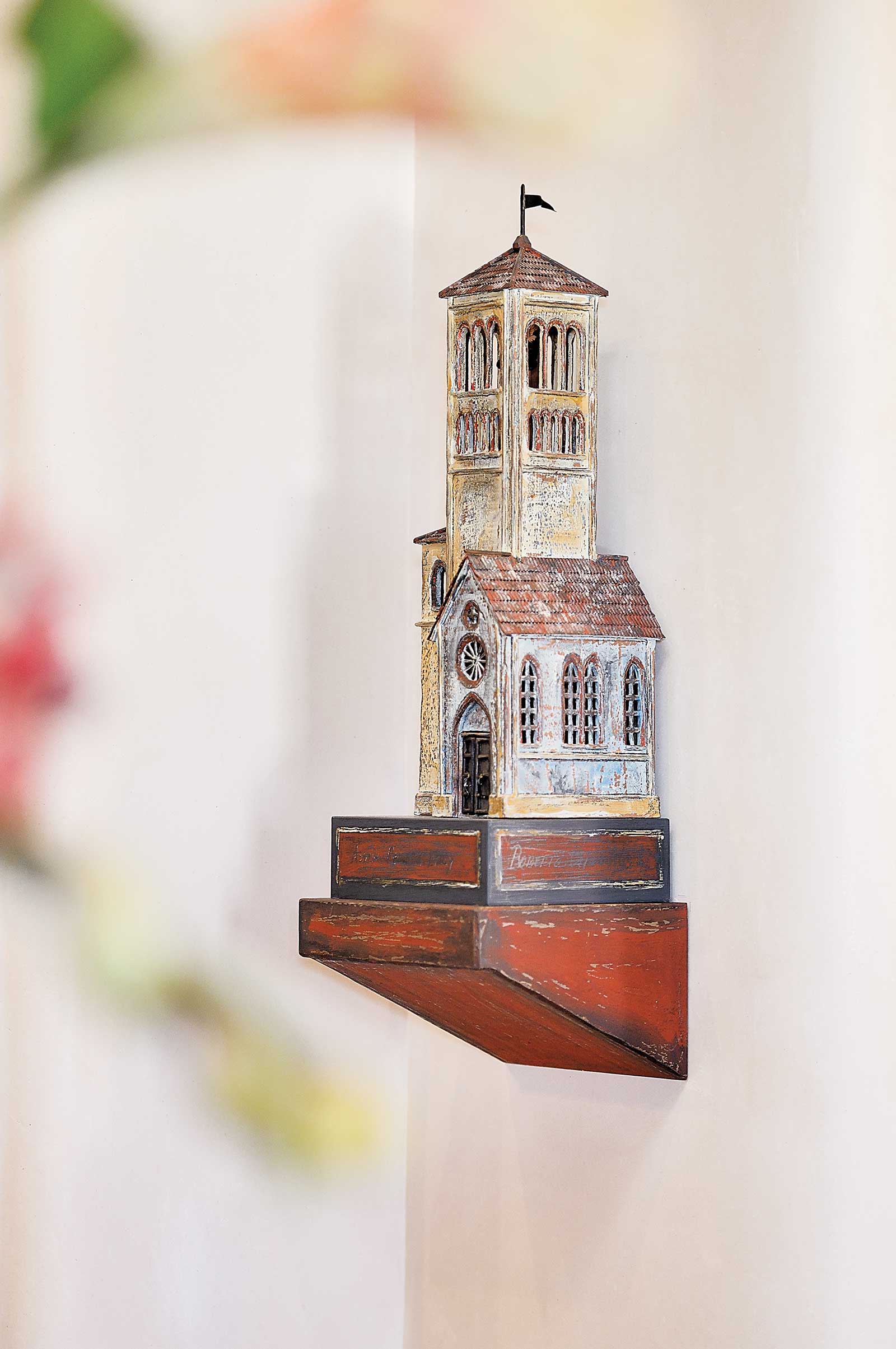 A wood church sculpture by Robert Cardinale.
The couple often invite artists over to see their work in the collection. They once invited Raymond Lopez to their home. Karl admires the artistic balance this artist brings to his carved and painted santos. “He’s a wonderful artist and his pieces are beautifully crafted. While he was here, he told us, ‘I forgot to sign one of my pieces.’ The next time he came to visit, he brought his tools, went out to the portal and carved his name on the bottom.”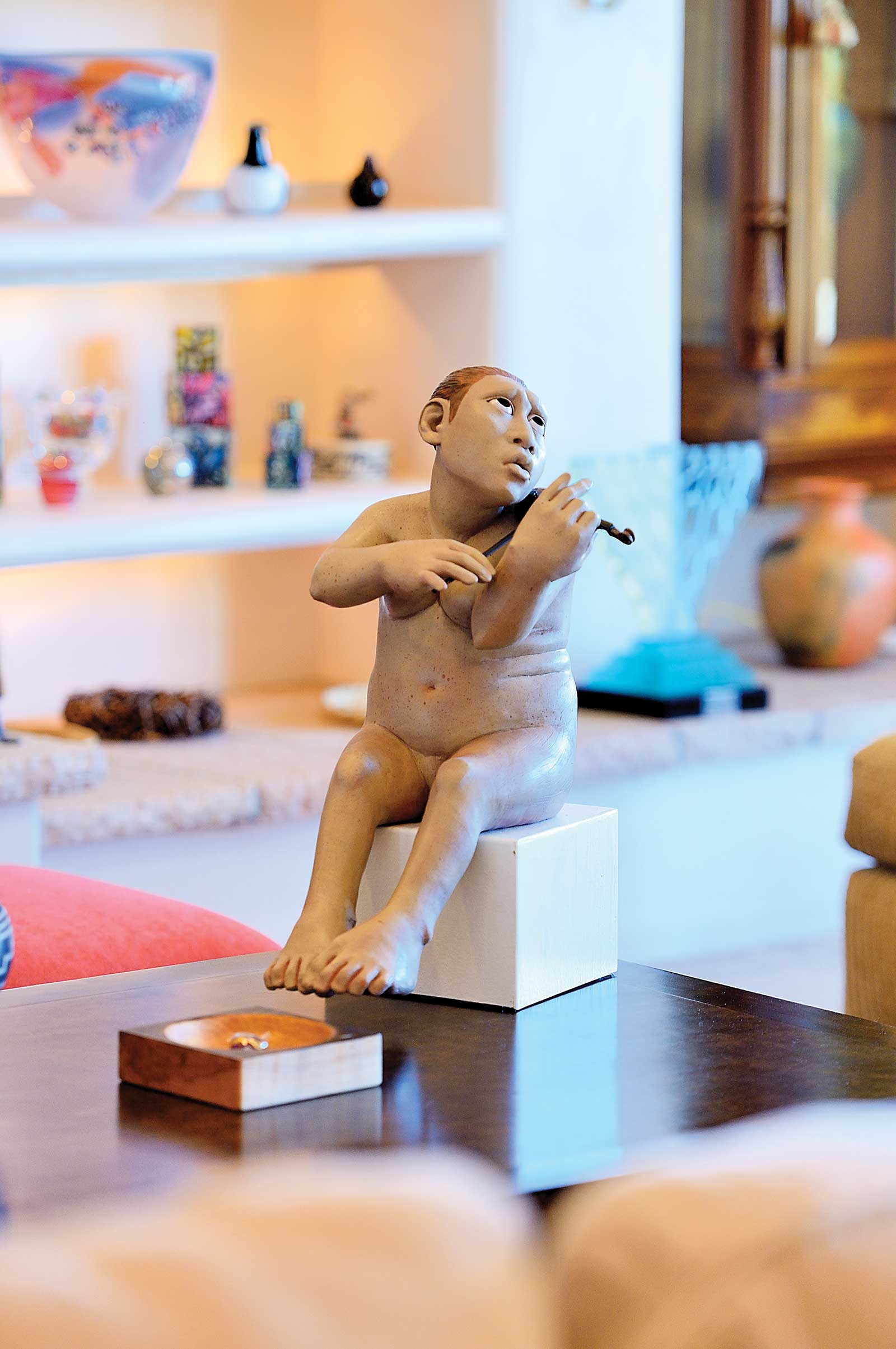 A clay sculpture, The Smallest Violin, by Roxanne Swentzell (Santa Clara) sits on a table.
One of the Schreiners’ favorite artists and good friend is Roseta Santiago. They were attracted to her work in a Santa Fe gallery “because of the beautiful, realistic and haunting subject matter. Each piece needs to be studied to determine in one’s own mind what the story is behind the composition.”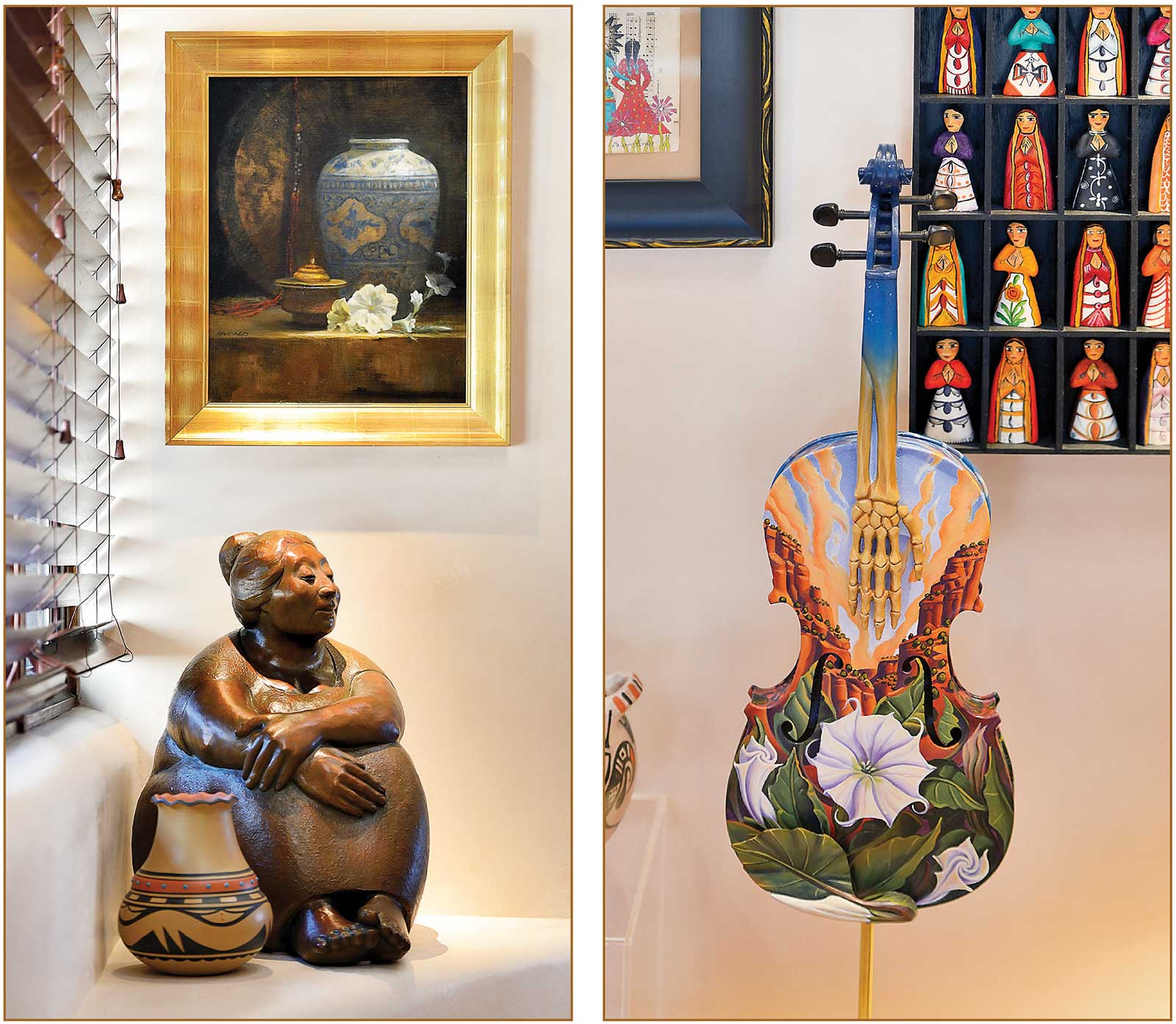 Left: Roseta Santiago’s Tibetan Teacup hangs above Martha Pettigrew’s bronze sculpture, Esperando. A pot by Cavan Gonzales (San Ildefonso) is next to the Pettigrew. Right: Jim Vogel’s painted violin, Serenade of the Deadly Nightshade, stands in front of Marie Romero Cash’s 100 carved and painted Madonnas.
On the wall behind Jim Vogel’s violin is a shadow box displaying 100 carved and painted Madonnas they commissioned from Marie Romero Cash, noted Santera. Marie called them when she had completed 50 Madonnas and wondered if that was enough. They gently let her know that they wanted 100. The finished shadowbox is a centerpiece of their collection.
James Koehler (1952-2011) spent 10 years as a Benedictine monk before turning to tapestry weaving. He said, “Whatever it was that drew me to the rhythms of monastic life, also drew me to the rhythms of the loom and to the rhythms of life as an artist/weaver.” He had displayed the weaving that the collectors chose, horizontally. When Karl asked him what he thought about displaying it vertically, he thought for a bit and agreed it worked that way too.
Karl says, “We move pieces around from time to time to get a different look.” Harriet adds, “I like the feeling the collection gives. I get a lot of pleasure out of it, and appreciate it every day.”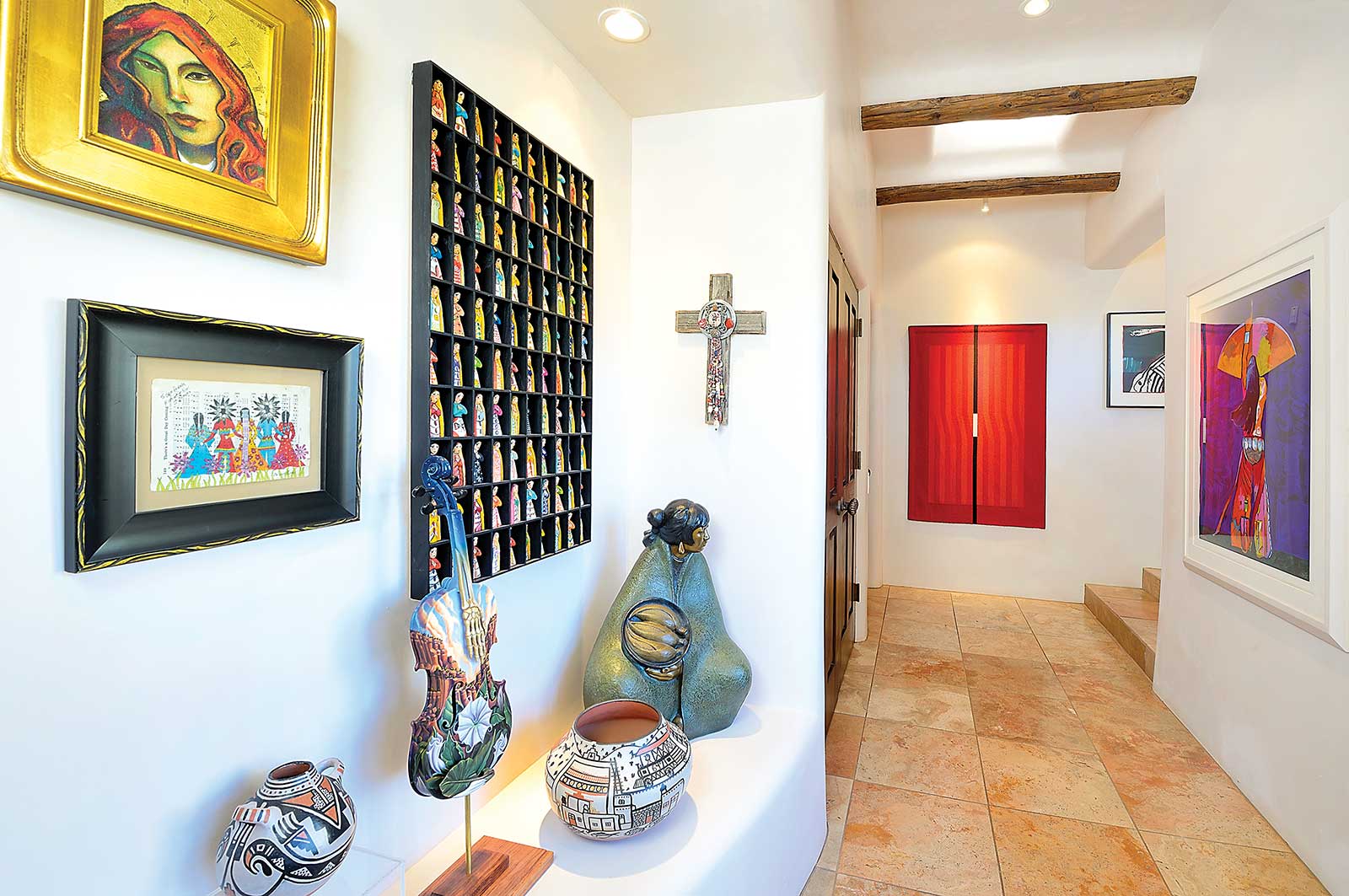 The weaving at the end of the hall is by James Koehler (1952-2011). Other artists include Miguel Martinez, Dolores Purdy (Caddo), Robert Tenorio (Santo Domingo), Jim Vogel, Marie Romero Cash, Martha Pettigrew and Nance and Ramón José López.Karl offers advice to beginning collectors. “Buy what you like and can afford. It is important to enjoy your collection and make it part of your everyday life.” They have developed an appreciation for what they consider a great artist in his or her own medium, even if they are unknown. “Our goal is to collect for personal enjoyment in the here and now.” —
Powered by Froala Editor