Business relationships in the art world can be as tumultuous as the market itself, especially when it comes down to galleries and artists. Artists can outgrow galleries, galleries can outgrow artists, galleries close and new inviting ones open, artists hit hot streaks (or fall into slumps), the market goes up and down.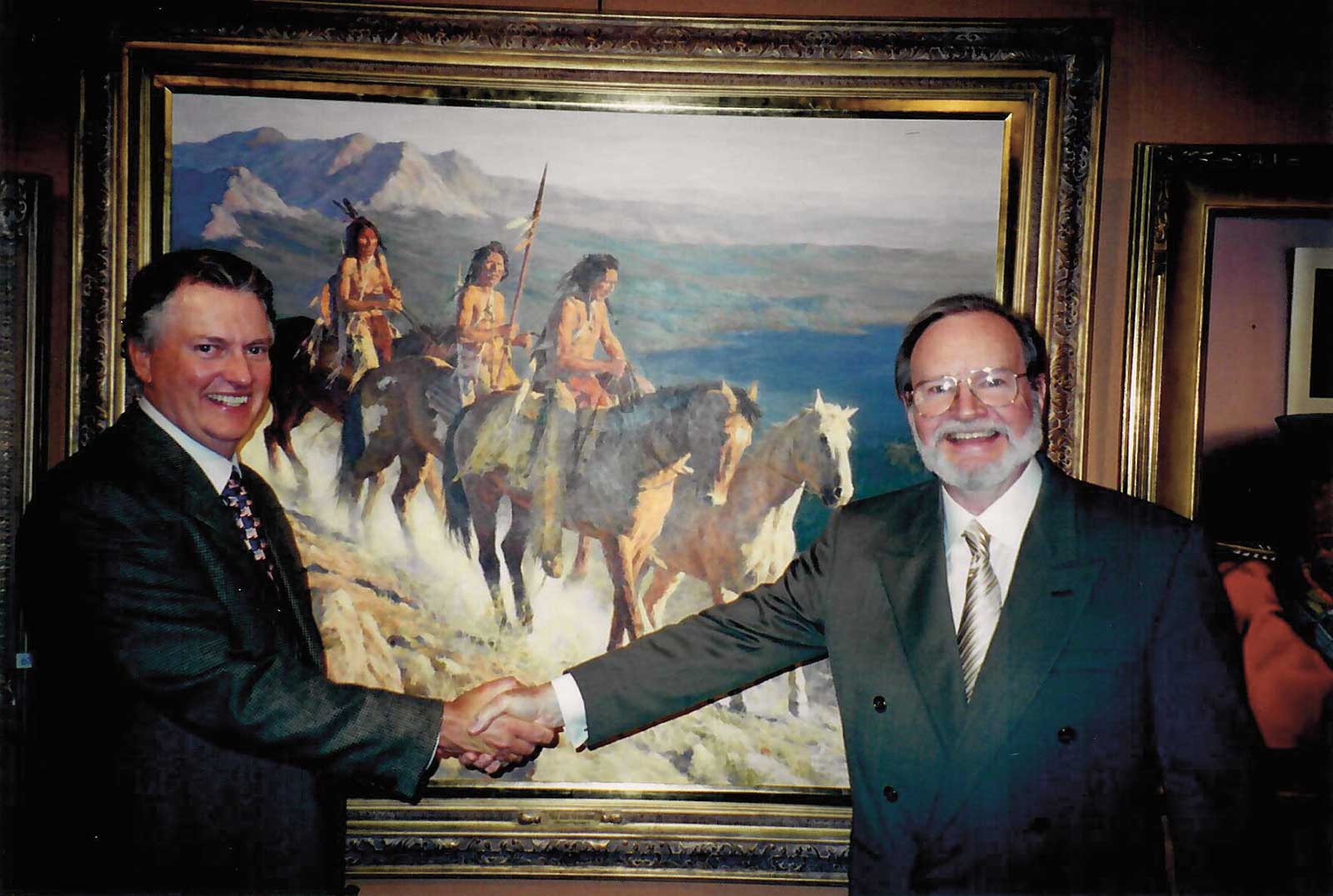 Settlers West Galleries owner Stuart Johnson, left with Howard Terpning in 2001. On the wall is Trail Along the Backbone.
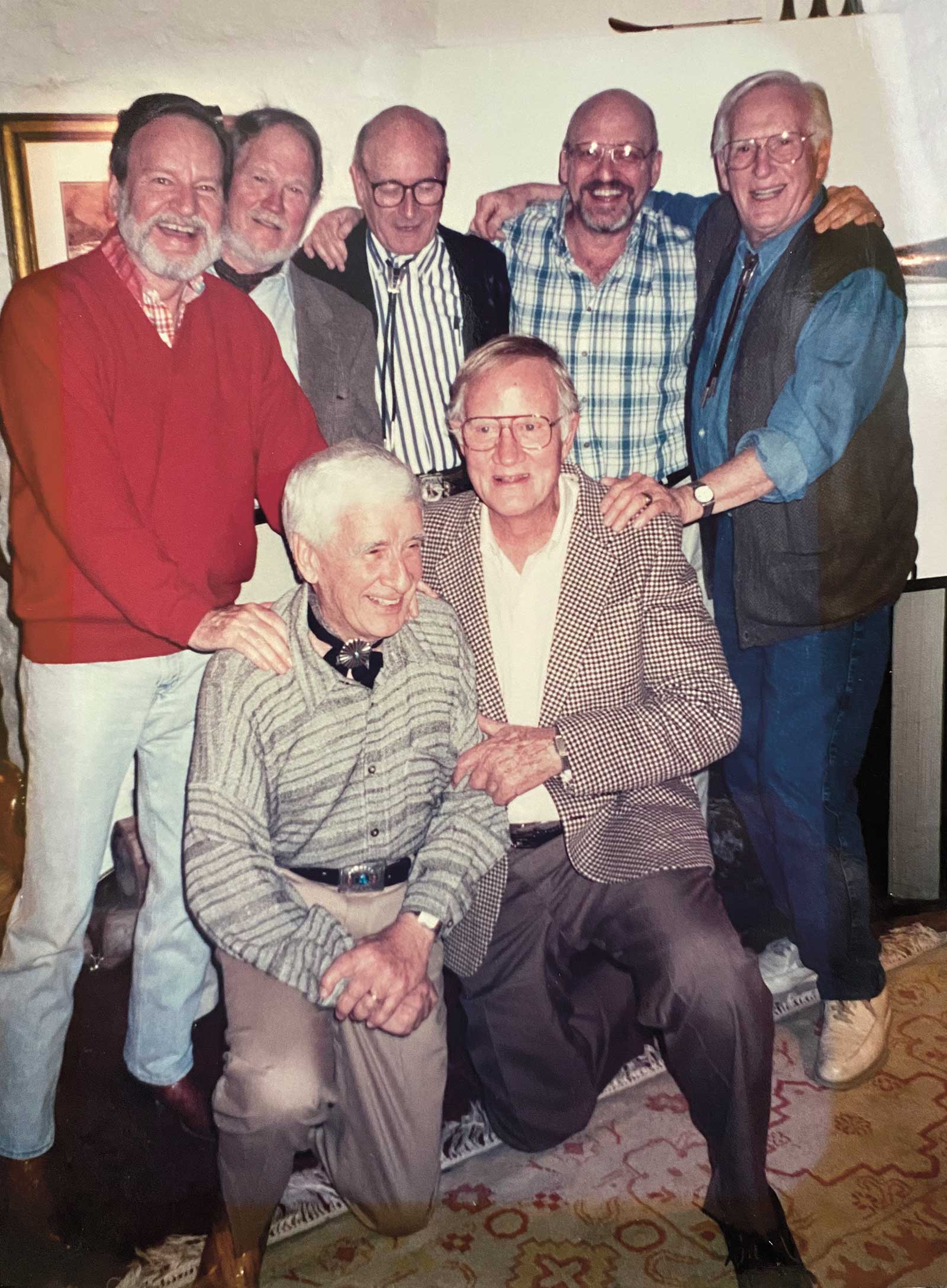 The Tucson 7: Howard Terpning, standing left, Bob Kuhn, Don Crowley, Harley Brown and Duane Bryers, with Ken Riley, left, and Tom Hill kneeling in the front. Stuart Johnson represented all seven members of the group.
It’s noteworthy when an artist and a dealer can stay together for even 10 years, so it’s even more remarkable when two people can maintain a working relationship for more than 45 years, which is how long painter Howard Terpning and Settlers West Galleries owner Stuart Johnson have been showing and selling artwork together. “It is remarkable, isn’t it? And even a little puzzling,” Terpning says with a laugh. “I guess Stu and I must like each other. After all the years we’re still friends.”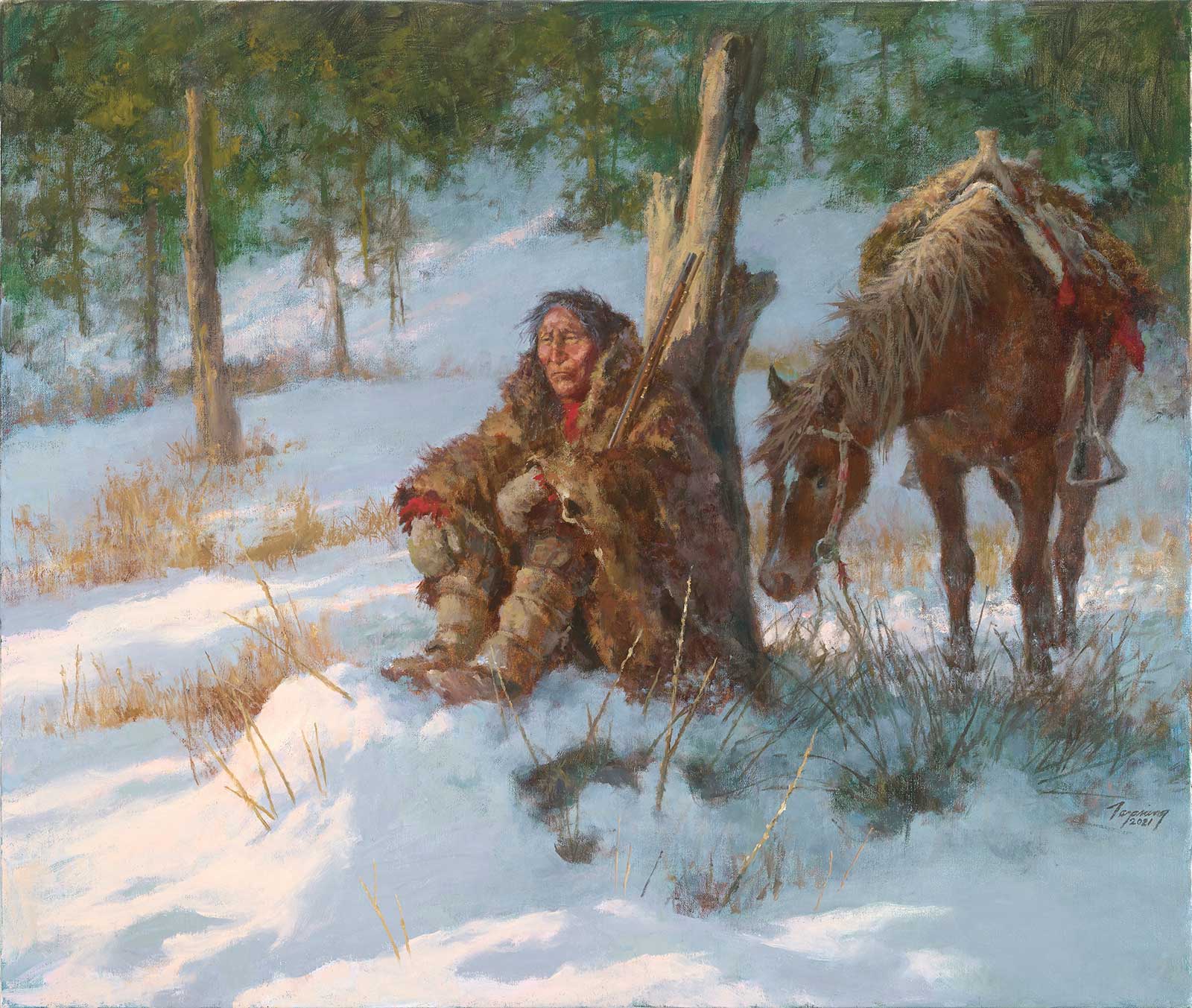 Howard Terpning, No Meat for the Lodge, oil, 34 x 40”. Available at The Great American West, Settlers West Galleries, November 20, 2021.
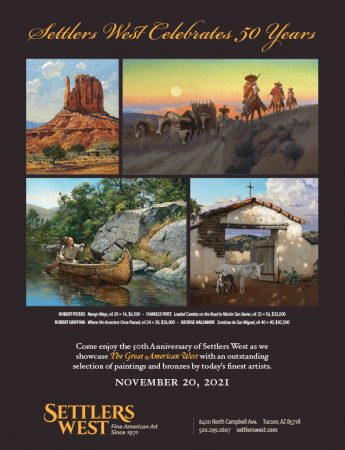
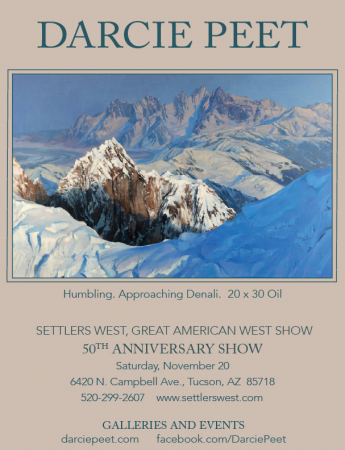
Their friendship almost overlaps completely with that of Settlers West itself, which is celebrating its 50 anniversary this month. Johnson started the gallery in 1971 after coming out to the West from Chicago. He almost bought a curio shop in Alberta, Canada, but when that fell through all roads started pointing to Tucson, Arizona. He scraped together some money—his mother contributed $1,000—and he started Settlers West, named after a W.H.D. Koerner painting. “I remember we had this little 1,000-square-foot place with paper on the windows and there I was with my coat and tie waiting on customers on August 1, 1971, the first day. And no one showed up. At one point at about 11 a.m. the bell on the door rings and it’s the mailman looking for the previous tenant,” he remembers. “I think I had $27 on me by the end of the week.”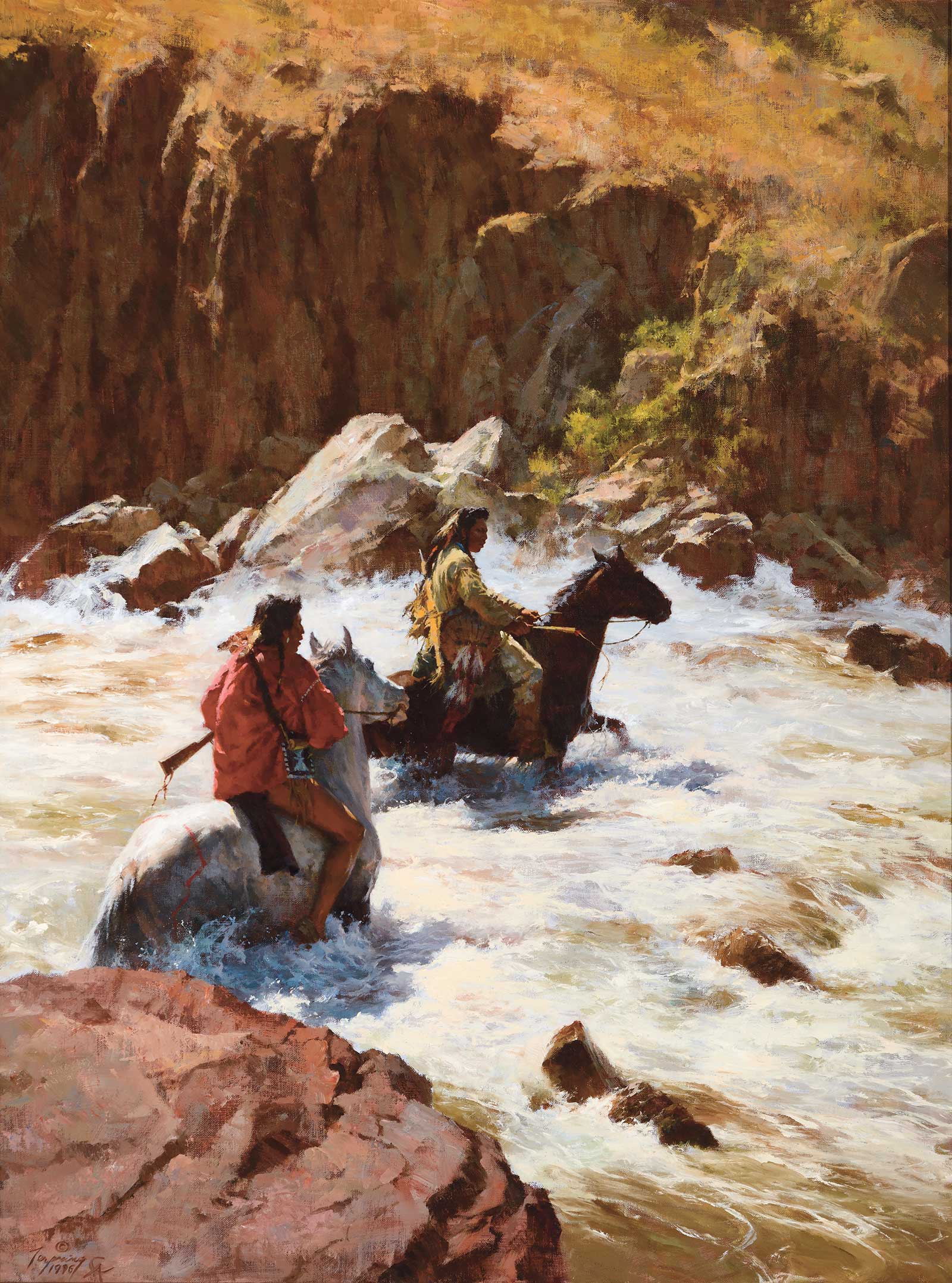 Howard Terpning, Bad Medicine Crossing (detail), oil, 40 x 30”. Sold at Settlers West Galleries, November 1996.
Johnson plugged along, though, and even took an overnight administrative job at the university hospital in Tucson. After he got off work at 7 a.m., he’d take a nap before heading down to the gallery, which was costing him $137 a month in rent at the time. Early artists included Nicholas Wilson and then Harley Brown, who was given the gallery’s first major show. Later he heard about a talented artist who had moved to Tombstone, a former illustrator named Ken Riley. He scooped up Riley, and then also Tom Hill and Duane Bryers.
It was sometime around 1975 when he had his first run-in with a Howard Terpning painting. Johnson was stopped at a red light on Campbell Avenue in Tucson, and he looked over and there were these magnificent paintings in the shop window. “It took me by surprise, so much that I almost hit the car in front of me. The owner was sort of getting out of the business so he let me rent his space and he suggested I reach out to Howard,” he says.
“I jumped at the chance.”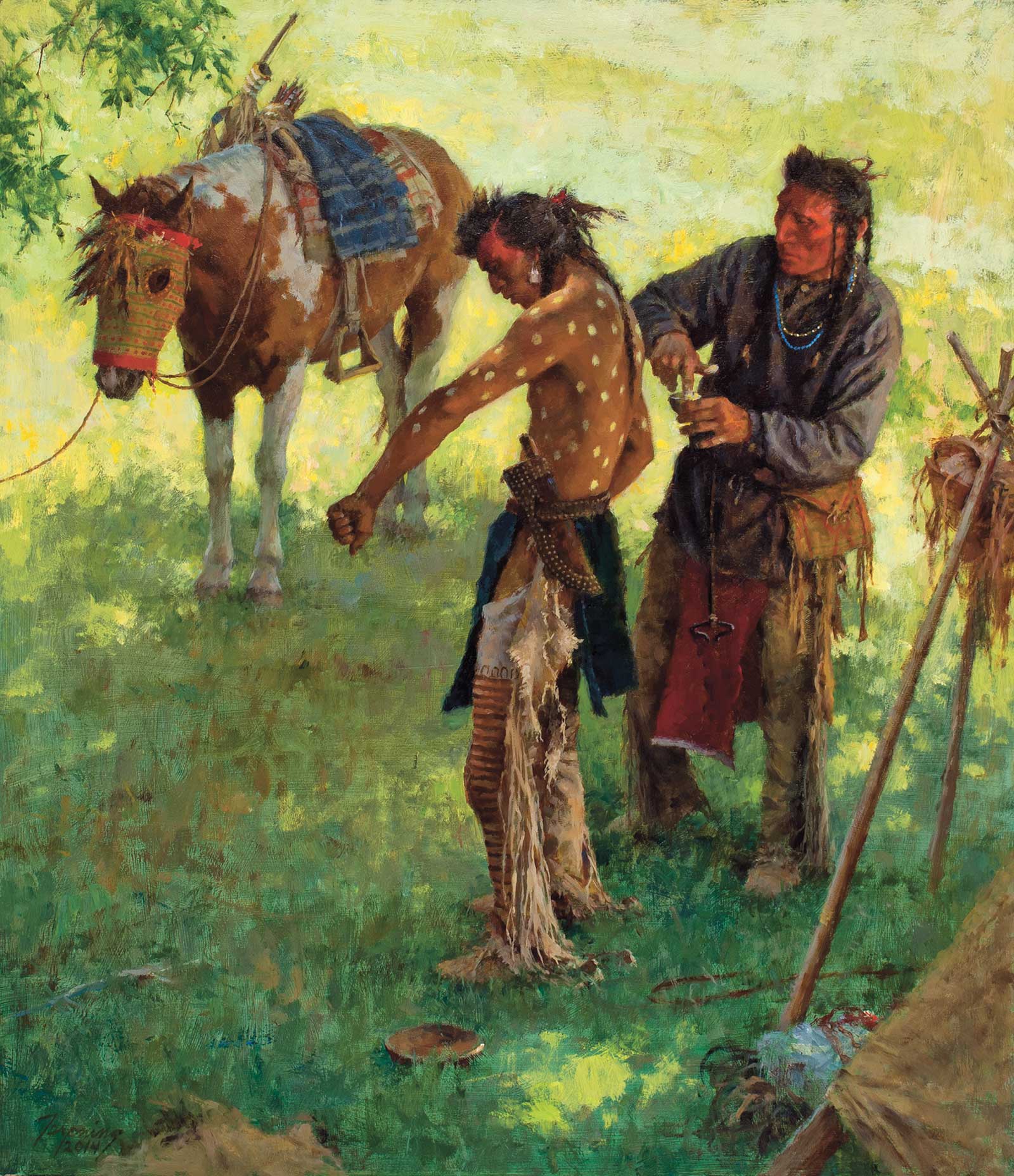 Howard Terpning, Hail Stones, oil, 29 x 25”. Sold at Settlers West Galleries, November 2014.
Terpning was living in Connecticut at the time and working as an illustrator for a variety of clients in New York—from magazines to movie studios. “I was bored stiff of commercial illustration, so I had sent these three paintings to this fellow in Tucson. He was an artist and had no experience with a gallery, so they hadn’t sold, but that’s when Stu saw them,” Terpning recalls. “After connecting with Stu on the phone, he said he was coming out to New York and we agreed to meet on a corner in the city and go to a museum together. Well, it was Monday and the museum was closed. So we just spent the afternoon getting to know each other.”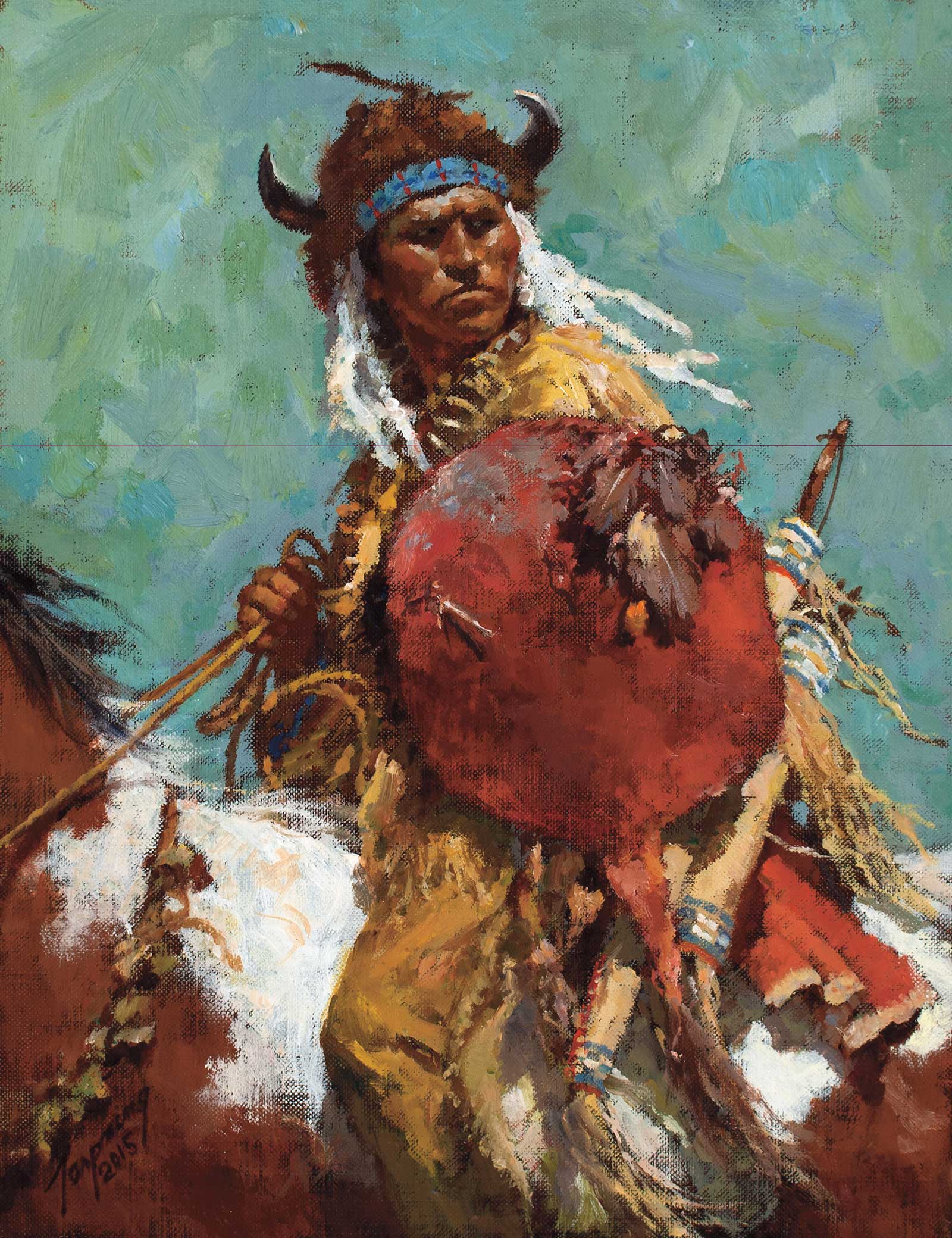 Howard Terpning, Cheyenne Red Shield, oil, 13 x 10”. Sold at Settlers West Galleries, February 2016.
The two hit it off and agreed to start working together. The business arrangement was almost immediately successful. Once the artworks started arriving at Settlers West they quickly found new collectors. Johnson remembers early paintings selling for $1,000 to $1,500, and then being surprised that one sold for $1,800. Of course, those prices wouldn’t stay that low for long, for Terpning or for Settlers West’s other artists. “It was around 1976 or 1977 that we started the Great American West show. Back then we used to have people line up in front of the gallery until the show opened, and then 50 people would come in to take a ticket off the wall to show that’s what they wanted to buy. It was something wonderful watching people rush into the gallery,” Johnson recalls. “In later years, as Howard’s works started going for more and more, we agreed to do a silent bid format for his paintings because people were buying them and immediately selling them again. He really wanted collectors to end up with the works as opposed to a dealer. Overall, Howard was very cautious about raising his prices. He wanted it to be very gradual. I mentioned once he was on the verge of a $100,000 sale and he thought I was crazy. But shortly thereafter it happened.”
Terpning, who had made the move to Tucson permanently by 1977, was then, and still today, flabbergasted that his work was so well received. “I can’t really remember the shows, but I remember I did quite a few pieces that turned out to be important for collectors. And the response from everyone was very rewarding. It was nice to know my work was appreciated,” the artist says. “And then to get this friend out of it all was really nice too. Still after all these years, Stu and I are hanging out.”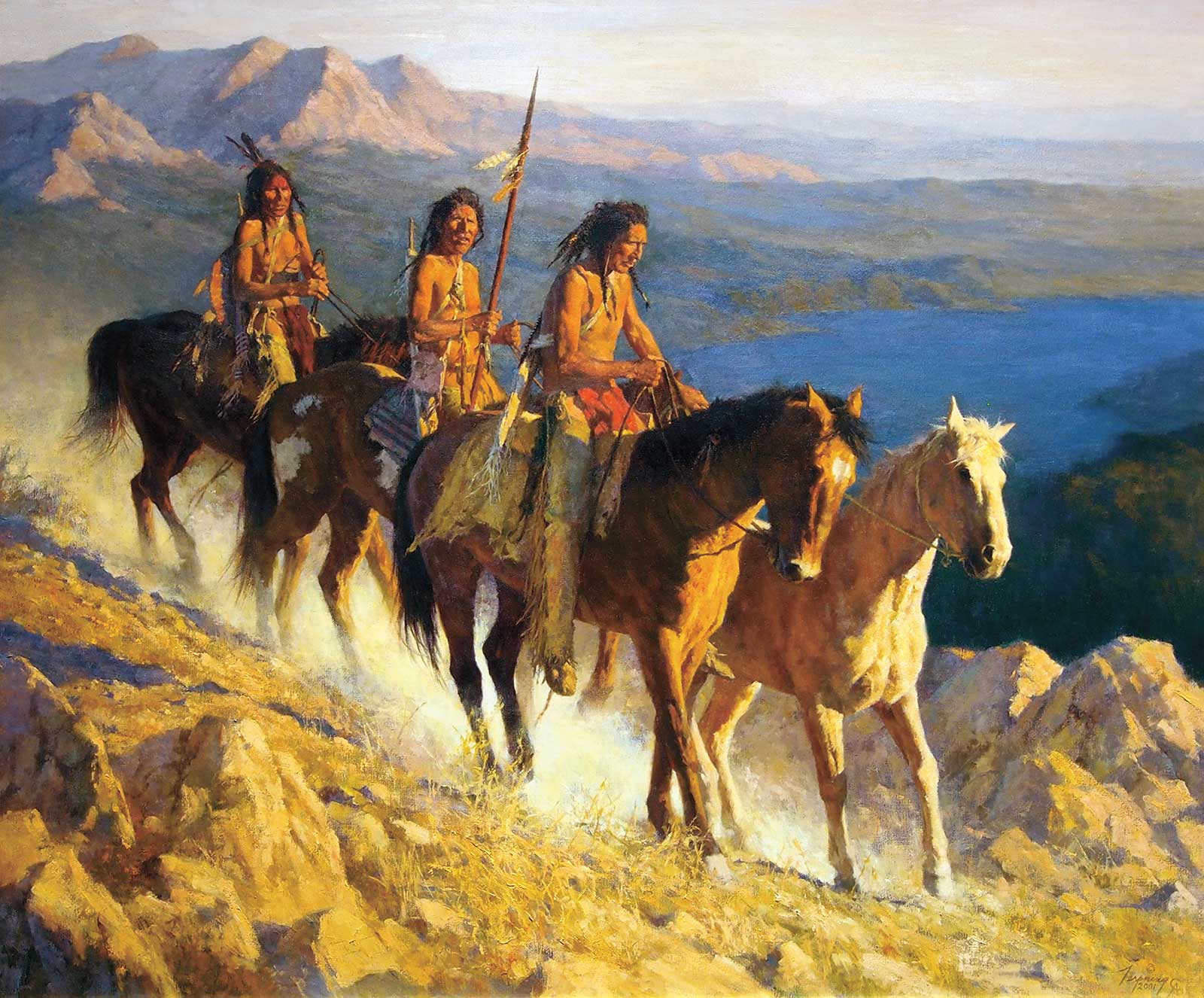 Howard Terpning, Trail Along the Backbone, oil, 46 x 56”. Sold at Settlers West Galleries, November 2001
Not only has Terpning showed at almost every single Great American West show—including this year’s 50th anniversary event—but he and Johnson have accompanied each other to art events, museum exhibitions, rendezvous-type gatherings and Cowboy Artists of America trail rides. “I’ll never forget the year he showed some paintings for the CA,” Johnson remembers. “They didn’t know Howard from beans, but by the next year he was a Cowboy Artist.” The two have also bonded over their love and respect of Native American history and culture, particularly the Plains People that so frequently are subjects in Terpning’s paintings.
“As a kid I had a great interest in Native American life and history, to the point that I started collecting beadwork and then developing a deeper interest in the Blackfeet. When I met Howard and then saw the kind of work he was doing, I knew it was going to impress me because I had the same interests,” Johnson says. “What made Howard’s work so different was his pursuit of knowledge. His paintings had a different kind of feel to them. He was really putting his heart into the work and the research. And he was such a craftsmen too. It’s amazing to think he came out West as the highest-paid illustrator in New York. He gave up a lot of security to come out here to do his Western work. At one point he kept getting calls from his agent because they wanted him to do this Clint Eastwood movie poster. But he knew if he took it he would be right back in the mix with illustration. And he turned it down. He turned it down because he wanted to tell these great stories about
Native Americans.”
From Terpning’s perspective, he certainly enjoyed their shared interests, but he also valued Johnson’s character as an art dealer. “Stu has always been fair and he has always been honest,” the artist says, reflecting back on 45 years of history. “All these years, he’s also been a great friend.” —
Powered by Froala Editor