The University of New Mexico Art Museum reopened this summer after an 18-month pandemic-caused closure. Fittingly, it is honoring one of the university’s own as it once again welcomes visitors into its galleries.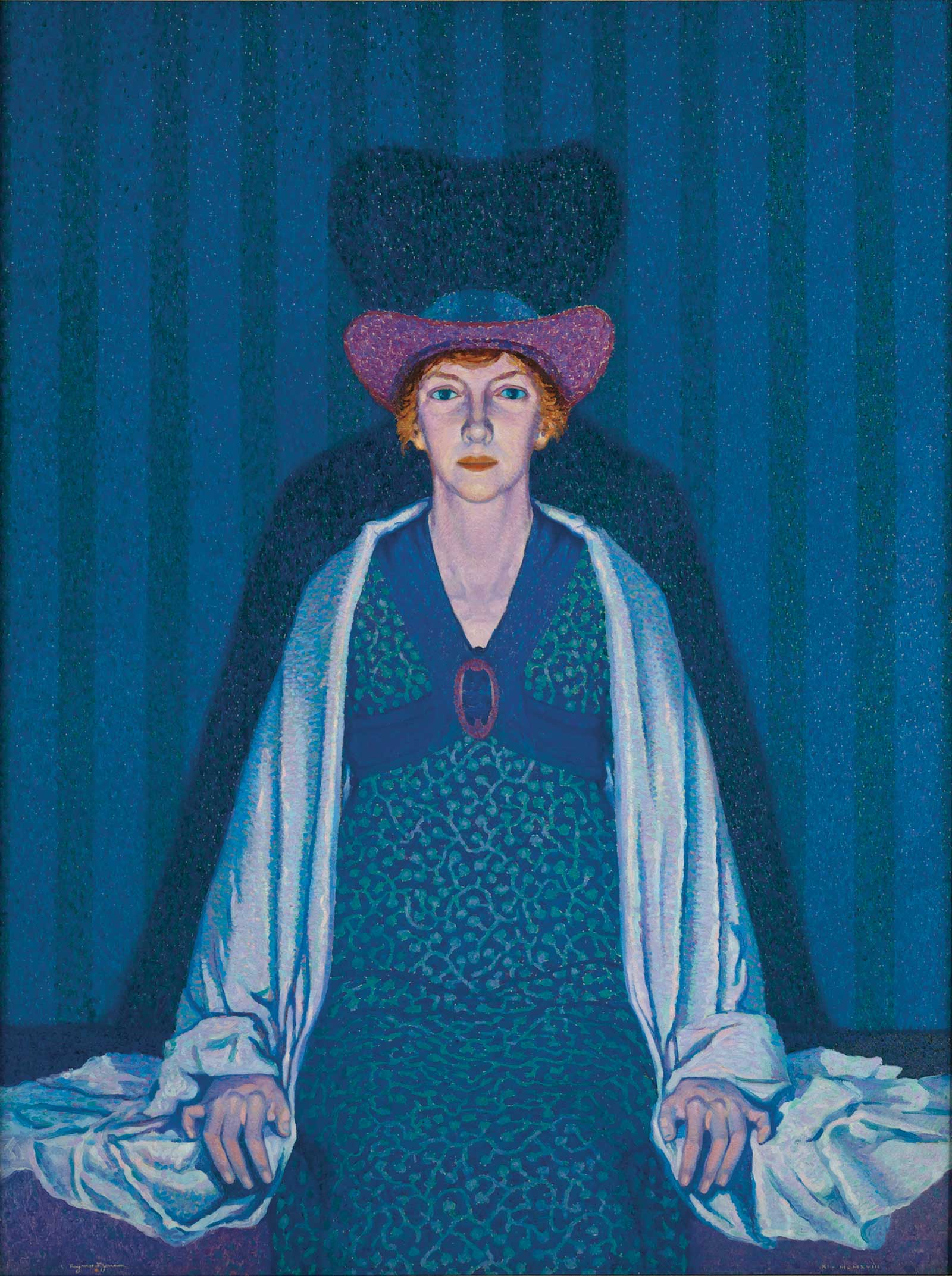 Violet Light (The Artist’s Wife, Vera), 1918, oil on canvas. Bequest of Raymond Jonson, Raymond Jonson Collection, 82.221.0028.
Raymond Jonson (1891-1982) had visited Santa Fe on a sketching trip and returned permanently in 1925 determined to make his paintings “an expression of sensation, rather than as a reflection of environmental appearances.”
In 1934, he became a part-time instructor at the University of New Mexico. He became a full professor in 1949. The following year, the university built the Jonson Gallery which became his home and studio as well as a teaching gallery. In 1938, he and a group of like-minded artists formed the Transcendental Painting Group “to carry painting beyond the appearance of the physical world, through new concepts of space, color, light and design.”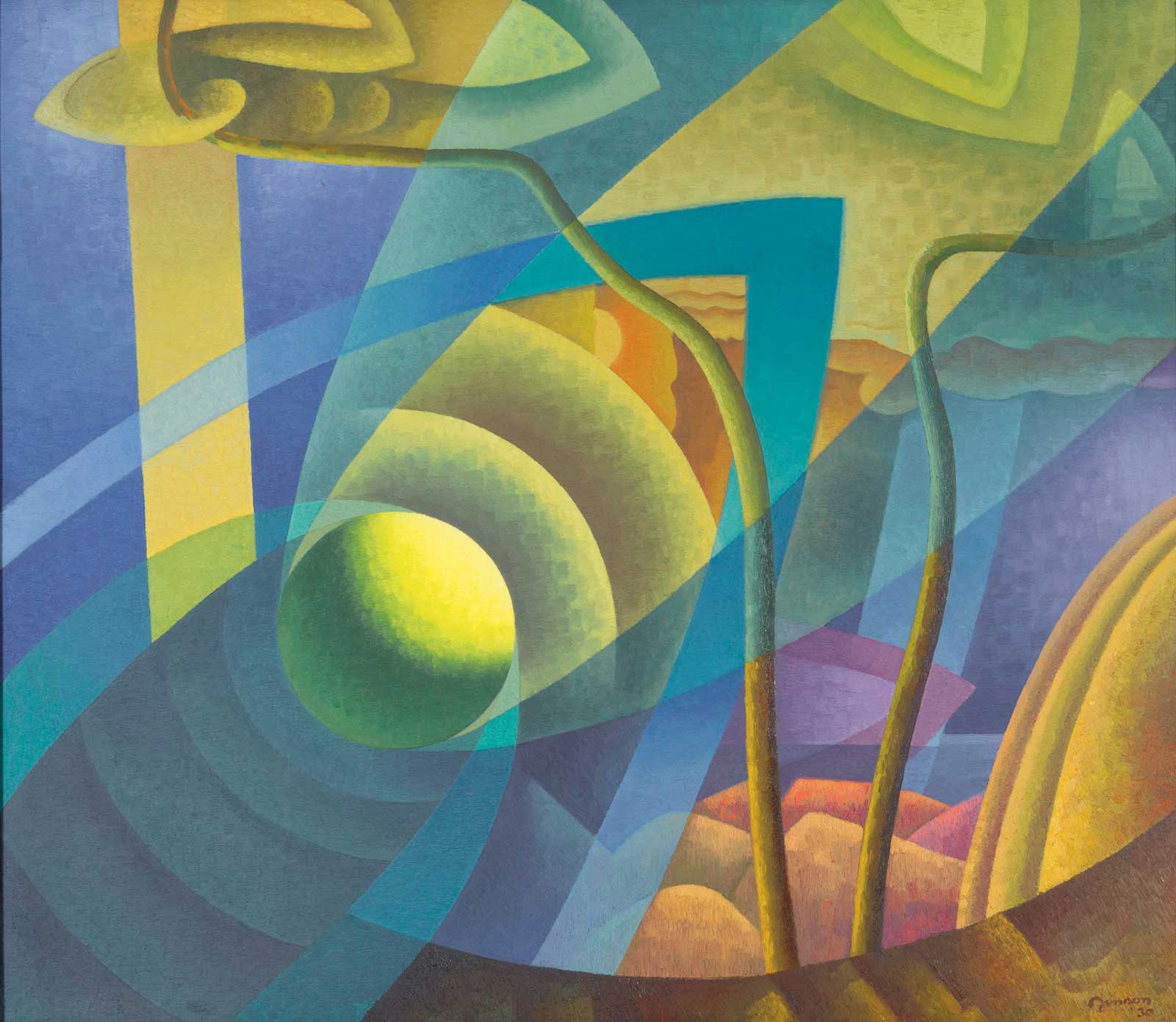 Time Cycle (Morning), 1930, oil on canvas. Bequest of Raymond Jonson, Raymond Jonson Collection, 82.221.1899.
The exhibition, Visionary Modern: Raymond Jonson Trilogies, Cycles, and Portraits, continues through November 24. The museum explains that it “contains 14 trilogies and cycles, each containing three paintings, that were made between 1918 and 1973. Jonson embraced the notion that the sum is greater than its parts, creating multi-canvas works because he believed a single painting could not represent vast subjects like the Grand Canyon. He also used trilogies and cycles to express the depth of feeling he experienced while exploring and living in the Western landscape.”
For those museum visitors familiar with Jonson’s more abstracted non-objective work, a pleasant surprise is a painting from early in his career, Violet Light (The Artist’s Wife, Vera), from 1918. Vera was secretary of Chicago Little Theatre where Jonson worked as stage designer, stage manager and scene painter. In an article for the Journal of the Illinois Historical Society, the writer notes, “His involvement with modernist theater design had a profound, enduring impact on his painting. It affected his understanding of the emotive, expressive possibilities of color and light, his awareness of flattened, abstracted forms, and his ability to manipulate space and depth.”
The paintings in his first trilogy, Time Cycle, 1930, show his shift toward non-objective abstraction. 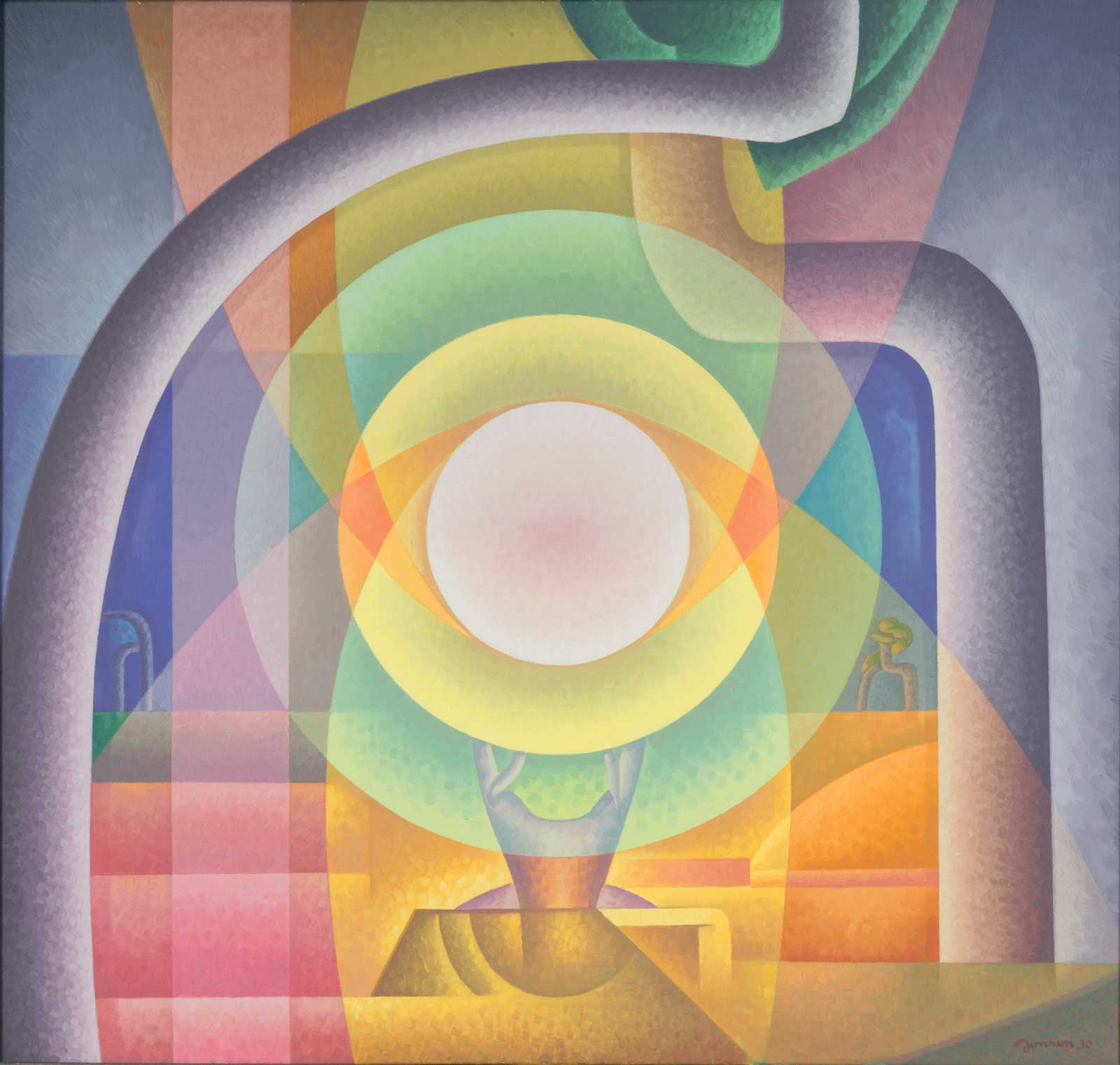 Time Cycle (Noon), 1930, oil on canvas. Bequest of Raymond Jonson, Raymond Jonson Collection, 82.221.1900.
In a 1964 interview with Van Deren Coke, the museum’s founding director, Jonson said, “Around us we have realism, strife, pain and greed. I wish to present the other side of life, namely the feeling of order, joy and freedom. By setting up my own plastic means I can at least thrill to the attempt of establishing some fundamental principles that are universal and enduring.”
Jonson is in the middle of a renaissance right now as he’s also one of the subjects of a new exhibition on the Transcendental Painting Group. Another World: The Transcendental Painting Group: 1938-1945 is now open at the Philbrook Museum of Art in Tulsa, Oklahoma. Jonson was one of 11 members of the influential group. —
Visionary Modern: Raymond Jonson Trilogies, Cycles, and Portraits
Through November 24, 2021
University of New Mexico Art Museum, 203 Cornell Drive NE, Albuquerque, NM 87106
(505) 277-4001, artmuseum.unm.edu
Powered by Froala Editor