Born and raised in Utah, Brett Allen Johnson began to fall in love with the vastness of the western landscape on family trips to Sedona, Arizona, to visit his grandparents. “My family valued the natural world,” he says. “I’ve always been inquisitive about the nature of our world and the universe. Those trips to Sedona were a formative experience and imprinted the Southwest on my mind. In the big spaces of the West you can stand and contemplate the vastness. There are parts of life that we can’t understand or fathom but what you can’t know is there.”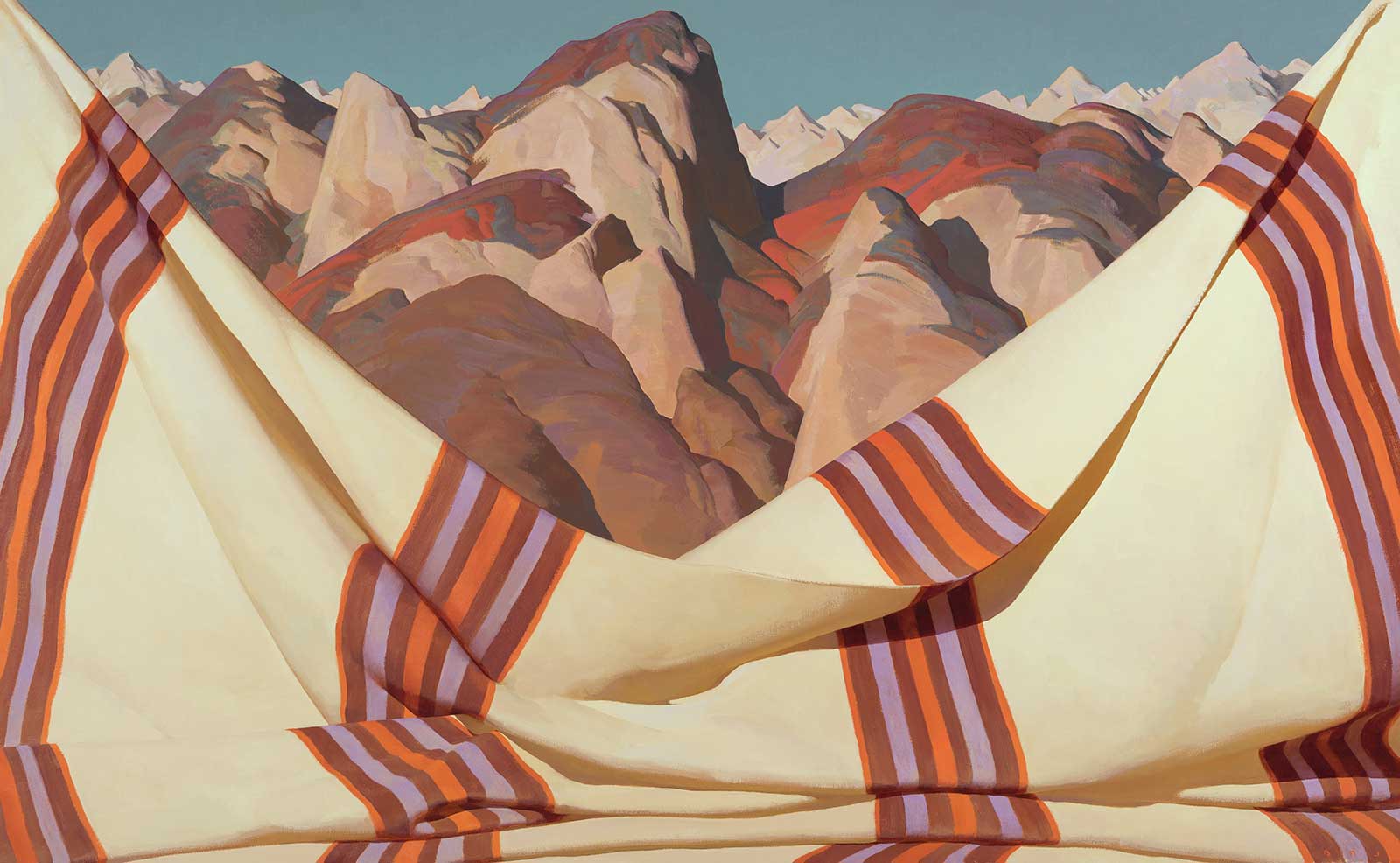 High Above the Rio, oil, 31 x 50”
He recalls a passage in Herman Melville’s Moby Dick in which Ishmael “takes the mystic ocean at his feet for the visible image of that deep, blue, bottomless soul, pervading mankind and nature.”
Intrigued by the curtain at his daughter’s dance recital, he thought about painting an image in which he could reveal part of the landscape while obscuring other parts. “It’s one of the long-standing things that I enjoy putting in paintings,” he says. “I like to create a dynamic tension between the foreground and the background, getting a peek through to what’s in the distance. In his painting, High Above the Rio, he surreally drapes a Rio Grande serape across the 50-inch width of the composition, as if unveiling the mountains behind. In High Mountains of Taos, the gate of San Geronimo Church at Taos Pueblo obscures the mountains beyond. The church was built in 1850 after several centuries of resistance to the Spanish presence. In the distance is Taos Mountain, a place sacred to the people of the Pueblo for over 1,000 years.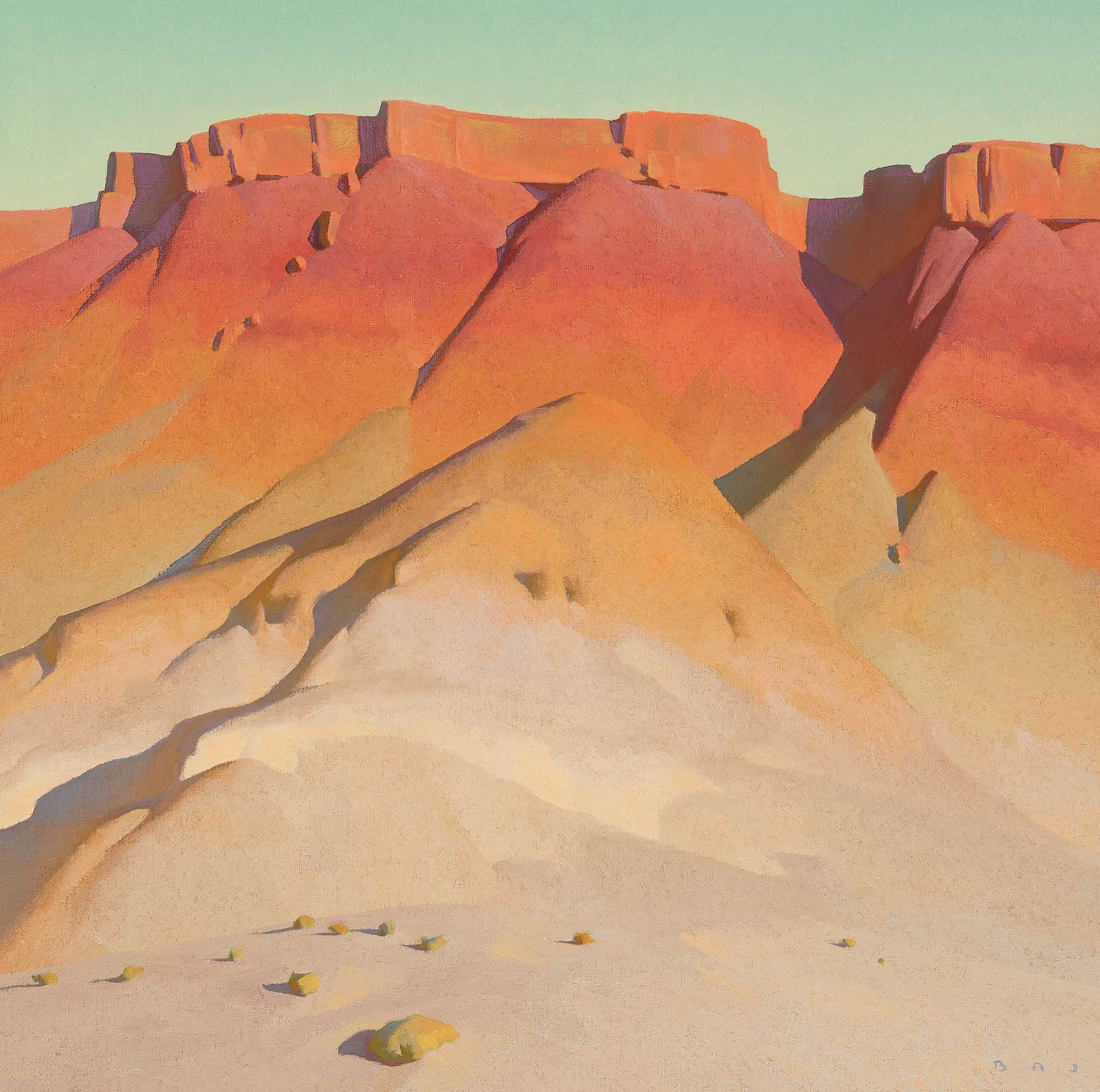 Desert Rainbow, oil, 16 x 16”
While working as a carpenter, Johnson took classes in graphic design but soon realized he needed to pursue art on his own terms. He had been making non-objective paintings but always admired the Taos Society of Artists. “Painters like [Ernest L.] Blumenschein and Victor Higgins were incredibly well versed in creating something new.”
He was able to attend the exhibition Wide-Open Spaces: Capturing the Grandeur of the American Southwest many times during its long run at Brigham Young University. “Maynard Dixon and other artists in the show took what
I love about the Southwest and took it to another space. Dixon had looming clouds and painted the emotive aspect of the landscape’s bigness and vastness. I could feel it. He designed his paintings to accomplish what he wanted. That gave me a bit of a roadmap to make it possible to portray the feelings I loved in a painting.”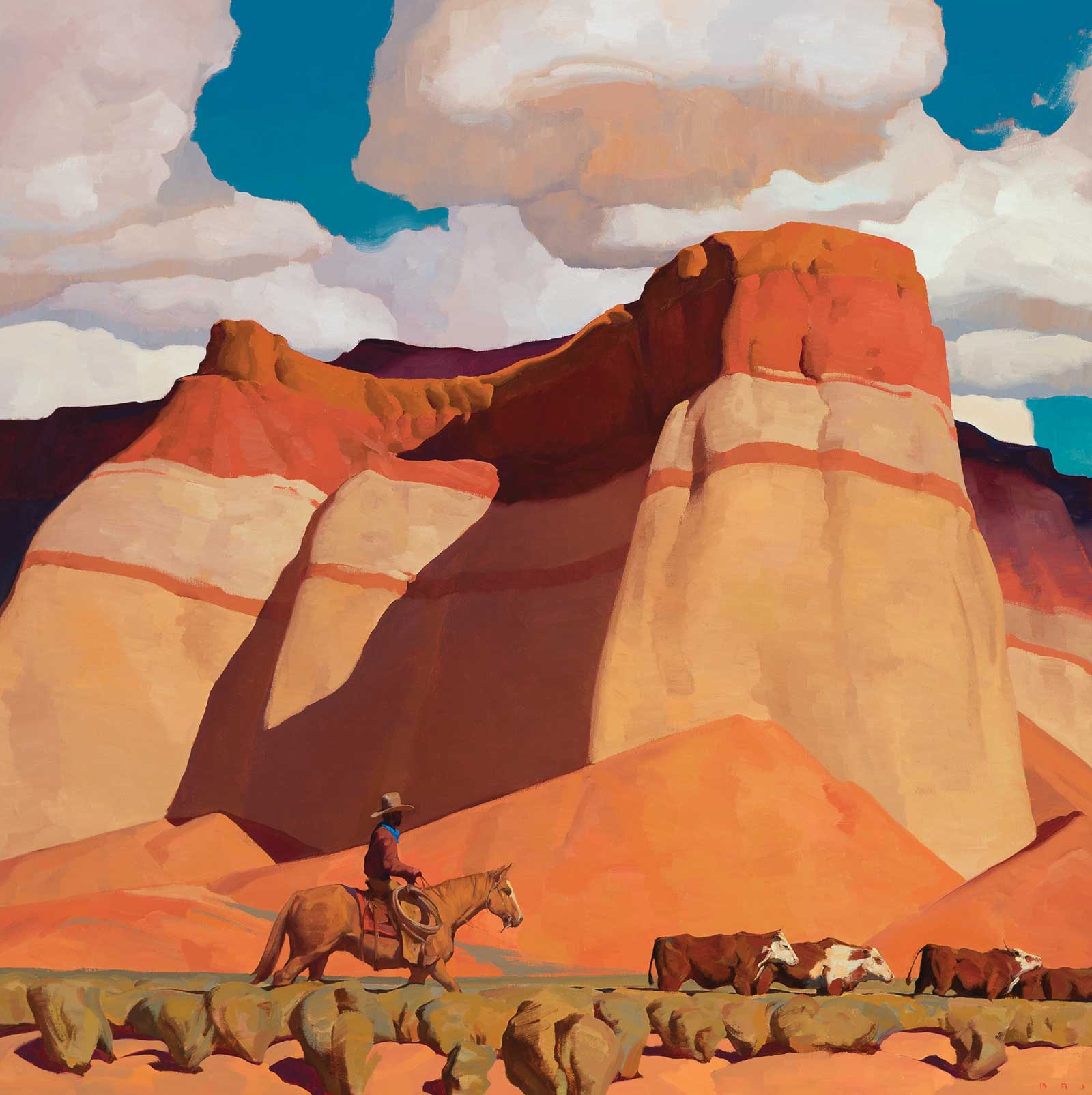 Canyon Clouds, oil, 40 x 40”
“Originally I did plein air paintings to study how light works. Later I studied art history and the way Renaissance and Baroque artists worked with light and with symmetry and asymmetry.
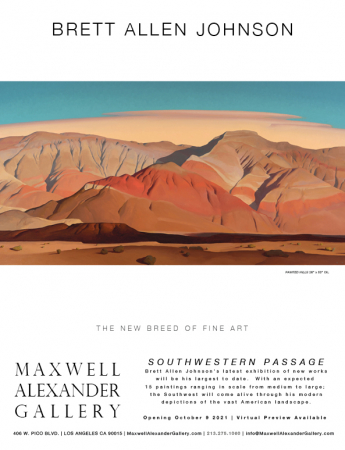
“I decided I wanted to make something profound, something real and believable, rather than to mimic what I see. I don’t often paint specific sites but sometimes I want the painting to be recognizable as a specific area.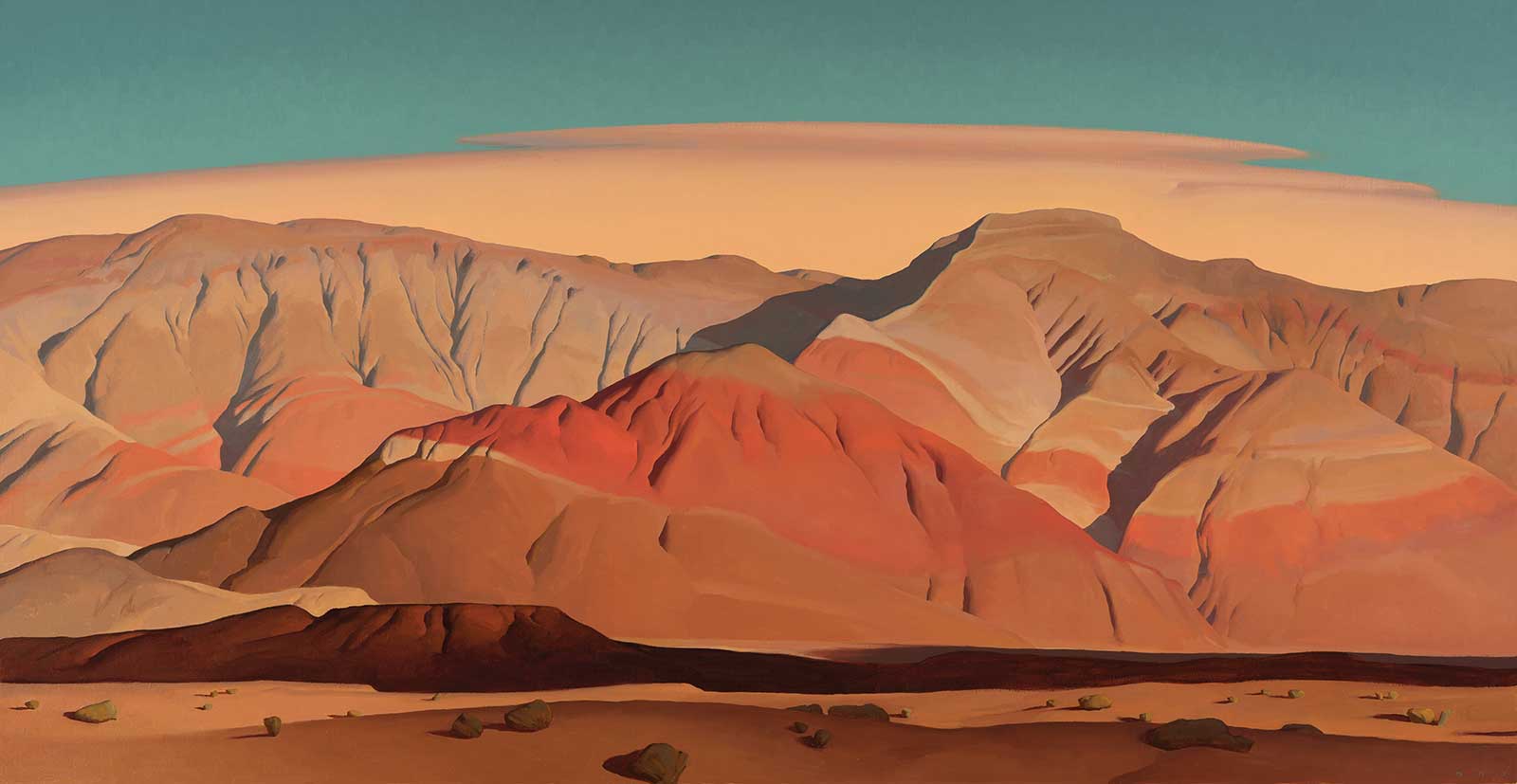 Painted Hills, oil, 26 x 50”
“The light in the Southwest is inescapable. We have a lot of big land forms, and we can see how the bright light brings them to life as on a classically painted figure or still life. Renaissance and Baroque painters taught specific conventions to create light in a picture. They took something natural and broke it down into its parts to make the illusion of light. When I painted the blanket or paint a mesa or a cloud, I design the light around it so it reminds me of what I felt when I stood there.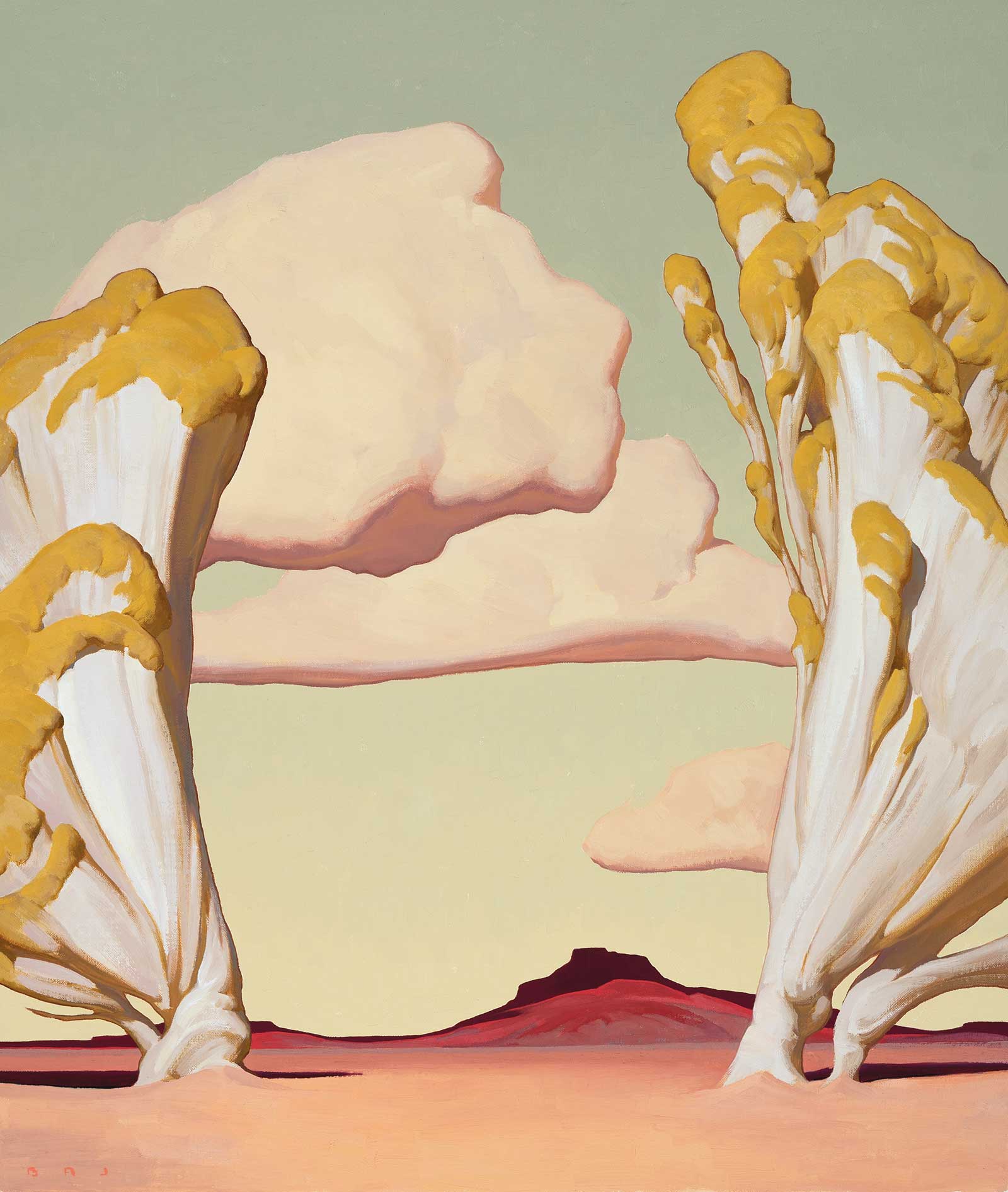 Paradise Valley, oil, 26 x 22”
“Color is my demon,” he continues. “It’s an emotional component in a painting. When I break down a scene I’m trying to figure out what the best method is to make the painting how I want it—how could this work in a way that’s compelling in a design sense. I can emphasize one color and deemphasize another to create some interesting effects. I also try to find a balance between an abstraction and a subject.”
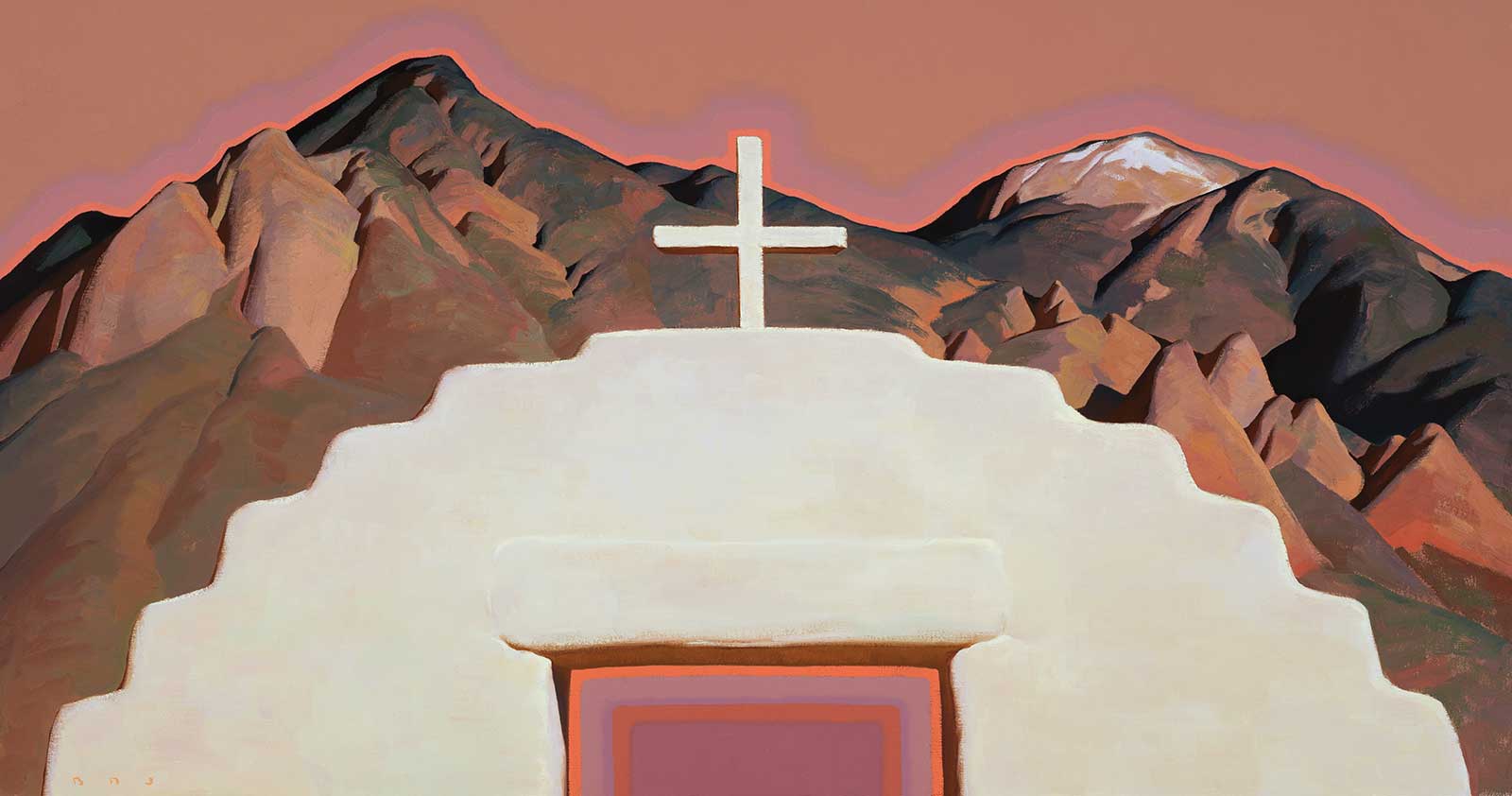 High Mountains of Taos, oil, 18 x 34”
In Desert Rainbow, the colors of the cliffs are caused by the different mineral contents of the rocks and soil. He emphasizes the subtle tonal shifts to “give the impression of a rainbow of color. It has a fun, abstract quality. There’s something magical about a rainbow.”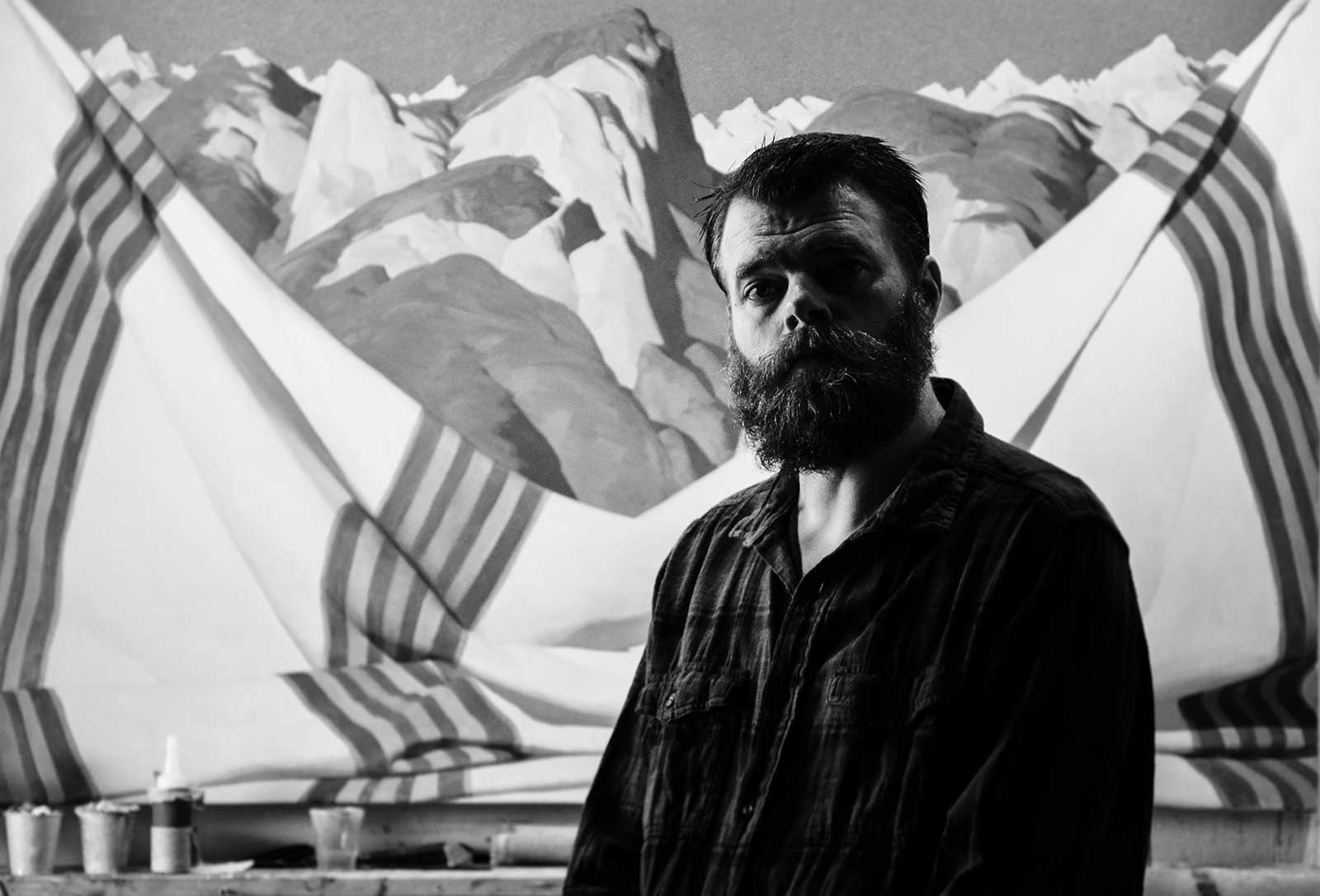 Brett Allen Johnson in his Utah studio. Courtesy the artist.His penchant for abstraction before he discovered the modernist painters of the Southwest is still a distinctive quality that distinguishes his paintings. The nearly featureless foreground of Desert Rainbow is composed of subtle shifts of color that merely suggest form as the eye ascends to the strong, colorful forms of the cliffs.
His latest work can be seen in an exhibition at Maxwell Alexander Gallery in Los Angeles, October 9 through November 6. —
Brett Allen Johnson: New Works
October 9-November 6, 2021
Maxwell Alexander Gallery, 406 W. Pico Boulevard, Los Angeles, CA 90015
(213) 275-1060,
www.maxwellalexandergallery.com
Powered by Froala Editor