Photography is a way we remember. “We” is the operative word. Despite its ubiquity as part of every cellphone, the camera, a device invented in France in the early 1800s, was a product of the Western world, of Europe and the United States. It sprang from a mechanical interest in science and a revolution—the Industrial Revolution—in the way humans make things that is endemic to a time, place and people.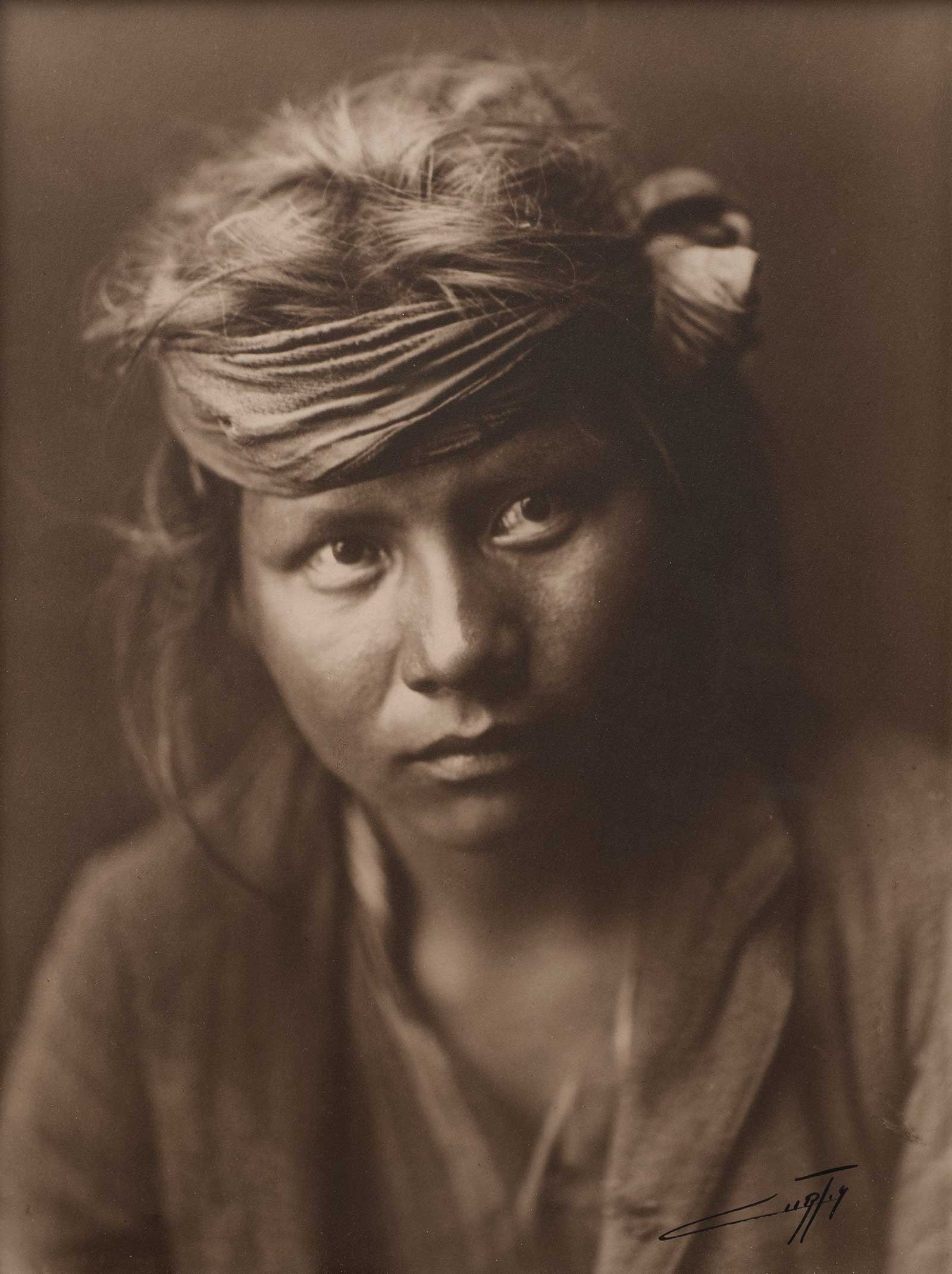 Edward S. Curtis (1868-1952), Son of the Desert, 1904, silver photograph, 13 1⁄8 x 10”. Peterson Family Collection.
Indigenous memory is different. The paths to memory are different. What is worth remembering and how it is remembered are different. Different from Western memory and not at all monolithic from one culture to another. From my perspective, which, by tradition, is closer to Edward S. Curtis than to the subjects of his photographs, Curtis is a transcriber, a recorder, a shaper, an artist. From another perspective, it might be worthwhile to think of Curtis as a translator and to view his photographs as translations from one culture and philosophy to another.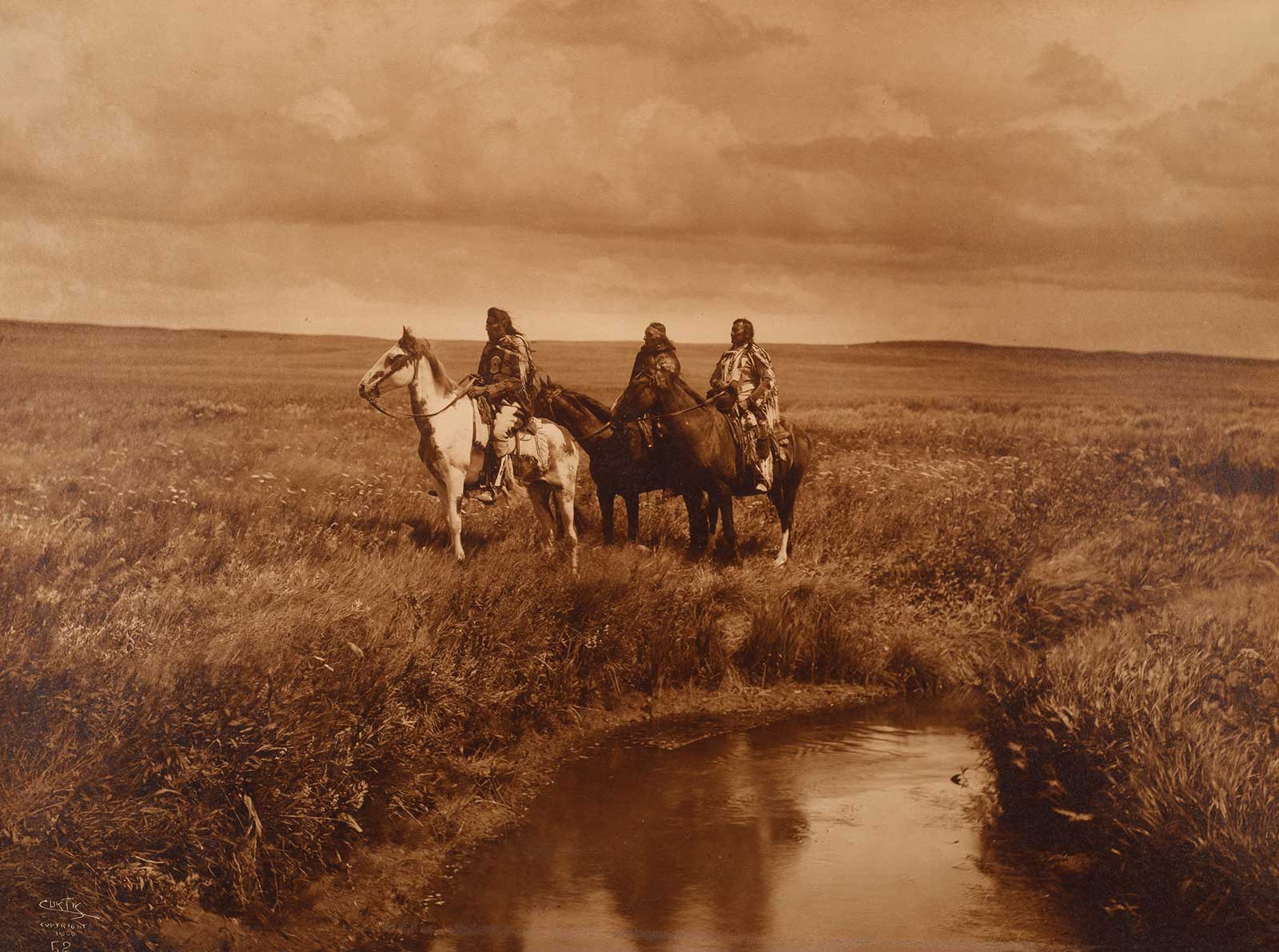 Edward S. Curtis (1868-1952), The Three Chiefs, albumen photograph, 11¼ x 15½”. Peterson Family Collection.
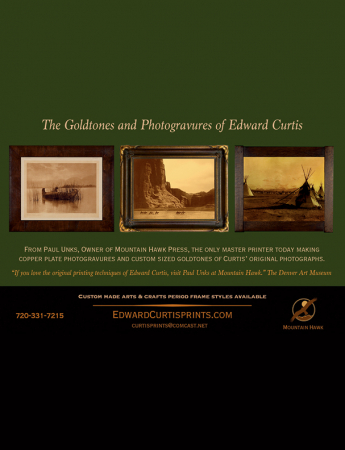
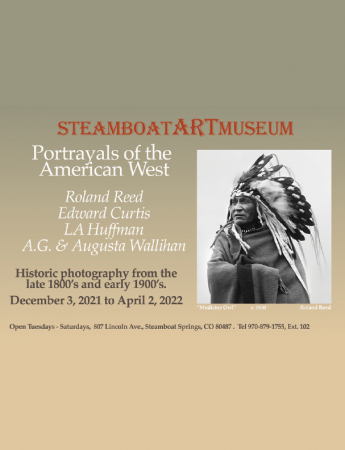
Light and Legacy: The Art and Techniques of Edward S. Curtis, opening on October 19 at Western Spirit: Scottsdale’s Museum of the West, offers a unique opportunity to ponder this and many other questions. The most comprehensive exhibition of Curtis’ work ever mounted, Light and Legacy features photogravures, original copper plates, orotones, platinum prints, silver bromides, silver gelatins, cyanotypes, glass plate negatives and recordings of Native American music. Viewers will be able to compare the same image in a variety of processes, side by side. The first part of the exhibition will feature at least four portraits, one dwelling, and four to six cultural images from each of the first 20 volumes of The North American Indian. The second half of the exhibition is devoted to Curtis’ inventiveness in the darkroom. Bottles of the minerals he used to develop his prints and a camera of the kind he traveled with will be on display.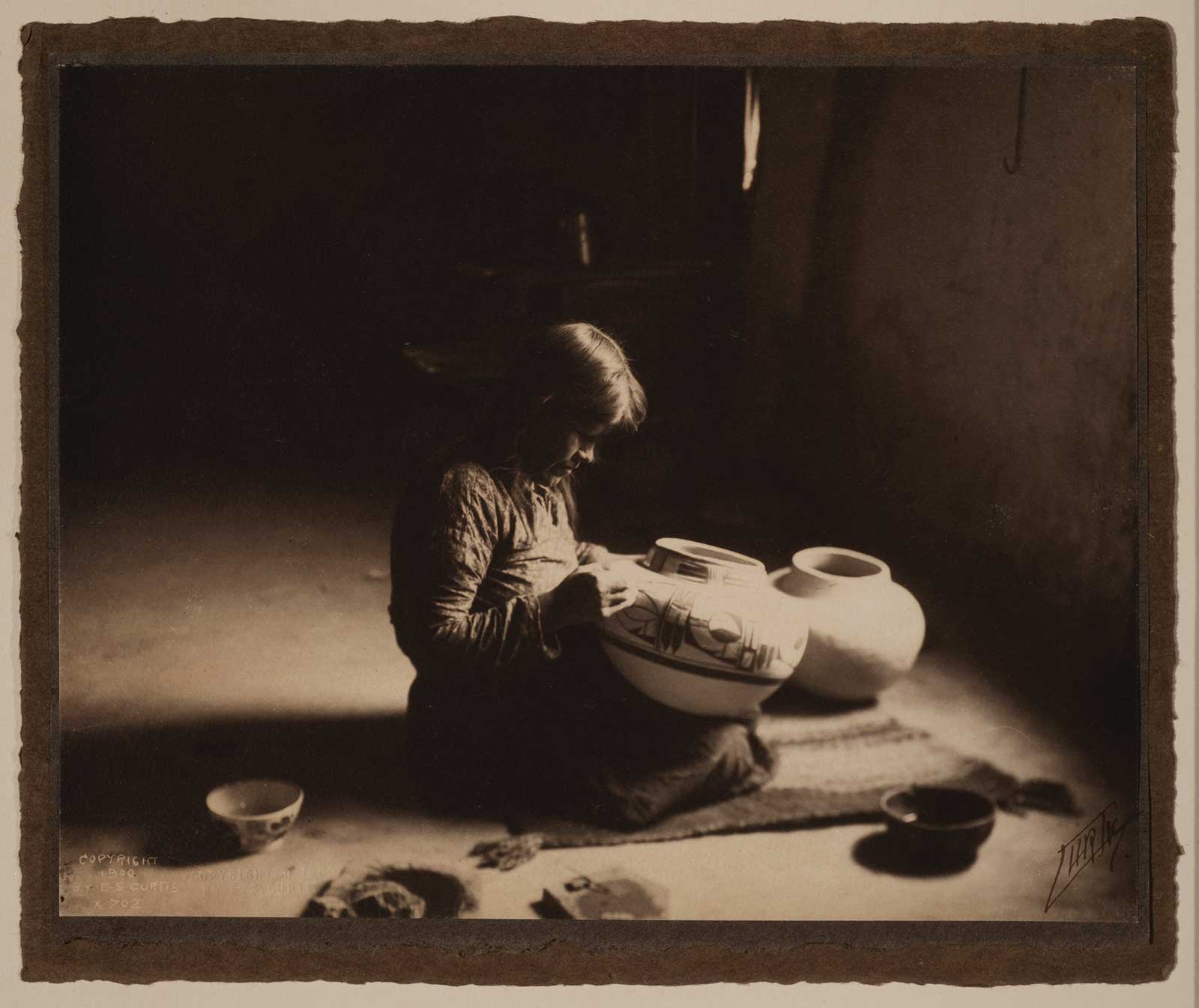 Edward S. Curtis (1868-1952), The Potter - Nampeyo, platinum photograph, 513⁄16 x 77⁄16”. Peterson Family Collection.
I wonder how Native peoples who had been visited by painters really saw Curtis and his box with the slots and round eye-like window. The epithet “Shadow Catcher,” given to Curtis by the Navajo because of his habit of running around looking for the best light for picture taking and picture making, suggests that they saw the box as some sort of magic, but I’m skeptical about this story. It’s a story told from a Western, European point of view. Isn’t catching shadows exactly what a camera does? Take the romance out of the nickname “Shadow Catcher” describes. Indigenous peoples the world over painted on hides, rock walls, pots and faces. Painting is the earliest record of human creativity. Capturing likenesses was nothing new. From the first moments of contact, European artists had been drawing and painting portraits of Indigenous peoples. No doubt the camera was a different device, yet by 1900, when Curtis embarked on his 30-year labor of love, The North American Indian, many Indigenous peoples knew the camera. Curtis wasn’t the first.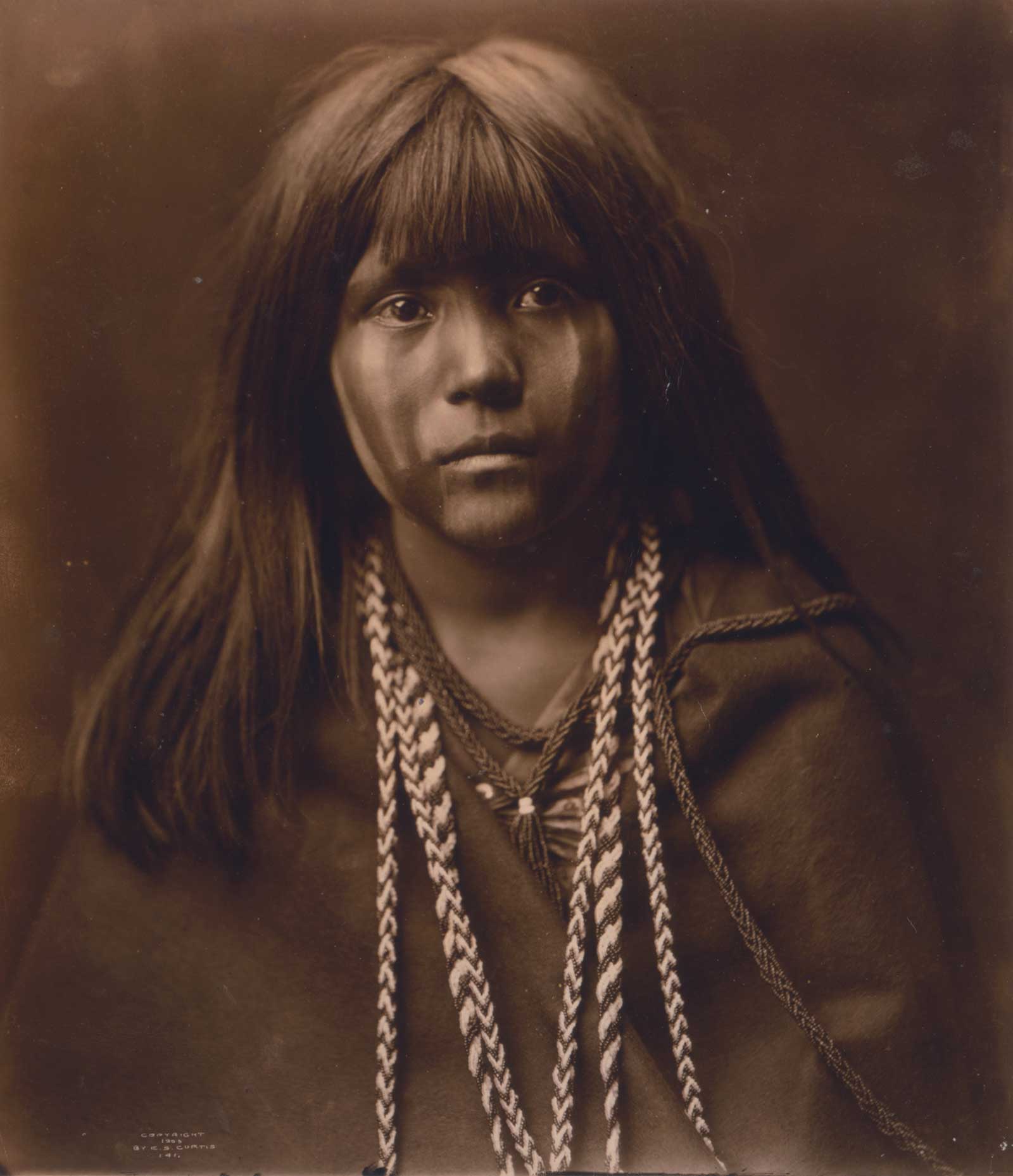 Edward S. Curtis (1868-1952), Mosa–Mohave, photogravure. Peterson Family Collection.
But the camera…Let’s think of the word “Shadow” in “Shadow Catcher” in a different way. Let’s think of shadow in terms of time rather than as a visual artifact that pairs with light in a photographic image. After all, people have been living by the length, direction, shapes and depth of shadows since time immemorial. Shadows are the hands of clocks before clocks.
Curtis was always racing time. Time. Within Indigenous cultures languages vary; oral and written traditions vary; faiths vary. Generalizations are dangerous. I was thinking about how to talk about this when I read Felicia Garcia’s essay, “Witness Me,” in the August/September issue of Native American Art. Garcia, a member of the Chumash Nation and a curator of education at the School for Advanced Research’s Indian Arts Research Center, writing on Native photographer Cara Romero’s work, says, “As Native people we exist beyond Western conceptions of time—connecting with our past, present and future simultaneously. So many museums stratify Native people based on time—for some reason the ‘traditional’ is always separated from the ‘contemporary.’ Yet, for many if not most Native people, it is impossible to separate who we are from who we were or who we hope to become.”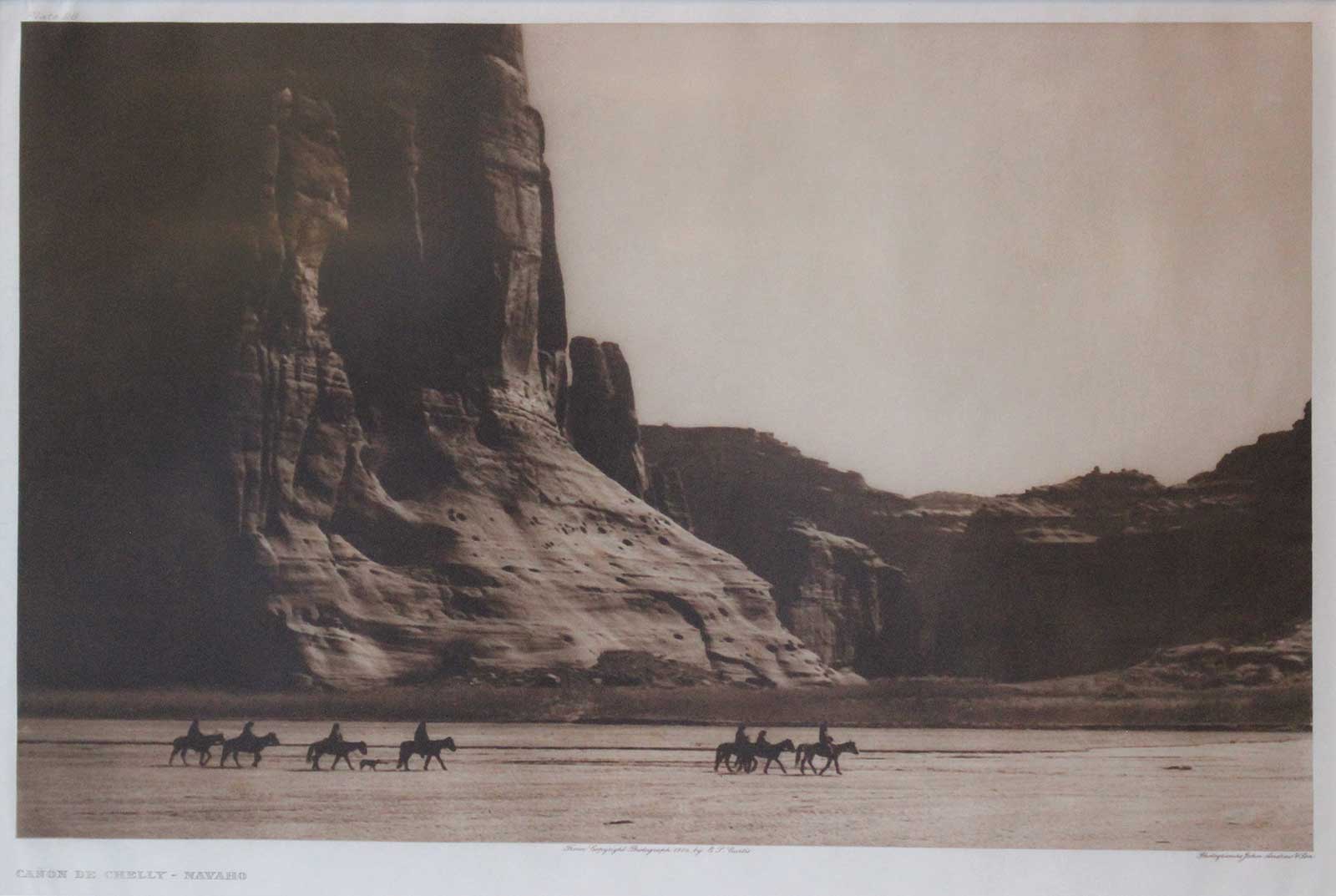 Edward S. Curtis (1868-1952), Canyon de Chelly, photogravure. The Peterson Family Collection.
Past and future inherent in the present. Immanent. Western time, that is, Christian time, is an arrow that moves in one direction. Time for the Ancient Greek and South Indian cultures has always appeared—geometrically, in my mind—as a spiral of recurrence. Native time, as Garcia conceives of it, is a pair of arrows—the past and future—converging on and disappearing into a single point: an ever-present present. Today, via quantum science, science fiction and fractal math, the loop seems to be supplanting the arrow in the Western imagination. Perhaps a meeting place for all these world views awaits us. I realize this is a lot of heft for a few sentences in a short essay to bear, but the idea—a question, really—sheds light on my thesis that Curtis’ photographs are translations from one system of thought to another. Bigger minds than mine have certainly gone over this ground.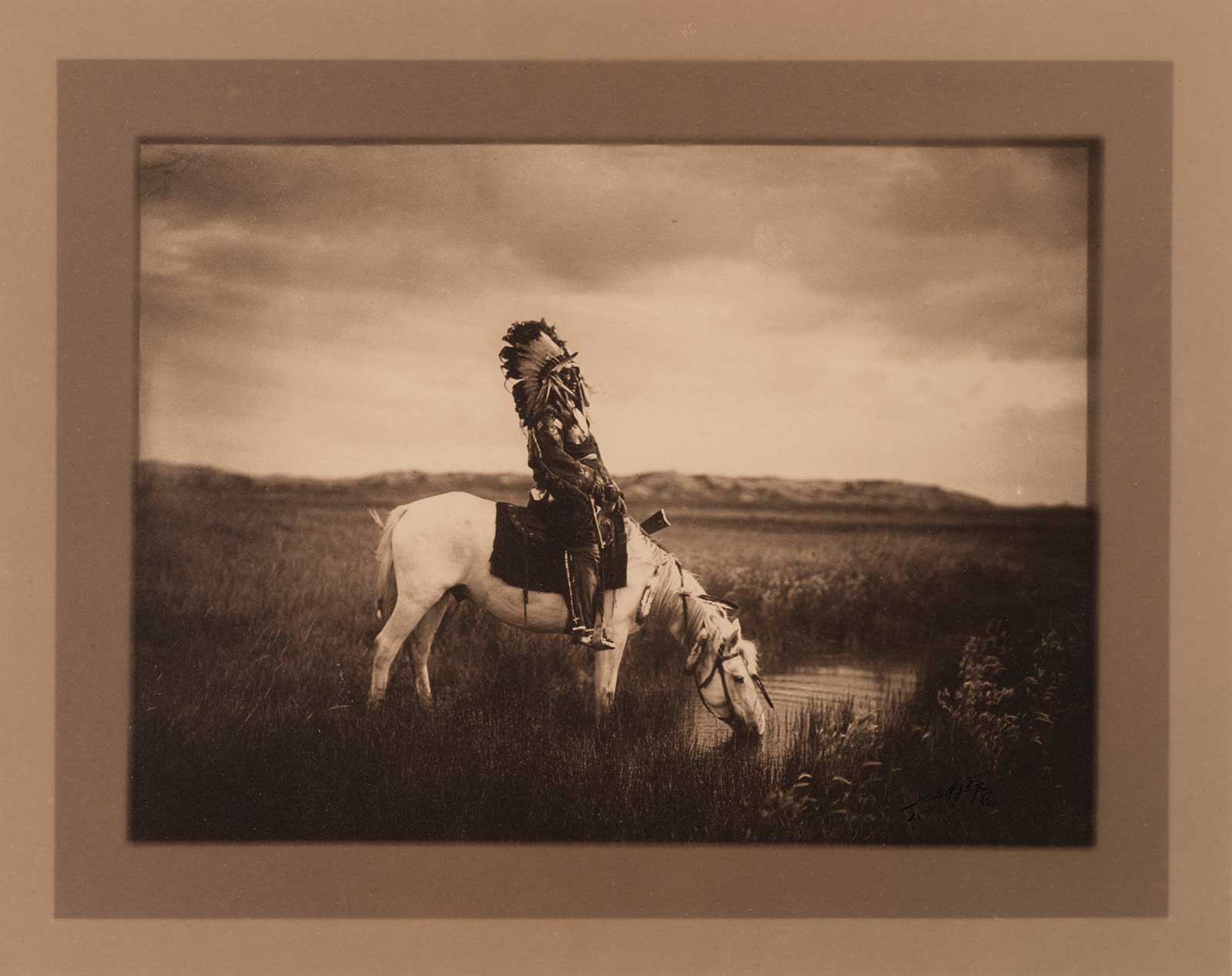 Edward S. Curtis (1868-1952), An Oasis in the Badlands, 1905, silver bromide border photograph, 5½ x 7¾”. Peterson Family Collection.
The subjects in Curtis’ photographs have a popular reputation for their stern, stoic, contemplative aspects. No smiles. Okay, let’s play a game. Think of all the painted and photographed portraits you can. Gilbert Stuart’s George Washington. Grant Wood’s American Gothic. Think of the countless dark, solemn portraits of forgotten people by anonymous, itinerant painters. Let them come to mind. Visualize them, as they say. How many smiles do you see? Not many. Franz Hals’s merry Dutch figures emerge as a revelation. Know why the Mona Lisa is the Mona Lisa? That smile, right? Not just because of its peek-a-boo, ephemeral, now-you-see-it-now-you-don’t nature. The fact of the smile is, in and of itself, unusual. Curtis was serious about his art. We know that he was an ardent student of the painted portrait; we know he wanted to achieve chiaroscuro and sfumato qualities in his photographs. Did that seriousness rub off on those who sat for him as he raced to catch his shadows? Could be. Only later, late, at the end, in Alaska, do you see his subjects smile more frequently. Perhaps that’s because Curtis, at 59, at the end of the adventure, was smiling, smiling and in no hurry. He loved the Alaskan islands because they were unspoiled, as he put it, by missionaries. He hoped, with a very un-Christian hope, that the sea would take any proselytizers who dared ply the waters around these islands to her watery bosom. These Indigenous people of the Arctic were the very people he had been seeking for 30 years. His joy may well have eclipsed the solemnity and urgency of his younger days—perhaps his subjects were more at ease.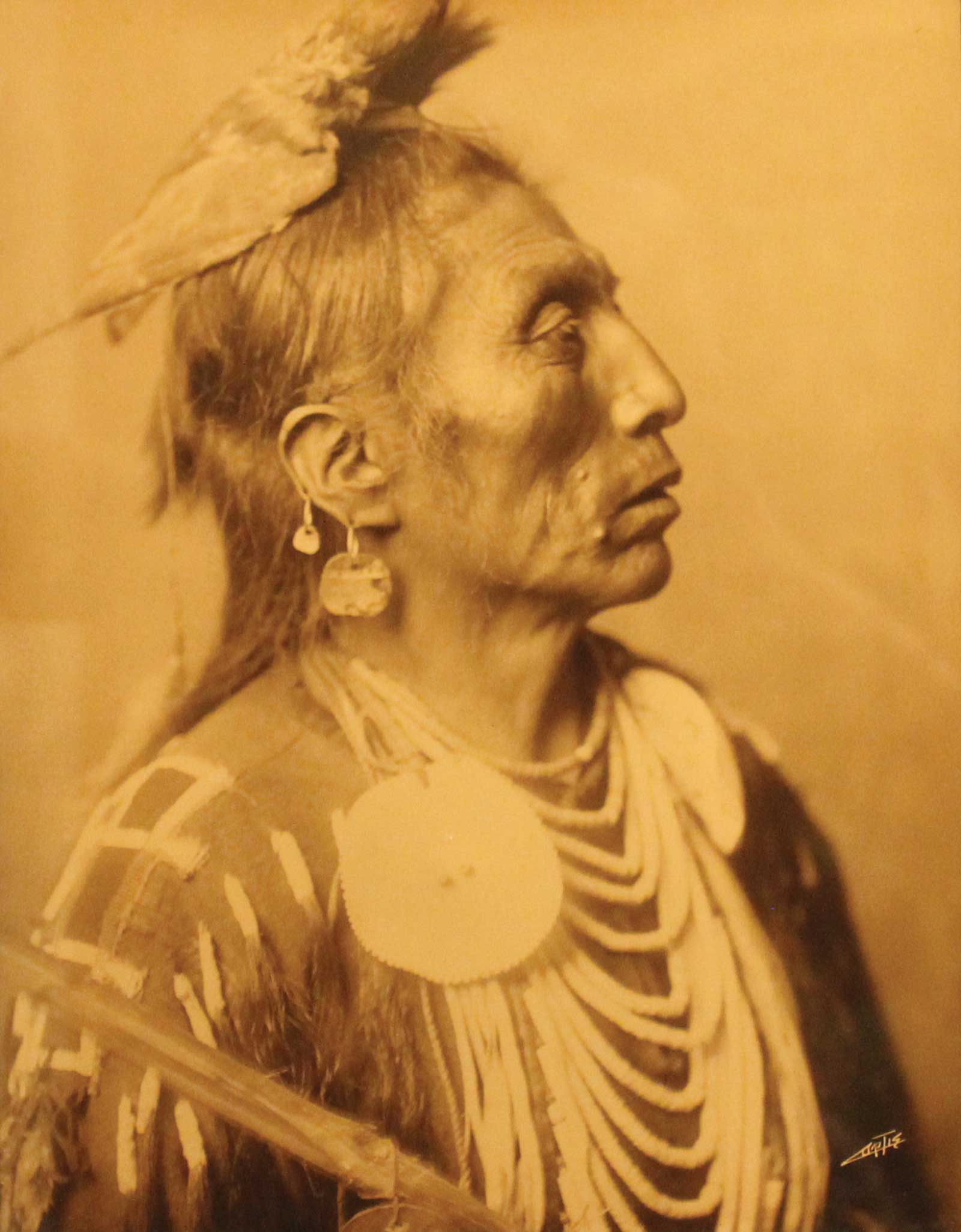 Edward S. Curtis (1868-1952), Medicine Crow, goldtone. Peterson Family Collection.
There’s more. If you really look back at Curtis’ photographs—you can see every image in the volumes and portfolios online at Northwestern University (curtis.library.northwestern.edu) you might start to count the smiles as they appear on the faces of the girls of the pueblos, in the kids everywhere, in men and women, young and old. I am reminded of jazz great Billie Holiday. For as long as I can remember, it has been assumed that most of her songs were sad, bluesy, lovelorn and that this sadness sprang from her troubled life. Not long ago, someone counted her songs, all of them, and found that well over half were upbeat numbers. Assumptions about her life and voice shaded our perception of her music. Pivot back to Curtis. In the shadow of the “vanishing race” myth that inspired Curtis in the first place, his images translated—and still do, to some—as stoic resignation and fatalism. Emotionlessness became a big part of the legacy of his photographs, the same emotionlessness we see in the Hollywood stereotype of Natives.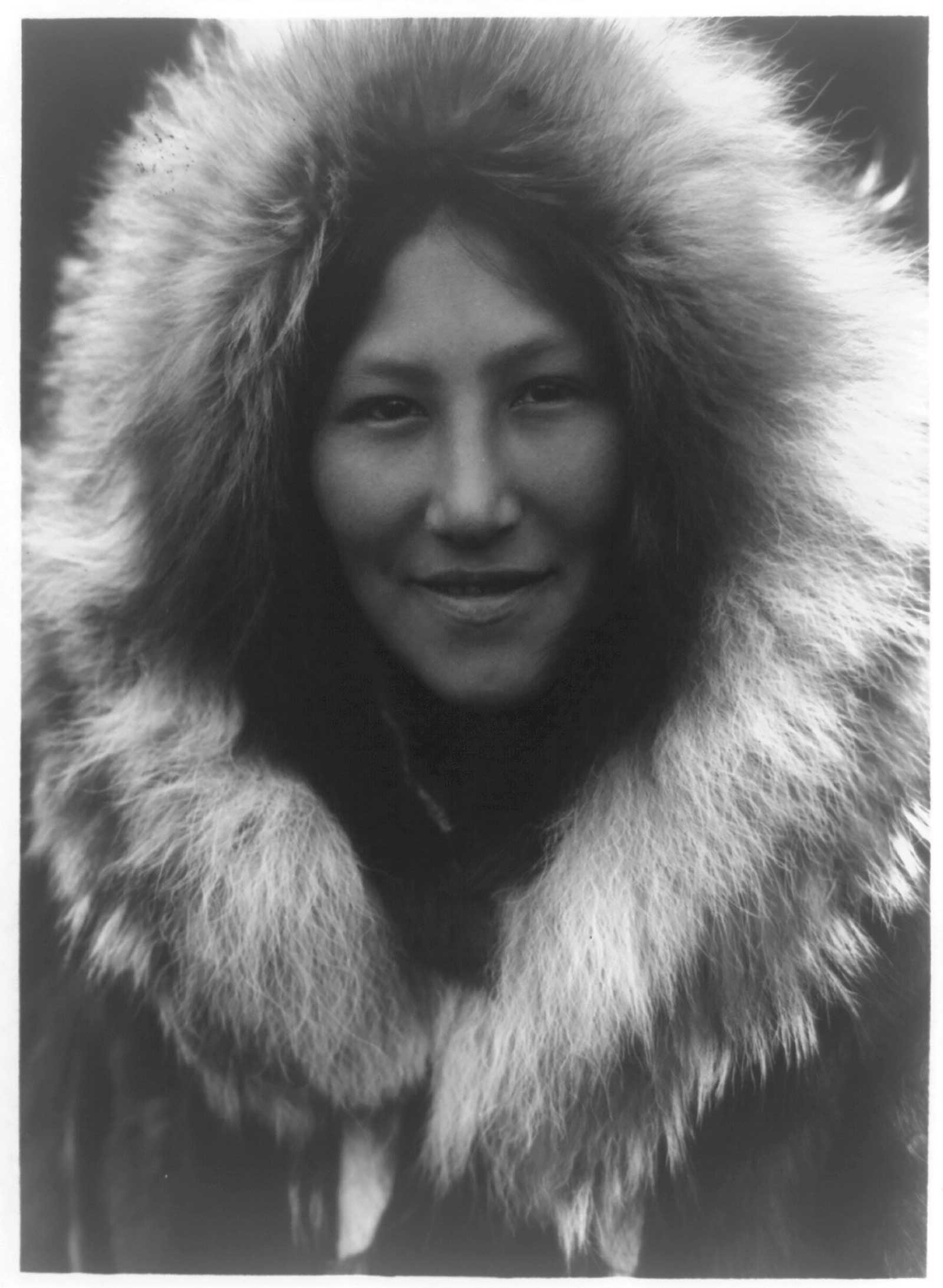 Edward S. Curtis (1868-1952), Ola—Noatak, 1929, photographic print. Library of Congress Prints and Photographs Division, Washington, D.C.
It is tempting to see Curtis’ images as time machines, as windows into a past—he wanted us to see them in exactly this way and to add the word “tragic” to past—but when you visit the exhibition and stand in front of any of the photographs, keep this idea of Native time in mind. Try to step outside the Western arrow of time and apprehend the eternal “is-ness” of the moment, the presence of the past, the future in the present, time as a point.
And isn’t this the point? The semiotics of looking at art? The immediacy of the connection that compresses time, however you think of time, into that flash of congruence between you and the artwork? When, in an instant, the world and time itself fall away and nothing exists outside of the energy between you and the artwork? Look at an Edward Curtis portrait, any portrait, and consider this: from another point of view, the eyes in the photograph have always been looking out at yours, and your eyes, in turn, have always been looking back. —
Light and Legacy: The Art and Technique of Edward S. Curtis
October 19, 2021-Fall 2023
Western Spirit: Scottsdale’s Museum of the West
3830 N. Marshall Way, Scottsdale, AZ 85251
(480) 686-9539, www.scottsdalemuseumwest.org
+++
James D. Balestrieri is the proprietor of Balestrieri Fine Arts, specializing in arts consulting, sales, research and writing. He is currently the writer-in-residence for the Clark Hulings Foundation, as well as estate and collections consultant for the Couse Foundation and communications manager for Western Spirit: Scottsdale’s Museum of the West. He was director of J.N. Bartfield Galleries for 20 years, worked with Scottsdale Art Auction for 15 years and has written more than 150 essays for various art publications.
Powered by Froala Editor