A few months before Charles M. Russell, Montana’s celebrated Cowboy Artist, died on October 24, 1926, Nancy Cooper Russell, his wife and business manager of nearly 30 years, replied to a letter from a childhood acquaintance who remembered her growing up in Helena. “Yes, I am, or was, the little girl you were talking about, way back in ‘94,” she wrote. “I, as you know, married the only Charles Russell in the world and my life has been very full of romance, which they like to make moving pictures out of, only mine happens to be real.” It was a touching tribute to a successful partnership that saw Russell’s rise to prominence as the preeminent portrayer of “The West that Has Passed”—indeed, the preeminent Western artist of his day.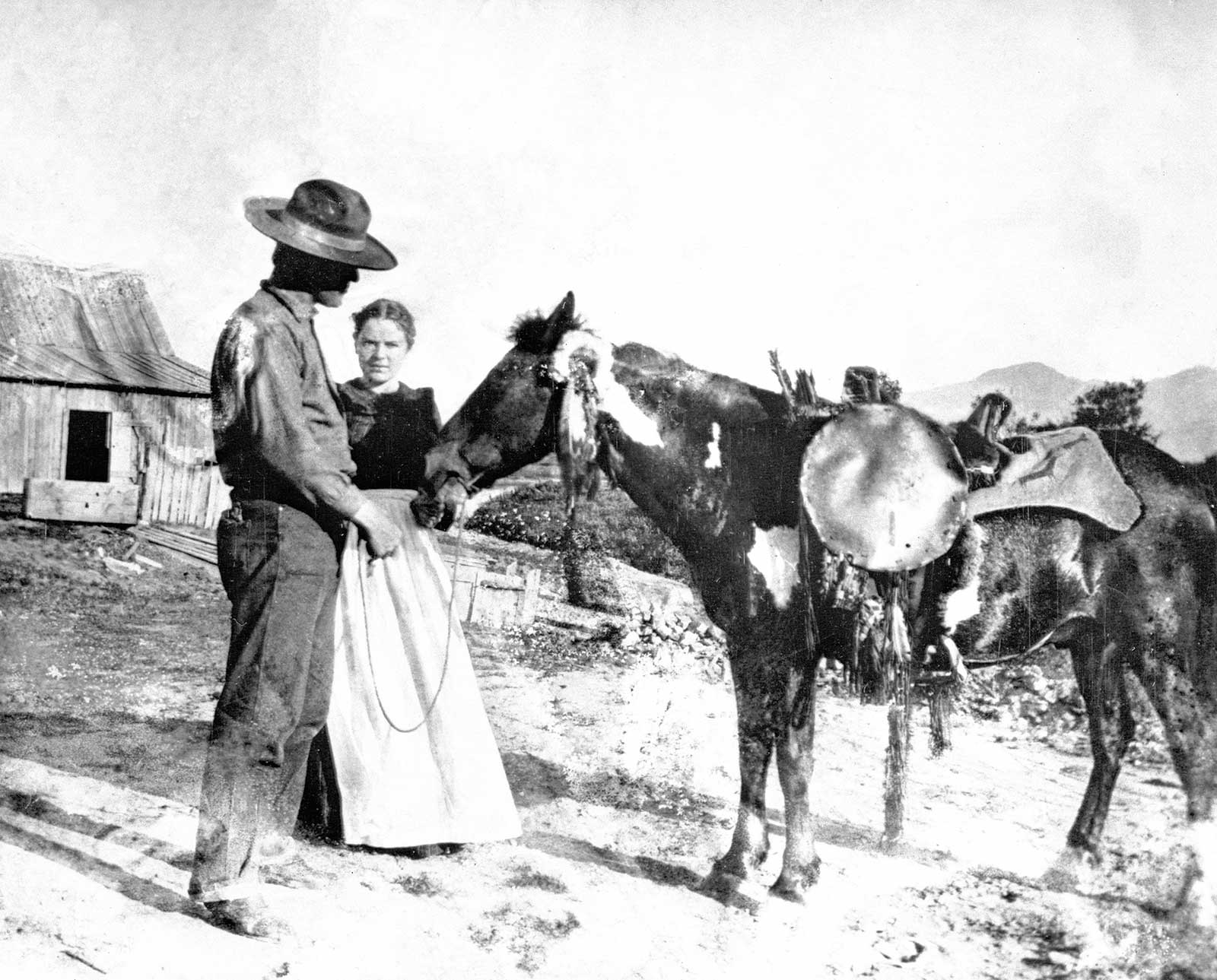 William B. Cameron (1862-1951), Charles and Nancy Russell with Charlie's beloved pinto Monte outside their home in Cascade, MT, 1897. Montana Historical Society Research Center, Photo Archives 944-681.
The small town of Cascade, Montana, between Helena and Great Falls, held a special place in the Russells’ hearts. It was where they courted, married in September 1896 and spent their honeymoon year relishing simple pleasures while they settled into wedded life. As Charlie continued to refine his signature themes––old-time Indians, cowboy routine on the unfenced range and the great herds of buffalo that once roamed the plains—Nancy assumed control of the business end of their affairs.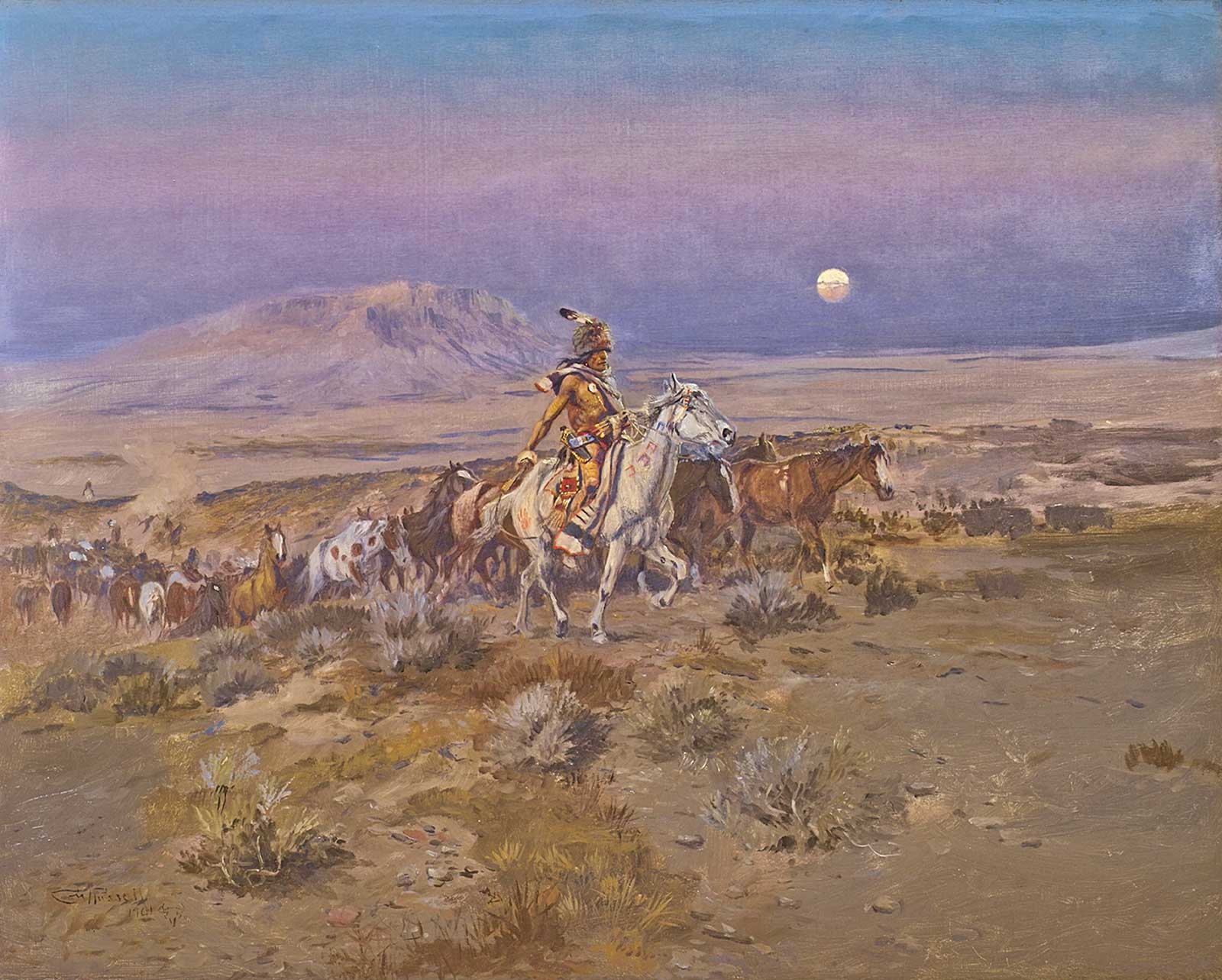 Charles M. Russell (1864-1926), The Horse Thieves, 1901, oil on canvas, 235/8 x 295/8”
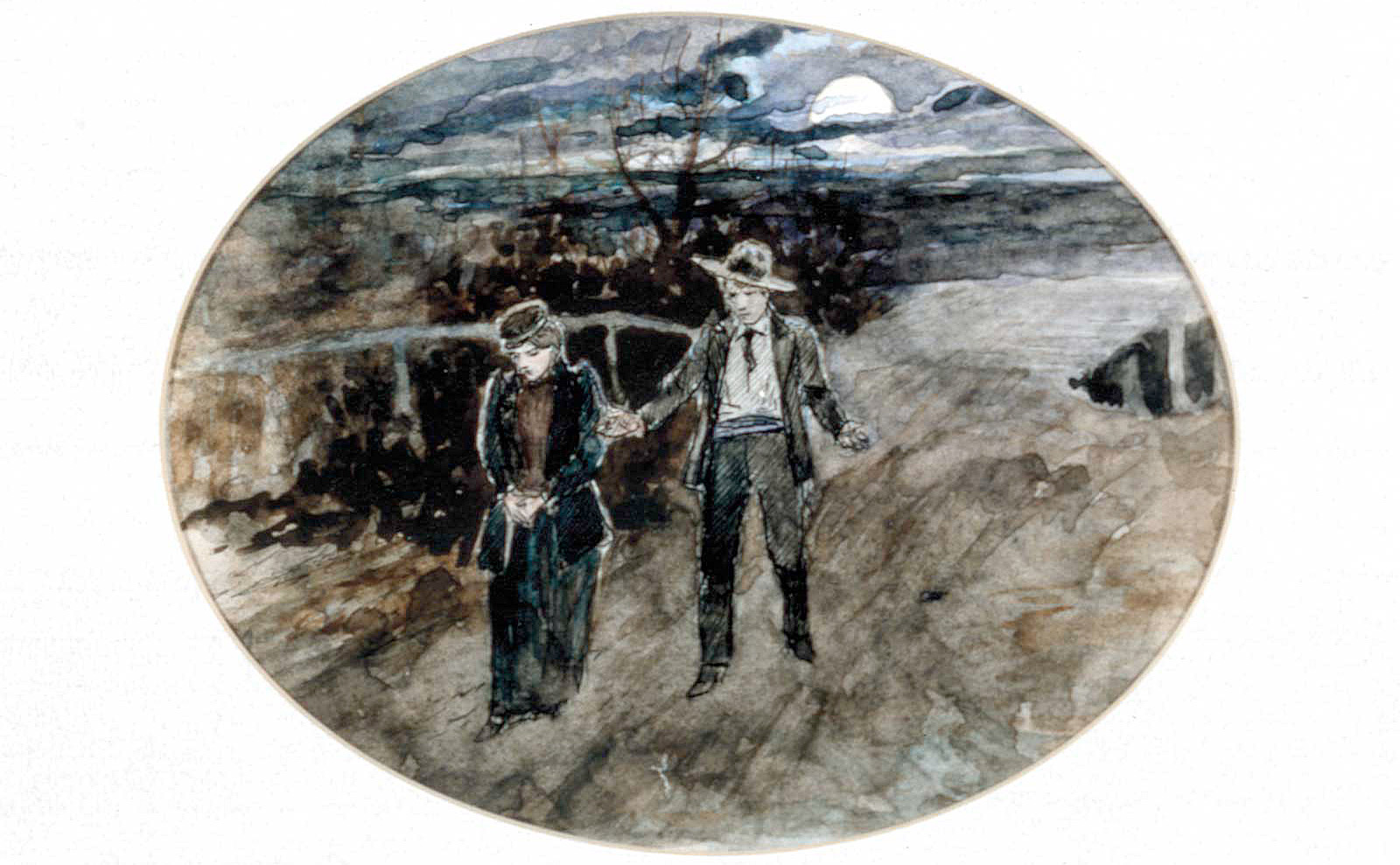 Charles M. Russell (1864-1926), Charlie Russell Proposes to Nancy Cooper, watercolor on paper. Gift of Jasper D. Ackerman, National Cowboy & Western Heritage Museum. 1977.30.
Within a year of their marriage they had moved to Great Falls, and within a decade, had built a summer home on Lake McDonald––Bull Head Lodge––amidst the natural splendors of Glacier Park. Both Russells found contentment in a world where the land still belonged to God. The rhythm of their workaday lives had taken on a faster tempo not because Charlie was dissatisfied with his own, ambling Great Falls pace, but because Nancy, as his business manager, recognized that the gold for art lay not in the hills of the Treasure State, but in the towers and mansions of the East. The wider world beckoned. When she recalled their first trip to New York, she described the experience with a revealing phrase: “Charlie’s Trail leads Him into a Lighter Mood.” He cast his first bronze on their next visit there, Smoking Up, 1904, and his art flourished as he was welcomed in by an expanding circle of friends who painted, wrote and performed on the stage.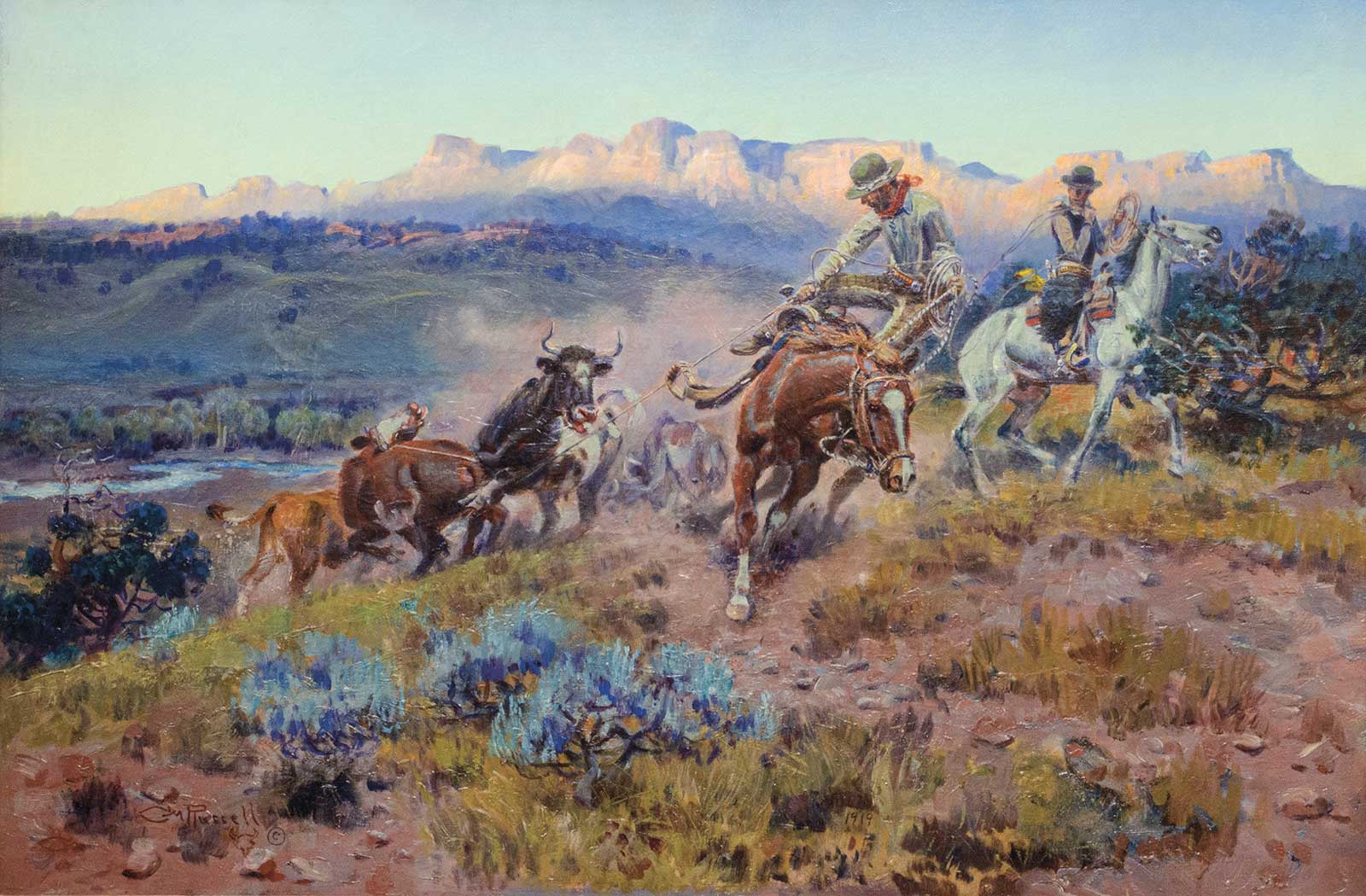 Charles M. Russell (1864-1926), Mussellshell Roundup (Roundup on the Mussellshell), 1919, oil, canvas, 24 x 36”
Nancy, in turn, worked hard on her end of their partnership, measuring her contribution by the rising prices for Russell art. “One day,” soon after they had moved to Great Falls, “we met a woman who wanted a water color of a steamboat stopped by buffalo crossing the Missouri River. The finished piece of work was a beauty, and we thought it should bring a good price. Charlie hoped the buyer would pay twenty-five dollars. We needed hay for the horses, and I wanted a new cook stove. So I asked if I couldn’t deliver the picture.” Charlie consented, but cautioned her not to raise the price and scare off the buyer because “we need the money.” Asked what she wanted for the painting, Nancy, “with a choking sensation,” replied, “thirty-five dollars.” Without batting an eye the woman wrote out a check. “Glory be!,” Nancy recalled, “ I had ten dollars toward the new cook stove.” Eventually, a single Russell painting, completed in the very last year of his life, would command $30,000.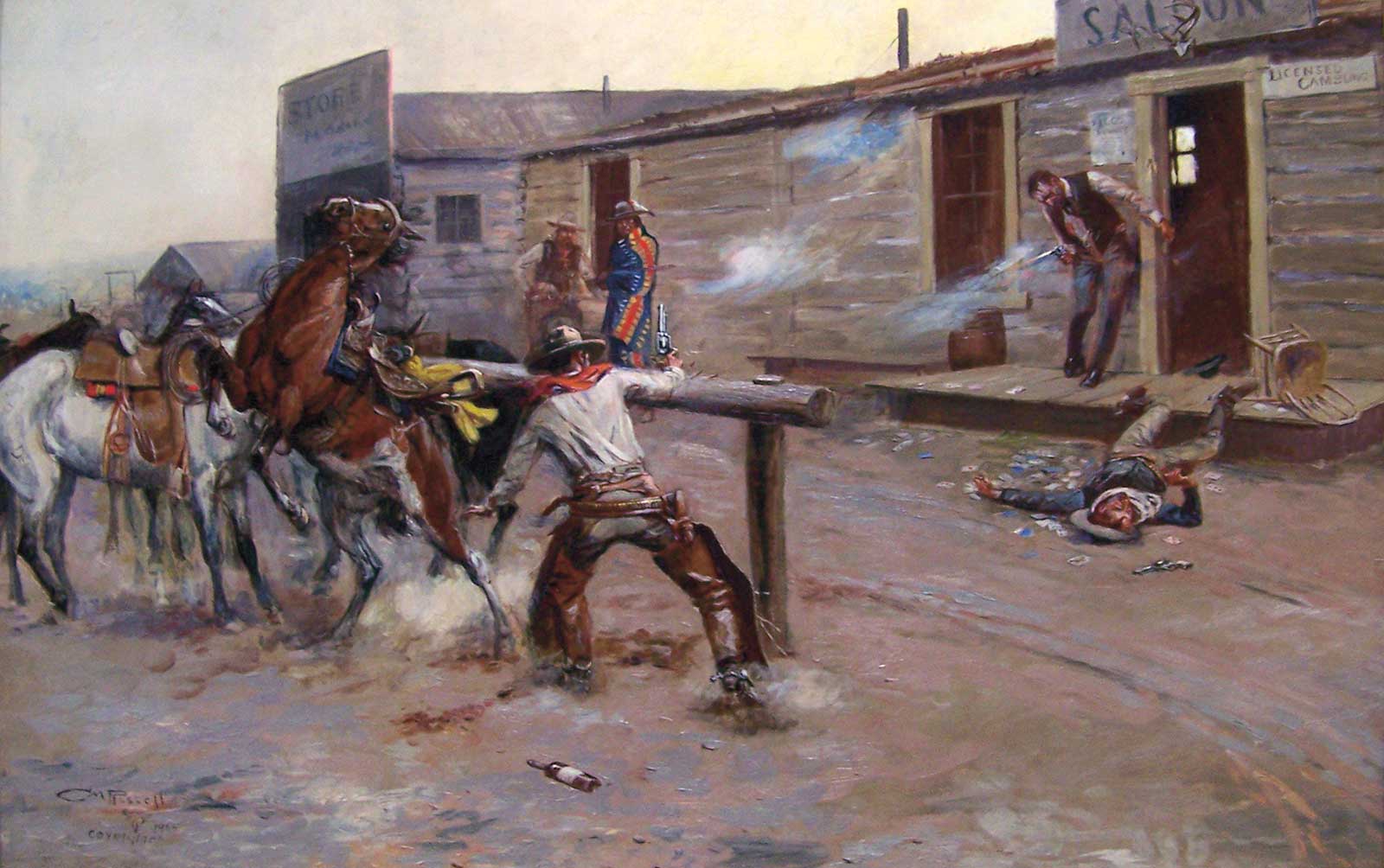 Charles M. Russell (1864-1926), Gun Fighters (Death of a Gambler), 1904, oil on canvas, 24 x 36”. As reported in our March 2021 issue, this work is now co-owned by the C.M. Russell Museum after partial ownership was awarded during the museum’s Art & Soul campaign.
When Charlie died, Nancy was fully engaged in the process of publishing his collection of Western stories, Trails Plowed Under, with Doubleday, a major New York firm. She saw it through to completion in 1927, then turned immediately to another project she had in mind, a biography of her “Cowboy Artist.” Nancy knew that keeping Charlie in the public eye would be key to continuing success in selling his art. The artist and his work were one, after all. What he painted and sculpted expressed who he was and what he stood for. In his masterful introduction to Trails Plowed Under, Will Rogers said it best: “we may have Painters in time to come, that will be just as good as old Charley. We may have Cowboys just as good, and we may occasionally round up a pretty good man. But us, and the manicured tribe that is following us, will never have the Real Cowboy, Painter and Man, combined that old Charley was.”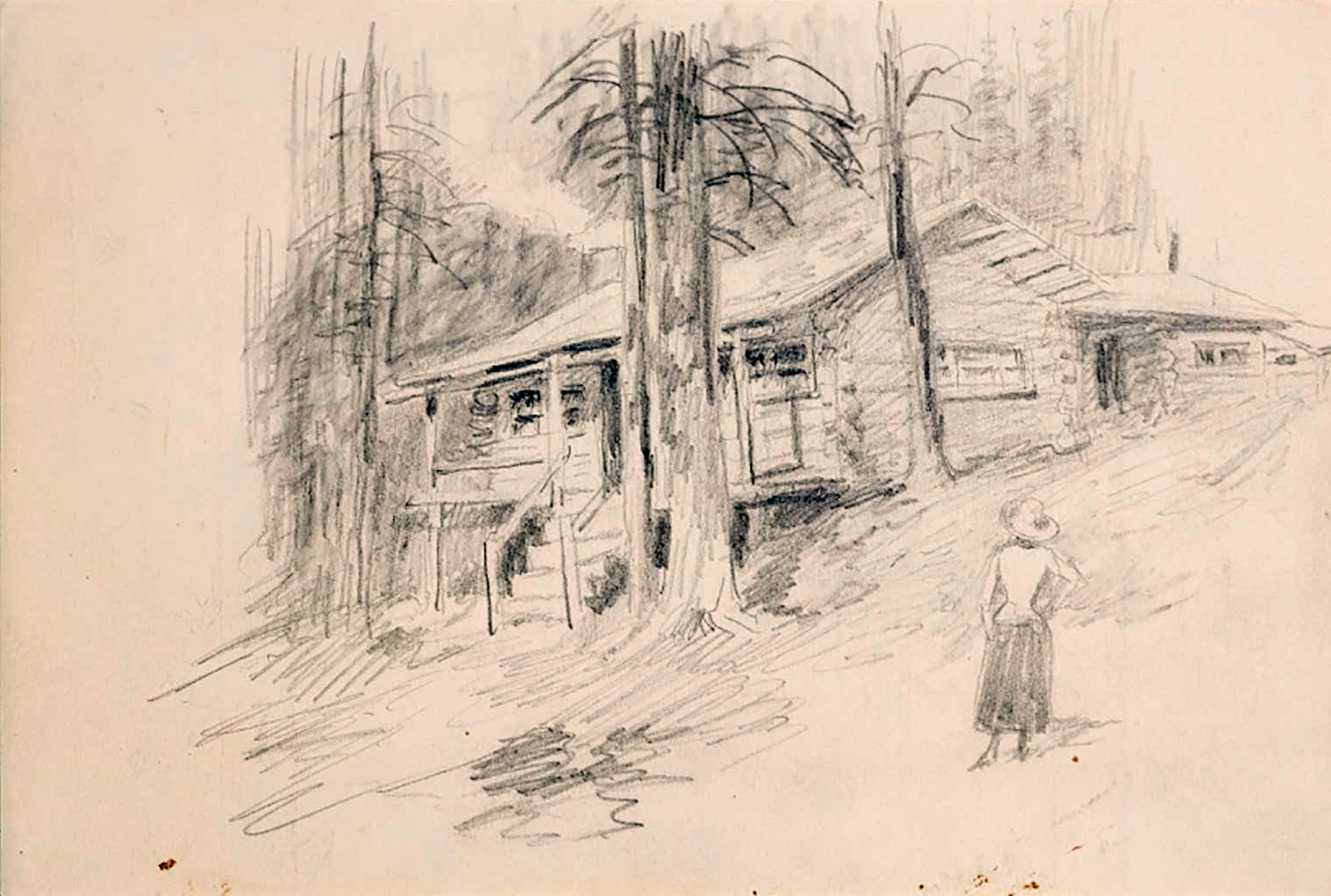 Philip R. Goodwin (1881-1935), Untitled (Charles Russell’s cabin at Lake McDonald, Montana), ca. 1907, pencil on paper; 4¾ x 71⁄16”. Denver Art Museum: William Sr. and Dorothy Harmsen Collection, 2009.321.
Nancy seized on the prospect of a biography, and commissioned Dan Conway, a Great Falls journalist, to produce a publishable manuscript. Over the summer of 1927, as a guest at Bull Head Lodge, Conway churned out “A Child of the Frontier.” It was quickly rejected by Doubleday as full of hot air rendered in purple prose. Undeterred, through 1928 Nancy worked assiduously on her own Russell biography. Her publisher, however, guided her toward an entirely different project, a book that would feature Russell’s humor and personality while offering deeper insights into the character of the man. Good Medicine, a collection of Charlie’s illustrated letters, would be the perfect follow-up to his collected stories in Trails Plowed Under. Both books were pure Charlie, after all. So Nancy set aside the biography for the time being, and devoted her energies to seeing Good Medicine through to publication. It was finished just before the Stock Market crashed in October 1929 and managed to make its debut the following April. Thereafter, Nancy had to steer the Russell ship through troubled waters as art prices plummeted during the Great Depression and interest in publishing a Russell biography fell with them.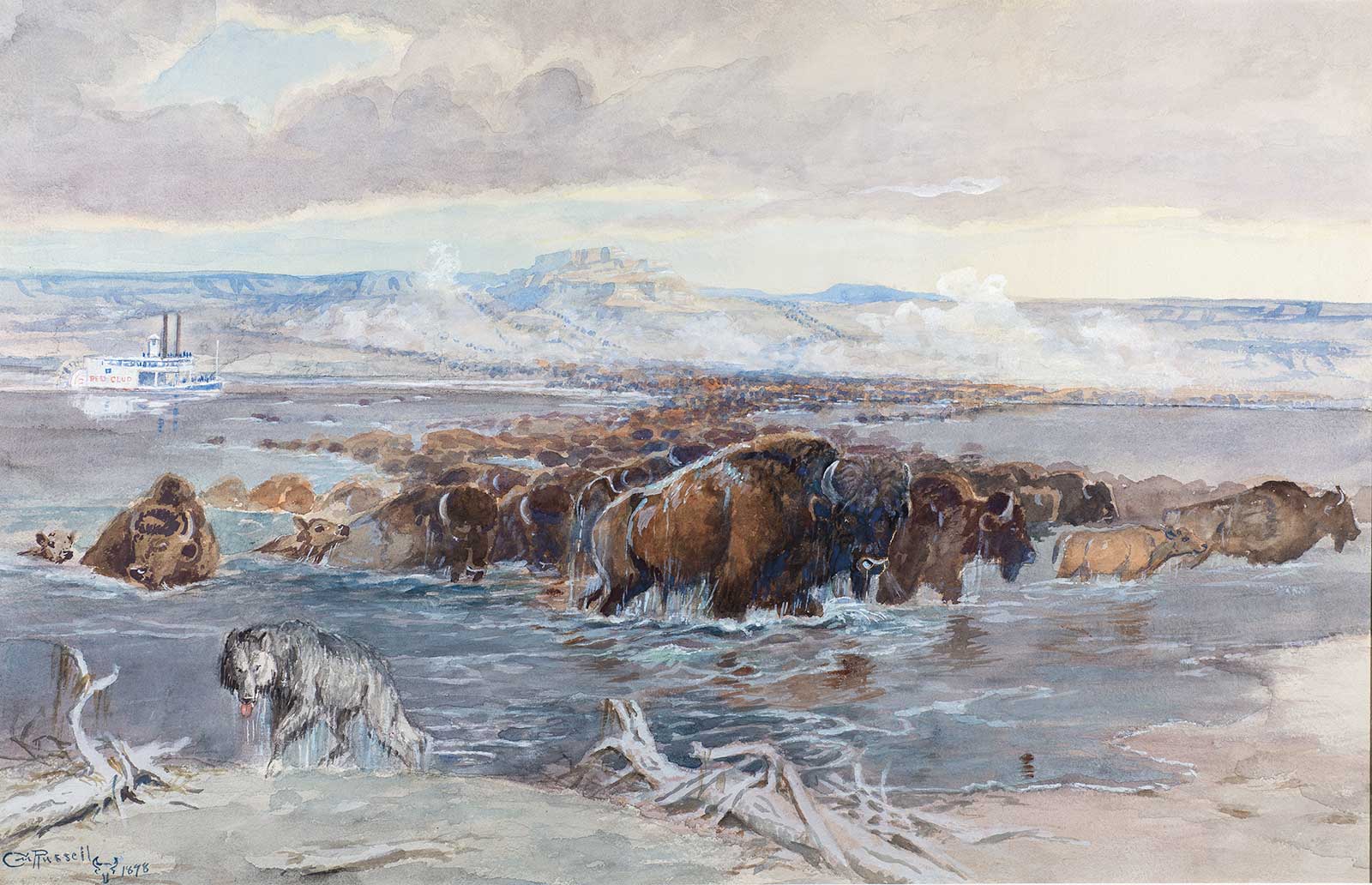 Charles M. Russell (1864-1926), Waiting for the Herd to Cross, 1898, watercolor on paper, 19 x 29”. This watercolor was the ”beauty“ that allowed Nancy Russell to buy a new cook stove, while solidifying her role as Charlie's business manager.
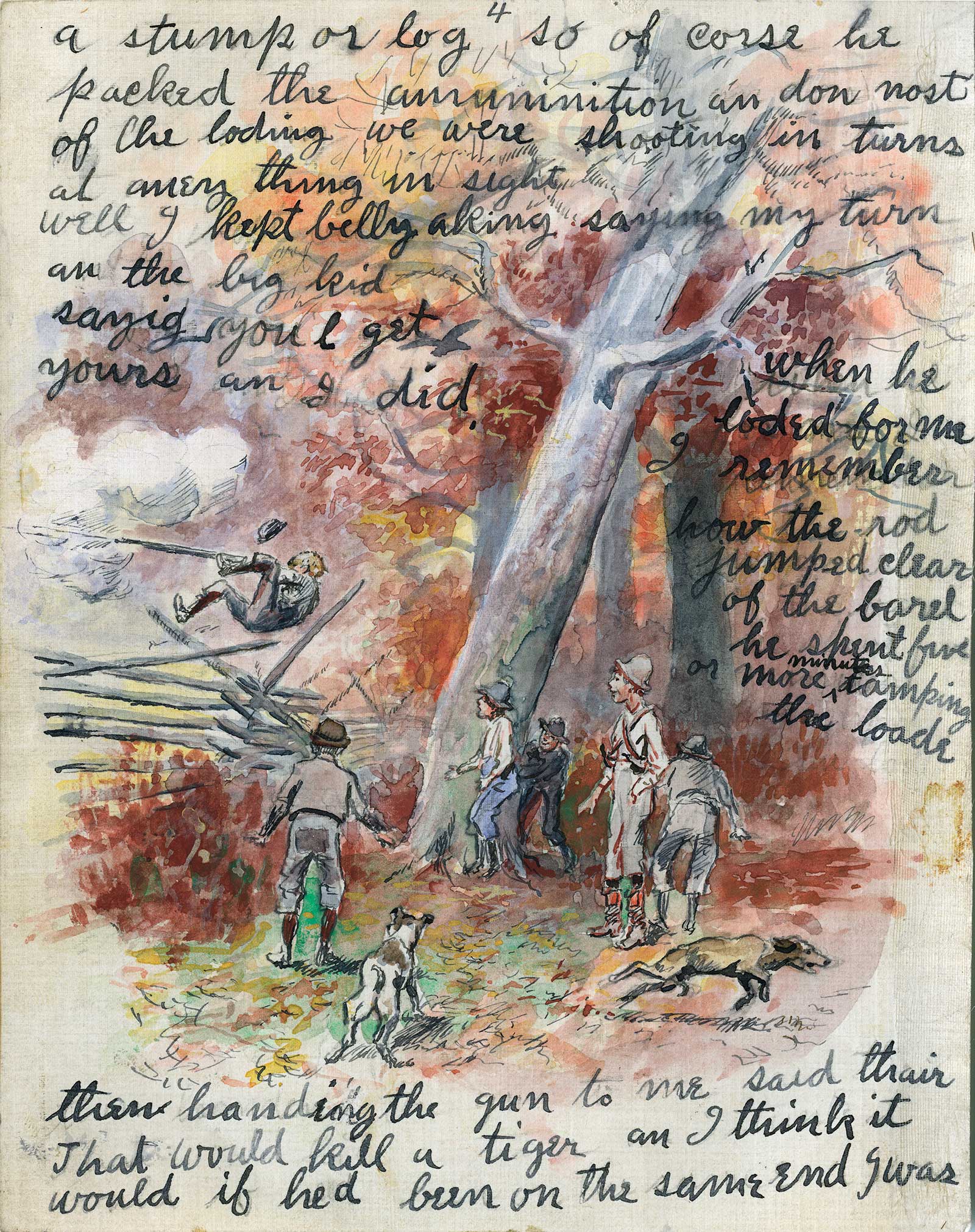 Charles M. Russell (1864-1926), Letter to Albert J. Trigg (St. Louis; A Cyote Who Licked My Hand) (detail), November 10, 1903, watercolor, pen and ink, 6¾ x 53/8”. C.M. Russell Museum.
In the face of such discouragement, Nancy might well have given up on the biography. She was no writer. She knew the success of Trails Plowed Under and Good Medicine rested on Charlie’s inimitable gift for storytelling, not hers. When they were introduced in 1895, he had lived half his life already. Born in St. Louis on March 19, 1864, he was 31 when they met. He would be 62 when he died exactly 31 years later. She would have to fill in the first half of his life by eliciting information from his surviving older siblings, sister Sue and brother Bent, and remembering visits when his father and other family members reminisced affectionately about his boyhood antics. She knew nothing at first hand about his early years in Montana’s Judith Basin with trapper Jake Hoover and various cattle outfits––”when I was a kid,” as he put it. She could describe them only at second hand from what he had told her, and what old rangeland cronies were willing to share. To recapture those years Nancy stole a page from Charlie’s book and strung together extended anecdotes that bounced around in time.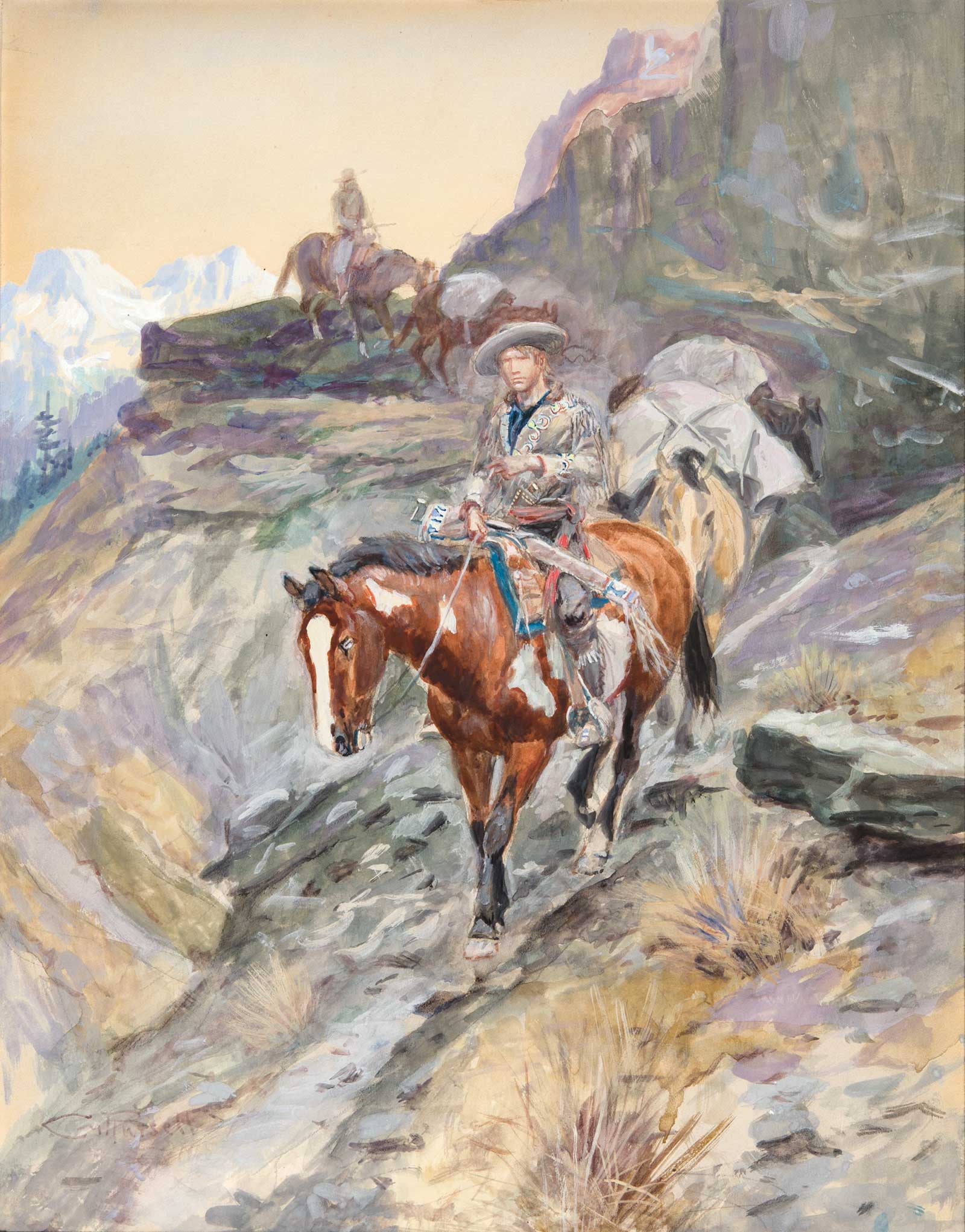 Charles M. Russell (1864-1926), When I was a Kid, 1905, watercolor on paper, 14¼ x 11”. C.M. Russell Museum.
After their marriage, of course, she knew his story intimately. For as long as they were together he made his living as an artist and Nancy was ever at his side, boosting his game and selling the man and his work. Beginning with their meeting at Ben Roberts’s home in Cascade, her book becomes a memoir as well as a biography, justifying the title she gave it, Back-Tracking in Memory: The Life of Charles M. Russell, Artist. Her book conveys the kind of information only Nancy could impart. Her descriptions of their first meeting, their wedding and their first Christmas together are magical. She oozes pride in her good business sense, implicit in arranging their seminal trip to New York in 1904, and tells stories on herself while relaying their experiences in England and Paris in 1914 on their only trip abroad. She tells the previously untold story of their botched formal introduction to the Prince of Wales (future king of England) at a Russell exhibition in Saskatoon, Canada, in 1919. These were career highlights, amusingly recalled as only Nancy could. Her rhapsodic chapter on the pleasures of life at Lake McDonald may have been aided by another hand, but the sentiments are all her own. In short, after Nancy entered Charlie’s life, her book, like her life, becomes a story no one else could tell.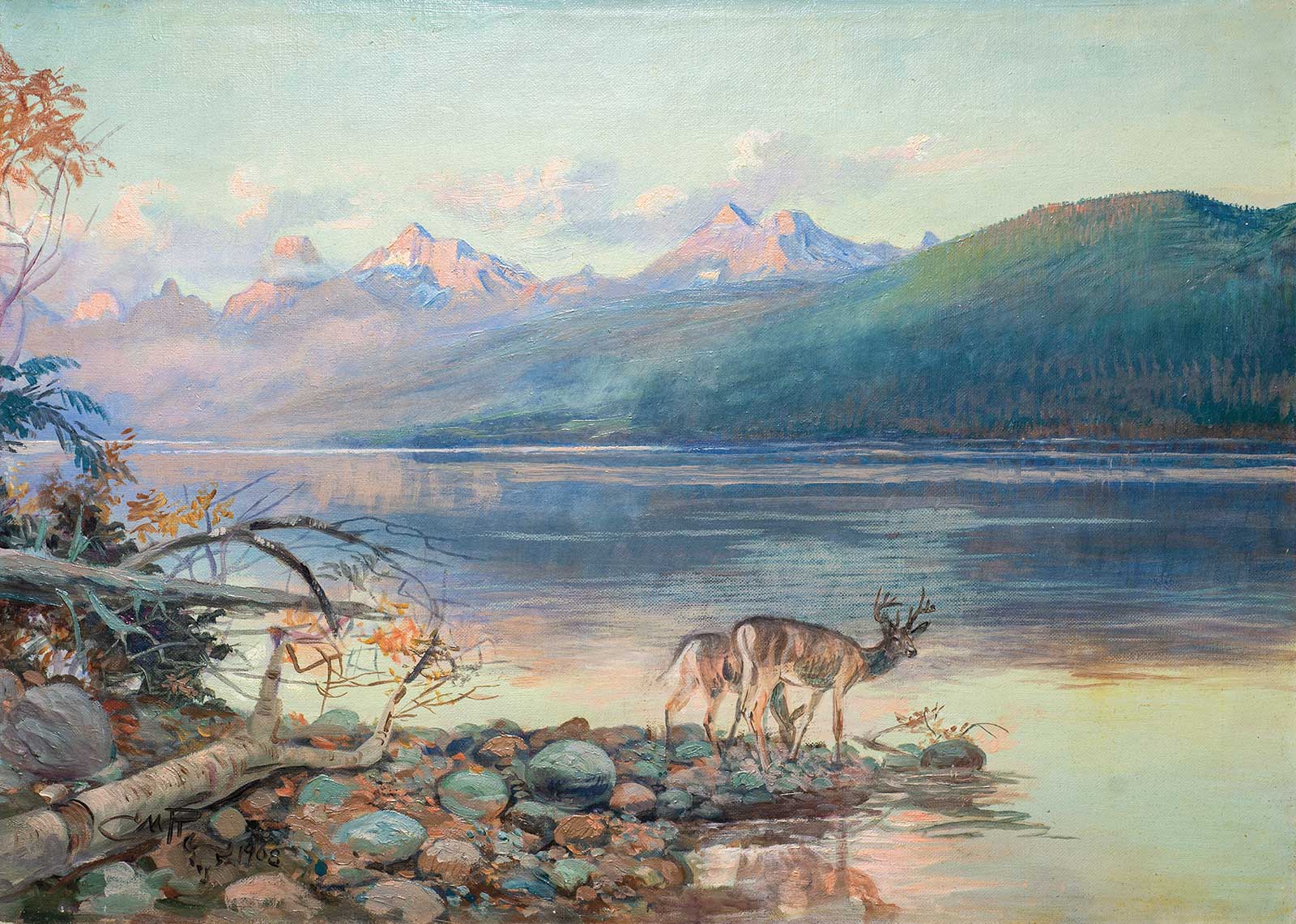 Charles M. Russell (1864-1926), Deer at Lake McDonald, 1908, oil on canvas, 145/8 x 20½”
Nancy never completed Back-Tracking in Memory. Having set it aside in 1929 to work on Good Medicine, by the time she was ready to return to the task of finishing it up, her health had faltered, leaving her with more memories to address than she could get to. She had the materials on hand to stimulate her muse––the poems Charlie wrote to accompany gifts he had painted or modeled, transcripts of his letters and letters from those who knew him well (read the letter from Bill Hart above), newspaper clippings and so forth––everything she needed to proceed, but she never got around to folding them into her narrative.
Tom Petrie acquired Nancy Russell’s unfinished manuscript about a decade ago and recognized at once that it needed to be published. The manuscript was short––just 116 typed pages—but its content was fascinating to anyone interested in Charlie Russell. Tom invited me to join him in bringing Nancy’s book to press. We have augmented the manuscript with additional chapters Nancy wrote that, for various reasons, were not included in the manuscript. For example, the pivotal chapter describing her first meeting with Charlie was removed from the biography to serve the immediate need for a biographical note at the front of Good Medicine; it, along with other draft chapters reposing in the Nancy Russell estate papers at the Gilcrease Museum in Tulsa, has been restored to its rightful place. We are immensely grateful to the Gilcrease for its cooperation. In addition, we have added sidebar commentaries to accompany illustrations pertinent to Nancy’s text. She had always wanted her Russell biography to showcase his art as well, and the sidebars accomplish that goal without altering a word of Nancy’s text. Finally, she made pages of notes about the people and things she meant to cover in her book. Some she got to, many she did not. Again, through the courtesy of the Gilcrease Museum, these notes are published verbatim in an appendix to our book that establishes the full scope of Nancy’s ambitions for her unfinished journey “back-tracking in memory.”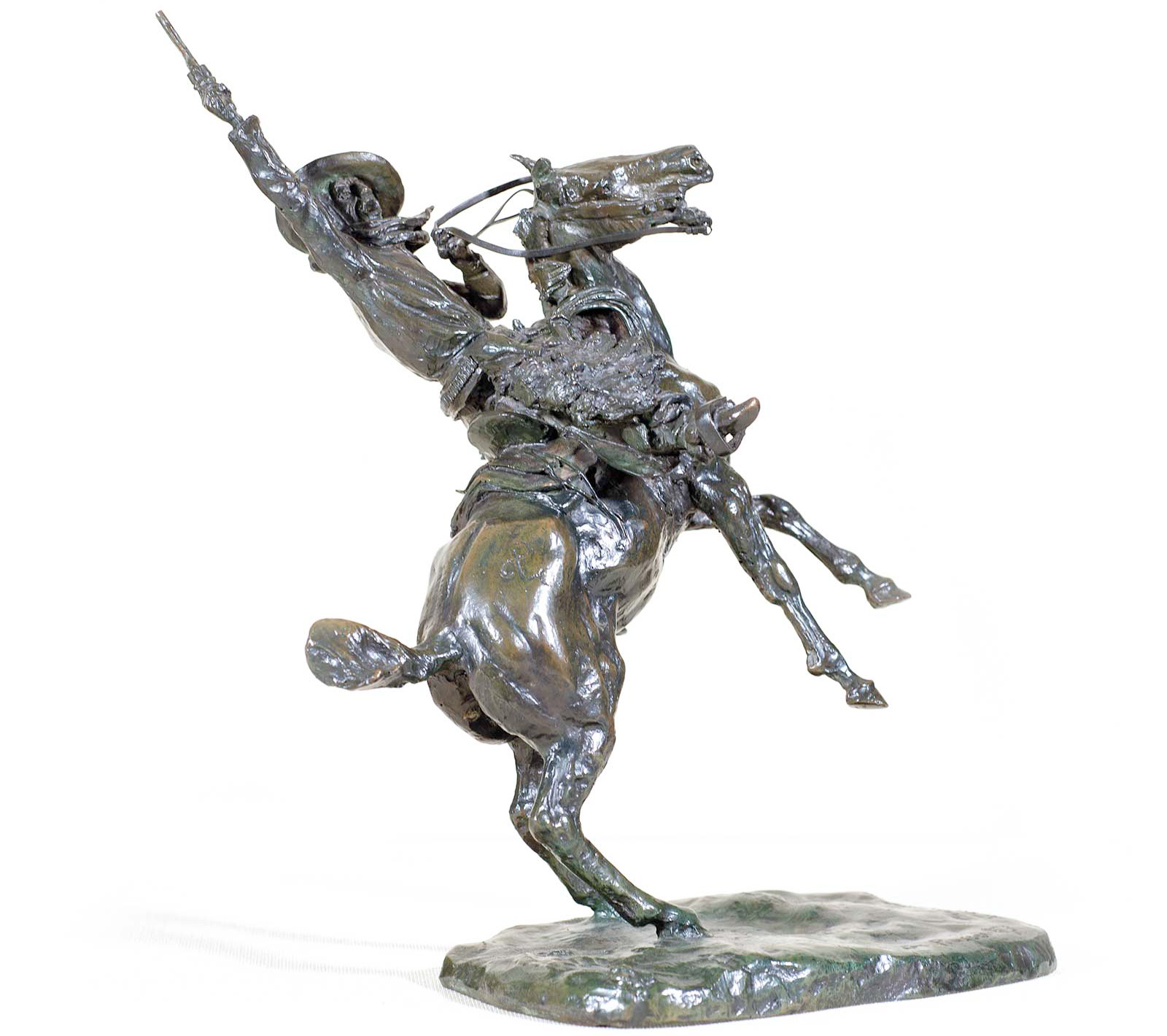 Charles M. Russell (1864-1926), Smoking Up, ca. 1903-1904, bronze. Russell’s first bronze, cast on his second trip to New York at Nancy’s urging. Unless otherwise noted, all images courtesy Thomas Petrie Collection.
It would have been easy for Nancy to abandon that journey well before her life ended, leaving the story of Charles M. Russell to someone else to write. But Nancy was nothing if not dogged. Four years before she died on May 24, 1940 (at 62, the same age as Charlie), she corresponded with a would-be biographer pressing her for help with his own Russell book. She was not about to surrender her claim to Charlie’s story, however. “I have been getting material together ever since Charlie has been gone that will have the heart and the meat in it that is necessary to give the world the picture of the Charlie that I knew,” she explained. Her unfinished manuscript is not the full meal she intended to serve, but it provides a substantial feast for readers who love heart and enjoy meat on the bone. Back-Tracking in Memory now joins Trails Plowed Under and Good Medicine to complete the Charles M. Russell trilogy Nancy Russell envisioned. —
Bill Hart Writes a Letter
With a view to rounding out her biography of Charlie Russell, Nancy sometimes called on his friends for added perspectives about her husband. W.S. Hart, an accomplished actor and silent film cowboy star was just such a special soulmate, as the partial quotation of Hart’s letter (dated January 22, 1929) to Nancy shown below reveals:
Dear Nancy:
It’s a great task to try and set down my memory of Charlie Russell, one of the greatest men that ever pulled on a pair of cowhide boots.
As you know I first met Charlie at your home [while playing a one night stand] in Great Falls, Montana, the early part of January 1902…
I knew many illustrators and painters in New York and the impression Charlie made upon me was so great that I begged him to make a trip East. I think it was during the following winter at my little flat on West 34th Street, I received a card bearing a New York postmark, reading, “Friend Bill: How! I’m in the big camp.”
There was no address given, just Charlie’s emblem, the buffalo skull. It took me several hours to find him, but I did. He and your good self were living at a little hotel (The Park) on 42nd Street near Sixth Avenue [now the site of the New York Public Library].
Charlie and you and I spent much of our time at the studios of Will Crawford and J. N. Marchand, also on 42nd Street. None of the artists had any money, but they were making a living. I was plumb broke and I have always thought the Russell family were doggone near the bottom of the pocketbook too.
Do you remember, Nancy, how we would all congregate at the studio of Crawford, Marchand, or one of the many others of the artist crowd, and have a party meal on the share and share alike plan? Yes, and draw lots to see who would wash and wipe the dishes. I remember one night when I was wiper [I heard a gunshot and]
I dropped a plate and you women folks all screamed and the men folks all rushed for the windows. Hell was poppin’ down below on 42nd street, seemed like more shots were bein’ fired that had been in the Spanish-American war, also there was the sound of running feet and breaking glass. “Seems like old times,” said Charlie. And it was. The one difference being that in the “old times” with such a fusillade of bullets there would have been SOME casualties. But the next morning when Charlie was looking at the bullet holes in the big plate glass windows along the street, he remarked, “Them fellers sure must have been shootin’ at tall men.” “Looks like the wild and wooly west, doesn’t it, Charlie?” someone said. “It’s wild all right, but not very accurate,” replied Charlie. Monk Eastman and his East side gang of gun boys did not measure up.
Powered by Froala Editor