The men are lined up along the barbed wire fence, their eyes turned toward the rising sun. Several of them rest their elbows on the metal fence posts, mindful not to snag their coats on the twirled prongs, as they steady long zoom lenses that pan back and forth across the gilded horizon.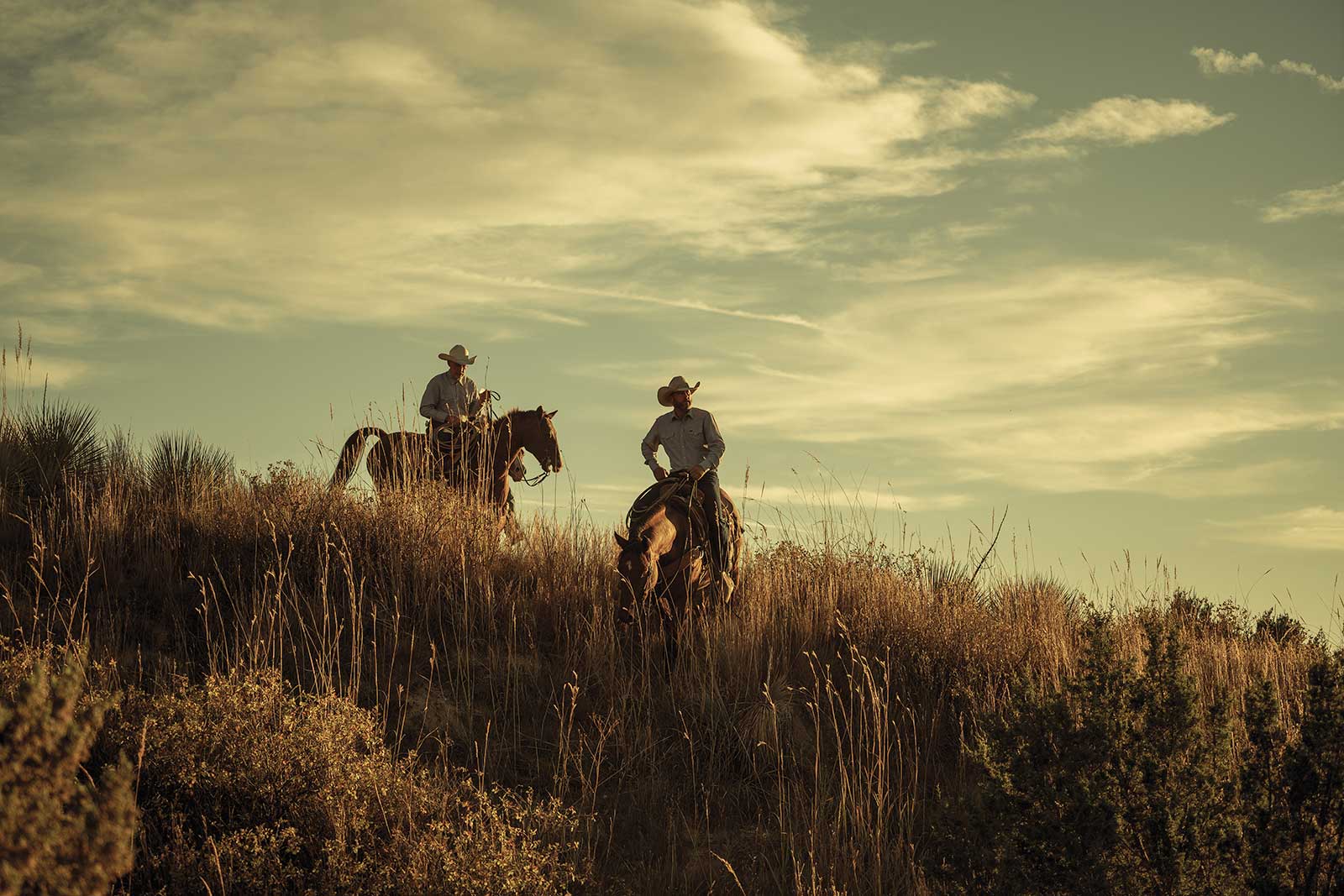 Painter Bruce Greene, left, rides with Ty Dunlap on the Spade Ranch near Canadian, Texas.
“I think that’s them,” one of them points down into a shallow, brush-lined valley. Amid the folds of land, tucked back behind a short mesa, dust erupts slowly from an unseen source. The morning light penetrates through it, shifting the brown Texas dirt into golden plumes that billow silently 1,000 yards away. The flaxen clouds shift and twist through the backcountry brush, growing more pronounced and ominous as they roll closer. Eventually the commotion disappears behind a ridgeline and reemerges, cresting over a dirt road that leads up to the position of the watchers on the wire, who are now turning and admiring the prize of the morning—120 black angus cattle.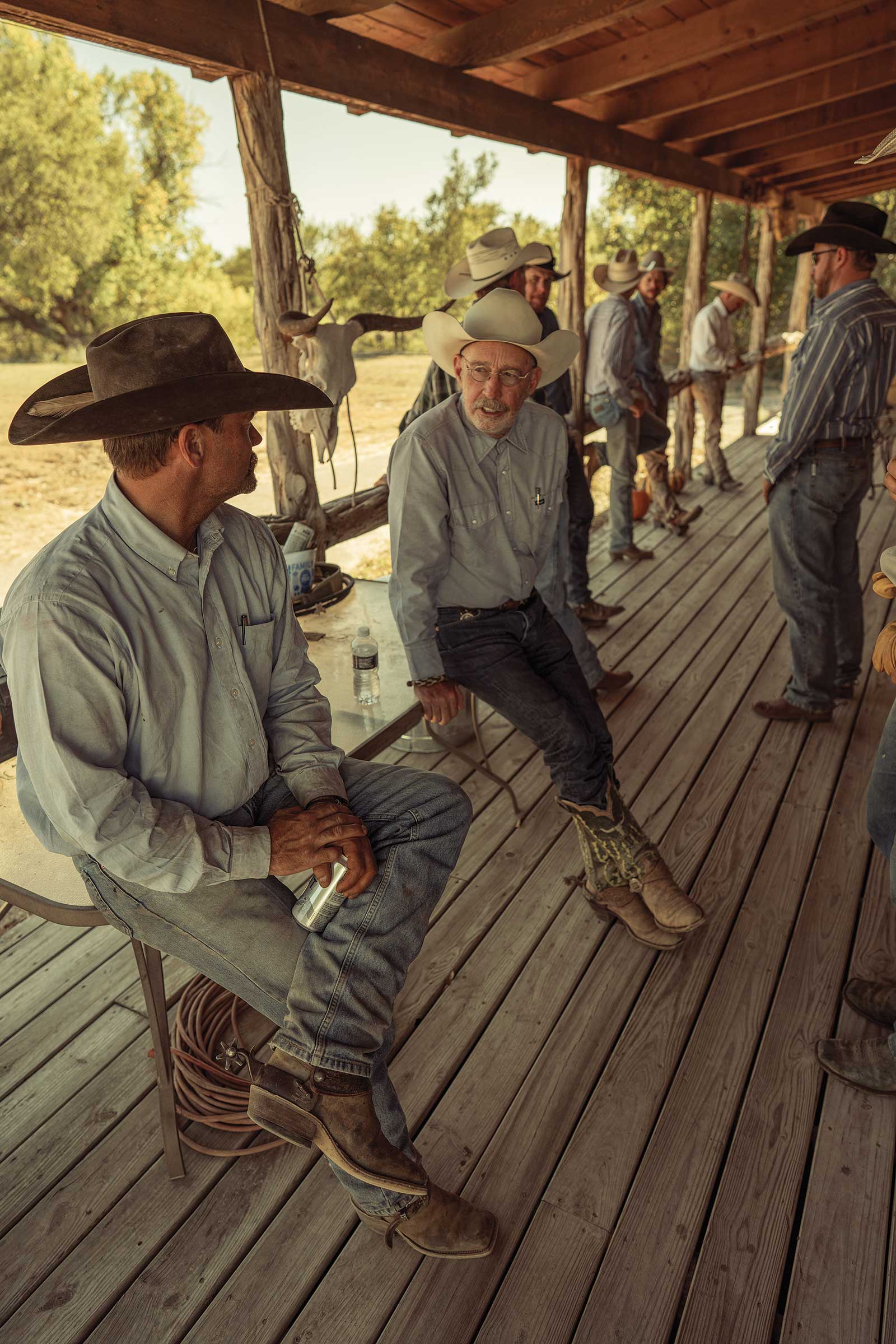 Painter Bruce Greene, center, talks with the working cowboys of the Texas Panhandle
The huffing cows are led by five riders on horseback who take position in the rear and the flanks as they guide the nervous, but otherwise mellow, cattle down a short road and into a series of pens perched at the top of a flat-topped hill with 360-degree views out over the
Texas Panhandle.
The six spectators—Martin Grelle, Bruce Greene, Tyler Crow, Teal Blake, Dustin Payne and Chad Poppleton—wander over to the pens as the last dozen or so cows are driven into their temporary home. As the final cowboy rides through, he slams a metal catchrod through the fencelatch, securing the gate behind him. “That’s about as easy as it gets,” Poppleton, the painter from Utah, says as the crying calves wail into the still, morning air.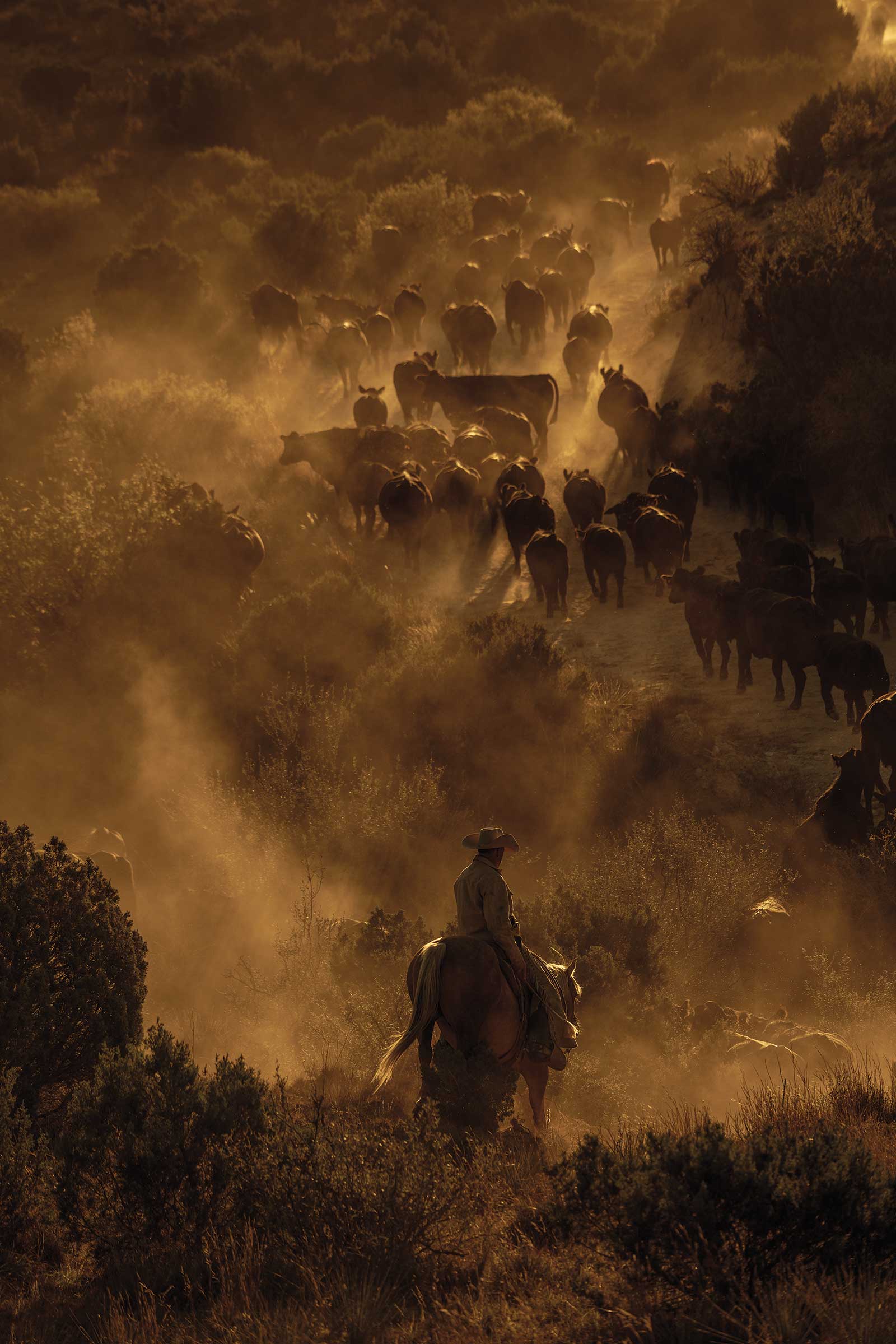 A Spade Ranch rider helps round up cattle amid dust and haze.
With that metal-on-metal clang, and the cowboys inside the pens now prepping to separate the mama cows from the calves, now there is no doubt: The annual Cowboy Artists of America trail ride is now in full swing.
Back in camp, other members of the CA are arriving from their respective homes: C. Michael Dudash from Idaho, Phil Epp and Mikel Donahue from Oklahoma, Wayne Baize and Jason Scull from Texas, and Grant Redden and Dustin Payne from Wyoming. It will be a light turnout this year, the year of Covid, and with the exception of a photographer, a writer and one longtime CA supporter, no guests will be attending. “We have to tend to the members,” Blake, the group’s current president says later after helping bring the horses back in from the northern pasture. “After the year we’ve all had, we just needed some time for us as a group. It’s about building these guys up and preparing for the coming year. We’re here to support each other.”
There is a long history of CA trail rides, longer than even the 55-year-old club itself. It was founders Joe Beeler, Charlie Dye and John Wade Hampton who attended a roundup at an American-owned ranch in Sonora, Mexico, in the fall of 1964. There they first began to talk about the creation of a group devoted to portraying the “cowboy West” in art. It wasn’t until the following year, in the summer of 1965, that the CAA would be formally started.
After the morning’s roundup and sorting is complete, the working cowboys return to camp with their artist shadows in close tow. The first day is light and ends at just after noon. They return to a hot lunch, which they take onto the patio, home to several rattlesnakes in a glass aquarium and a pile interlocked antlers that serve as a centerpiece on a table—several artists untangle the bone-white trophies to determine if they are from mule deer or white-tail deer. After lunch, everyone breaks their separate ways: The working cowboys tend to their horses, several artists take quick siestas in their tents and others shoot the breeze and swat at flies in the warm Texas sun. Greene and Donahue light cigars and sit in the shade, admiring the light coming through the leaves of a nearby cottonwood.
Lariats are brought out and they take turns lassoing a plastic cow’s head mounted to an ice chest. Poppleton teaches a visiting city slicker. “Get a big loop here with your hondo,” he says pointing down at the knot that slips around the rope. “Give yourself a big spoke, and let your wrist power the spin over your head. And when you’re ready just paint a big brushstroke in front of you over what you want to hit.” Payne, who’s competed in rodeo and knows his way around a lasso, grabs his own rope and kills time with the group. Seemingly from almost any distance, and any approach speed, Payne can hit his mark. With a helicopter-like spin that nearly whistles in the air above him, he whips the rope forward and it makes a loud crack as it lands, and then a sudden accelerating zip noise as he yanks the rope back through the hondo. Later, they push the ice chest aside and bring out a metal roping target, and Payne easily throws a perfect loop toward the dirt that bounces up and snags the target’s two back feet. Crack, zip. Crack, zip. Crack, zip. The sound could lull a baby to sleep.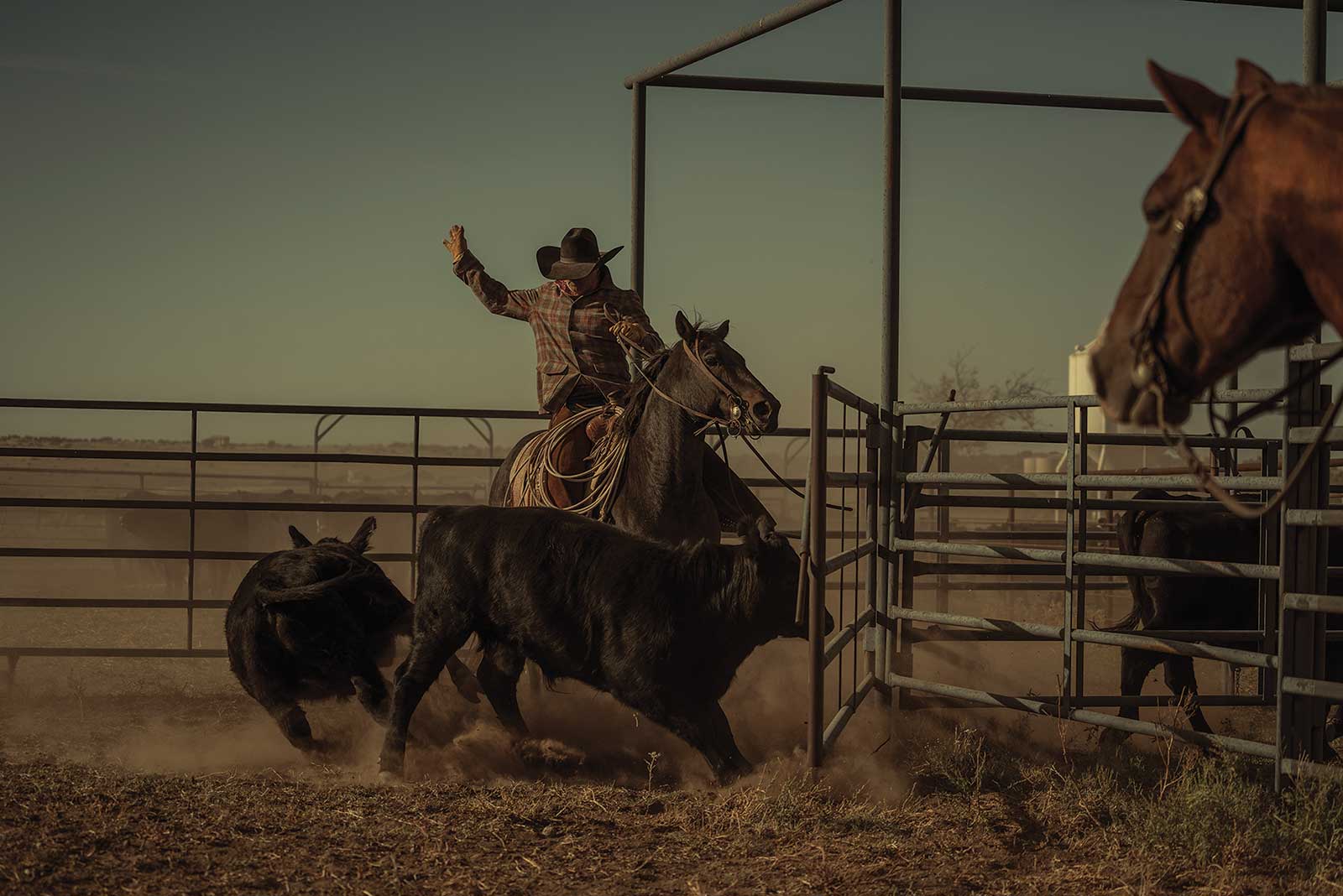 Painter Teal Blake at work on the Spade Ranch. Blake, who’s a working cowboy when he’s not in the studio, organized the 2020 Cowboy Artists of America trail ride.
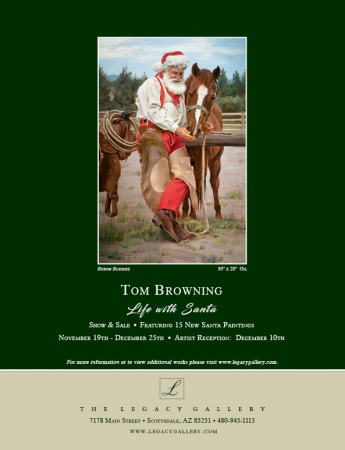
This is what time in camp looks like. The artists relax, drink coffee out of metal mugs, pass around bags of beef jerky and sunflower seeds, and they often talk shop. What brushes are you using? How do you prepare your canvas? Where do you buy your paint? Redden pulls out his phone and shows the paintings he’s been working on, and one that recently sold in Wyoming. Grelle, who’s prepping a major one-man show a year from now, shrugs at the deadlines in front of him: “When I get back, it’s full-speed ahead,” he says. They speak of the artists who couldn’t make it—Bill Nebeker, Tom Browning and others. And the ones who have been gone for some time, but have cast a long shadow—Beeler, Frank McCarthy, Tom Lovell, Tom Ryan and Bill Owen.
The Panhandle division of the Spade Ranch is located about 45 minutes outside Canadian, Texas, itself a 90-minute haul northeast of Amarillo. The drive to Canadian, through fields of cotton, sorghum and wheat—and hundreds of wind turbines, whirring silently over the land—shows how rural and peaceful this part of Texas is. And later, that isolation reveals another reward: no light or noise pollution. When night spins over the Spade, the sky fills with stars, a vast field of pinpoints, each one winking from within the dark canvas. Even the Milky Way, a hazy belt of light buckled across the sky, shines bright from this part of the Panhandle. “Imagine looking up and seeing this every night,” an anonymous voice says from around the campfire as glowing embers pop and float upward like fading meteors. “It’s enough to make you never go back.”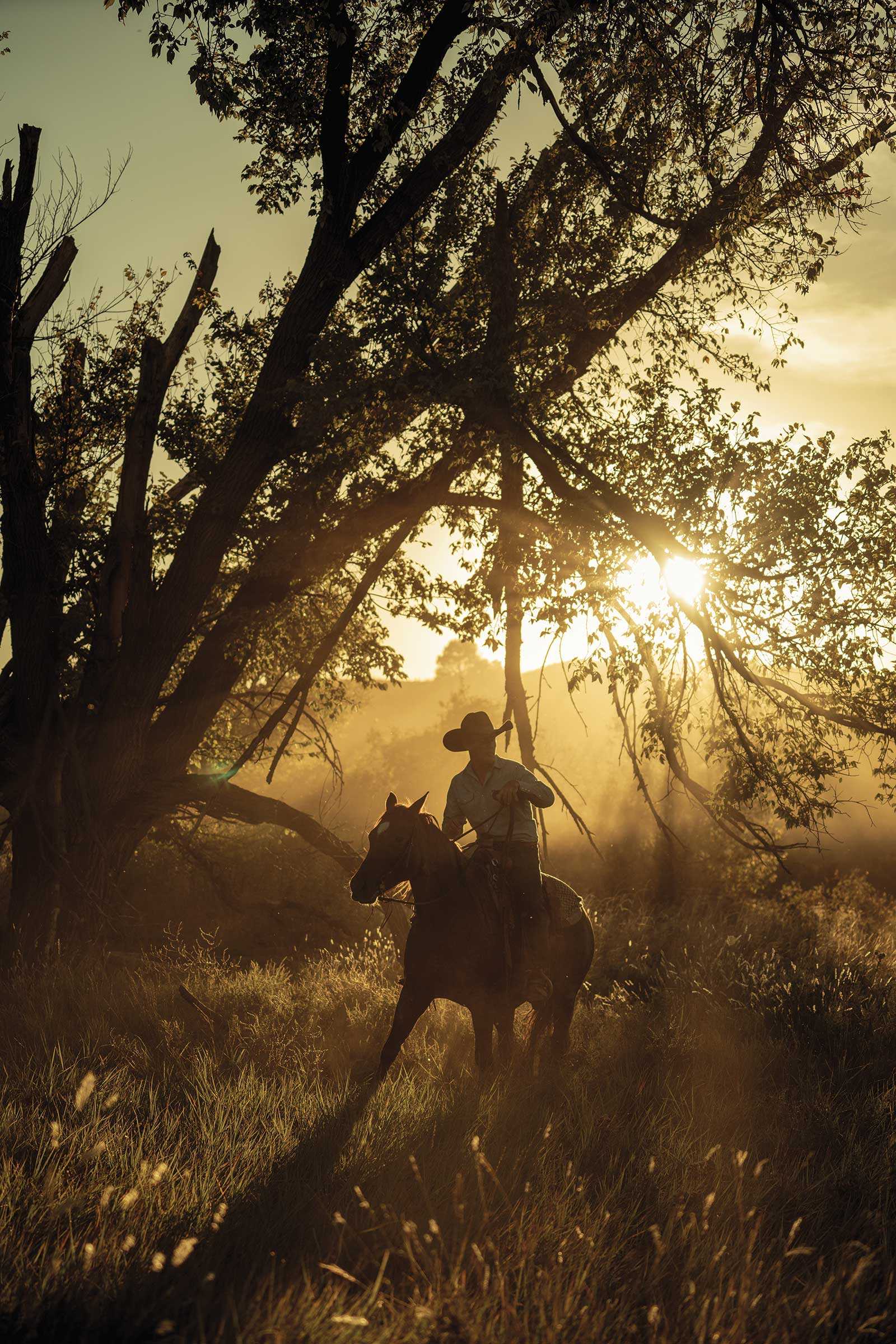 A cowboy rides through the trees and brush of the Texas Panhandle
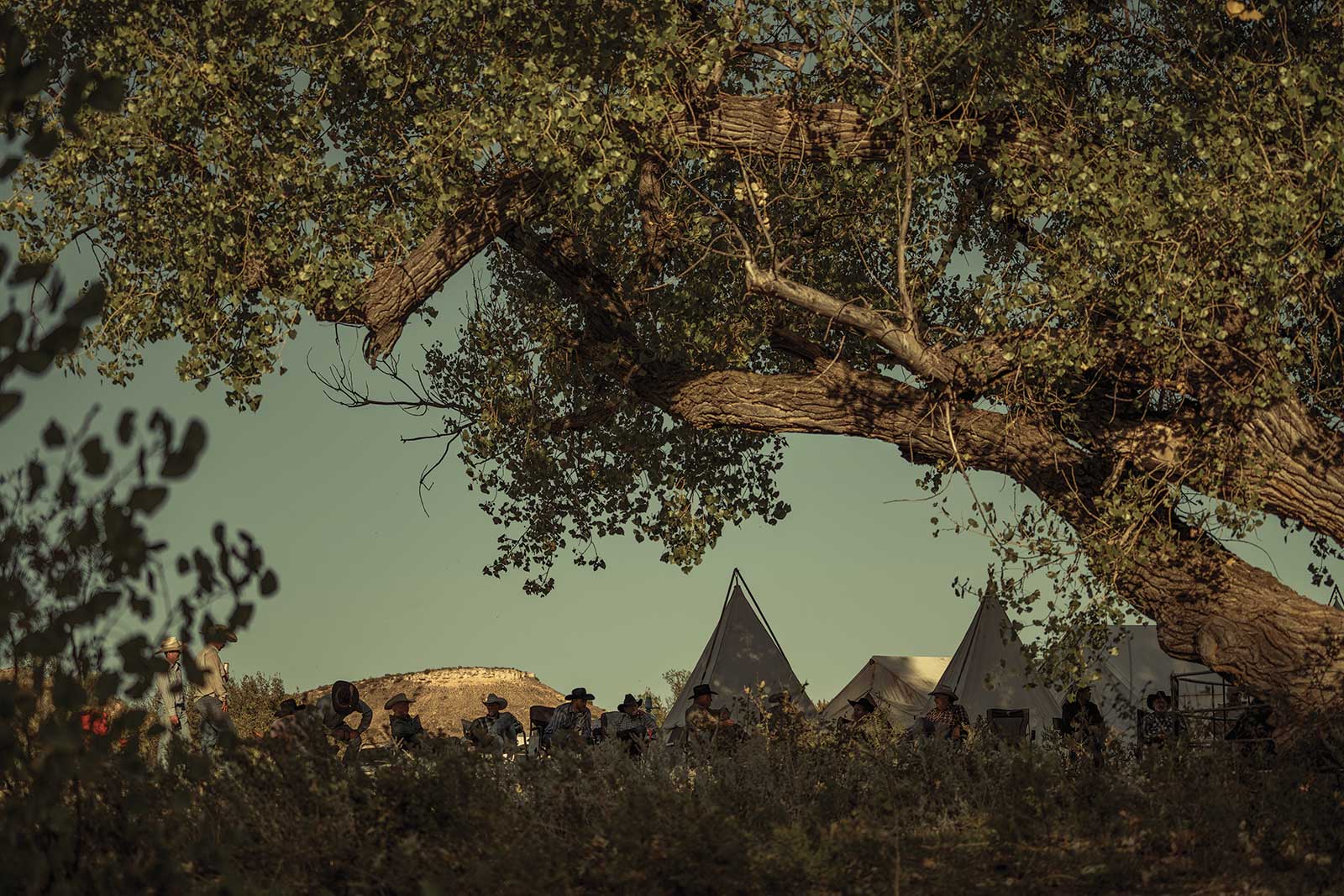 CA members in the shade of a cottonwood tree at the end of the day
After the stars come out, Blake arranges the evening’s entertainment—it’s movie night. There’s popcorn and candy, and brownies with ice cream. The screening is of Burt Kennedy’s cowboy picture The Rounders starring Henry Fonda and Glenn Ford. The film is set in and around Sedona, Arizona, which is appropriate since that’s where Beeler, Hampton, Dye and George Phippen started the CAA in 1965, the year the film was released. The canvas tent serving as a screen has drawings by Greene and Clark Kelley Price, which adds a nice touch to several sequences of the film as the rough sketches appear to be actors within the scenes. At one point, a band of coyotes howl away in the distance.
The cowboys head out the next morning, but the CA sticks close to camp. It’s the day of their annual meeting. Other than a break for lunch and to move chairs into shifting shade, the meeting goes uninterrupted from 8 a.m. to nearly 5 p.m. These are famously secretive engagements for the group, but they are likely filled with everything you’d expect from any organization: an accounting of funds, an examination of future potential members, a review of donors and other supporters, and discussions about revenue, marketing, social media and events. When the meeting breaks, the weary members seem to sigh relief. “It’s been a tough year,” repeats Blake. “With all that was going on we had to a lot to go over. Covid hurt us as much as it hurt everyone else. We’re making plans to get back on track.” Blake, who went into the meeting the president, left as a regular member. Presidents serve a year, and during the meeting the presidency was passed to Redden, the soft-spoken artist from Wyoming. One news item that came out of the meeting that can be reported: the CA will hold a miniature show in the spring in Scottsdale, Arizona, and the annual exhibition and sale in the fall of 2021 in Fort Worth, Texas.
That evening, as if on cue, the earth takes a breath and sends a warm breeze gusting in from the west. The Texas men—Grelle, Greene and Baize—hold their hats and sort of nod in familiarity at the rapid appearance of this phenomenon. All that night, the gnarled old cottonwood sways and rattles, its leaves sounding like a waterfall breaking against rocks. Throughout the night, the canvas tents balloon up and deflate, and then balloon up again—the beating hearts of the Spade Ranch.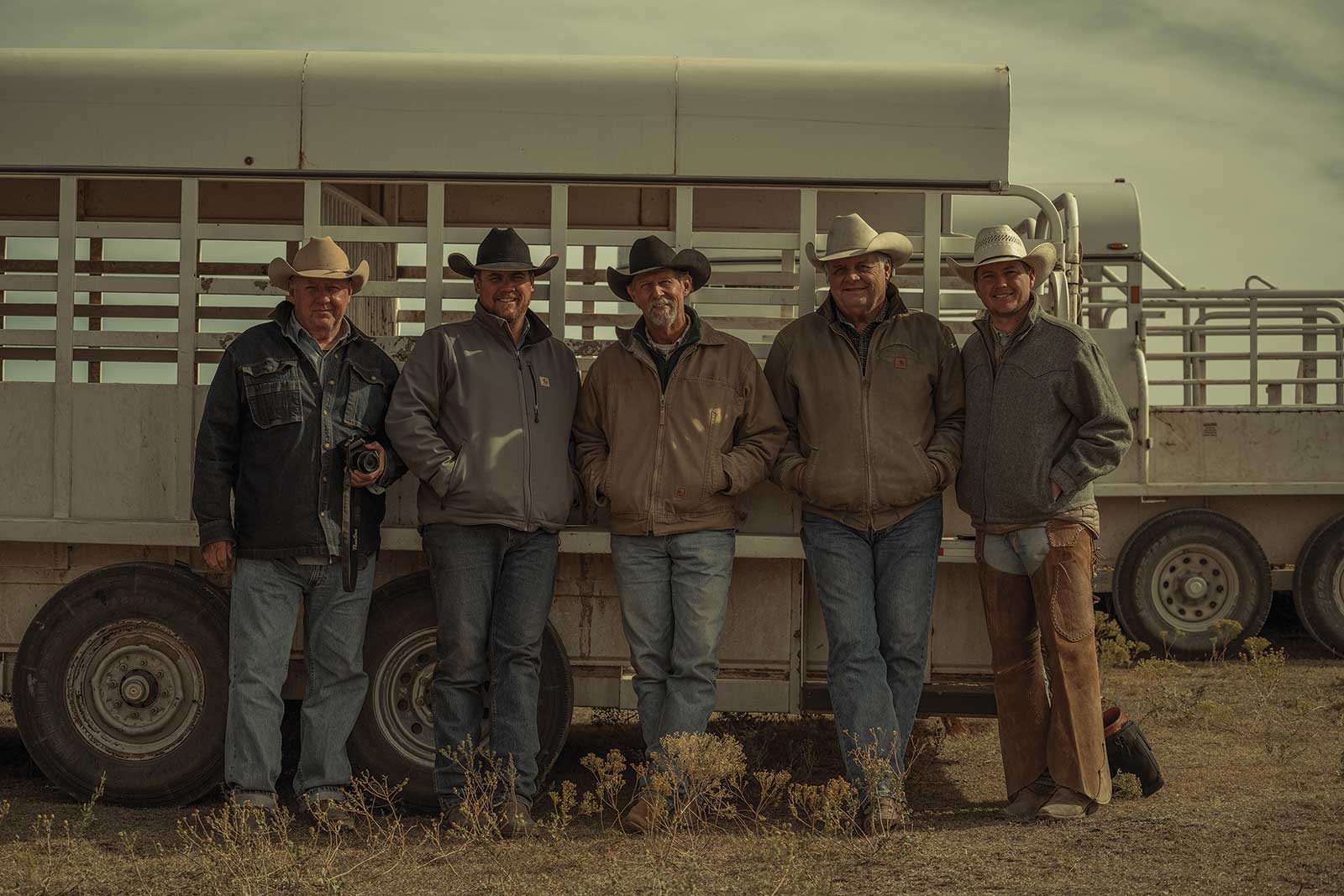 members Phil Epp, left, Chad Poppleton, Martin Grelle, Mikel Donahue and Tyler Crow
By the third morning, while everyone was waiting to get chow in the ranch house, Pandhandle Spade manager Jason Pelham is regaling his guests and his cowboys—the “Yes Sir” crew, five or so riders of varying ages, whose politeness was registered in every sentence: “Yes, sir…,” “Thank you, sir…” and “Sure thing, sir…”—about life on the ranch and cowboying in general. Pelham, a big man with a large push-broom mustache, could write a dissertation on the best kinds of wraps to use on a saddle, or how to achieve the best cutting edge on a knife, or the ideal horse to ride when chasing down mama cows. He’s the kind of person who has a story for every occasion. During a break in the conversation, he points down a hallway in the house and tells everyone to go sign their name to the wall. The cowboys sign their names, and the artists draw small pictures above their signatures. “Not everyone gets to see the wall,” Pelham says, a somberness in his voice. “Once you sign your name to that wall, in case you never make it back, others will know that you were here.”
After biscuits and gravy, comfort food for an early morning with some cows, everyone beats the sun out the door heading to the north pasture to round up 100 or so cattle scattered on a beautiful strip of land marked by panoramic vistas from rocky buttes topped with wind-whipped mesquite and narrow box canyons carved into the hillsides and dry creekbeds. Blake, Crow, Greene and the “Yes Sir” crew round up the cows with relative ease, guiding them through grassy fields and up dusty, rutted roads to the pens. They occasionally ride into the shadows of mesas, only to rise up into the sunlight later as the ridgeline dips—it’s a William R. Leigh painting come to life. Up on the hill, with the cattle in the pens, the sorting commences, with a magnificent rider and cutting horse making short work of driving the mama cows away from their calves. The whole morning is an exhibition of horsemanship. It’s exquisite and pure.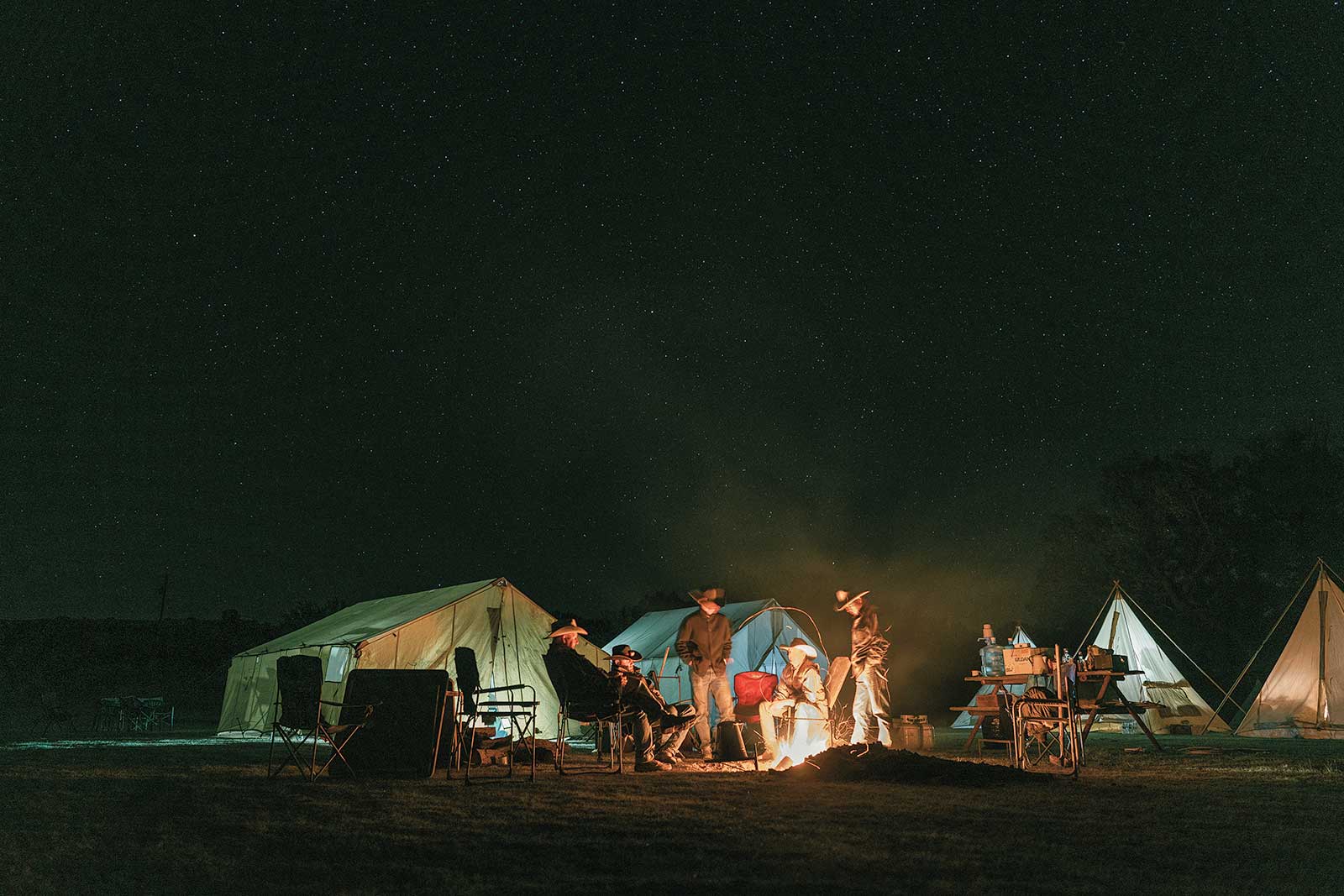
After the cattle are sorted and checked, a truck arrives and the riders drive some of the calves up a chute into the back. They’re destined for another pasture to be weened off their mamas. The cowboys hop off their horses, tuck their gloves behind their belt buckles and shed their long chaps. Pelham hands around canned sodas and, if you’re so inclined, a cold bottle of beer with a donut wrapped around the neck. The cows bellow in the background and the Texas wind pushes over the hill, as if driven by the morning sun. Many of the artists will be heading home soon, no doubt to turn what they witnessed at the Spade into paintings and bronzes.
And that’s the ultimate purpose of the CA: to continue that long tradition of the “cowboy West.” The artists come and go, and so do the cowboys, but this aspect of the West, largely untouched by time, remains as strong as ever. —
Powered by Froala Editor