How do you top a monumentally important solo show? For John Coleman, you just do another.
To almost anyone—in any field and in any discipline—making lightning strike twice would be a fool’s endeavor. But art isn’t random, and neither is success. And after Coleman’s blockbuster sold-out show in 2016, in which he unveiled his first major display of oil paintings, the Arizona artist now has something he didn’t have before: a mandate from collectors to continue pursuing work, in any medium, that makes him excited to walk into his studio every day.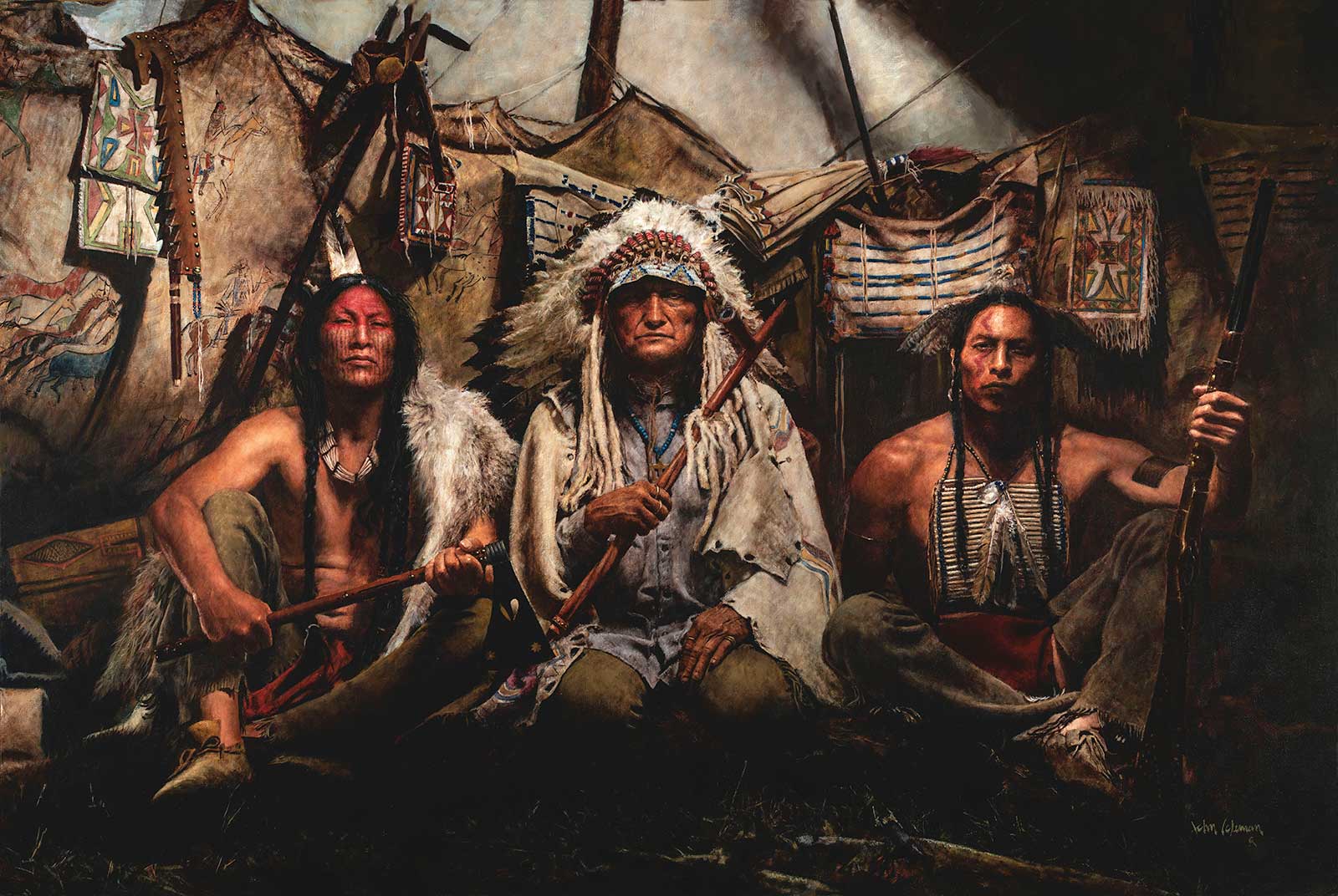 1876, Gall – Sitting Bull – Crazy Horse (detail), oil on canvas, 45 x 66½”
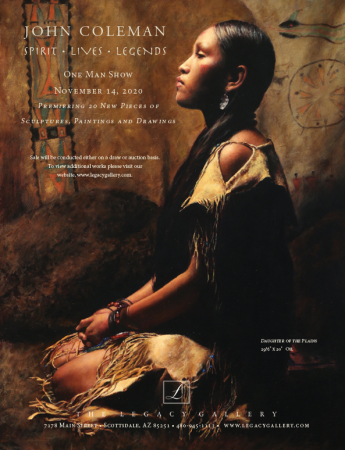
Four years after that historic show, Coleman is returning to Legacy Gallery on November 14 in Scottsdale, Arizona, where he will unveil a new collection of work—oil paintings, drawings and bronzes—that has been gestating in his studio for the last several years. For Coleman, these shows don’t always come easy, which is why he takes years to develop them and usually skips several major museums exhibitions during the lead-up to the show. “For this one I’ve been working almost two years now, which is more than it was the last time and that show had the same number of pieces,” he says from his studio in Prescott, Arizona. “This might not be a bigger show, but it’s a better show. I put a lot more into it and I didn’t even know I could put more into it.”
Coleman is even returning to the 2016 show title, Spirit • Lives • Legends. The choice was intentional because in many ways this body of work is a continuation of the one that preceded it—he’s simply adding another chapter to a developing story. The show, which will be sold by-draw with several live auction works, will include 20 pieces: 12 oil paintings, four drawings and four bronzes, including a massive version of He Who Jumps Over Everyone that will be assembled within Legacy’s second-floor gallery. “It’s going to be put together and the joints will be seamless. I want people to see it and wonder how it got there, sort of like a ship in a bottle,” Coleman adds. “And then one of the drawings, a life-size work of The Oracle, might be the best drawing I’ve ever done. My goal was to really push myself in every way.”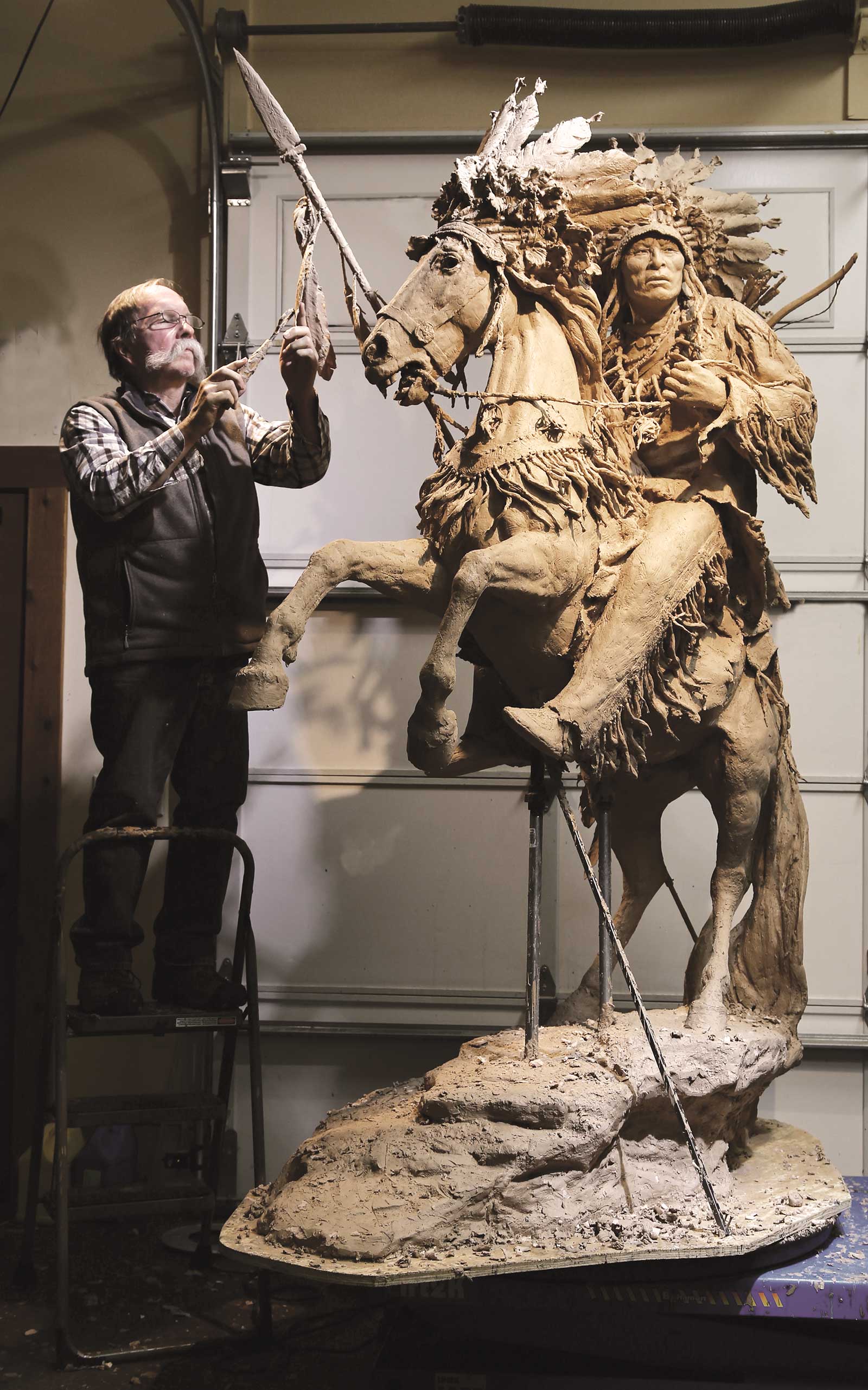 John Coleman works on the clay version of He Who Jumps Over Everyone in his Arizona studio.
The November date for Spirit • Lives • Legends was picked nearly a year ago, at a time when the world looked very different than it does today. “We just picked a date not knowing what was coming. At that time, my life was perfect.
I was at the top of my game. And then everything changed,” he says referring to the pandemic. “It was strange how devastating it could be on one level, for many people, but also on another level it allowed me to calm my mind. It just kind of stopped everything in its place and it allowed me to focus on the work. What a terrible thing to happen to us as a country, but it’s also a really strange time be alive.”
Legacy Gallery owner Brad Richardson agrees with Coleman that 2020 has been a profoundly strange year, but also commends how the artist handled all of it throughout the spring and summer. “We talk a lot about John’s work because it’s so powerful, but another aspect to John is his professionalism. I can’t ever recall him missing a deadline, or rushing something at the last minute. He plans his works, and then he works that plan,” Richardson says. “We’ve been talking about this show for three years, which should give you some idea of how he handles these things. After the 2016 show, he enjoyed the briefest moment of success and celebration, but then he got right back to work. He knew he had to elevate it. And even then, with so much pressure on him for another show, John never rattles. He doesn’t scare easy. He’s a real pro.”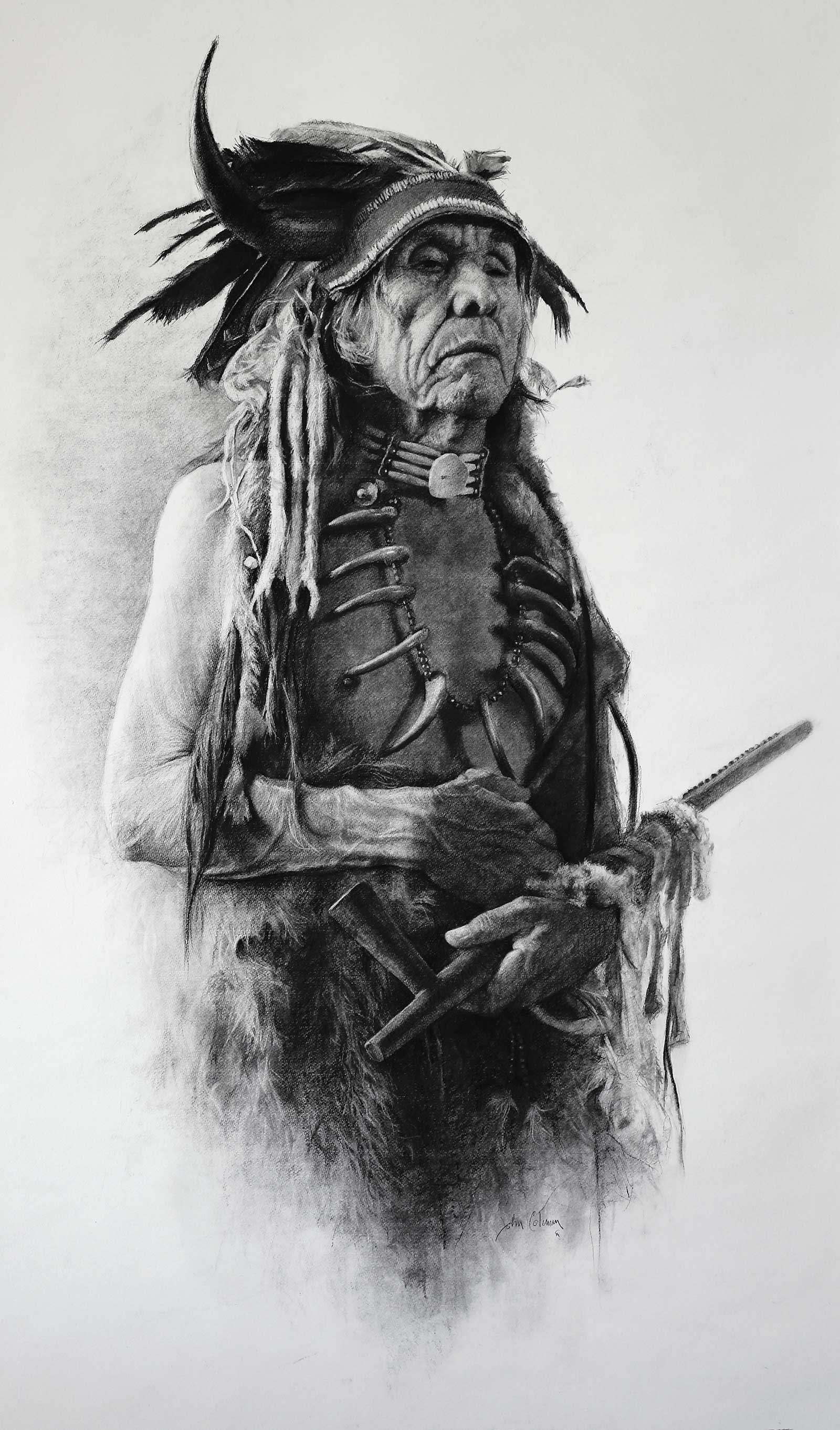 The Oracle II, charcoal on paper, 64 x 38”
It all comes down to optimism, and for anyone who’s had a conversation with Coleman, or been in one of his workshops, this aspect of his life is apparent. He recognizes that negative thinking requires more energy and yields worse results. And energy and time are luxuries to artists. He also freely admits that age (he’s 71) plays a role in his optimism, particularly after grandchildren started entering his life. You can see the grandfather in him come out in several of his new works: Council of the Little People, which shows a young Native American girl playing with her dolls; Sisters of the Greasy Grass presents a similar scene but with a slightly older girl who is wearing a beautiful dress with intricate bead and quillwork; and Mother’s Blessing, showing a new mother gazing down lovingly on her baby in a beaded cradleboard.
“Me in my 30s, I didn’t have the sensitivity to women that I do now. But we had two daughters and our family started to grow and I found myself opening up to different things. And then it came around again when we had grandbabies, and then a great granddaughter. Suddenly there is sensitivity there to these subjects,” Coleman says. “For me, though, these are just as much stories about me as they are about these subjects. I’m not just making pictures. My hope is that I’m creating something that can bring an audience into a place where they have empathy for the person who created it. Then it becomes poetry and almost ethereal. And that’s the hook that grabs people.”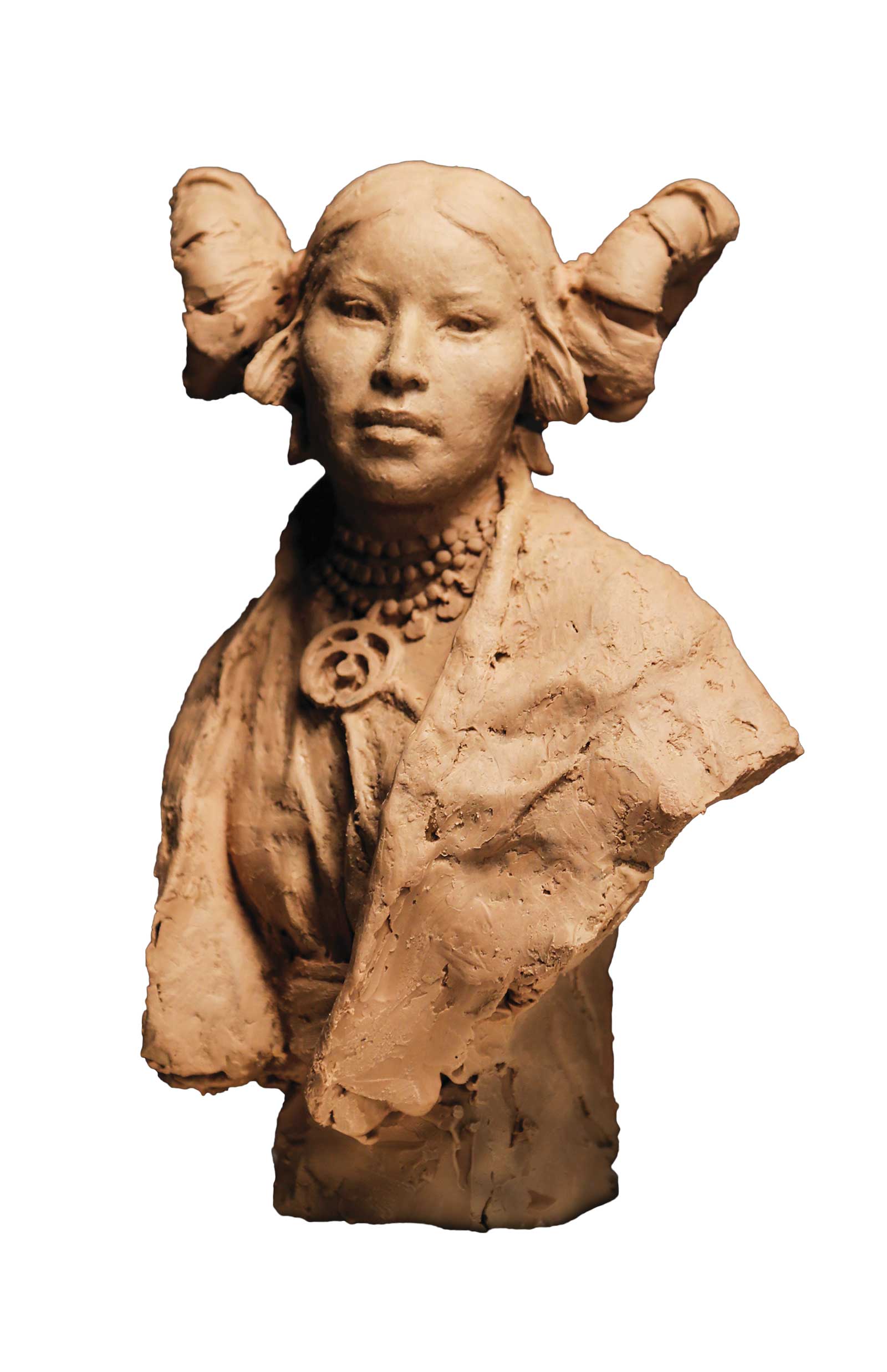 Maiden from Second Mesa, clay for bronze, 11 x 7 x 4”
He points to Daughter of the Forest People, one of the new pieces that shows a young girl in a magnificent robe seated outdoors. Her expression is one of beauty, but also quiet ferocity. “That look she has, that’s the hook because it plays against type. The setting and the mood create a feeling of harmony, and yet if you were to come upon someone looking at you this way you might turn around and go the other direction,” he says about the work. “That’s my fairy tale piece. It deals with the fantasy part of Native American stories. Our culture is very real and literal, but with Native Americans, their cultures open the door to so many other things.”
Coleman’s newest painted pieces show a sensitivity to subject and culture, but also to light and shadow, which he paints dramatically with an almost Renaissance-like fervor—call him the Cowboy Caravaggio. He doesn’t just paint around his subjects in dark pigment, he paints atmosphere and mood in those shadows and then allows that secretive ambience to wrap gently around his subjects. “There’s a subtlety to the shadows, and they tend to delay the rest of the painting until you figure it out,” he says. “With my pieces I build everything up at the same time, putting paint down where it’s needed. It’s kind of a Rembrandt thing, but it all comes down to shadow and mystery. Without that mystery it’s amazing how flat it falls. It’s like watching a movie without music. But with the music, there are all these vivid and wonderful things going on in the imagination.”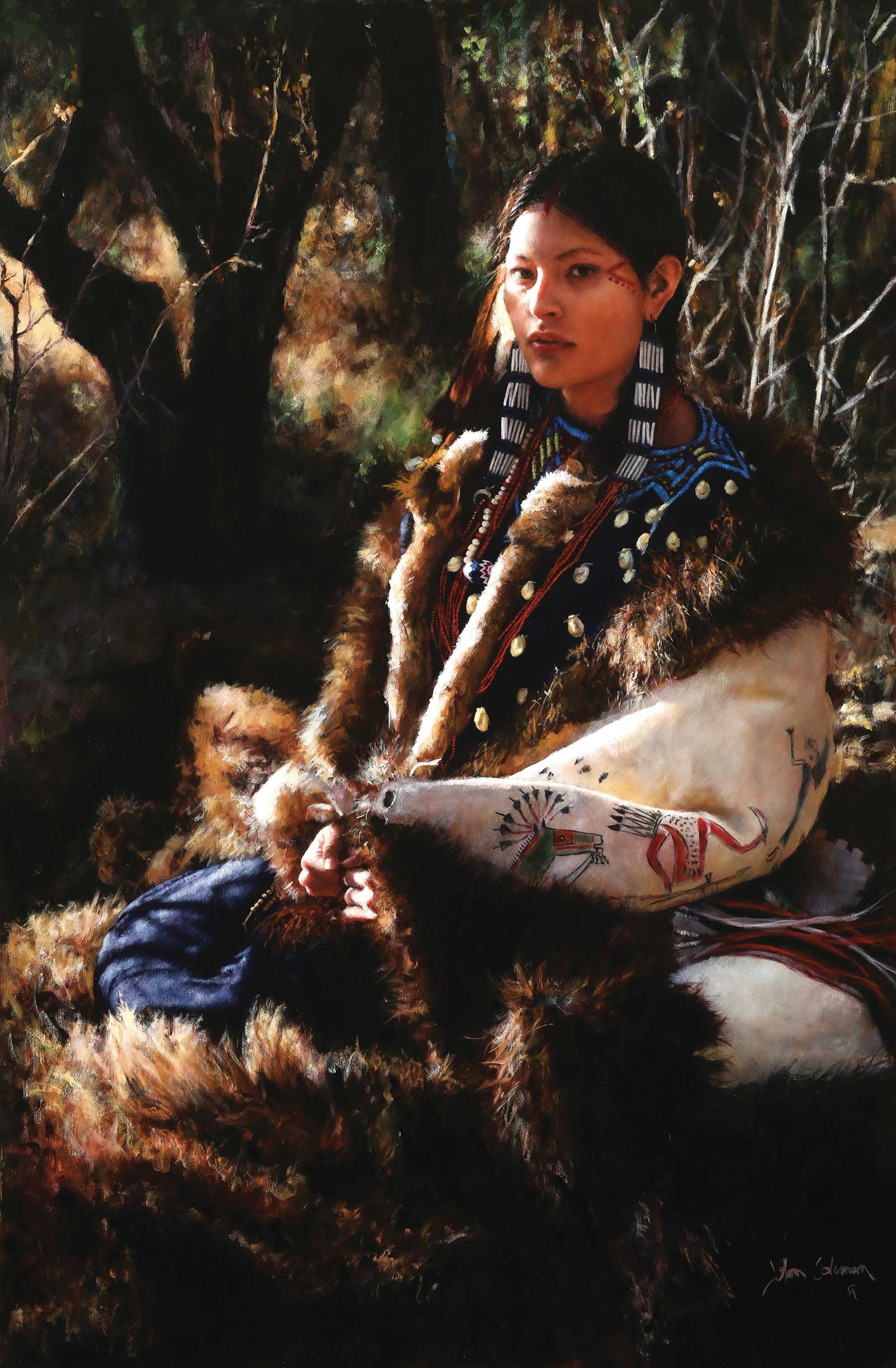 Daughter of the Forest People, oil on canvas, 45½ x 30”
Caravaggio and Rembrandt are certainly fine comparisons to Coleman’s paintings, but I think a more modern and interesting comparison leads to the great cinematographer Gordon Willis, who shot the first two Godfather movies for Francis Ford Coppola. Willis, who would bathe his sets in dramatic shadow while emphasizing subtle overhead light, was often called the Prince of Darkness by his peers. Coleman’s a film buff—he frequently quotes from Carol Reed’s 1965 film The Agony and the Ecstasy, about Michelangelo and Pope Julius II during the painting of the Sistine Chapel—so he’s immediately familiar with Willis’ work. He agrees that light plays a huge role in his painted works, but also to his bronze pieces, which can change drastically depending on how the light falls them.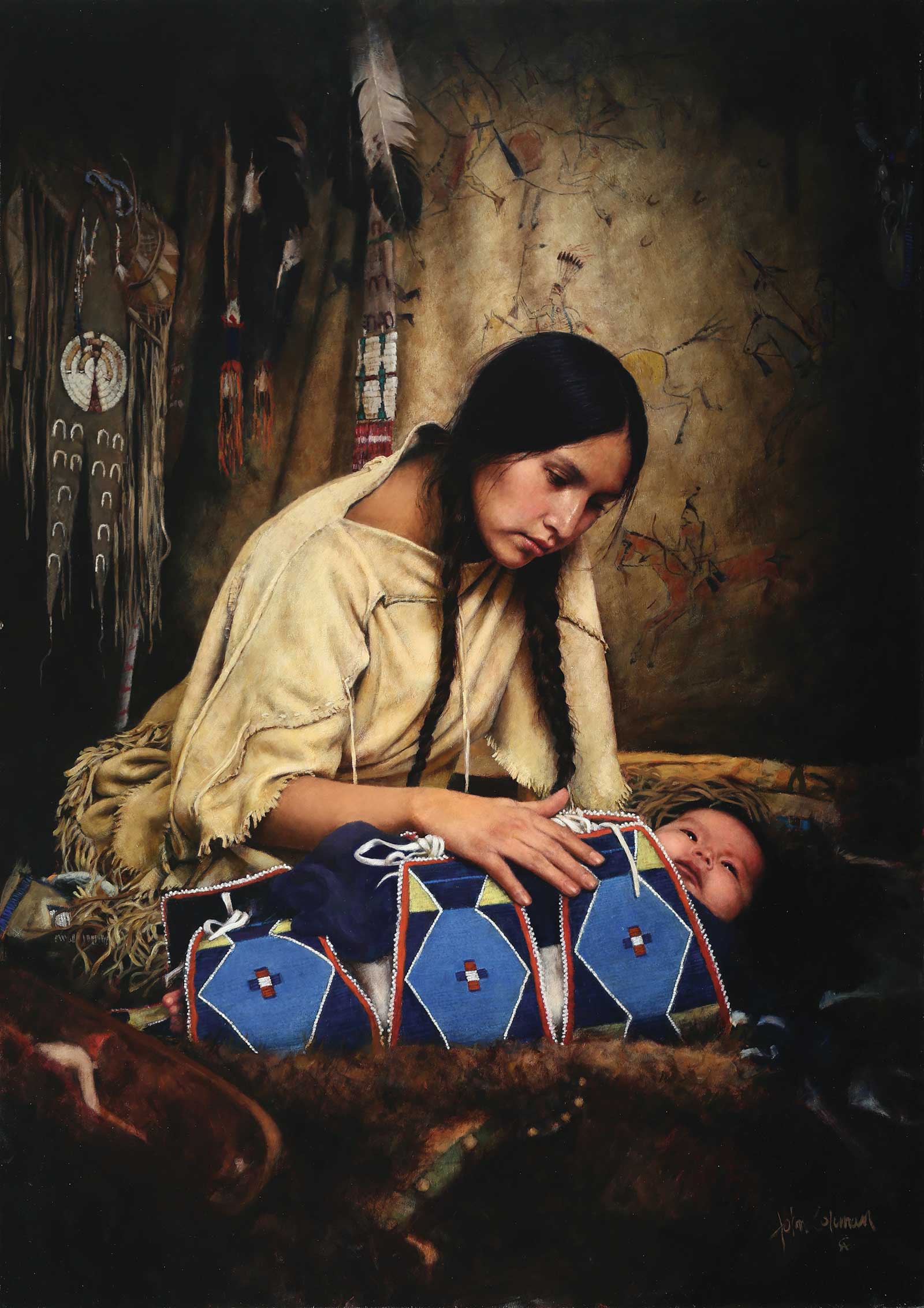 Mother’s Blessing, oil on canvas, 48 x 34”
“It all comes down to mood, and for me it is a romantic mood. But light is also a tool, one of many that artists use. And any tool that can help you can also hurt you, so there’s always a balance there,” he says. “There is eloquence in how we use these tools. Abraham Lincoln wrote a letter to his friend and told him, ‘I apologize for the length of my letter. I didn’t have time to make it brief.’ One of the hardest things in the world is to simplify something. Simplicity is a tool. When I go to a museum I like to hold my thumb up over spots of a painting to see if it still holds up. If the thing I’m covering doesn’t carry the burden of something else in the painting, then it’s not contributing. Basically, the painting should fall apart without it. These are some of the things artists are using to create with, and for me it’s all very exciting.”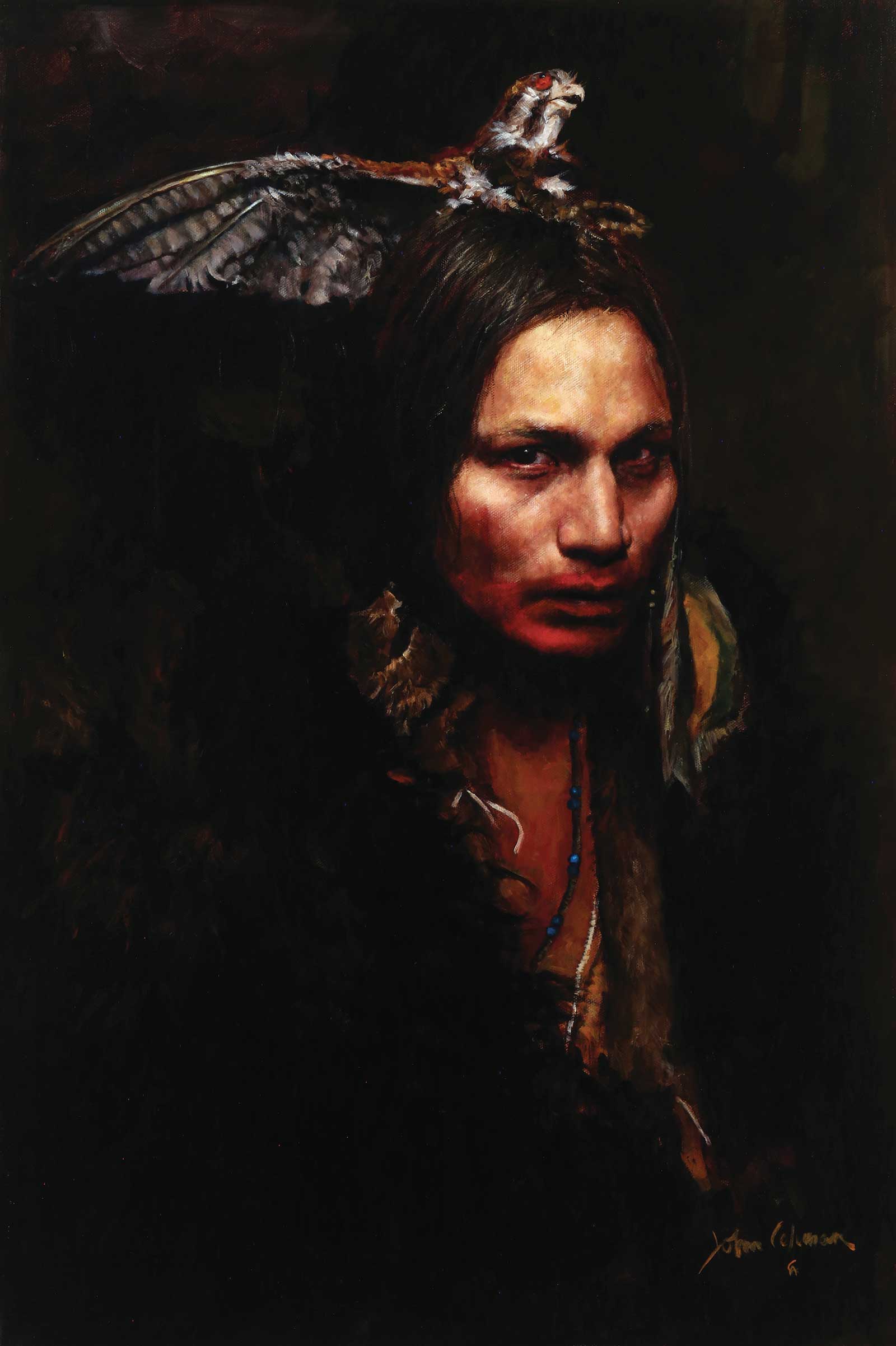 Night Spirit, oil on canvas, 26 x 17½”
And Coleman is himself excited—for the future, for the show, for Western art. Although it’s been a long year, he’s hopeful that Western art, along with everything else, will come out of this better and healthier. Art has certainly helped him push through and it will continue to guide him forward.
“Western art is a romantic look at where we all come from. I just recently watched Ken Burns’ Country Music. I enjoyed the part about Hank Williams, who they called the Hillbilly Shakespeare because he transcended the genre to another level,” Coleman says. “You can’t watch that show and think that the stuff that was born in the past stays in the past. It’s timeless, which is the essence of art. And I feel the same way about Western art. It’s poetry.” —
Powered by Froala Editor