In the 1940s, a popular song by Cole Porter was sung by Roy Rogers, Kate Smith and Frank Sinatra. Bing Crosby and the Andrews Sisters sold more than a million copies of their version. Even jazz great Ella Fitzgerald sang it in her rendition of the album The Cole Porter Song Book. “Don’t Fence Me In” was a hit. Based on lyrics by Robert Fletcher, the song begins:
Oh, give me land, lots of land under starry skies above
Don’t fence me in
Let me ride through the wide open country that I love
Don’t fence me in…
The romance of the West enraptured even boys like me growing up in the east and proudly wearing my Hopalong Cassidy outfit.
I once knew all the words to that song.
Phil Epp has lived in the real West, born in Nebraska and living in Kansas. He says, “I am strongly imprinted into the open spaces of the Great Plains. I grew up in a sparse area and am comfortable with emptiness in the landscape. I want to portray that part of me, to convey to whoever looks at my paintings the magnificence of that open space. I place icons of the West like horses, cowboys, the moon, in contrast to the space—just one or two icons and the remainder is empty space.”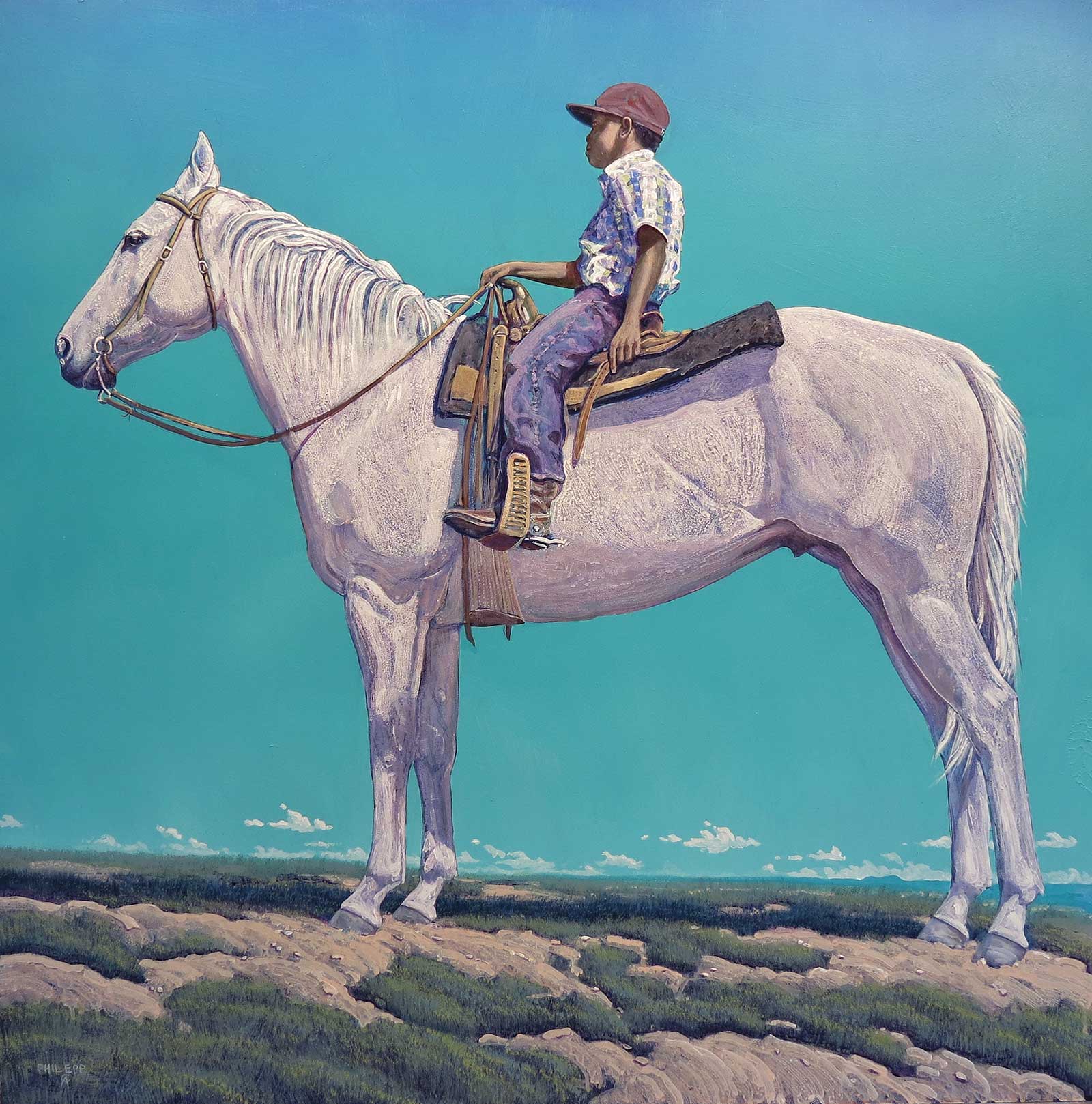 Young Horseman, acrylic on board, 40 x 40”
Afternoon Breeze is quintessential Epp with a vast sky that some refer to as a “Phil Epp sky”! Horses on a hill are silhouetted against a sky populated by dramatic clouds. Epp travels around the countryside looking for interesting groups of horses both for their compositional relationships and for the way they intermingle, “who’s in the lead, who’s buddying up,” paralleling, as he sees them, human behavior.
The clouds become iconographic yet tangible, tumbling across the sky, composed of swirling shapes that echo the swirling forms of the hill and shrubs below. They are painted with thickly textured paint in contrast to the featureless sky. Horses and clouds against the flat sky suggest an even greater depth. He says, “My goal was to bring the clouds forward and to push the sky back. Empty skies are air and I attempt to have them be air by adding lots of texture up front.”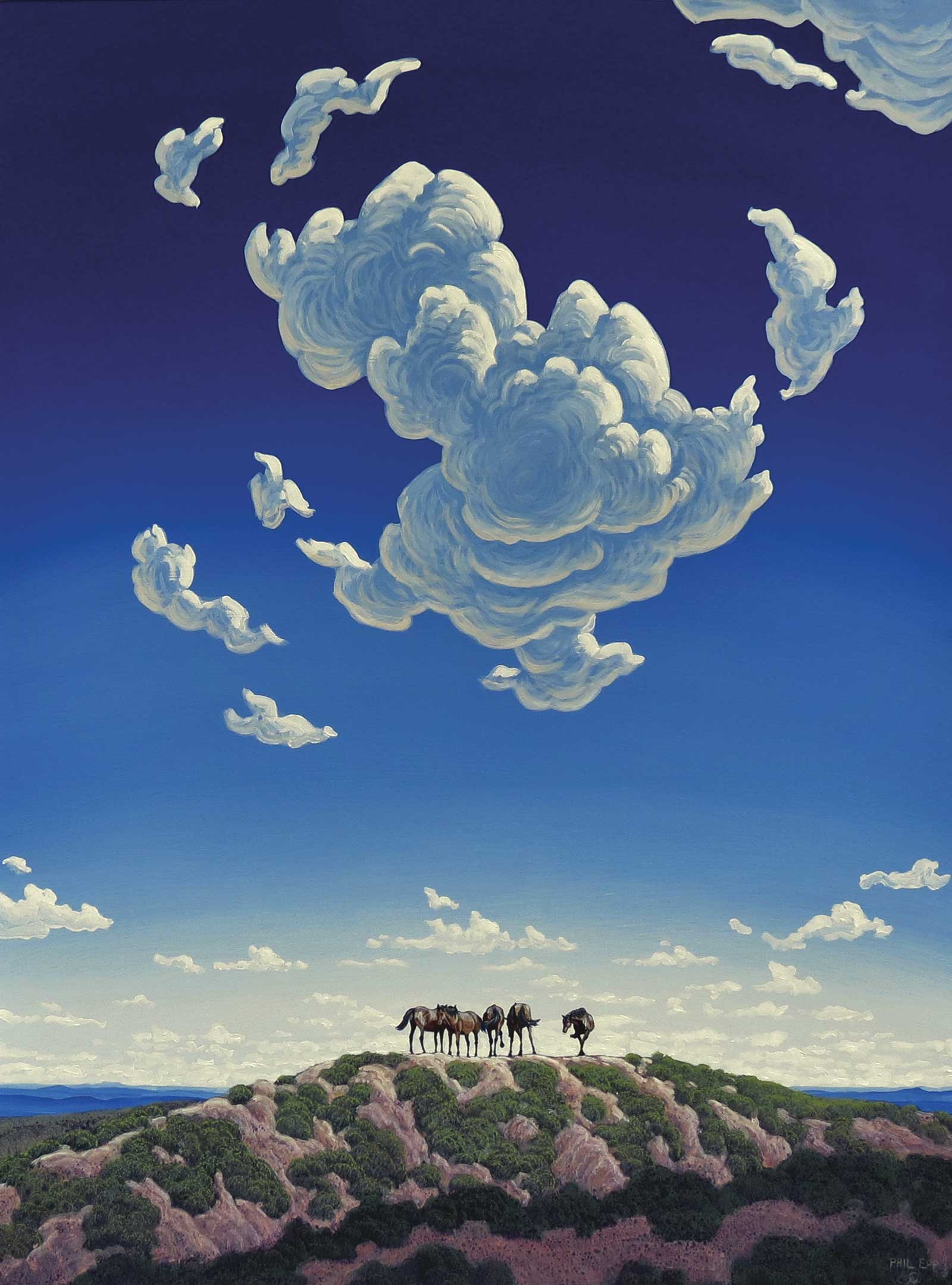 Afternoon Breeze, acrylic on board, 40 x 30”
In 2009, Epp was a U.S. cultural ambassador to Kazakhstan with the Department of States’ Art in Embassies Program. He explains, “My ancestors were from Ukraine and there were many similarities to life in Kazakhstan. Life there also recalled my childhood. Out on the open steppe observing the horses, I was impressed by the simpleness of the peoples’ life and their respect for horse culture. I was surprised and pleased at how friendly everyone was. It was one of the greatest events of my life.
“Our family farm was at the tail end of old farming before mechanization and the industrialized farm,” Epp continues. “We had livestock cattle, chickens. As early as I can remember my father and I were sitting at the table and he was trying to draw a horse for me.
I was only 5 or 6, but I kept looking and thinking he’s doing a pretty good job, but I can do better!”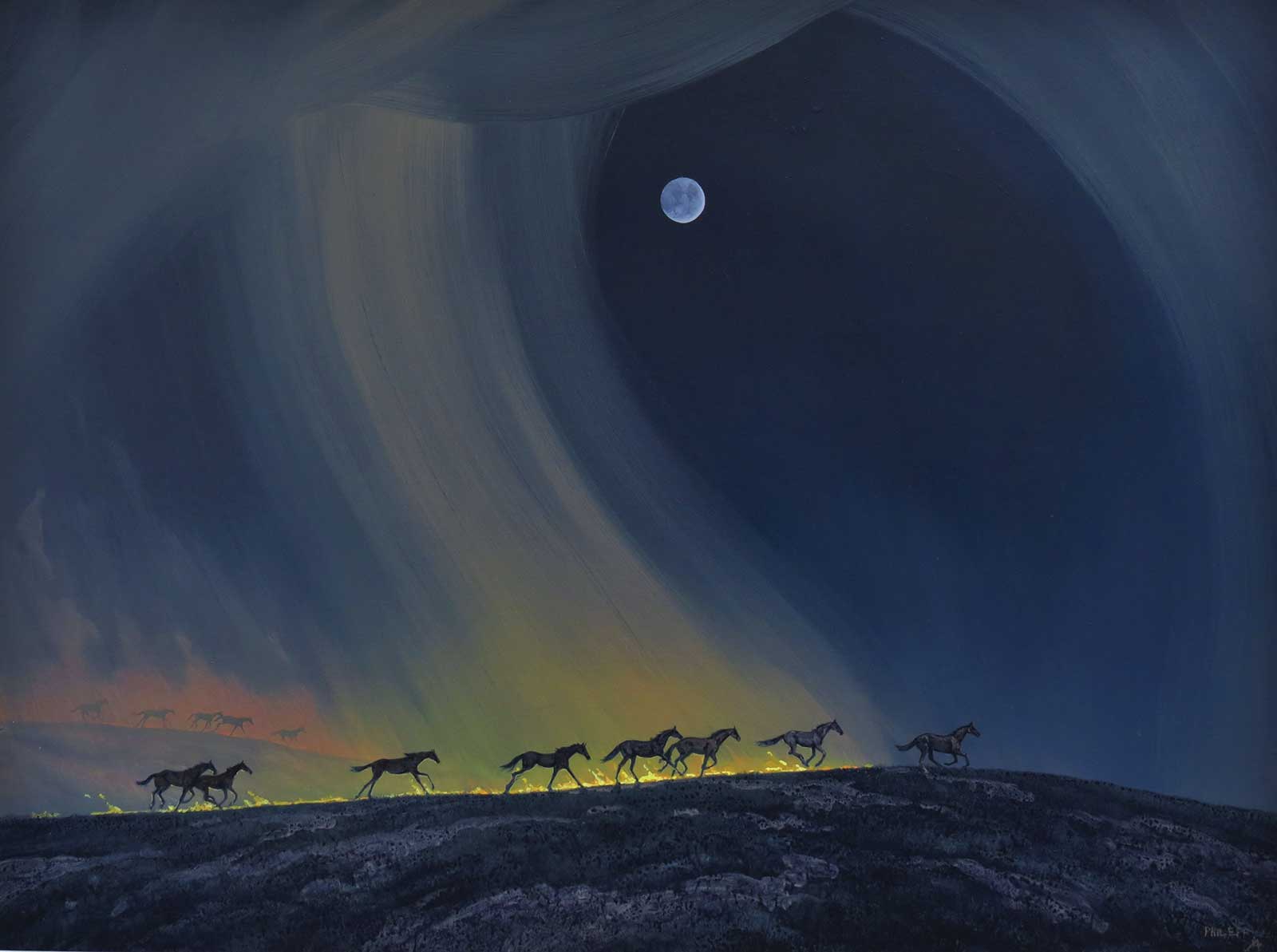 Prairie Fire, acrylic on board, 30 x 40”
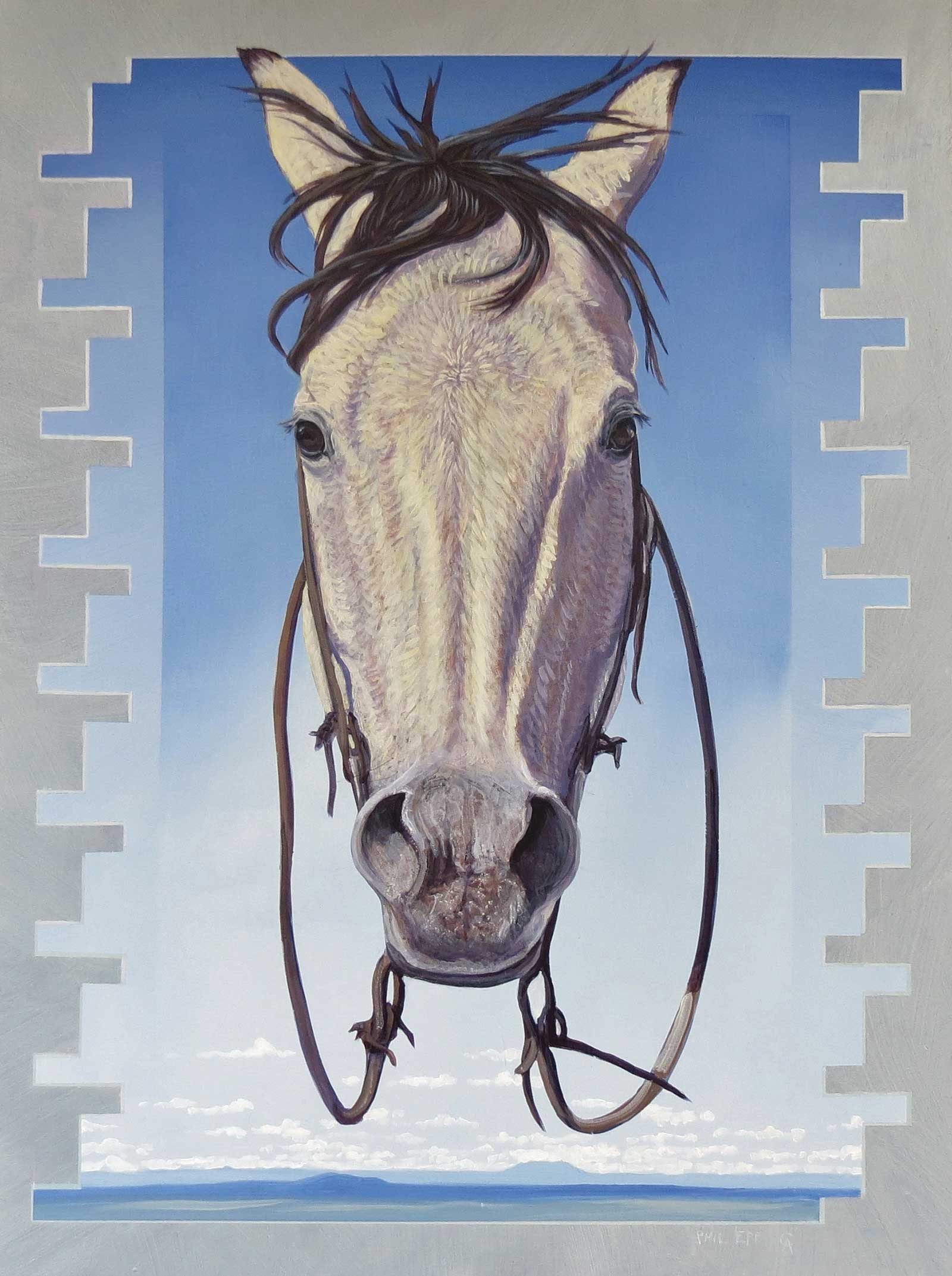 Out West, acrylic on board, 40 x 30”
Epp furthers, “I’ve always thought about realism. I liked horses and things Western—cowboys, Native Americans, the wide-open spaces. When I went to Bethel College I learned about Picasso and Rothko and got an appreciation of other movements in art history. For a time I was intrigued by minimalism—Donald Judd and Jules Olitski. I went back to realism, but I kept some of that minimalist thinking. I started collecting regionalist artists like John Steuart Curry, Thomas Hart Benton and artists of the WPA period. That reminded me of growing up in the agricultural atmosphere of the ’40s and ’50s. As I progressed in my work I kept pulling all those influences with me. Little parts show up from time to time. I kept accumulating bad habits but I made it work. In college I learned printmaking, mostly intaglio, from Robert Regier. I bought an etching press and wanted to just mess with it like a hobby. I experimented with what imagery works on a small plate.”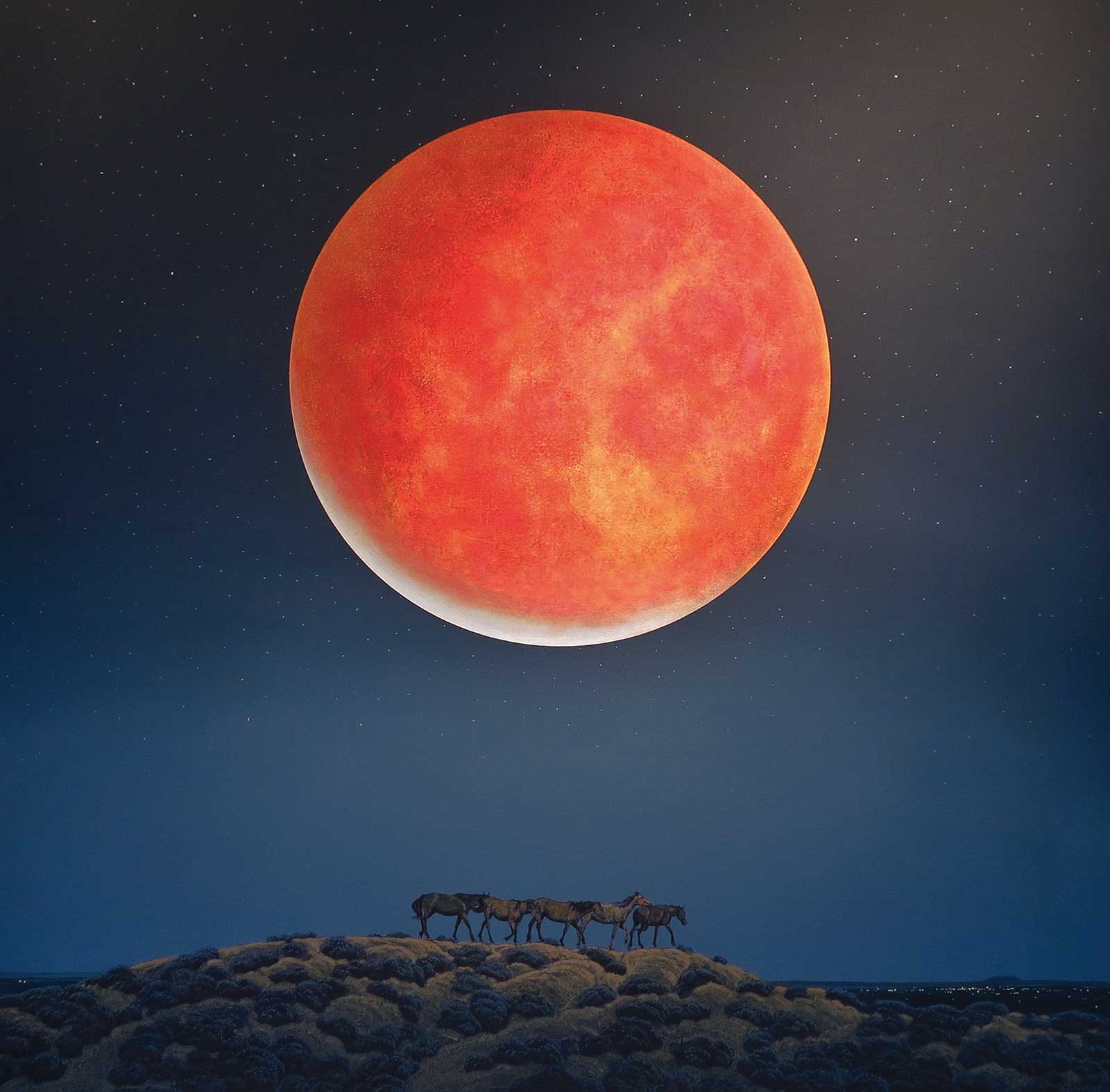 Red Moon, acrylic on board, 40 x 40"
In 1985 Epp received the Kansas Governor’s Award. In 2016 he was invited to be a member of Cowboy Artists of America, a group dedicated “to authentically preserve and perpetuate the culture of Western life in fine art.”
“Growing up I was a big fan of the CAA artists like Charlie Dye and George Phippen. Western cowboy design and culture have always been a part of me,” Epp says. “When I joined CAA, I thought my paintings might be too far out, but I’ve never been challenged on that. I emphasize the wide-open spaces and others paint an up-close grittiness. We all have so many things in common. We have the same interests, but how we see cowboy culture varies. It’s different for each artist. Many of them are absolute geniuses.”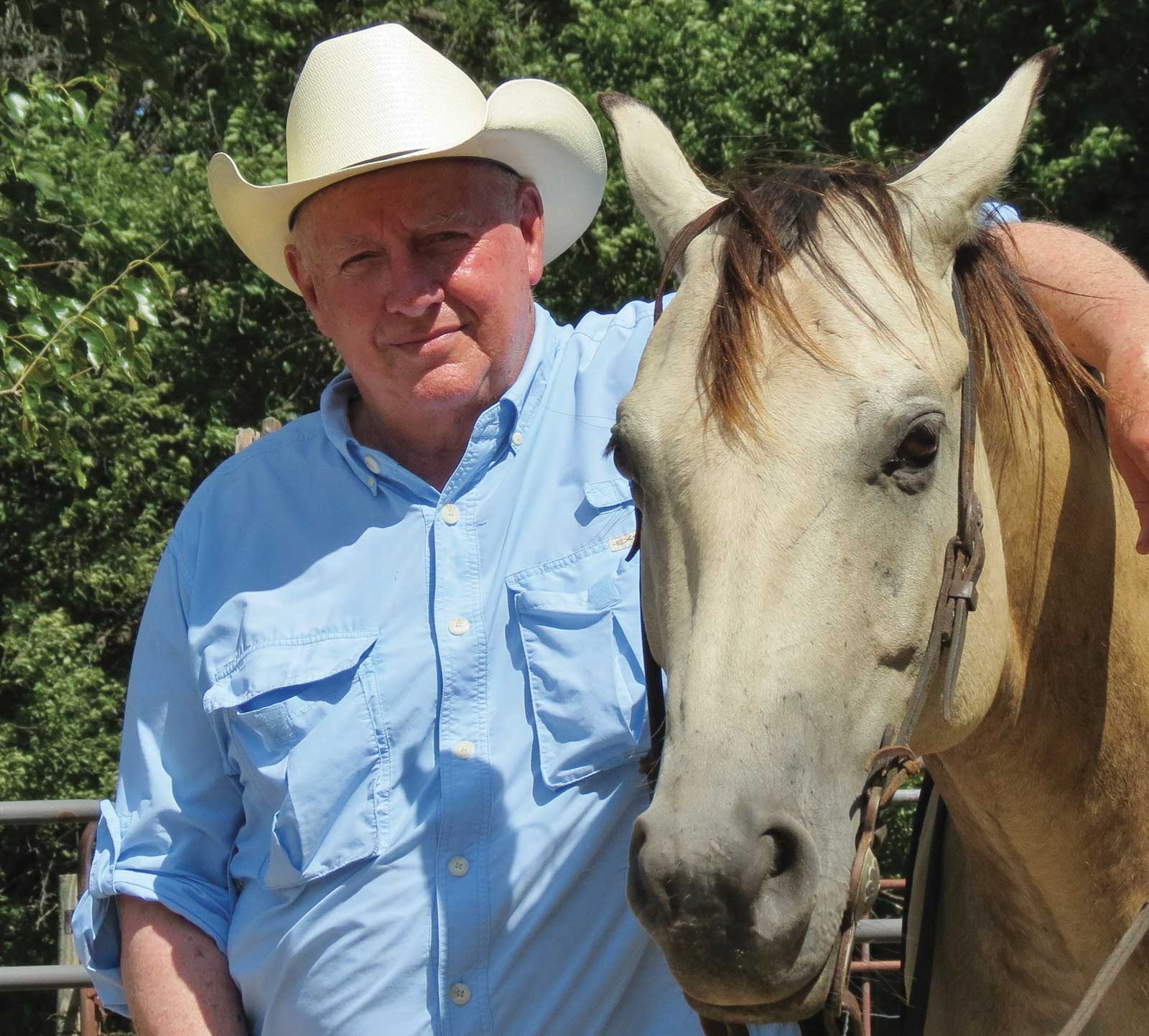 Phil Epp with one of his horses.
Epp often approaches his canvases intuitively. “Sometimes I do sketches. I usually have some idea where the overall composition will go,” he explains. ”As it evolves, I respond to the stroke I did before partially out of intuition, partially out of intention.”
Describing his paintings, he says, “They celebrate the naïve, the simple, the pure, the unspoiled and spiritual.” —
Powered by Froala Editor