Last year Logan Maxwell Hagege began work on what would become the largest painting of his career. And then life happened.
“It’s weird because we went from one event to another, each one a big thing in our lives, and the painting was there in various stages the whole time,” Hagege says. “I just pushed it along bit by bit.”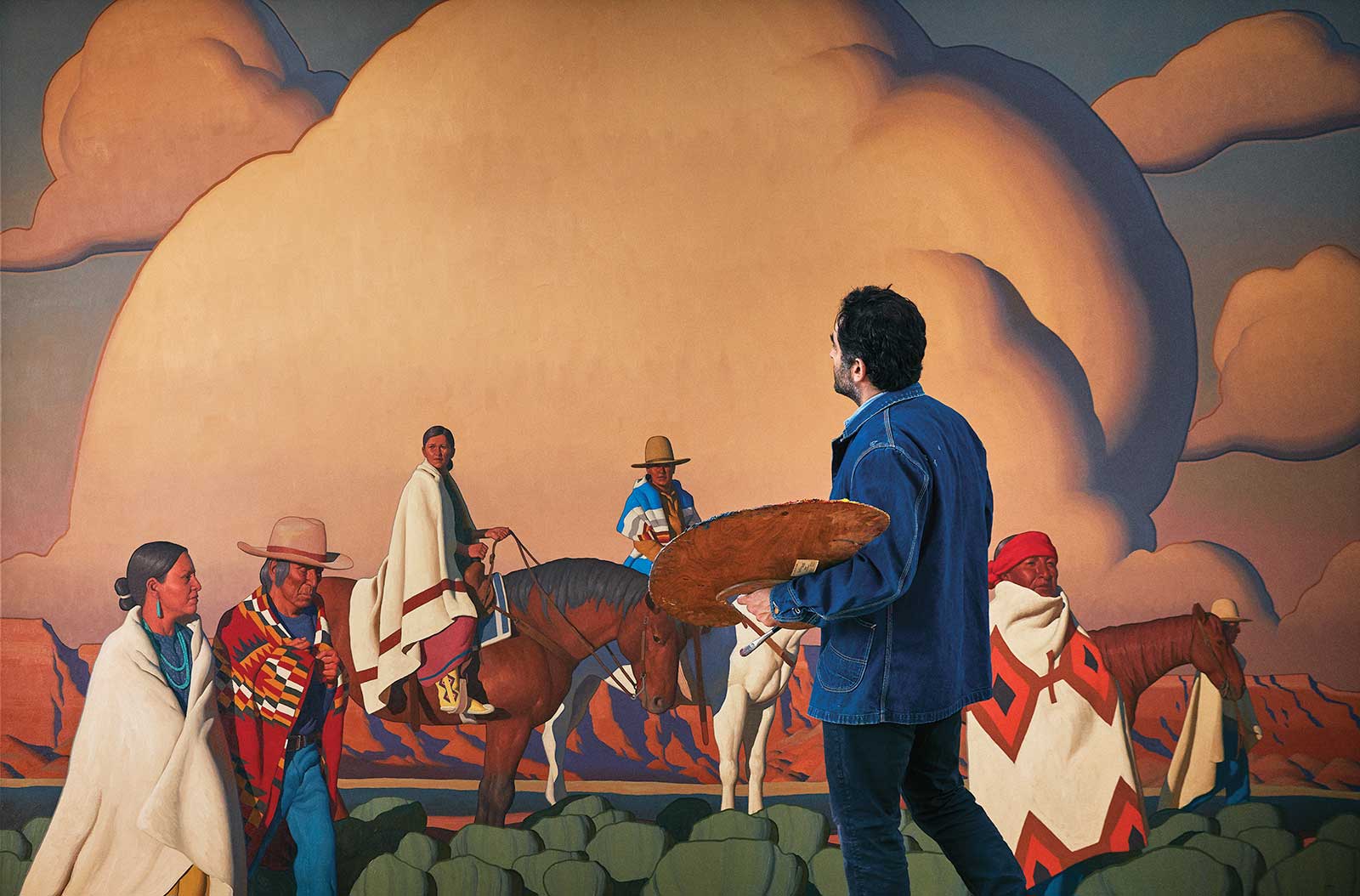 Logan Maxwell Hagege in his California studio with The Song at Sunset, the largest work he’s ever made.
First, in August of 2019, there was a big move to a piece of property in Ojai, California. There was no studio—one is now in the works—but there was a two-car garage, which was suitable as a temporary studio space. Then, in November, his wife Misty gave birth to their second child, a girl they named Poppy. New baby, Christmas, New Years…the whole period was a blur. By March, the country was in a coronavirus lockdown. “It’s funny because quarantine is like a typical day for an artist,” he adds.
The universe was certainly pushing back, but Hagege finished the work, later titled The Song at Sunset. The 8-foot-by-12-foot painting, which features five figures and three horses framed beneath a monumental cloud over the Vermilion Cliffs, is now the centerpiece of the artist’s major new solo show, Dear Old Western Sky, opening May 23 at Maxwell Alexander Gallery in Los Angeles. He’s aiming for around 18 pieces total, which would also make the show his largest to date.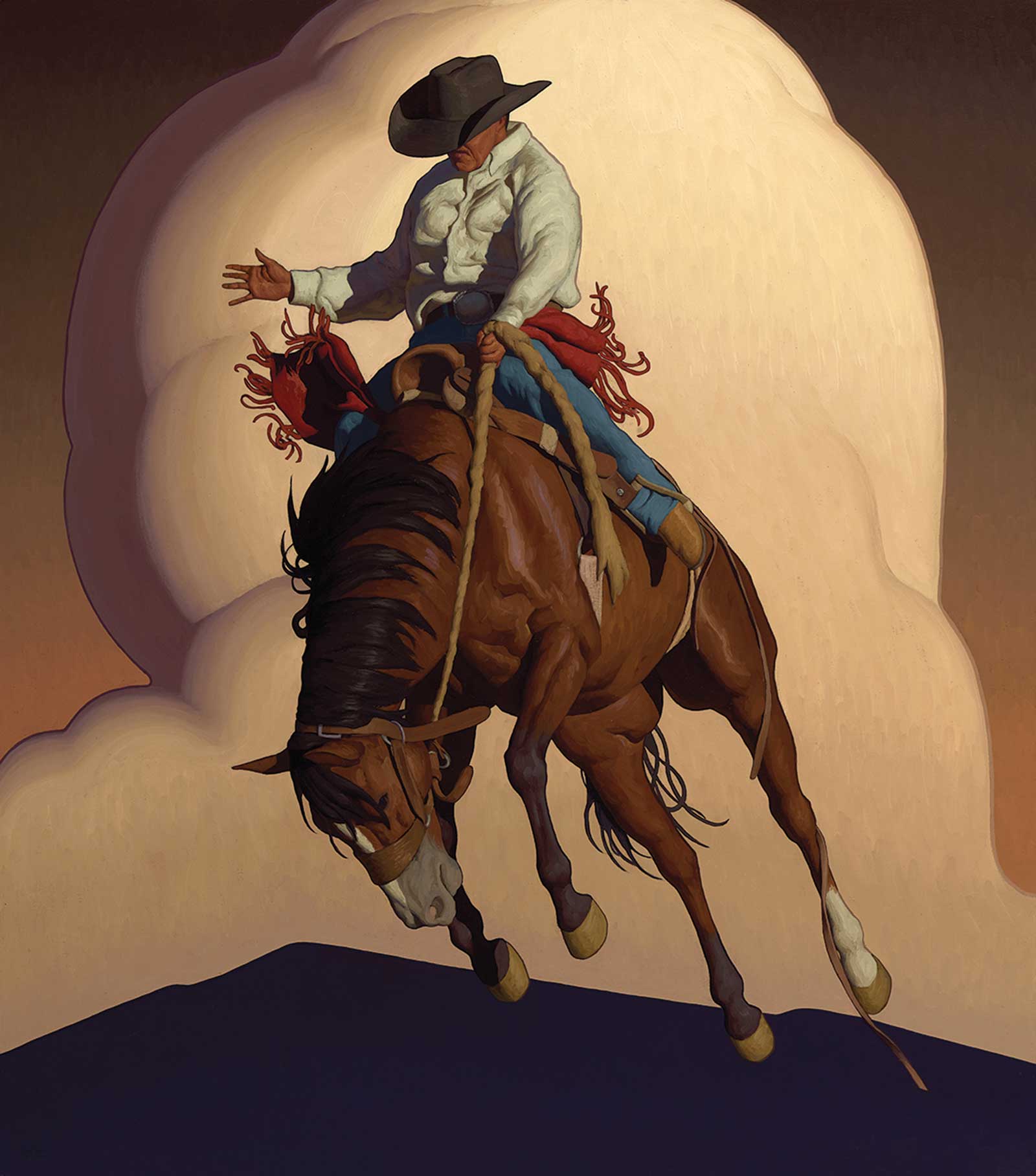 Wicked Ways, oil, 43 x 38”
“I felt like I’ve been a little bit conservative at past shows, particularly with painting sizes, mostly because there’s this weird fear I have that everything won’t sell. It’s silly to even think about,” he says. “So what I really wanted to do was free myself of that thought and just let myself go completely free. As an artist, I don’t have to stay within a certain set of rules, using certain colors, or painting in a certain method. I’m allowed to break rules—that’s the cornerstone of art.”
He continues: “An audience doesn’t always know what it wants, until it wants it. It’s an artist’s job to expand that horizon. Honestly, I never thought my work would be successful until it was. I learned there is room for what I’m doing—it’s a ‘if you build it they will come’ sort of thing. If an artist creates in an honest way, and they’re excited about it, people are drawn to that. Another thing I’ve really learned is that you have to give people more credit.
I had a fear that maybe they wouldn’t get my work, but why wouldn’t they? If you give the audience more credit, it frees you up to push past your own limitations.”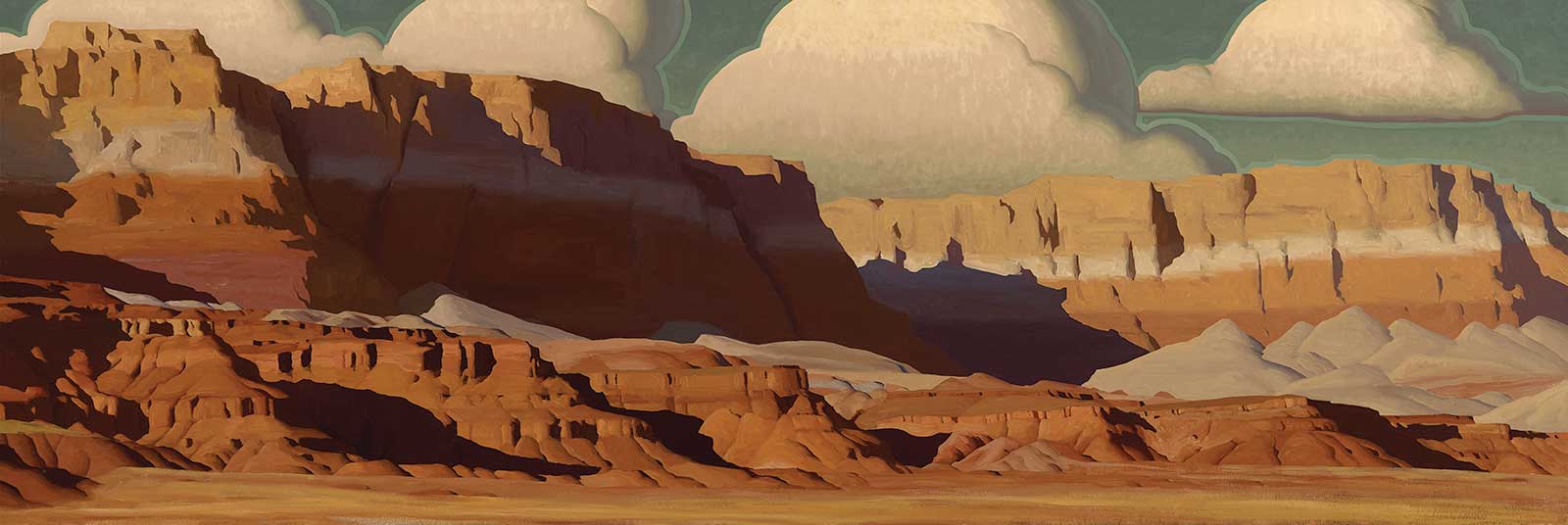 Crawling Light, oil, 24 x 72”
Another approach he’s taking is avoiding being pigeonholed by labels, including some of the more buzzworthy ones like “New West,” a term he’s still on the fence about, mostly because his own work is so conservative when compared with the Taos Society of Artists, regionalists of the 1930s and 1940s, and painters such as William Penhallow Henderson, Andrew Dasburg, Jozef Bakos and Georgia O’Keeffe. “These artists were painting way ahead of their time, even a hundred years ago,” he says.
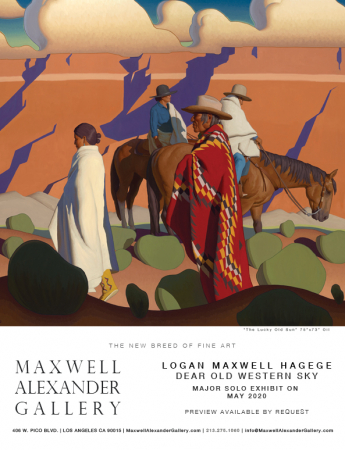
By operating outside the confines of the “New West,” market expectations or those rules artists give to themselves, Hagege has found his work open up more, and his newest show is proof of it. Consider just the skies in each of the new paintings: In Wicked Ways, a large bucking bronco work, the sky has an earthy warmth to it, with hints of burgundy and sienna that swing lighter toward the horizon line. In Glimpse of a Day, a round work showing hollyhocks, the sky is a magnificent purple as it skates around the edge of a ballooning cloud rendered without a single stroke of detail or dimensionality. The Lucky Old Sun uses blues and greens to make the sky pop behind the clouds and land, which are simplified and abstracted when compared to the impressive detail in the figures.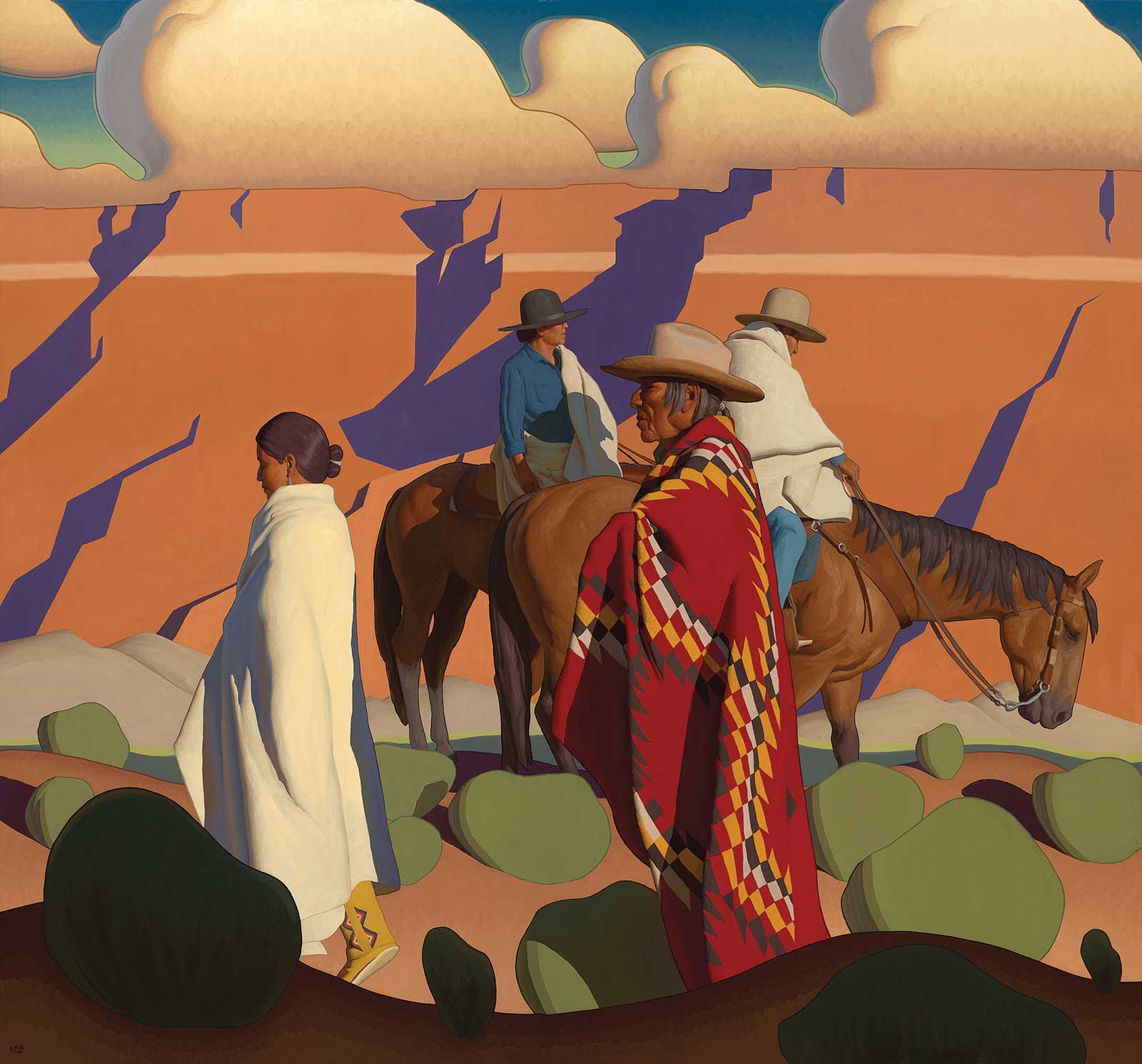 The Lucky Old Sun, oil, 75 x 73”
Of course, many of Hagege’s great calling cards are going to be here, including his stunning figures, many of them Native Americans, as they stand as quietly within the sand and sage of his desert locations. His works are push-pull relationships between detail in the foreground and simplified forms in the background, and that dynamic returns here as well. Also present is his fascination with Native American textiles, including beautiful examples of Navajo blankets. In The Man from Bylas, Hagege uses a weaving to adorn a figure in profile, his nose, mouth and chin cutting a resolute silhouette against the blue-green sky. The painting has other wonderful details, including an arrow pin on the hat and a hatband that seems to match the blanket. Notice the man’s face, from his deep wrinkles and skin aged by the sun and time. Now hop over to Crawling Light, a huge 72-inch-wide landscape, and notice the shadows in the cliffs, the cracked façade of the mesa, the small detail in the edges of the canyons—whether human figure or natural landmark, Hagege has painted each in a way that suggests reverence.
Then, of course, there’s The Song at Sunset. He had done large paintings before, including several right out of art school at the beginning of his career, but he had never undertaken one this big. “I ordered the canvas from this place in LA with no idea what I was going to paint on it. I wanted it in my studio to nag at me,” he says. “It started from sketches in my notebook, just little ideas here and there. At one point I had probably 20 different ideas for the painting, including one that was just a huge portrait, which I will eventually do. Once I knew I wanted a multi-figure painting I zero’d in on that general composition.”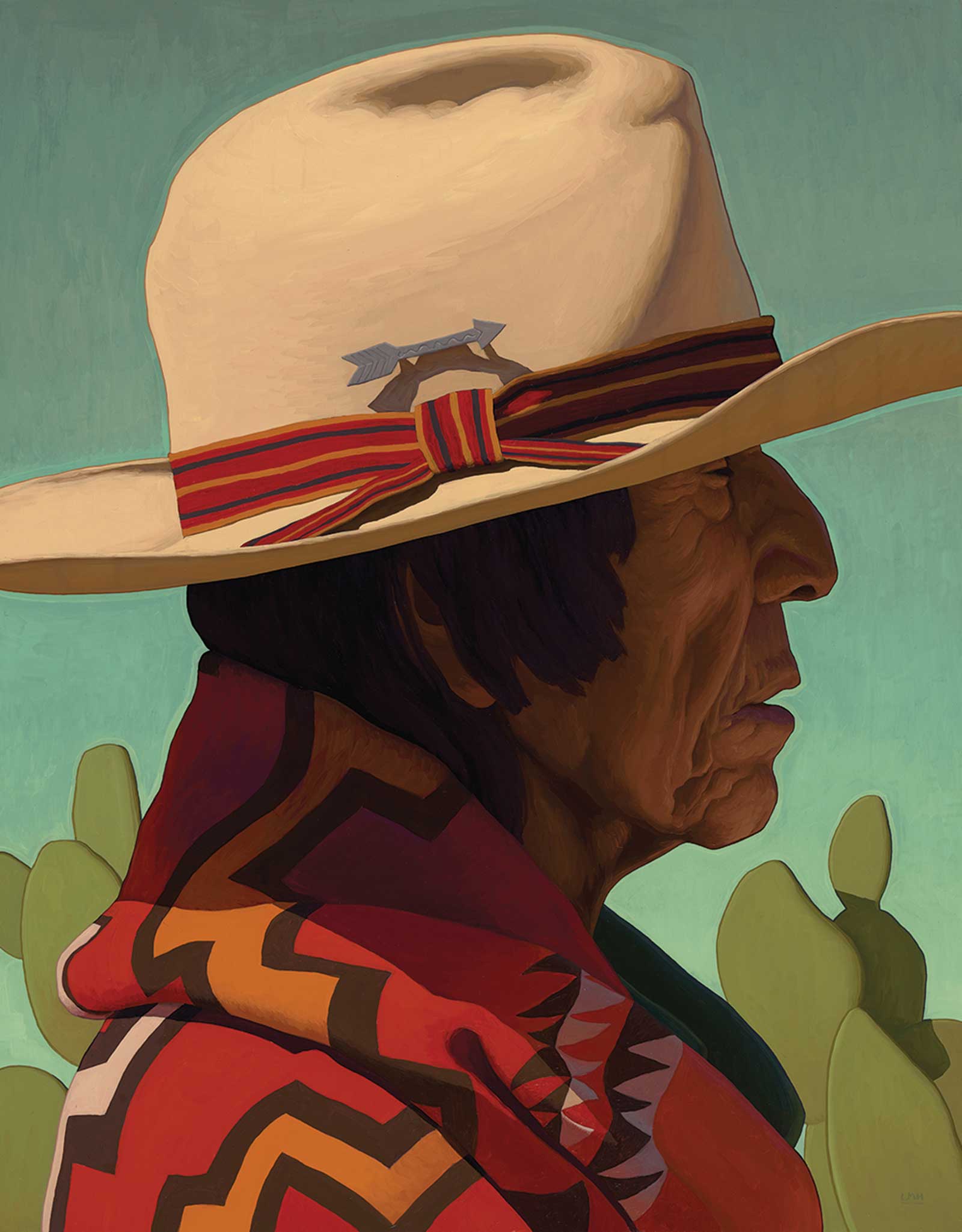 The Man From Bylas, oil, 32 x 25”
Once he had a rough sketch in his notebook, he did a simple 12-inch-wide drawing on paper. Normally he would do color studies, but not for this one. “When I do color studies I feel locked into them when I do the final piece.
I end up just trying to match the colors, which can hold an artist back,” he adds. “So for this one I wanted the colors I painted on the final version to be it, and nothing else. Giving myself room to fail was scary, but also fun.”
With a drawing in hand, he laid out a grid on the big canvas to help him transfer the smaller version. Once he had a rough drawing in charcoal, he went over it with thinned-out oil paint in order to lock the drawing into place. It’s at this point he begins to finalize the composition one last time before he starts laying down the oil paint. He also uses an oil wash to begin to put down some color. With all the bones of the painting arranged on his canvas, then comes the oil paint.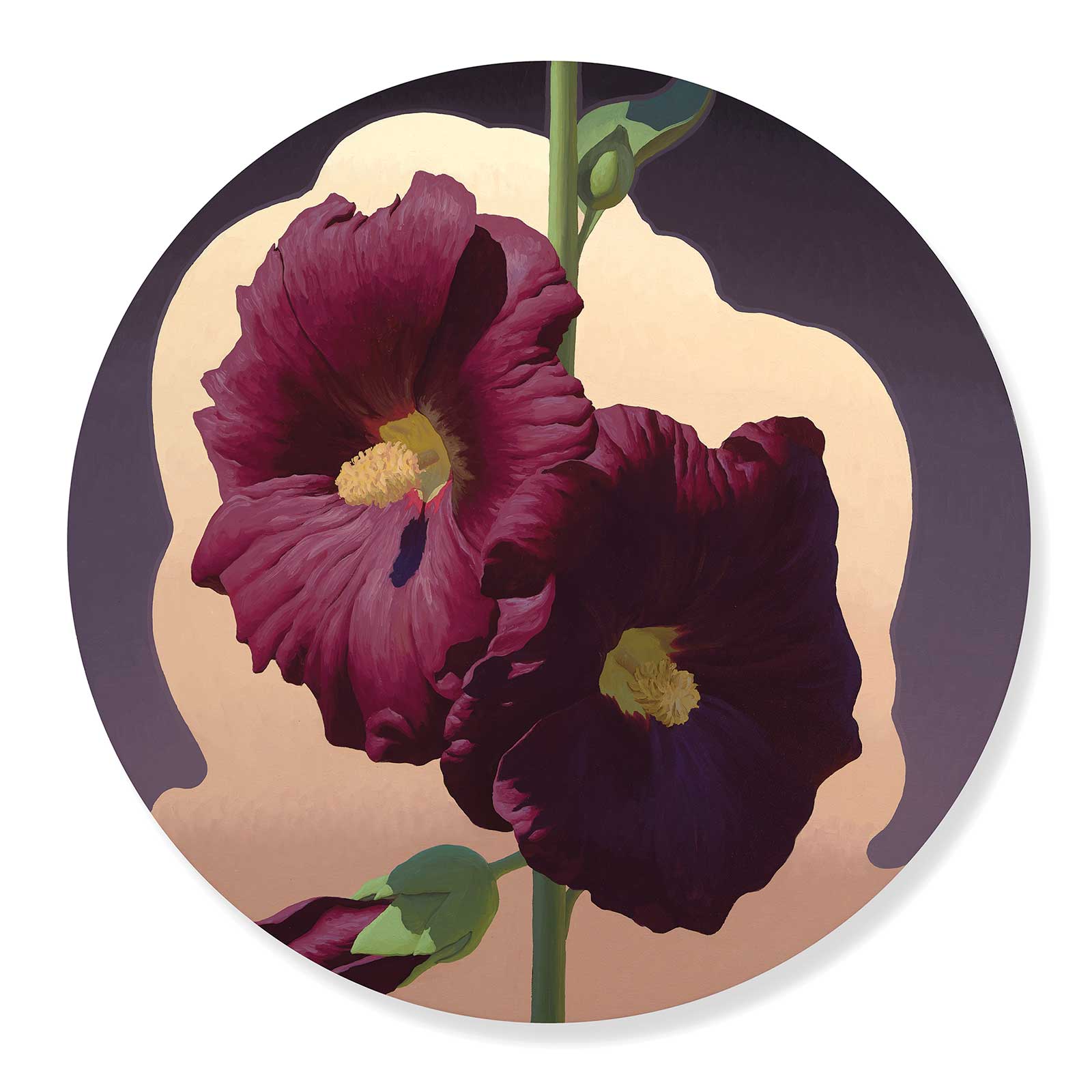 Glimpse of a Day, oil, 35”
“I’m more of a details-last person. I like to start in the big masses, like the sky, first. The sky is a great place to start because it sets the color key of the painting. It’s difficult to do the figures and then have them match the key of the sky,” he says. “Every artist is different, but working big to small seems to work best for me. Some artists can just paint an eye all by itself in crazy detail before painting the rest of the face, but that’s not me.”
He adds: “When it comes to detail, I’m always asking myself what can I take out versus what can I leave in. If I don’t need to go further than I won’t. It’s a reductive way of thinking, but it works.”
Hagege knew it was done when nothing was screaming at him anymore. And when it stopped screaming at him The Song at Sunset sat on cinder blocks in his garage in Ojai, a humble birthplace considering the places paintings like this end up.
I ask him if he’s worried about it selling at his show. After all, few collectors even have space for a painting that big.
“My job is just to make the painting. Selling it is someone else’s job, one that I have no control over,” he says. “Besides, I did this one for me.”
Logan Maxwell Hagege: Dear Old Western Sky
May 23, 2020
Maxwell Alexander Gallery
406 W Pico Boulevard
Los Angeles, CA 90015
(213) 275-1060
www.maxwellalexandergallery.com
Powered by Froala Editor