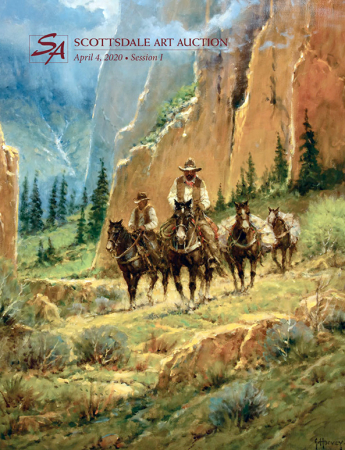
Canyon de Chelly in northeast Arizona has been inhabited for nearly 5,000 years, its fertile soil and water sources making it ideal for settlement. A classic photo by Edward Curtis depicts seven Navajo on horseback along with their dog, riding through the canyon, dwarfed by the 800-foot cliffs. Canyon de Chelly is a transliteration of the Navajo Tséyi’, meaning literally “inside the rock.” It is still home to Navajo families who farm and raise sheep there.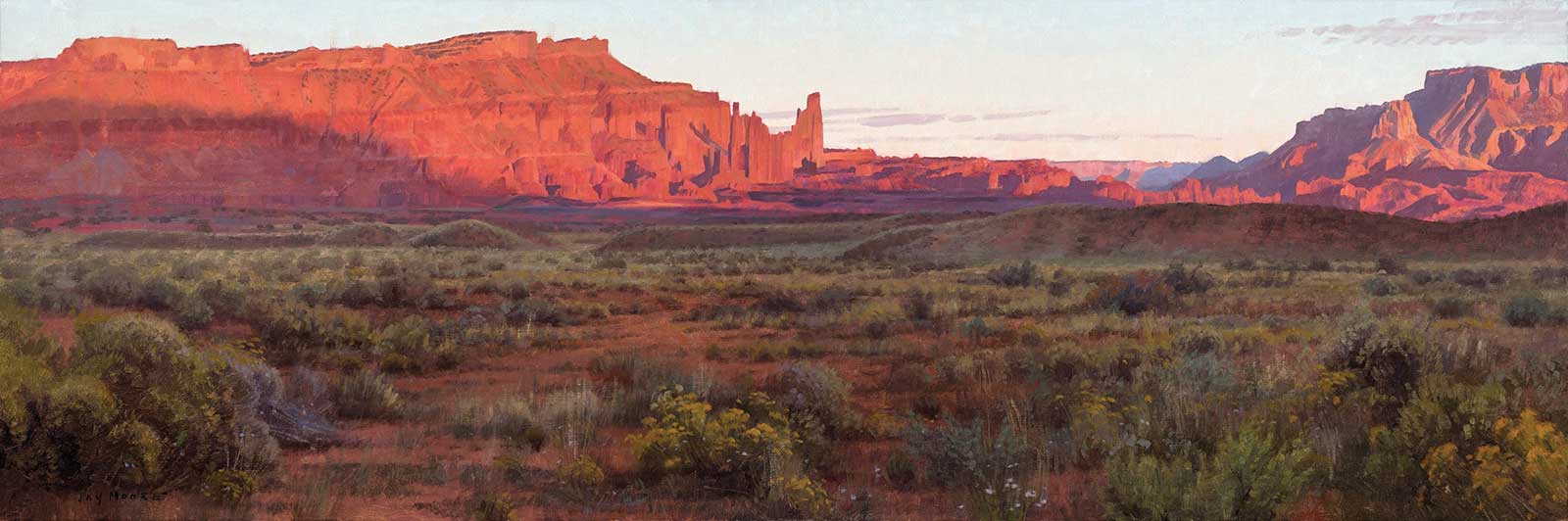 Astoria Fine Art, Going Out in a Blaze of Glory, oil, 20 x 60", by Jay Moore.
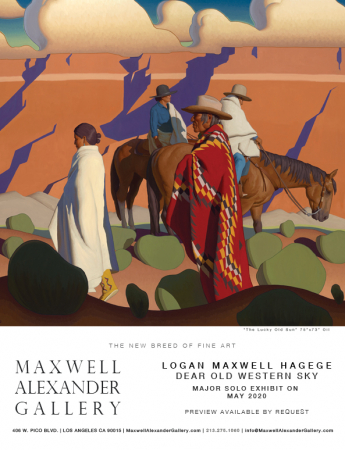
Ray Roberts’ Canyon Riders continues the theme more than 100 years after Curtis’ iconic photograph. His highly developed sense of design has allowed him to depict the vastness of the canyon in a small, 12-by-16-inch format. He also continues the work of the California plein air painters, commenting, “There’s a brotherhood of painters who came before me and who will come after. We speak in the past, present and future. We talk about our experience and personality, our torments and exhilarations; we talk about the beauty of the fleeting light, time and of our family, friends and acquaintances.”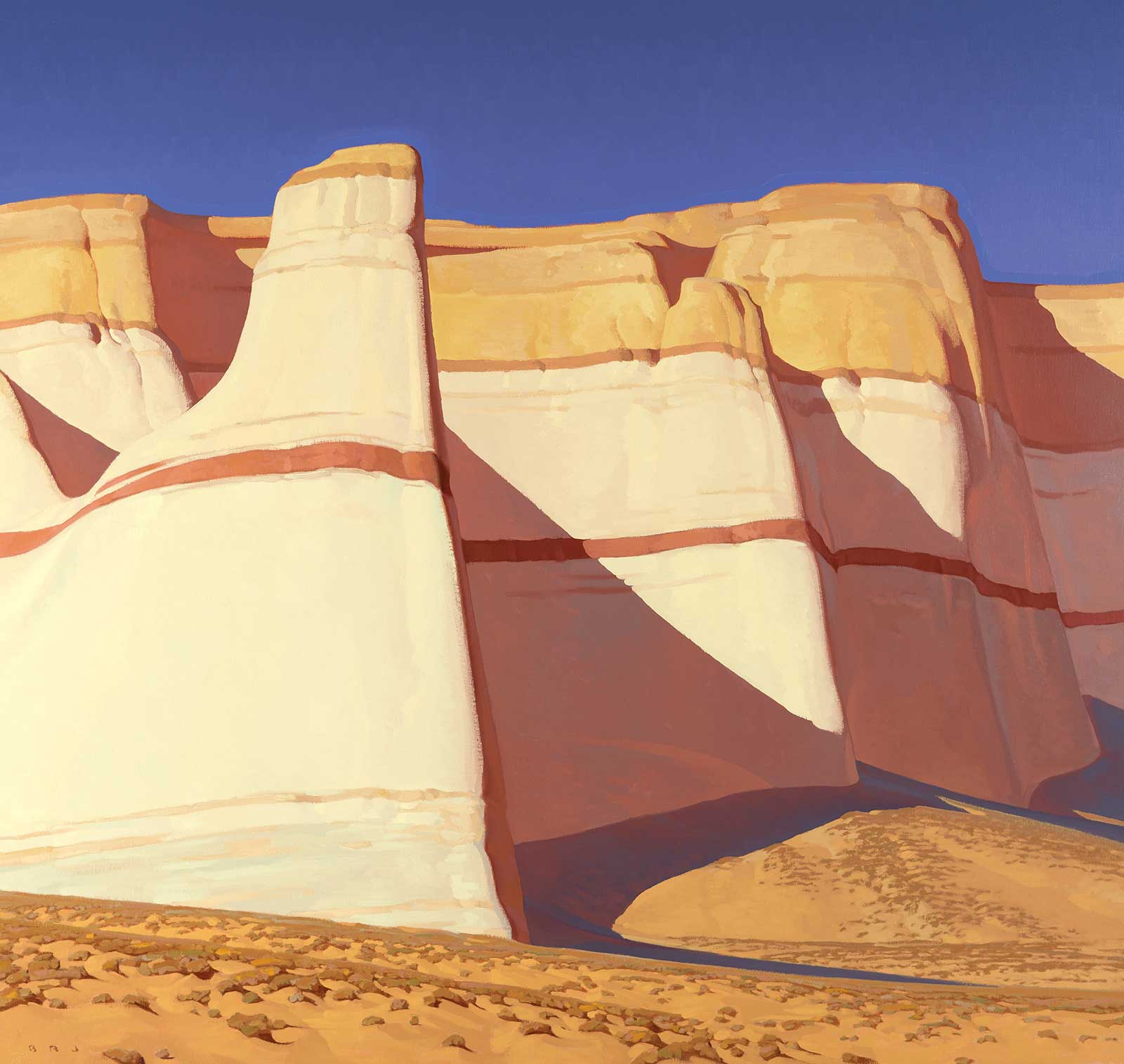 Maxwell Alexander Gallery, Of Stone and Sand, oil, 36 x 38", by Brett Allen Johnson.
Explaining his attraction to the desert, he says, “The desert is so stark, so quiet and so isolated, it’s remarkable how introspective you can get. You feel like you’re part of time. You can see it in the time it took for a river to carve a canyon. It’s humbling how short our time is in comparison—how small we are in comparison.”
Jay Moore has chosen a nearly 2-by-5-foot format to depict his vast panorama, Going Out in a Blaze of Glory. The shadowed desert in the foreground allows the eye to travel to the distant redstone cliffs made even more red by the warm light of the setting sun. Moore immerses himself in the landscape once he has chosen a subject for a painting. “I plan a trip around the season and the time of day I want to paint it. Over three or four days I do small graphite sketches and then some plein air sketches. Once I work out the composition I work on the colors and values. I also make journal entries about the scene, what I did that day, the weather, etc., and I take a bunch of photographs. Back in the studio I decide which ones deserve to be larger paintings.”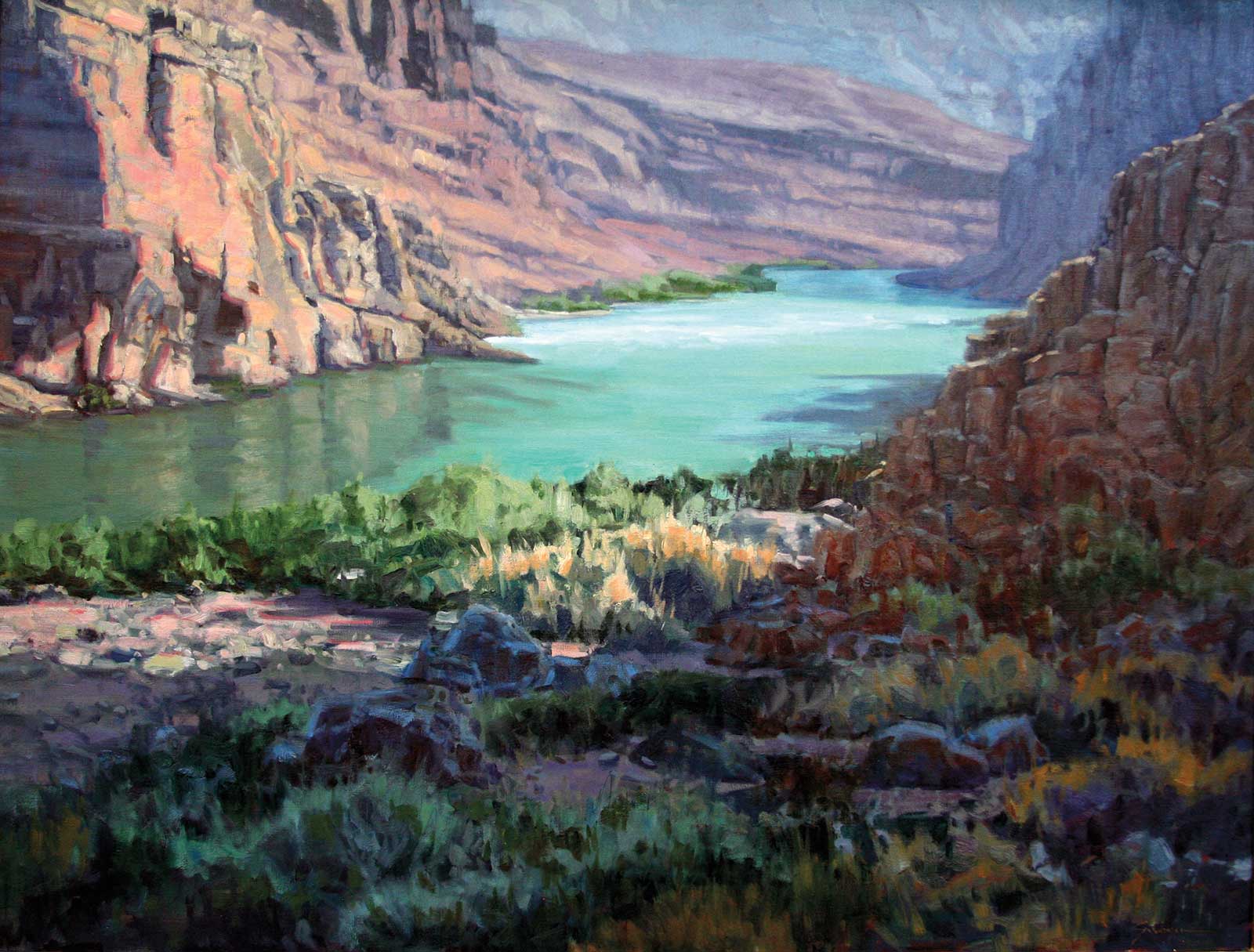 Grand Canyon Celebration of Art, Perched Above the Canyon, oil on linen, 30 x 40", Susie Hyer.
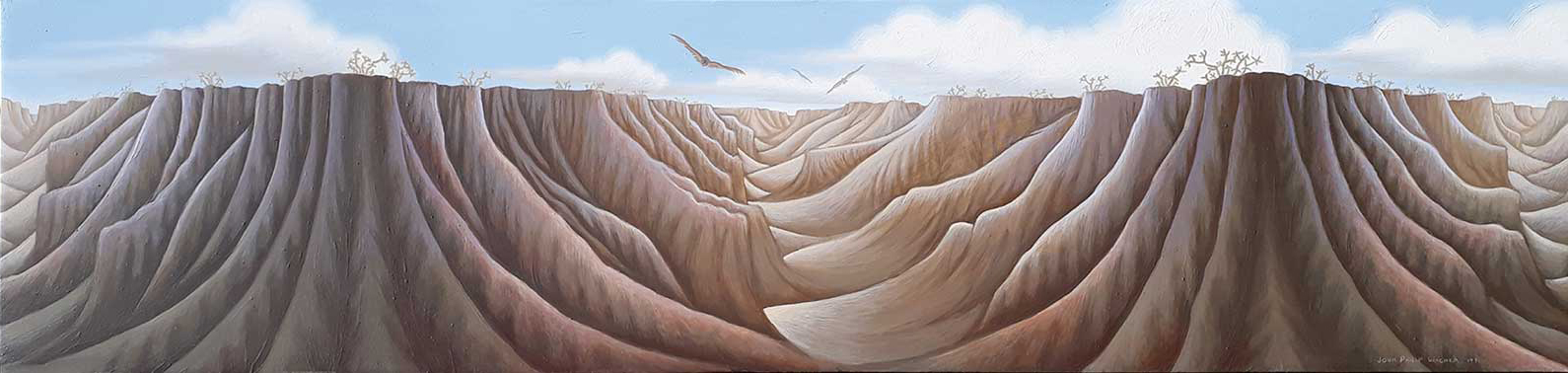 John Philip Wagner, Desert Labyrinth, oil on canvas, 20 x 60"
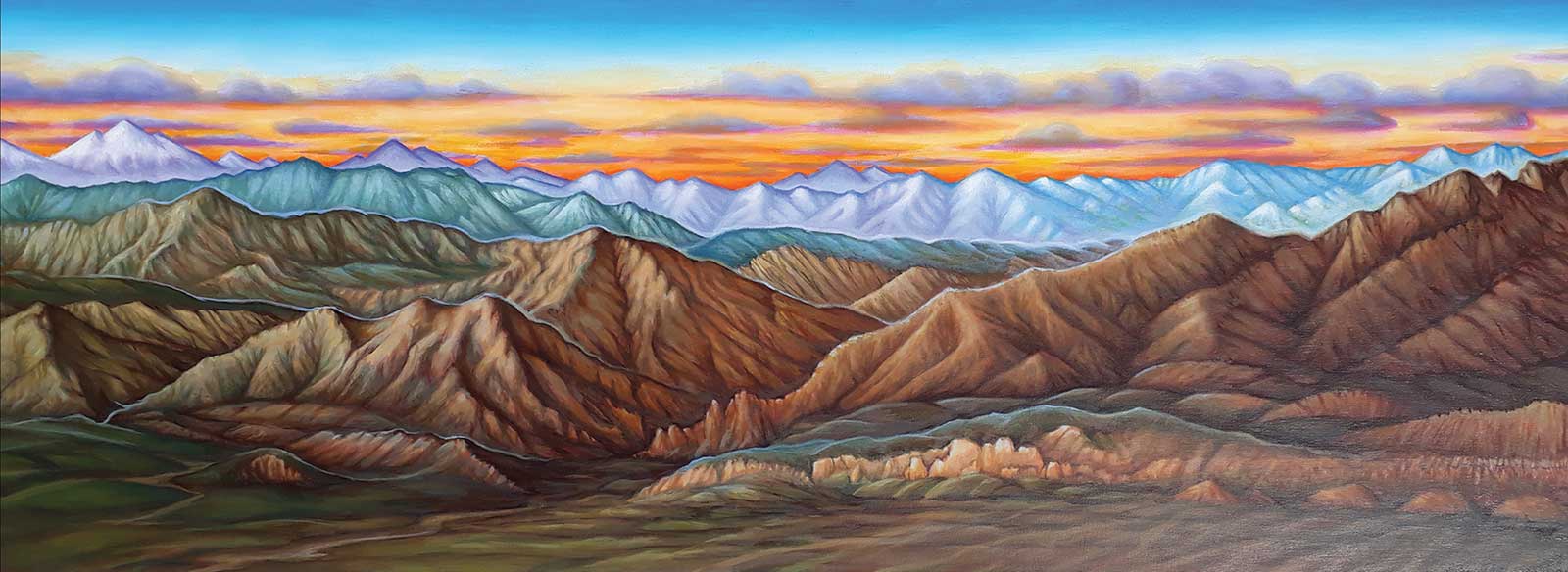 John Philip Wagner, Skyline, oil on canvas, 20 x 60"
James Nottage, former curator at the Eiteljorg Museum wrote of Moore’s paintings, “They are a treat for the imagination that can make you think you have been there or maybe want to go there.”
It’s no surprise that Matt Smith says, “I enjoy working in areas where one can travel for miles without seeing the influence of man.” He was born in Missouri but moved to Arizona when he was young. He still lives there and his love and interest for the Sonoran Desert continue to grow. In Sycamore Creek, saguaro cactus rise up on the banks of the creek. Emblematic of the desert Southwest, saguaro only grow below 4,000 feet and in the relatively small area of northern Mexico and southern Arizona. A few have migrated to southeastern California.
Smith paints from direct observation, finishing about one-third of his paintings in the field. His application of paint adds nearly as much interest as his interpretation of a scene, creating “surface quality” he says, quoting John Carlson, who aimed for “a richness of surface and pigment.”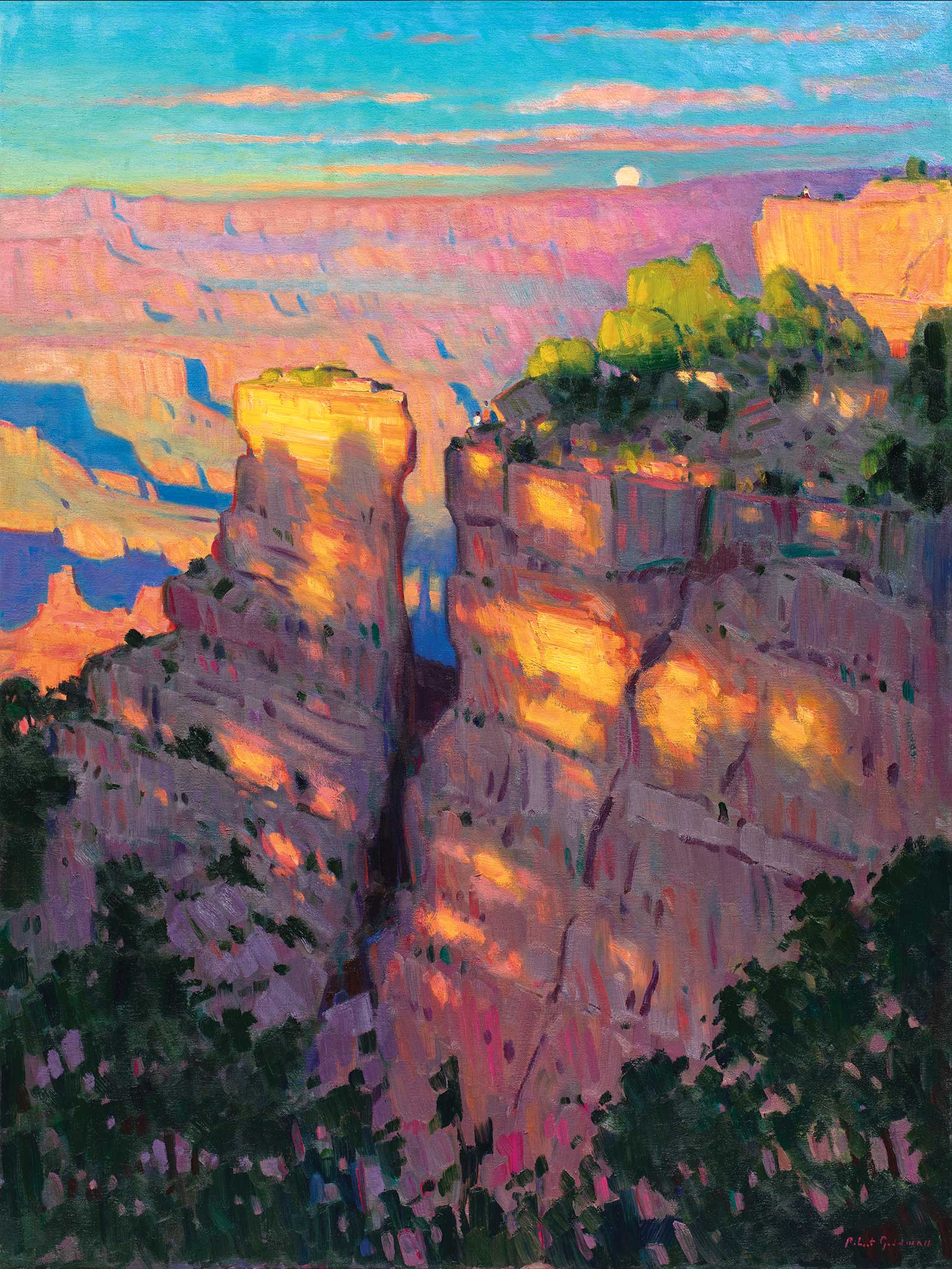 Grand Canyon Celebration of Art, A Moment in Time, oil on canvas, 40 x 30", Robert Goldman.Peter Hagen’s Where We Never Wander depicts the often overlooked phenomenon of arroyos in the desert. Hagen lives in Santa Fe where arroyos are abundant, often dry pathways through the desert except when they contain raging torrents of snow melt or monsoon rains. Summer hikers through the arroyos have to be on alert for flash floods caused by distant storms. It is the many changing qualities of light and weather in the high desert that inspire his work. The eye focuses first on a chamisa nearly dead center in the composition with the dry arroyo filling three-quarters of the left side and a thin line of mountains dotting the horizon.
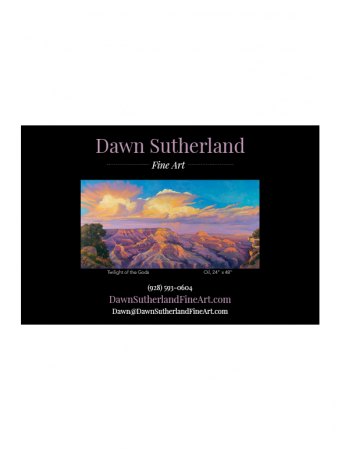
For a continued discussion on canyons and deserts, read through this special section. Western artists and galleries have included inspiring new work and words of wisdom.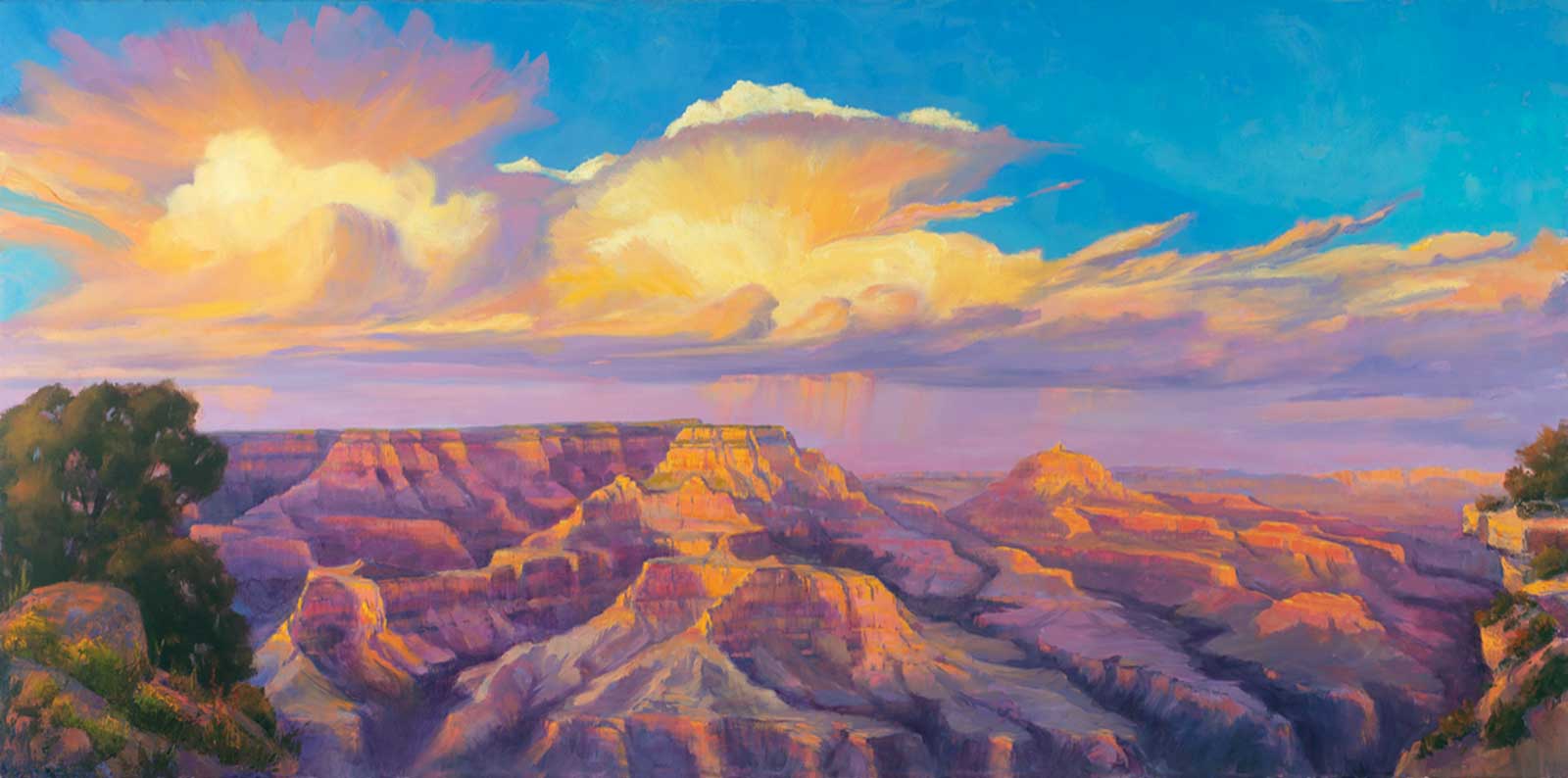 Dawn Sutherland, Twilight of the Gods, oil, 24 x 48"
With the thought that art plays a critical role in the appreciation of national parks, the Grand Canyon National Park provides an annual tradition called the Grand Canyon Celebration of Art. The event invites artists to paint “en plein air” for one week at the canyon. Art coordinator Kathy Duley furthers, “[From September 12 through 19], visitors will have the opportunity to watch the artists paint along the south rim as they interpret the ever-shifting light and shadow, amazing land forms and vibrant colors of this vast landscape.”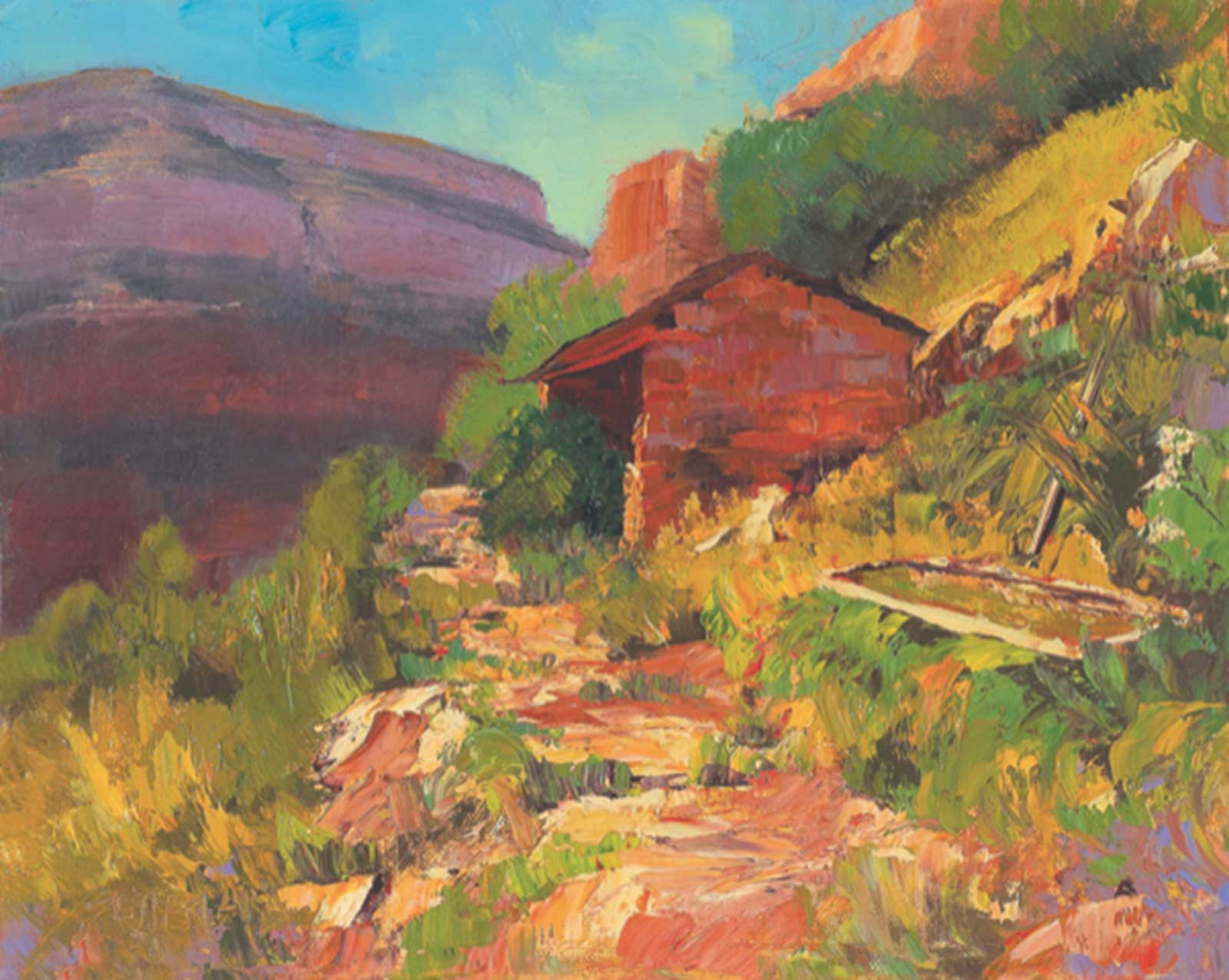 Dawn Sutherland, Hermit Trail Oasis, oil, 8 x 10"
This includes first-time participating artists like Bonnie McGee, from St. George, Utah, to more seasoned participants like Robert Goldman from Prescott, Arizona, who won Best of Show for plein air last year.
Artist Dawn Sutherland feels most at home in nature and painting gives her yet another way to interact with it. “A way to honor the beauty of nature is to capture it on canvas,” she says. “Whether it’s the Grand Canyon, or an intimate glimpse of the desert, I look for a scene that inspires me—that draws a little gasp.” 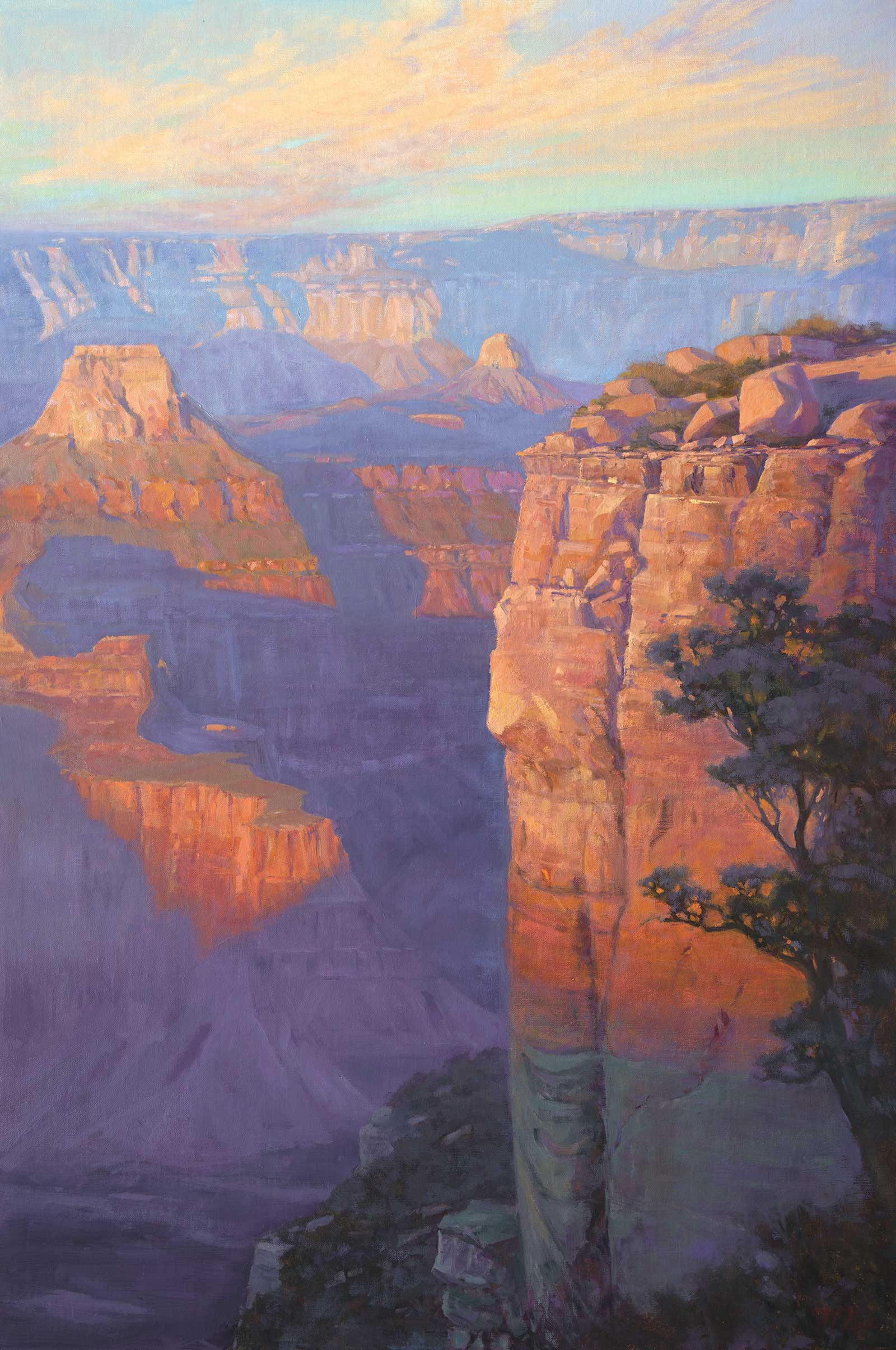 Grand Canyon Celebration of Art, The Sacred Hour, oil on linen, 36 x 24", Bonnie McGee.
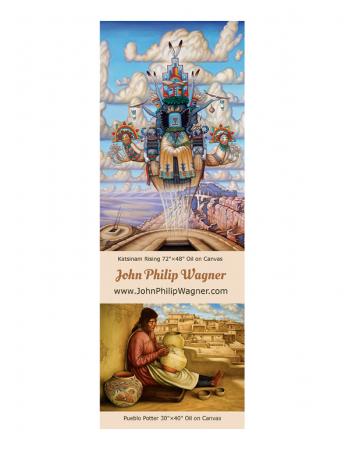
John Philip Wagner also has a very intimate connection to nature. He commits his unique “mythohistory” to canvas against the backdrop of the Southwest, and breathes into it what he likes to think of as a “sense of dust.” “Dust itself depicts the style of the Southwest,” he states.
“ln dust is hidden the images of many eons past,” continues Wagner. “The memory of lives and civilizations long gone. It embodies a feeling of time and perception and is something always around us, always with us, yet we are not always aware of it. Dust hangs in air hazing the landscape, muting its colors. Then the rain comes, the dust disappears and the scene completely changes.” It is with Wagner’s paintings that myths are elusive but the visual message is crystal clear.
Featured Artists & Galleries
Astoria Fine Art
35 E. Deloney Avenue, Jackson Hole, WY 83001
info@astoriafineart.com, www.astoriafineart.com
Dawn Sutherland
2300 W. Kiltie Lane, Flagstaff, AZ 86005
dawn@dawnsutherlandfineart.com
www.dawnsutherlandfineart.com
Grand Canyon Celebration of Art
(480) 277-0458, kduley@grandcanhyon.org
www.grandcanyon.org/get-involved/events/celebration-of-art/
John Philip Wagner
(970) 430-5416, jay@coyotenewmedia.com
www.johnphilipwagner.com
Maxwell Alexander Gallery
406 W. Pico Boulevard, Los Angeles, CA 90015
(213) 275-1060, maxwellalexandergallery.com
Powered by Froala Editor