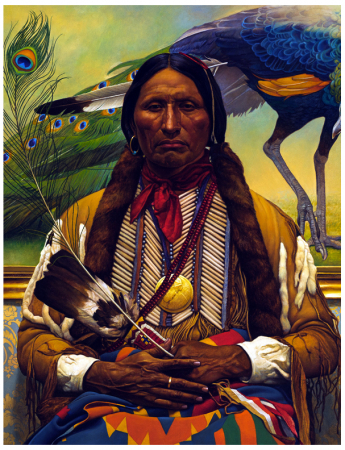
Howard Terpning has long said that as long as his eyes can see and his hands can hold a brush he would keep painting. The 92-year-old painter is definitely a man of his word.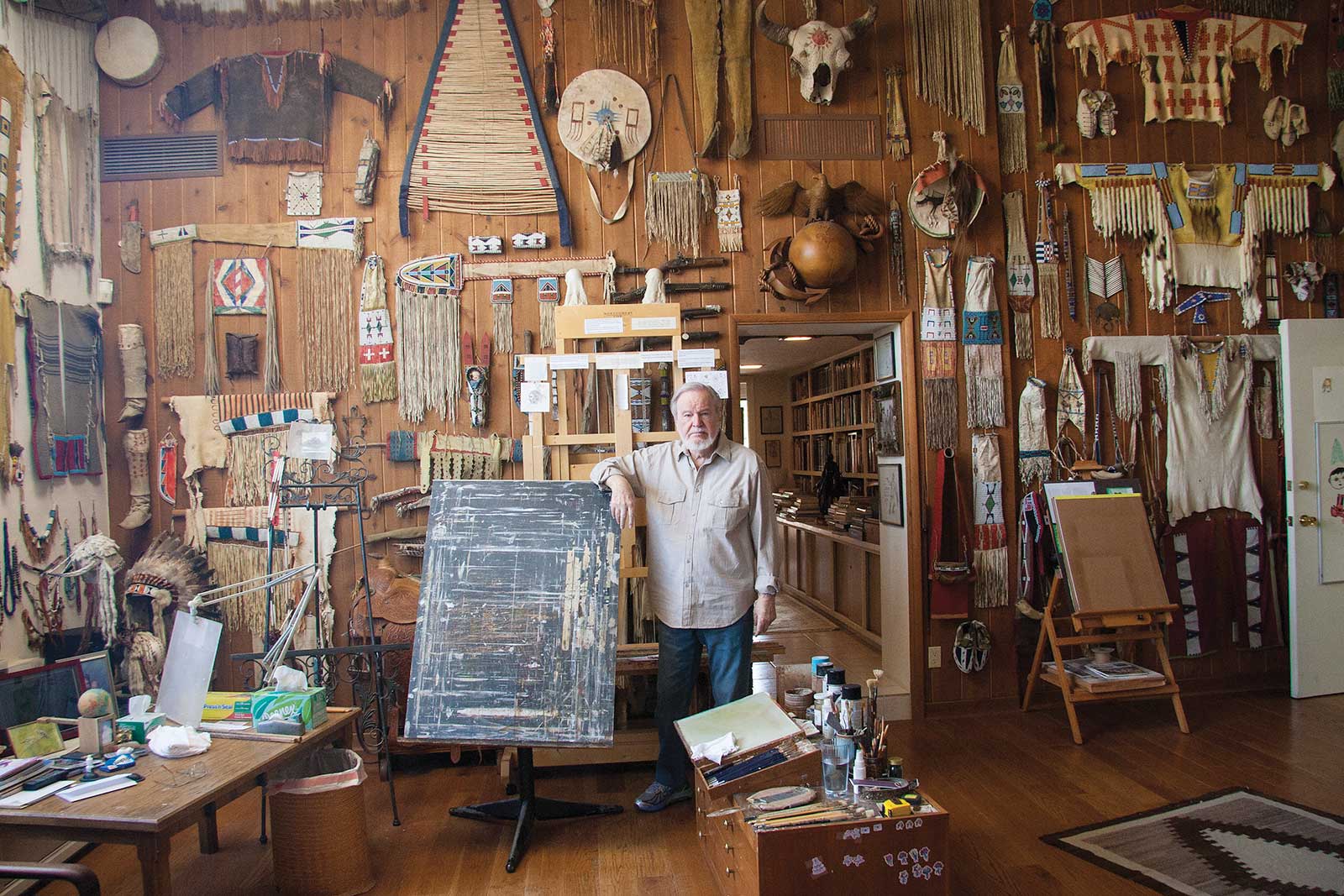
When Western Art Collector stopped by his home in Tucson, Arizona, we found him between paintings—one had recently left his studio and another was slowly starting to materialize—but painting was on his mind and his studio was prepped for the new work, which now comes at a leisurely pace since he retired from museum and gallery shows, and their incessant deadlines.
Not only is Terpning one of the great standard-bearers of Western art—whose works are treasured around the globe and have been known to sell at seven figures—he’s also one of the last painters still working today to be so thoroughly shaped by the Golden Age of Illustration. Early in his career he apprenticed under Haddon Sundblom, who cemented Santa Claus firmly into American pop culture by way of Coca-Cola, and was later initiated into a thriving world of illustration himself, from consumer products to movie posters. He discussed all this and much more, including his work as a civilian combat artist during the Vietnam War, when we visited him and his studio, which is decorated from top to bottom with Native American artifacts.
These days his works sell privately or enter the family collection, but Terpning still keeps his fingers on the pulse of the art world and watches from afar as the genre continues to excite collectors, many of whom were brought to Western art by Terpning’s legendary presence throughout a magnificent 45-year career.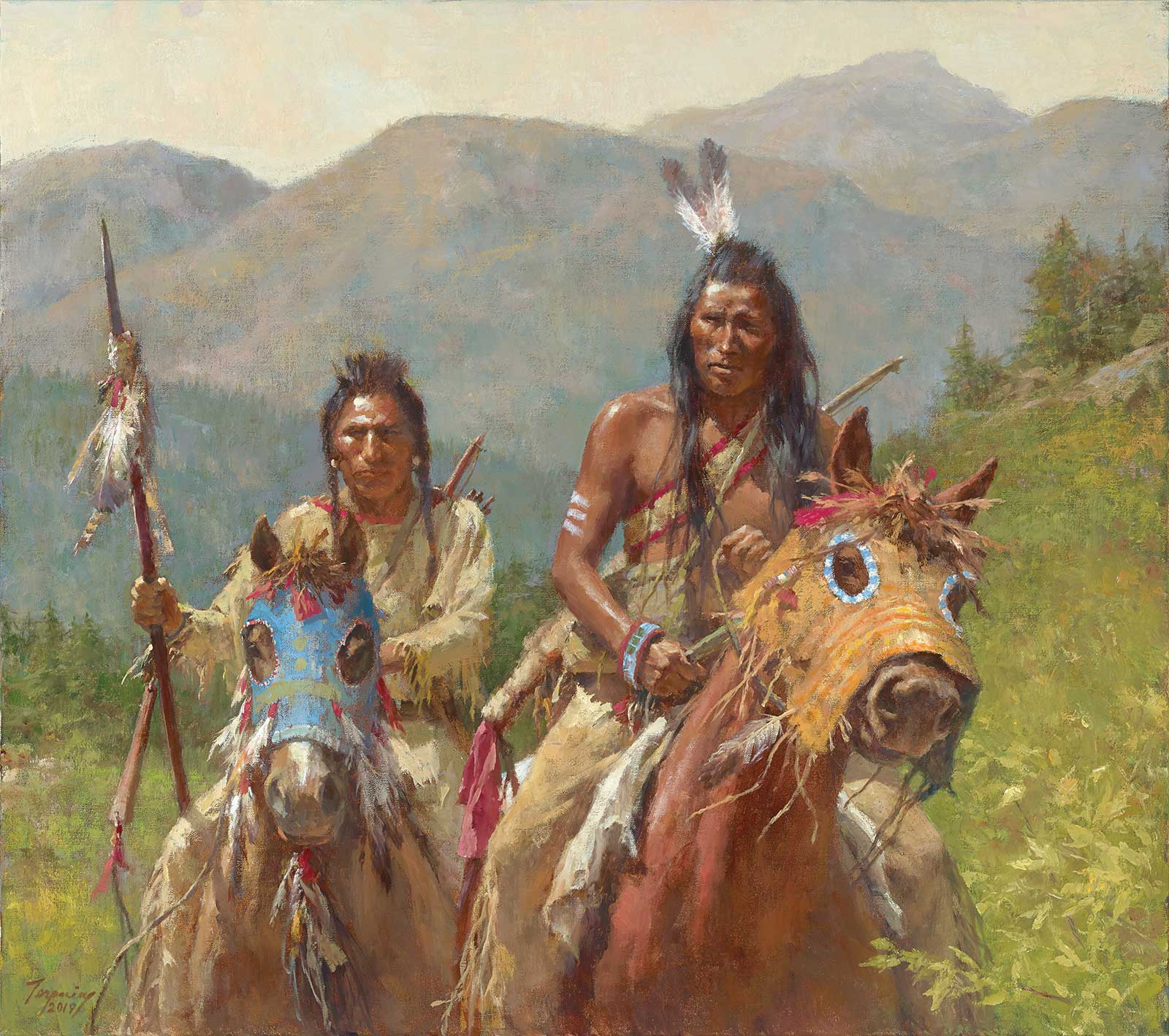 Mystery of the Crow Medicine Horse Masks, 2019, oil, 31 x 35”
When starting your fine art career, how did come to decide on Arizona, specifically Tucson?
In 1975 [Settlers West Galleries owner] Stuart Johnson came to New York and I met him in the city. We met on a street corner, I don’t even remember which one, but we agreed to meet on a street corner and then go to the Heye Foundation. Like me, he had this great interest in [Native American] artifacts, so we met up and took a cab over there and the damn thing was closed because it was on a Monday. We decided to sit somewhere and we visited and we hit it off. He, of course, had a gallery out here in Tucson and after that we would communicate over the phone and I would send him pictures. He would have shows and I would send work and come out, and then subsequent shows as well. I just loved it our here. [My wife] Marlies missed the pine trees, but she liked it too. My career was just starting to get going and we thought let’s make the move. We knew with the way things were going we could live anywhere we wanted. We did look at Santa Fe, but [our son] Steve had some allergies to the dust and we walked past a car on the street and you could see inside on the dash was covered in dust. We also looked in Scottsdale, but then came to Tucson. This house was empty at the time, so it was quite fortuitous
I guess. But we’ve been here ever since.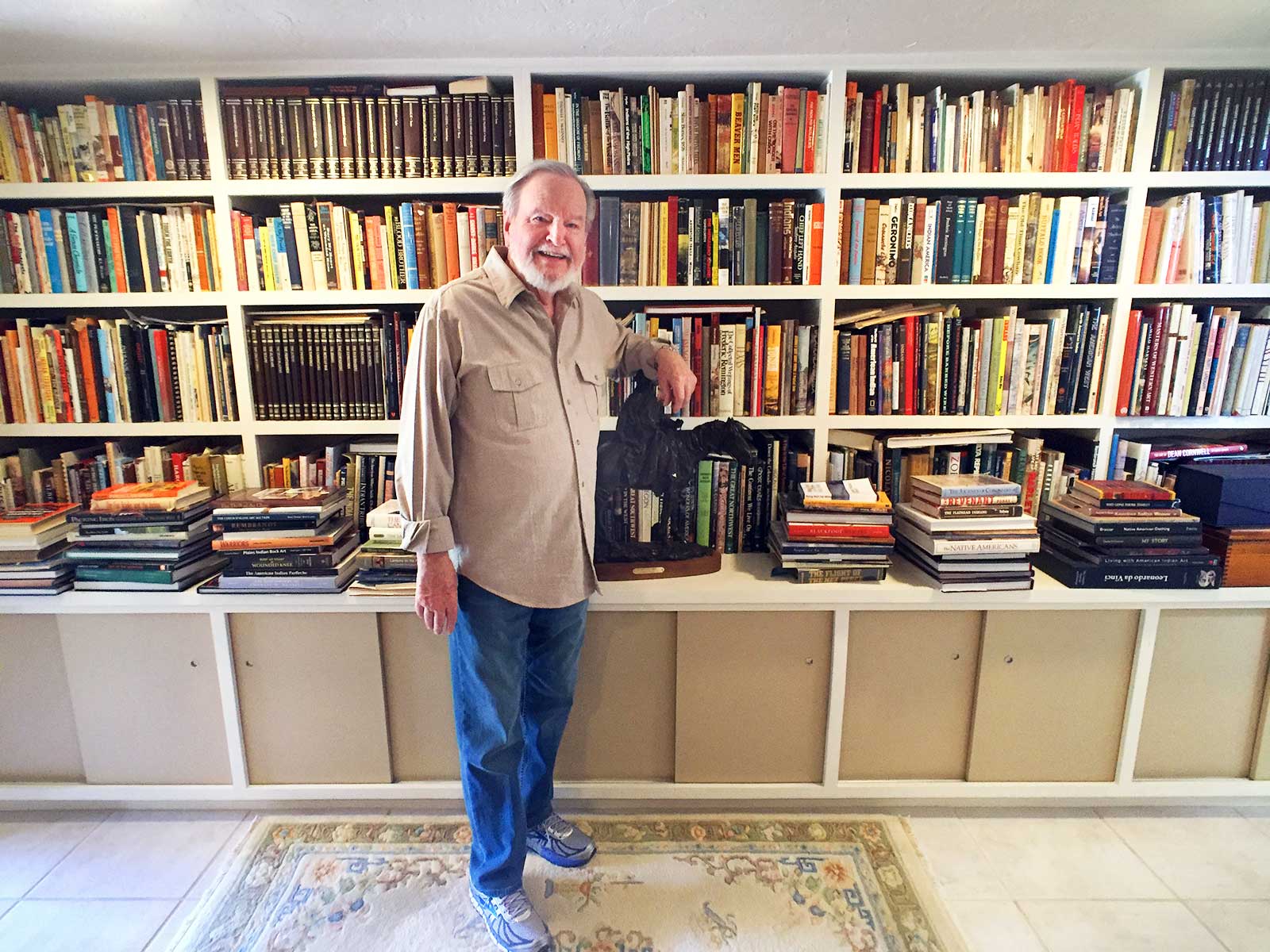 The artist in his library, which plays an important role when gathering information for new works.
Do you remember your first piece that was in a museum collection?
The Gilcrease had on loan Chief Joseph’s Ride to Surrender for a long time, so long that they assumed it was theirs until the collector eventually took it back. But my first one was probably Offerings to the Little People at the Phoenix Art Museum.
Artists seem to feel a great sense of honor when their works are in museums. It means the work will be remembered and publicly seen for a long time.
We all want to think that our works are going to survive and stand the test of time, and only time will tell if that’s the case. There are almost 600 pictures of mine out there in the world, and I don’t know where most of them are except for the big paintings, and I have one friend who has more than 50 paintings. The Basha Collection also has a number of my works. If some of them end up in museums that’s always nice for me, because they are seen. 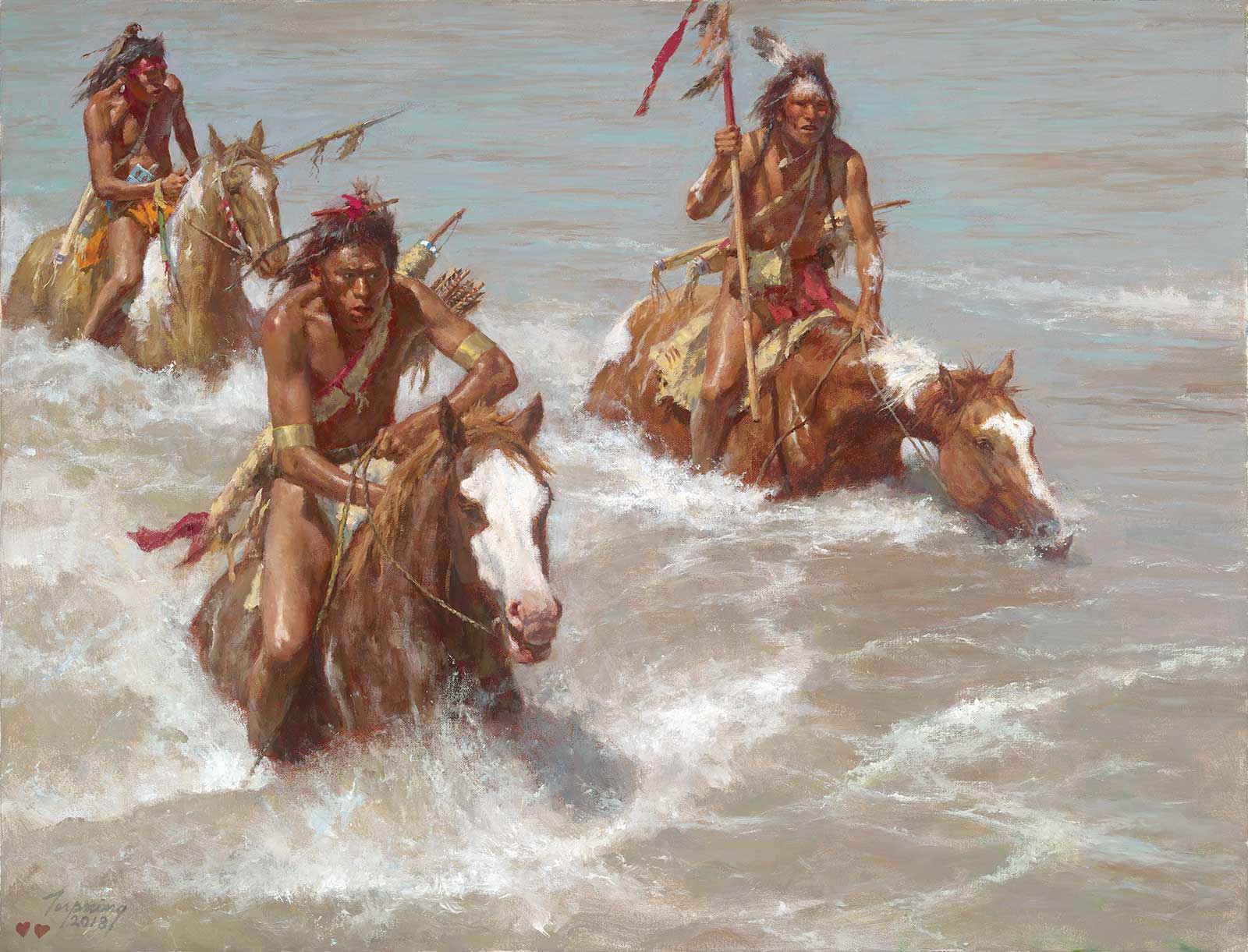 Pursuit Across the Yellowstone, 2018, oil, 32 x 42”
Has the process of deciding what you want to paint or gathering your reference material changed at all in recent years?
It’s certainly harder to gather all the material and get everything together. You have to go out and get horses and for models I’ll take any live body for a model…It’s a lot of physical effort, but I’ve got endless stuff. If I get an idea it can be something very specific. I usually have the artifacts and even if it’s not the right tribe it can still provide a semblance of an article I can alter. Years and years ago, it was easy because horses were all over the place, and I had my own horse for a long time. Now if I want a certain horse in a certain way with certain lighting, you can’t fake it—you just have to have the right facts. It just gets to be more of a challenge and I can’t face that any more if it’s too difficult.
How do you step into a painting? Do you get ideas from books or history, or from nature?
My process is the same as it’s always been.
I keep my challenges a little more modest these days. It starts from an idea, which can come from anywhere—it can be reading or just looking at something, and it makes me think of a scene. From there I can do some little sketches, see if it’s workable. But it all starts with the idea. If it’s exciting, I’m off and running. If it’s just going to make a nice little picture, so what? There’s a million nice little pictures out there in the world. All of the reference that’s available, it’s available to everybody, so sometimes it depends on how much you’re willing to dig and willing to spend on the research and going to whatever efforts are required to get what you need to do the right picture. Books, libraries, artifacts…it all helps. I can find anything I need in my own library, and sometimes I’ll just being going through it endlessly to find the right thing.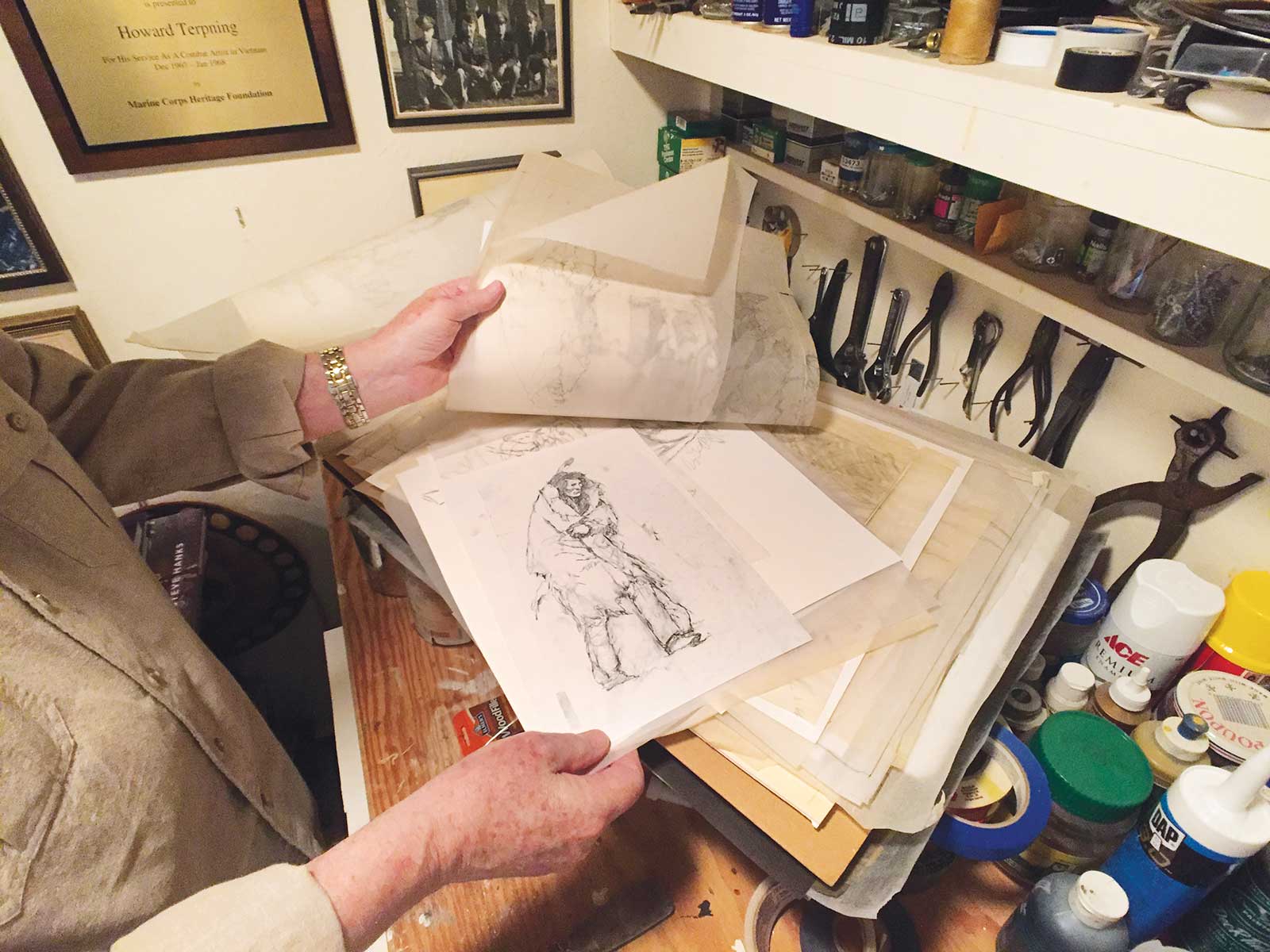 Flipping through old sketches in a library and workshop area off his studio, the artist finds an early figure drawing for Chief Joseph’s Ride to Surrender, one of his most famous pieces.
But I can imagine that books only go so far. Young painters sometimes think that the key to painting is an accumulation of knowledge, but I imagine an accumulation of experiences is just as important.
The experiences do matter. I once went on a buffalo hunt in the winter in Montana on snowmobiles. It was sort of a once-in-a-lifetime thing. And then I think of all the rendezvous, the Custer reenactments, the Indian ceremonies with the Blackfeet…these experiences accumulate over time, and they provide a rich background of memories that take years and years to create. I used to be offered the chance to go to ceremonies in the summer—the Kiowa wanted me to come once and other tribes as well. Every summer I would always be working on the [Cowboy Artists of America] show and then Stuart Johnson would want a piece for his fall show, so I would be doing six to eight paintings every summer and I turned down a lot of things and that was a big mistake. I should have said to hell with it and left the studio to go out and see more. I certainly did have a lot of opportunities that I did take advantage of and I’m glad I did.
I’ve found that it’s difficult to talk with many veteran artists about their technique because so much of what they do is intuition. So when you ask why did you put this color there, or something like that, they often don’t have the answer as to why. They just knew it belonged there.
That’s right. A lot of it is intuition. It’s an intuitive process because you have to make a decision every time you put a brush on the canvas—the value, the color, how that stroke interacts with the other strokes—all day, every day, or for however long you work. It’s a reflective thing, a personal thing, a very emotional thing. And then amid the intuition, sometimes we all get happy accidents. Sometimes you have to recognize the accident and leave it the hell alone before you go fiddling with it and ruin it. There are a lot of accidents that are disastrous, and you have to fix those, but every painting is a learning exercise. And when you get the painting finished it’s a good painting, but next time it can get better. That’s the carrot in front of the donkey’s nose.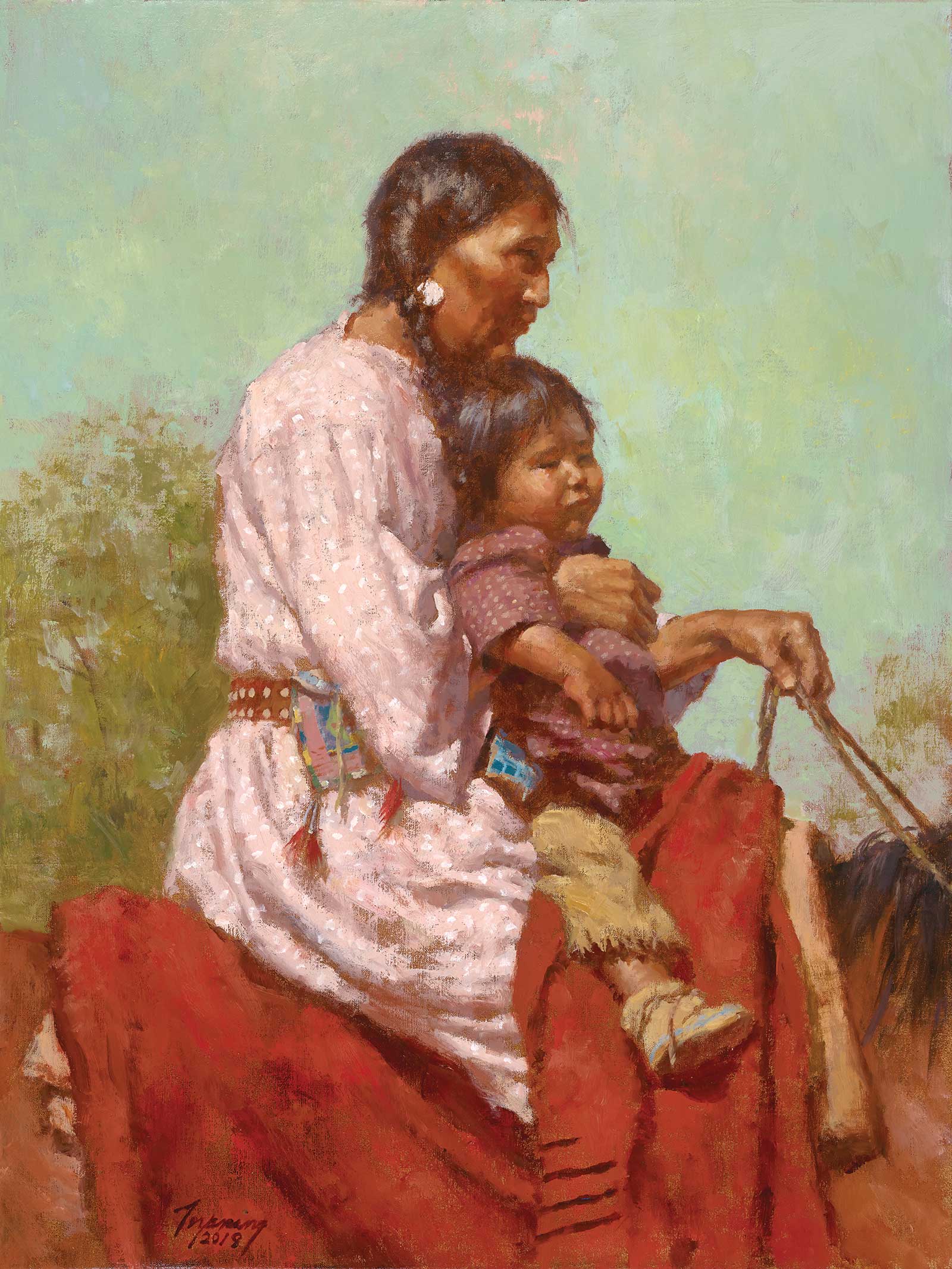 New Branch on the Family Tree, 2018, oil, 24 x 18”
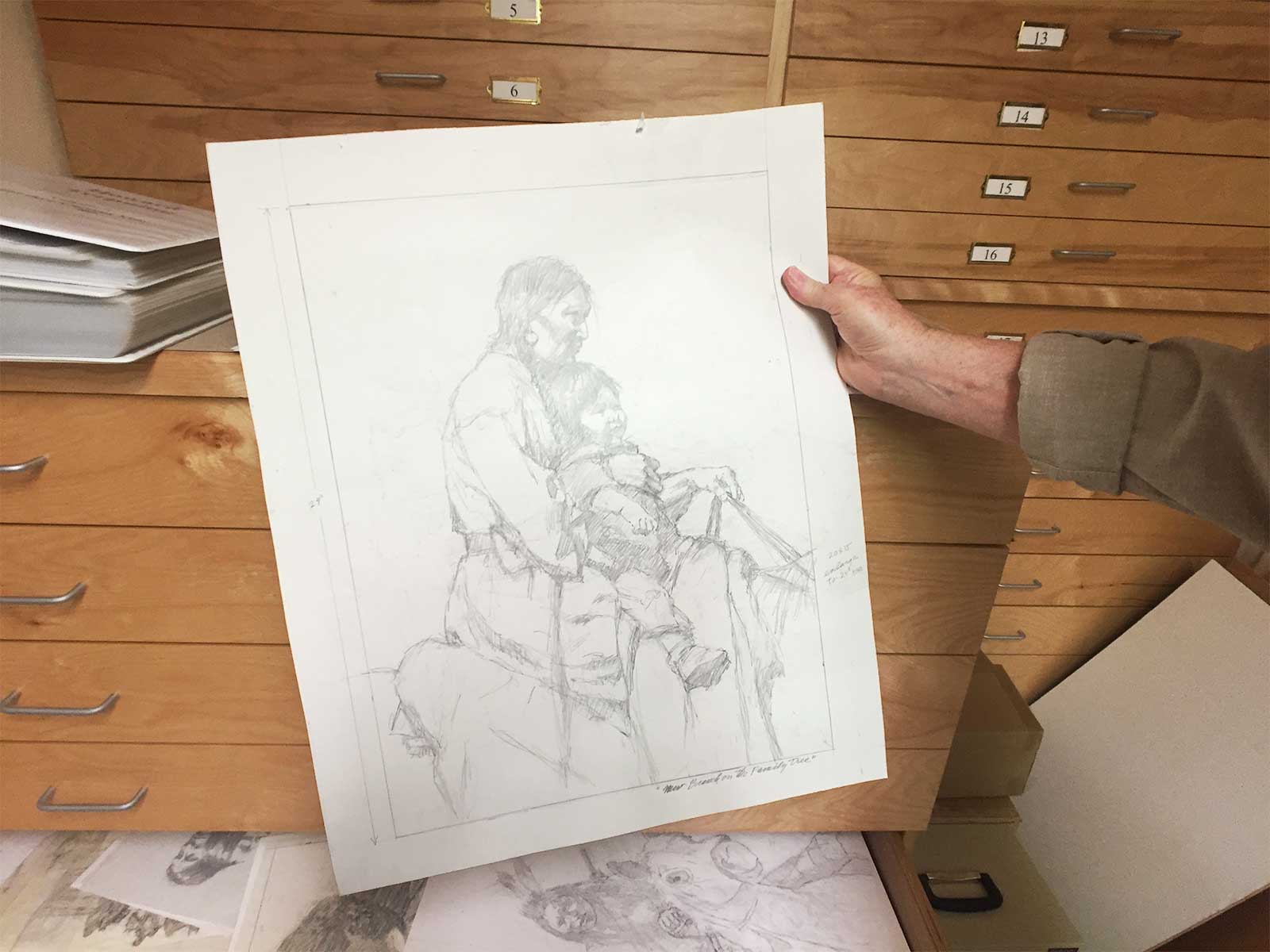 Howard Terpning holds up a preliminary sketch for a 2018 piece, New Branch on the Family Tree.
You said you are working on a new piece. Do you have a title yet?
I do. It’s called Plenty Wagon Come. It’s a trail with these wagon tracks going off over this hill. There is a lot of sage and it’s all overgrown and hasn’t been used in a long time, and an Indian is laying across this thing with his ear to the ground. There are two horses, one with an Indian sitting on it and another that belongs to the fella on the ground. I’ve wanted to do this for so many years, and I never could figure the damn thing out. I was trying it as a horizontal and I would put the figure in the foreground, then in the background, horse in front, horse behind…every now and again I would take the sketches out and screw around with them, but I could never figure them out. And just recently, on a Sunday morning, I had a eureka moment and I decided it was going to be a vertical instead of a horizontal. Now, I haven’t painted it yet, so it still might not work, but we’ll see.
This is very encouraging to other artists. If Howard Terpning still struggles with his paintings, then there is hope for everyone else when they struggle.
All painting is one damn problem after another. That’s exactly what it is. I mean, hell, if it were just painting by numbers—“do this color here, do this color there”—then everyone and their brother would be painting pictures. There’s a million artists out there as it is.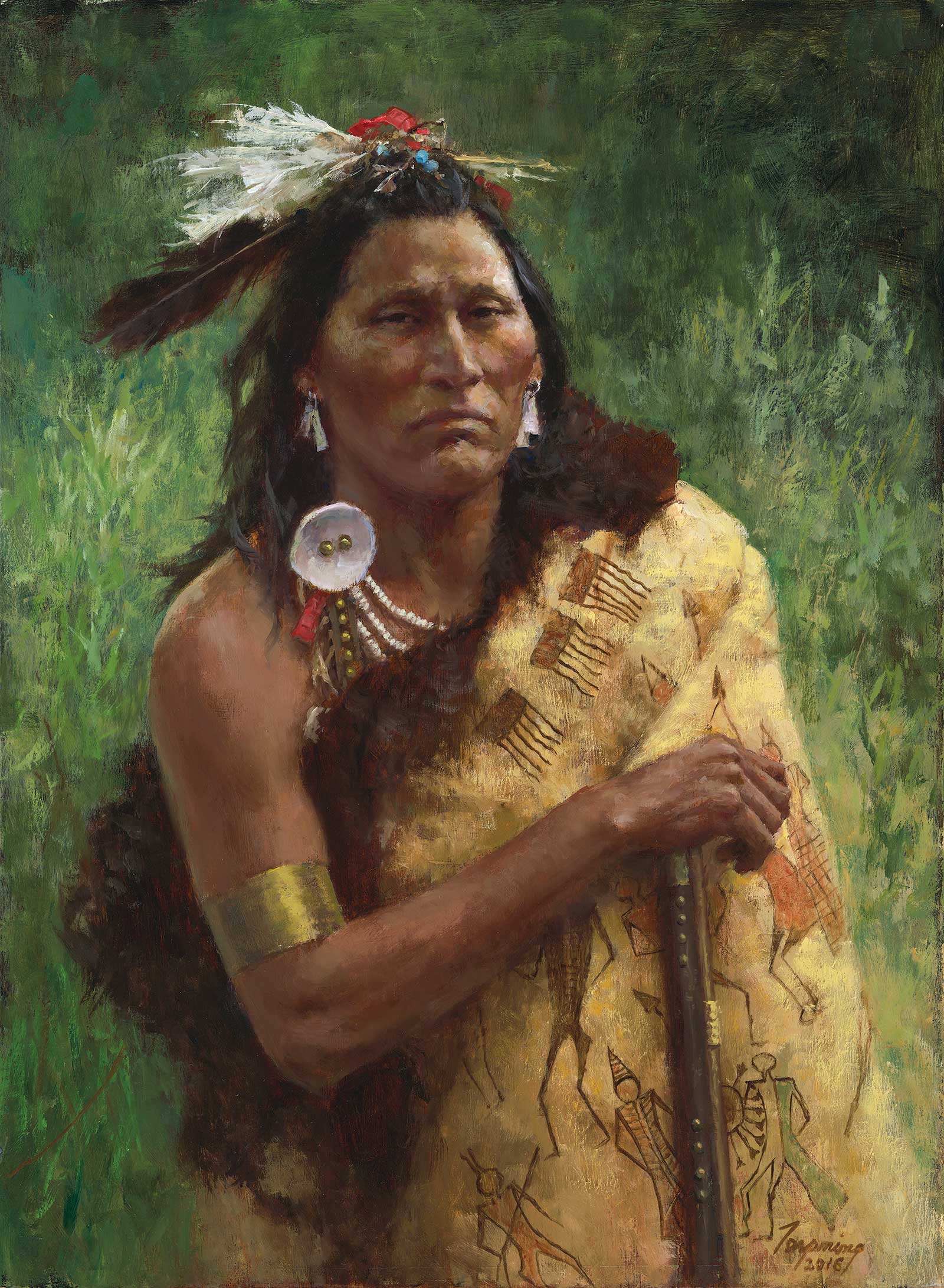 Three Trophies, 2016, oil, 26 x 19”
What was the Western art world like when you came onto the scene in 1976 and 1977?
I remember it very well. The market was booming. These rich Texas oil men would come up to Scottsdale and they would just buy things off the wall, some of them without even looking at them. I heard this from Troy Murray who represented me—it was Troy and Marilyn. Galleries were all over the place. The market was remarkable. You start thinking, “I guess it’s always going to be this way.” I started out with a gallery here in town, a nice fellow owned it. He had some of my works, three paintings—probably the first three I did, which I had done in the summer of 1974. Anyway he couldn’t sell them. Stuart Johnson has told me this story many times. He was driving down Campbell Avenue [in Tucson], and he was stopped in traffic and he looked to his right and there were my paintings in this gallery. So he pursued them and found out who I was and that’s how we got connected. But this fellow couldn’t sell the paintings, so he sent them up to Troy Murray and the idea was if Troy could sell them they would split the commission. Troy sold them right away and then Troy contacted me and asked if I wanted to be represented by him and I did. So I sent Troy some paintings, and I was represented by Schreiber Gallery in Taos. My thinking was that Troy was open in the winter, Taos was open in the summer. And then Stuey stepped in there as well. Very quickly there was a lot of demand for my work so I wasn’t able to fulfill all of my obligations so I just focused with being with Stuart. The market was incredible then. There was Fowlers Gallery on Main Street, Steve Rose and many others. [John] Clymer and [Tom] Lovell were the big guys then, and Brownell McGrew. And then all the CA members, like Bill Owen and [Joe] Beeler and those guys. Bob Scriver and I became good friends and he was a big help to me. He was, in many ways, more Blackfeet than many of the Blackfeet. He had this place in Browning, [Montana], and he was born and raised there. His dad had a trading post there, a mercantile or something like that, and he was the owner of the Thunder Pipe Bundle, which was a great honor. He was so helpful to me, especially when it came to helping me learn about the Blackfeet people. Bob was a character, an absolute character. It’s fun to think back on these people who I haven’t thought about in a long time. I’ve had a hell of a lot of experiences, incredible experiences, including in Vietnam. Every one of them has influenced my work.
How did your experience in Vietnam influence your work?
The big one was material things. When you’re in the middle of some pretty bad situations and you reflect on it, material things don’t make a damn bit of difference. It’s what you have inside you that helps you survive. Seeing the disaster over there, and seeing the way the local people—the peasants and especially the children—to see how they lived was heartbreaking. All the fathers and brothers, they were either dead or in the war. These little kids were growing up as little packs in the village, and when you walked through they would just cling to you and it’s hard not to be affected by that. You have to be hard hearted to just blow it off. I never knew anyone who could and I certainly couldn’t. It influences your life in many ways, and it certainly helped me to appreciate my own life, the security and safety we have. It just changes you somehow.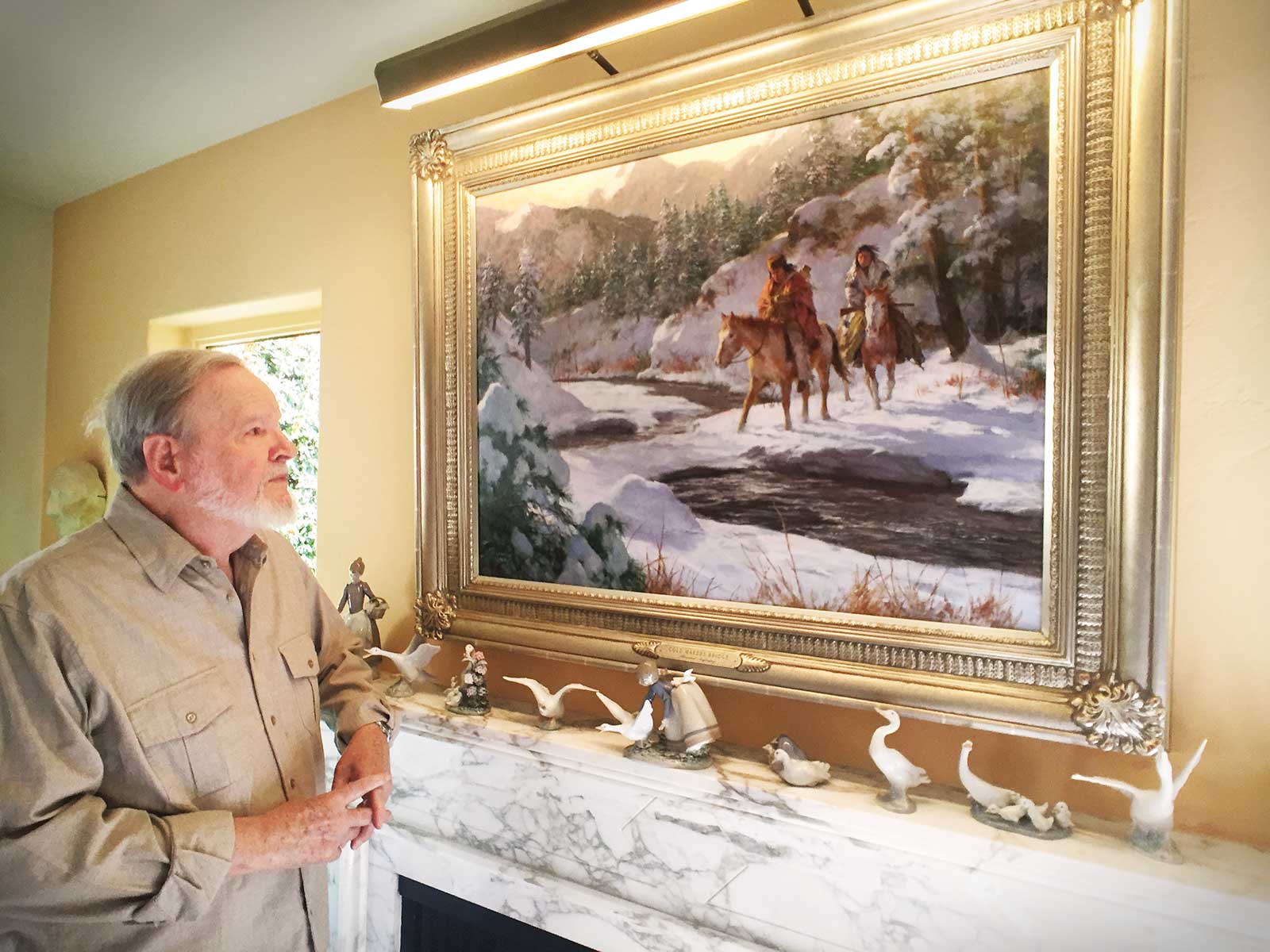 Howard Terpning stands next to Cold Makers Bridge in his Tucson home.
Your paintings of Native Americans have always been praised for your sensitive portrayal of the Plains People and what they went through, including what happened to them as the West expanded and they encountered white people. Did your experience in Vietnam help inform your perspective on Native Americans and what they went through?
I think it did affect my work in that way. There were so many similarities to the Vietnamese people with what was going on over there and what happened to the people of the Great Plains and the hardships they had. Just look at the buffalo. As the buffalo disappeared, they were being hunted for their hides, and even the Plains Indians started slaughtering the buffalo so they could trade goods. It was corrupting their whole culture, and then the buffalo were gone and they didn’t even realize it. It’s unbelievable how they had to live and survive. They not only had to fight the white man, but they had to fight each other. Like Vietnam, I couldn’t help but be moved by these people and what they had gone through to survive.
Before you started painting Native Americans and the Plains People, you began your career in illustration. It’s always fun to run across those images. Just yesterday I saw one for Orange Crush in 1960 that was attributed to you.
It’s nice to know people enjoy those works.
I don’t recall the image you’re talking about; there was a lot of them then. I guess I’m better known for my movie work, but I did do ads for everything, including whiskey, cigars, Pendleton woolen wear. I did Pendleton for four years and they wanted me for a fifth year but I said no because I was transitioning into my art career.
Some artists look down on their illustration work, but illustration is often the first place people experience art, whether it’s through a billboard or a poster or a magazine ad. Illustrators fill the world with art.
When you think about it, that’s all there was back then—it was paintings or nothing. I have a book on Haddon Sundblom that Morgan Weistling sent me. I apprenticed with Sunny for a year and a half. I was just fascinated at what he did. Gil Elvgren, he did the best pinups, he lived right around the corner from Sundblom and would come over to visit. We were all in awe of Elvgren and Sundblom and everybody else that was doing the big-time stuff.
I just had the occasion to write a little bit about Sundblom. His Santa Claus paintings are classics.
Funny thing is he ended up using himself as the model. He was a Swede, and as he got older he looked the part, from his cheeks and his eyebrows to the little glint in his eye. His studio was a big studio and they had a photo room with a full-time photographer and they had the whole deal. It was great if you needed model shots you could call up the ad agency or the modeling agency and tell them what you needed and they would send them over. They’d come into the photo room and the pictures would be taken and then printed out and you had your references. It was great. I used to model for him sometimes. It was fun. I was only in my early 20s. It was usually with some young girls. I’d do these casual embraces. One time
I was a lifeguard. Another time I was a delivery guy with a cap and big grin on my face. It was great and was a learning experience.
You mentioned you have almost 600 paintings done. Do you keep a tally of finished works?
I do keep track. Back when I started I would jot each one down in a notebook—what the piece was, a title, where it was going, that sort of information. Right now I have 596 works completed and I’m working on sketches for 597. I need to get to 600. It would be a good number to hit, don’t you think? —
Powered by Froala Editor