The art world, especially the Western Art world, is riddled with stories. Tall tales, windies, rumors, apocrypha—call them what you will. When you work for an old gallery, like J.N Bartfield in New York, every drawer, every bin, every letter, yellowed and faded with time, is fairly saturated with the dust of story. And so, when I recently traveled to Tulsa, to spend some time with Laura Fry, senior curator at the Gilcrease Museum, to hear about the impressive expansion that is about to begin there—and to gather impressions for this article—I went with a story of my own.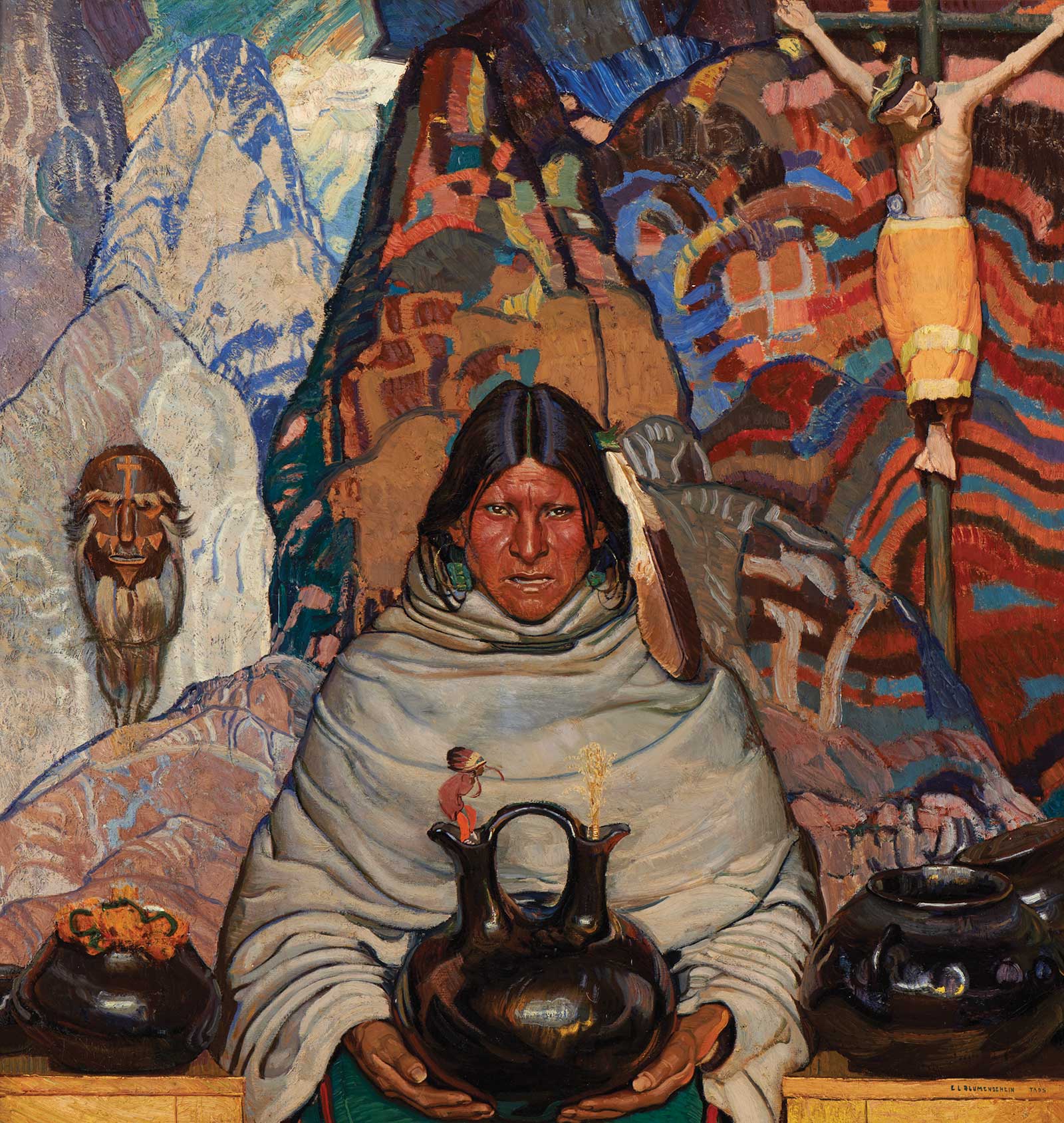 Ernest L. Blumenschein (1874-1960), Superstition, 1921, oil on canvas, 46 x 44¾”. GM 0137.531. Gilcrease Museum, Tulsa, Oklahoma.
As the murmurs of amazement from school groups on field trips echoed against the high ceilings in Helmerich Hall, I stood with Fry at the top of a flight of steps and told the story of how, in 1944, Jack Bartfield had been in the running with Thomas Gilcrease and others to purchase the collection of Dr. Philip G. Cole, a prominent collector of Western art who had known both Remington, Russell and many of the Taos artists and owned some of their greatest works. As the story goes, bidding was to close at a certain hour on a Friday. Bartfield’s bid was higher than Gilcrease’s, but Bartfield’s lawyers had arrived minutes after the deadline, so Gilcrease won out. Bartfield was understandably upset, but said he’d rather lose out to a museum than another dealer. Fry added her layer to the tale, saying that Gilcrease was said to have opened one box, seen that it was filled with paintings by Joseph Henry Sharp and placed his bid, saying, “I’ll take all of it.” It was 636 works of art, plus manuscript and archival material. Bartfield’s has a copy of Cole’s list. I’ve seen it. Now that’s how you build a museum. Cole resided in Tarrytown, New York. His house can’t be more than 10 minutes’ walk from my home. Do I dream of stumbling across some masterwork of his that somehow slipped away from the Cole estate and Gilcrease? What do you think?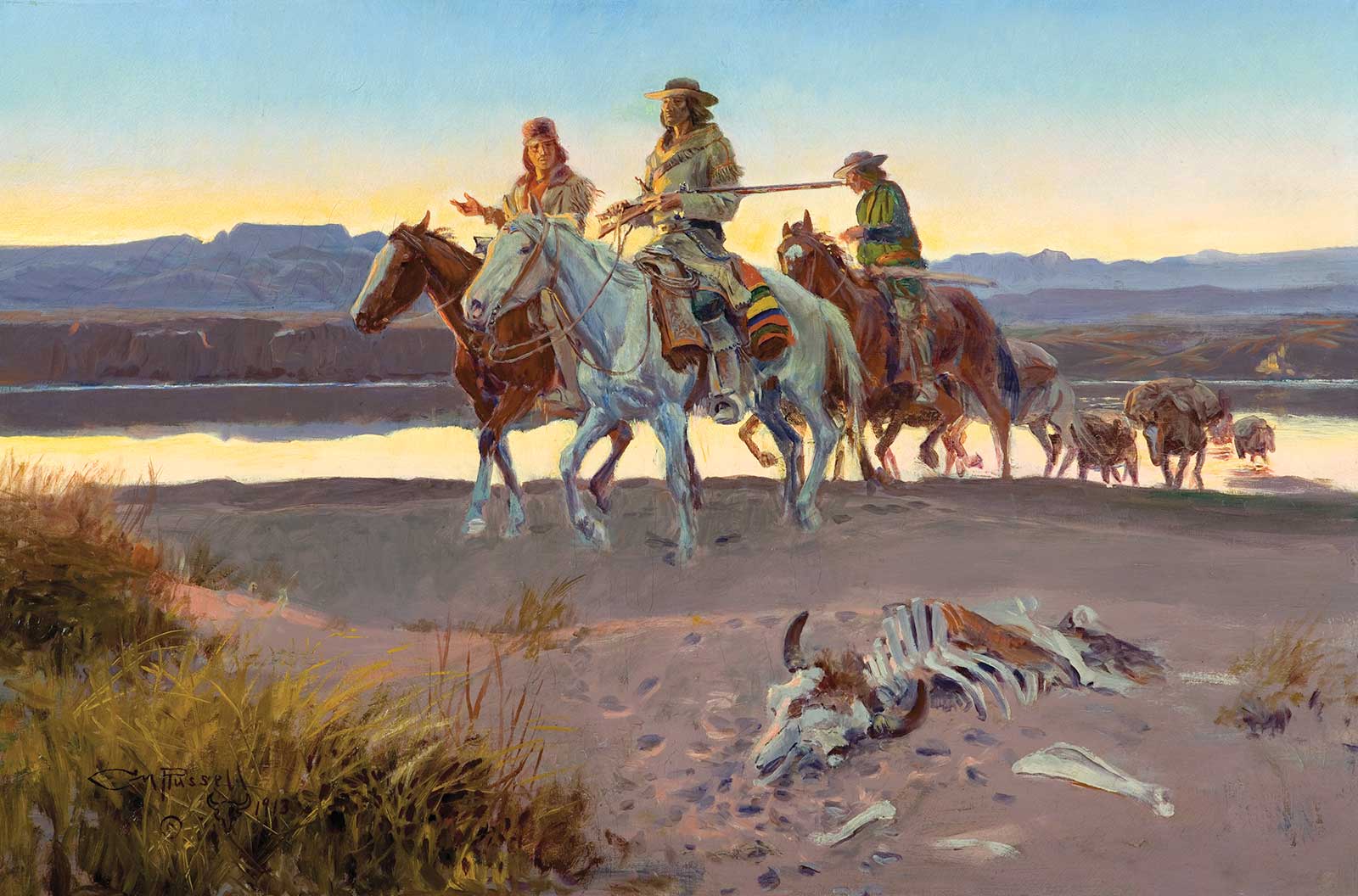 Charles M. Russell (1864-1926), Carson’s Men, 1913, oil on canvas, 24 x 36”. GM 01.2245. Gilcrease Museum, Tulsa, Oklahoma.
The $83.6 million expansion at the Gilcrease will be designed by Tulsa’s 1Architecture—who will oversee construction locally—and SmithGroup—which was responsible for the striking National Museum of African American History and Culture in Washington, D.C. When it is finished, there will be: a new facade, a 5,000-square-foot changing gallery for traveling exhibitions, three changing galleries designed primarily for the Gilcrease Collection, three new core thematic galleries, open storage space to display more of the collection, education space, a new grand entry and great hall, and more. Much of the existing exhibition space will also be renovated. Considering that fewer than 5 percent of the museum’s objects—which number nearly half a million—are available to the public at any one time, the work is vital, necessary, and exciting.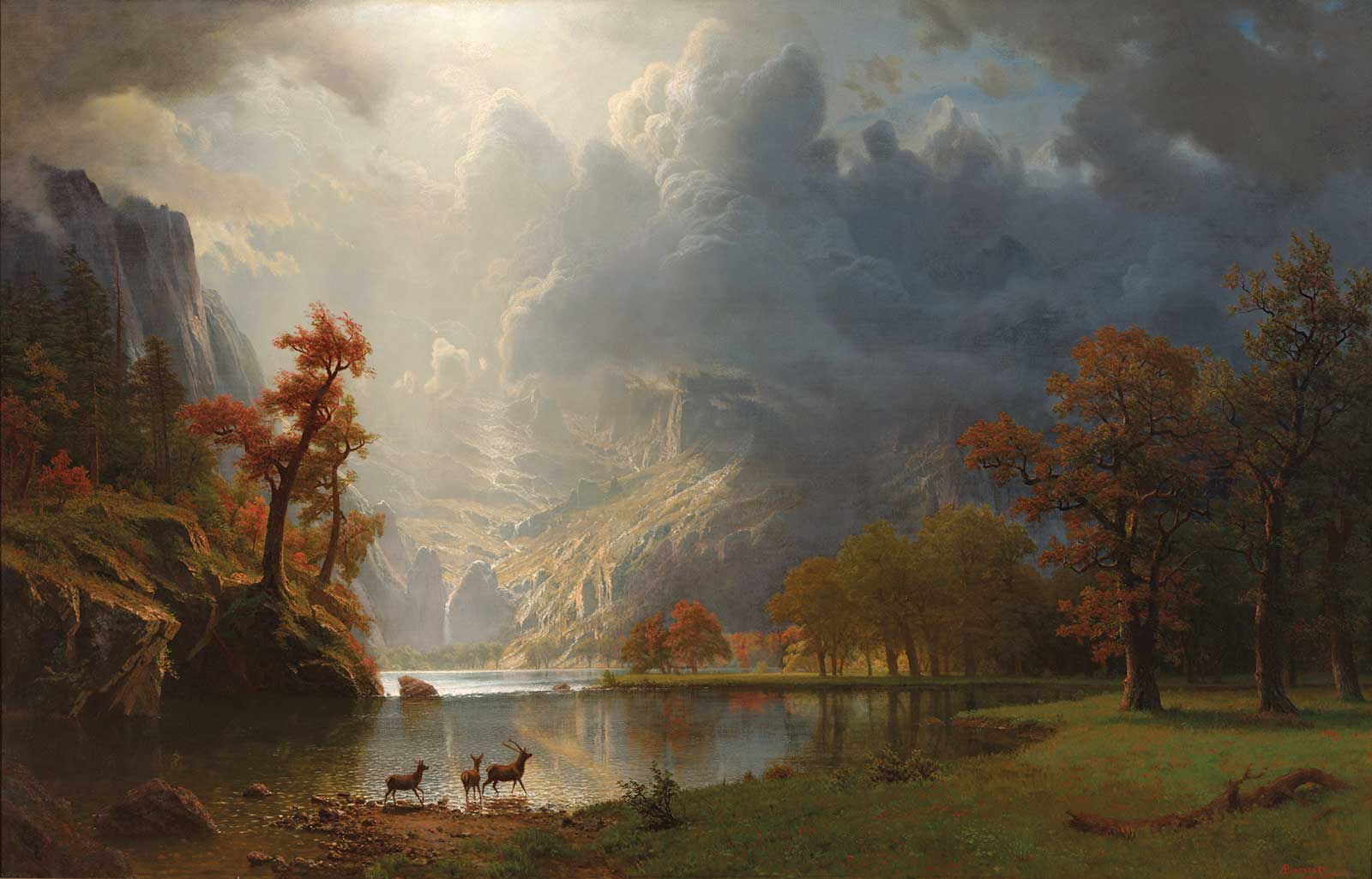 Albert Bierstadt (1830-1902), Sierra Nevada Morning, 1870, oil on canvas, 53 x 831⁄8". GM 0126.2305. Gilcrease Museum, Tulsa, Oklahoma.
To see where the museum is headed, it’s worth taking a look back at its origins. Born in 1890, Thomas Gilcrease was an enrolled member of the Creek Nation, one of the five so-called “civilized” nations—tribes seen as having sufficiently adapted to white European ways—that had been “removed” from the American Southeast to lands west of the Mississippi early in the 19th century. “Civilized.” “Removed.” George Orwell would have had much to say about this rhetoric of colonization.
Like other Native Americans, Gilcrease received an allotment of 160 acres—that turned out to be saturated with oil. Because of the status of the Creek, Gilcrease managed to keep control of his land and the oil extracted there. By contrast, the Osage, a local Indigenous nation, were found to be “incompetent,” and were subject to guardianships by whites who exploited and even murdered them for their wealth. The recent book, Killers of the Flower Moon, documents these crimes and the partial and insufficient restitution the Osage received.
But Gilcrease flourished. He studied. Then he traveled to Europe and North Africa. There he took keen interest in history and the arts. On his return, he began to collect paintings, sculptures, books and manuscripts and to bring his dream—an American museum in Tulsa—into being. And he was voracious, purchasing entire collections—like Cole’s—as well as significant individual works. My journey took me to the archives, where head librarian and archivist Renee Harvey guided me through the museum’s extensive holdings: a letter from Columbus’ son in Hispaniola to the King of Spain, an unmatched collection of documents related to Spanish colonization, Benjamin Franklin’s personal copy of the Declaration of Independence, a myriad of journals related to Canadian and Arctic exploration, and a veritable treasure trove of narratives of conflict, captivity, enslavement, escape and freedom, dating back to the earliest European arrivals.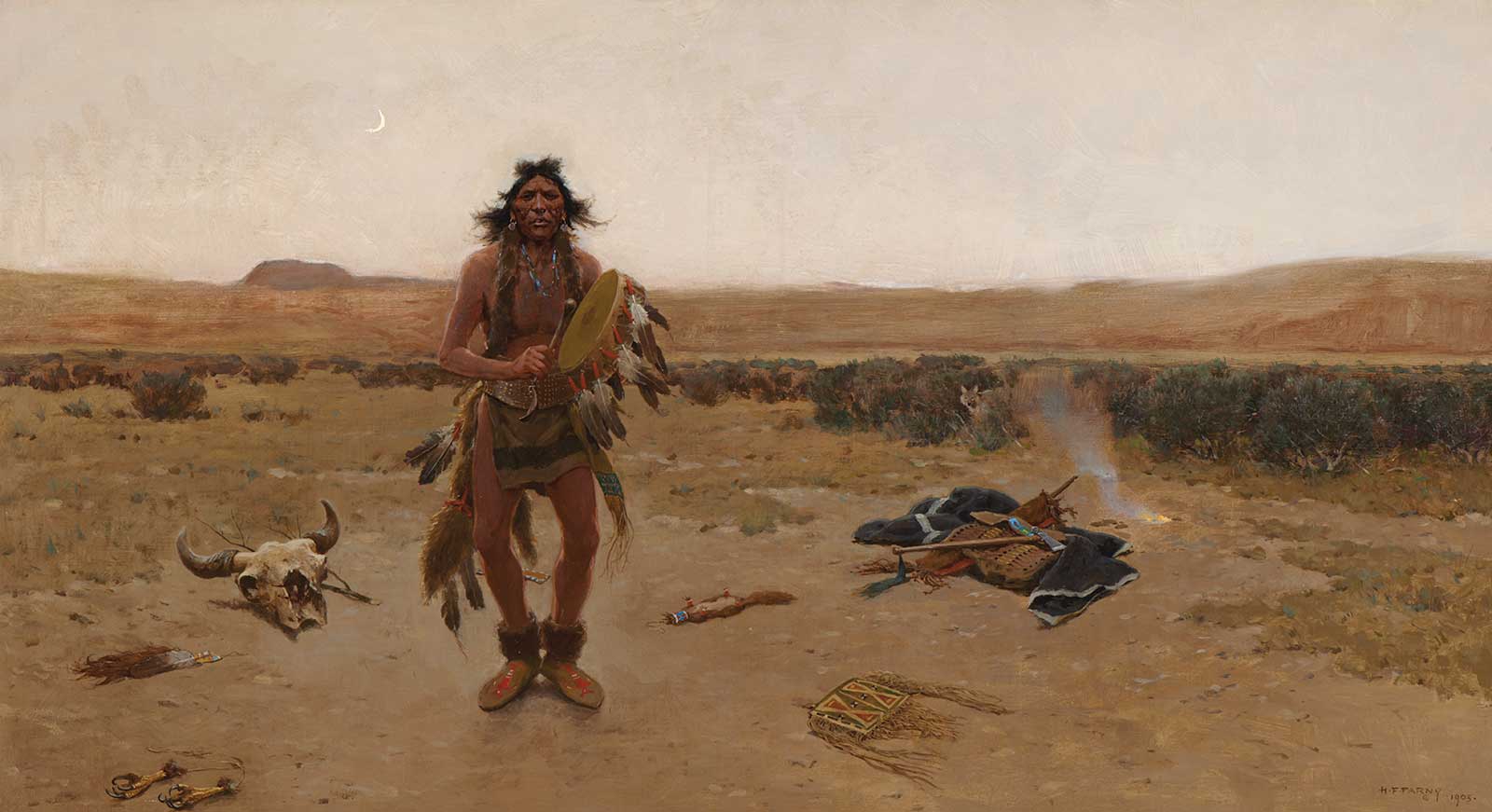 Henry Farny (1847-1916), The Sorcerer, 1903, oil on canvas, 221⁄8 x 401⁄8”. GM 01.1225. Gilcrease Museum, Tulsa, Oklahoma.
In the massive storage areas below ground, Fry walked over to one of many rolling racks and pulled one out. Dozens of portraits of Native Americans by Sharp stared back at me. The effect was overwhelming. In an adjoining room, there were drawers of watercolors—from simple color studies to full sheets—and pristine etchings, all by Thomas Moran and his wife, Mary Nimmo Moran. Near the rack of Sharps, I had seen several oils of Mexico by Moran and had not known he did so much work there. The Gilcrease has some 300 Sharps; Morans number over 1,000. Fry led me down a long hallway, flanked on one side by George Catlin’s vivid and stylized paintings of the West as he saw it in the 1830s, and, on the other, the contents of W.R. Leigh’s 57th Street studio. We then entered the museum’s galleries of Native American objects and I saw drawer after drawer filled with row after row of what were certainly some of the finest Clovis projectile points ever collected.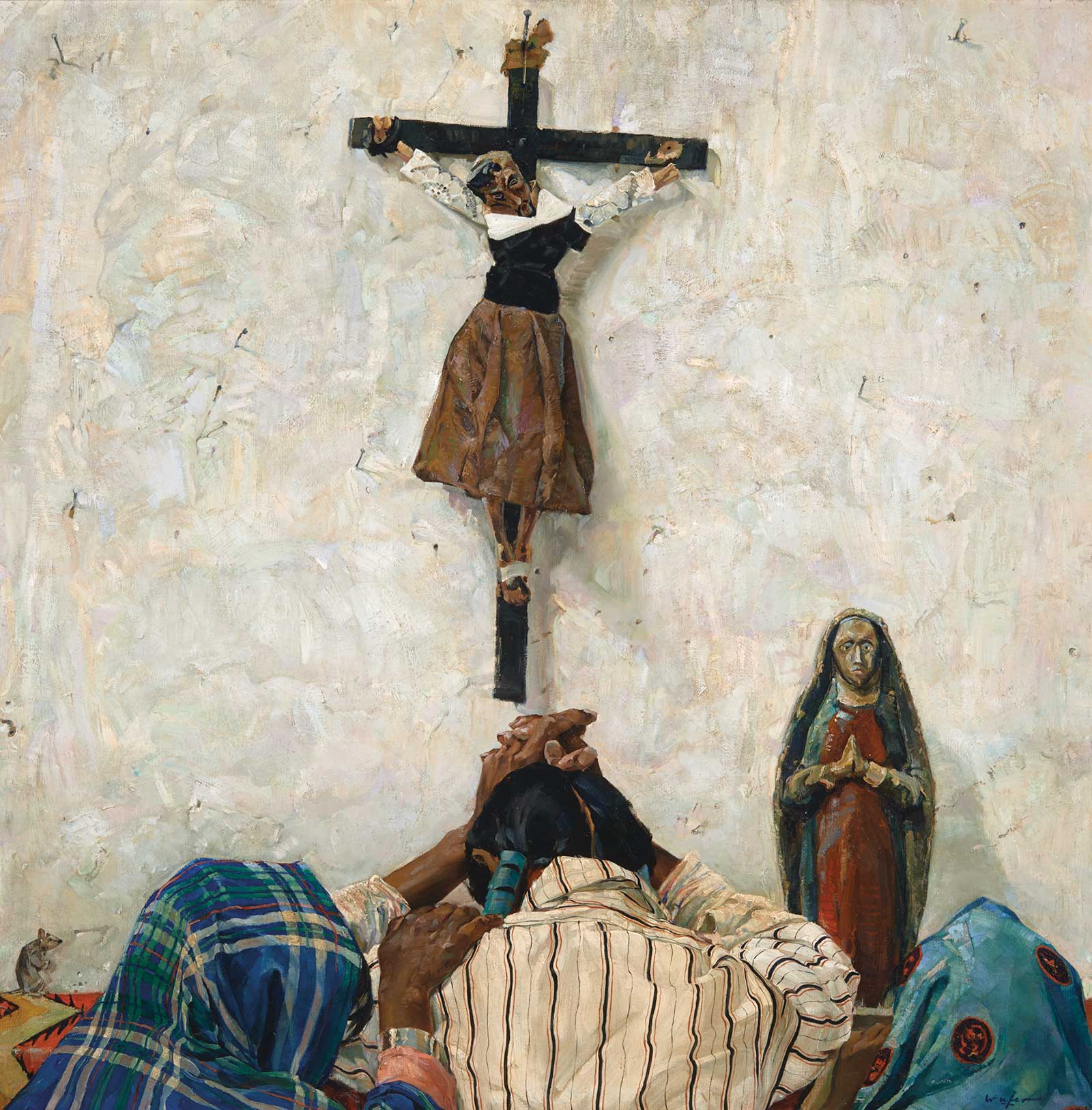 Walter Ufer (1876-1936), Hunger, 1919, oil on canvas, 49½ x 49½”. GM 0137.2196. Gilcrease Museum, Tulsa, Oklahoma.
It was right about then that the scope of Gilcrease’s project began to coalesce in my mind. Gilcrease wasn’t simply interested in an American museum. What he was was pursuing went beyond even the continental. His vision was hemispheric, a museum of the Americas, representing pre-history and history, the arts, and material culture from the high Arctic to Tierra del Fuego. Contact and pre-Contact cultures. Indigenous cultures and empires, as well as those that preceded the modern nation states in North, Central, and South America, as well as the Caribbean Islands, a museum that would grow and change as the hemisphere changed. As borders and boundaries fall, as cultures collide and adapt to one another at the speed of light, Gilcrease’s idea is both ahead of its time and right on time.
I asked Fry how the new space and renovation will add to Gilcrease’s original vision for the museum and what it will it bring that, perhaps, Gilcrease himself could not have dreamt of? Fry replied: “When the Gilcrease Museum first opened in Tulsa in 1949, Thomas Gilcrease envisioned blending an art gallery, museum and library to preserve and share the many histories and diverse cultures of North and South America. By creating a new interpretive plan to guide museum exhibitions in the future, we seek to expand on Thomas Gilcrease’s original multicultural approach and broaden the perspectives presented at the museum. Mr. Gilcrease would have been amazed at the expanded communication tools and information sharing available for museums and researchers today. Using both low-tech and high-tech methods, we hope to bring the Gilcrease collections to life through innovative storytelling and interpretation, making new connections between the past and the present.”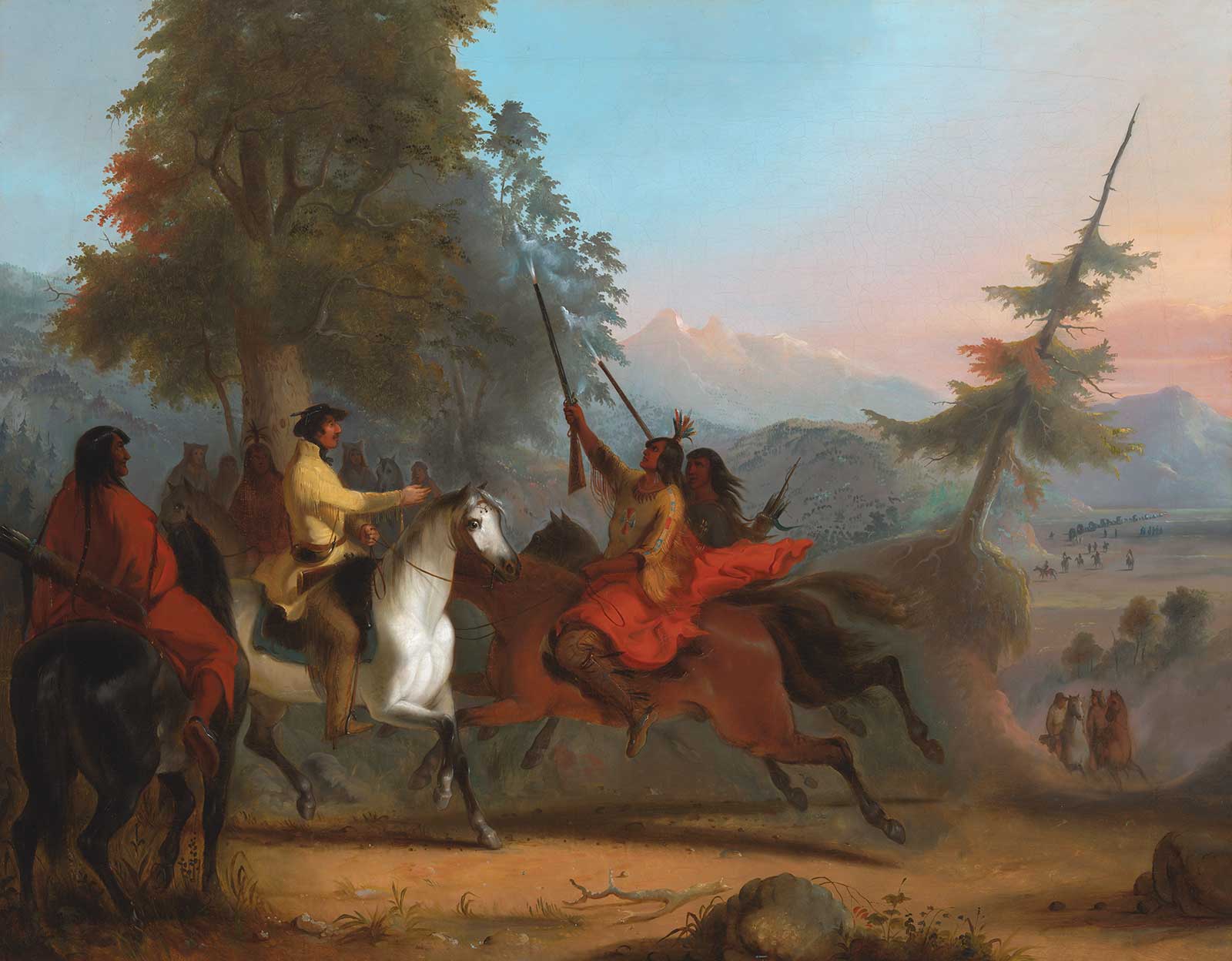 Alfred Jacob Miller (1810-1874), Stewart Meeting Indian Chief, mid-19th century, oil on canvas, 327⁄8 x 421⁄8". GM 01.738. Gilcrease Museum, Tulsa, Oklahoma.
Tulsa is a place of great energy right now—not just fossil fuel energy—and the Gilcrease seems poised, not only to be the beneficiary of that energy, but to create and release energies of its own. Some of these are energies long stored up, waiting to be released; others are cutting edge energies, arising out of new contexts and new ideas. The Tulsa I saw felt like a crux, a crossroads of cultures at a crossroads. History has been made here many times. History here has also been suppressed. Killers of the Flower Moon makes a move toward excavation and reconciliation. The massacre of African Americans in Tulsa in 1921 (recreated in the opening sequence of HBO’s adaptation of the graphic novel The Watchmen), only recently taught in schools, commemorated and, in some small measure, atoned for, makes another.
Perhaps a place in the throes of confronting its past is precisely the sort of place where truths, even hard truths, can and should be presented. Americans All, one of the exhibitions currently on view at the Gilcrease, exemplifies not only the future of the Gilcrease, but the future of Tulsa and, perhaps, all the Americas. Paintings by Audubon, Bierstadt, Leutze and others in the pantheon of American art hang beside fascinating works by artists such as Mazen Abufadil, Jave Yoshimoto, and Carmen Castorena, who have made Tulsa their home—and identity their subject. In this context, we remember that almost all of us find our origins elsewhere, that we are all immigrants.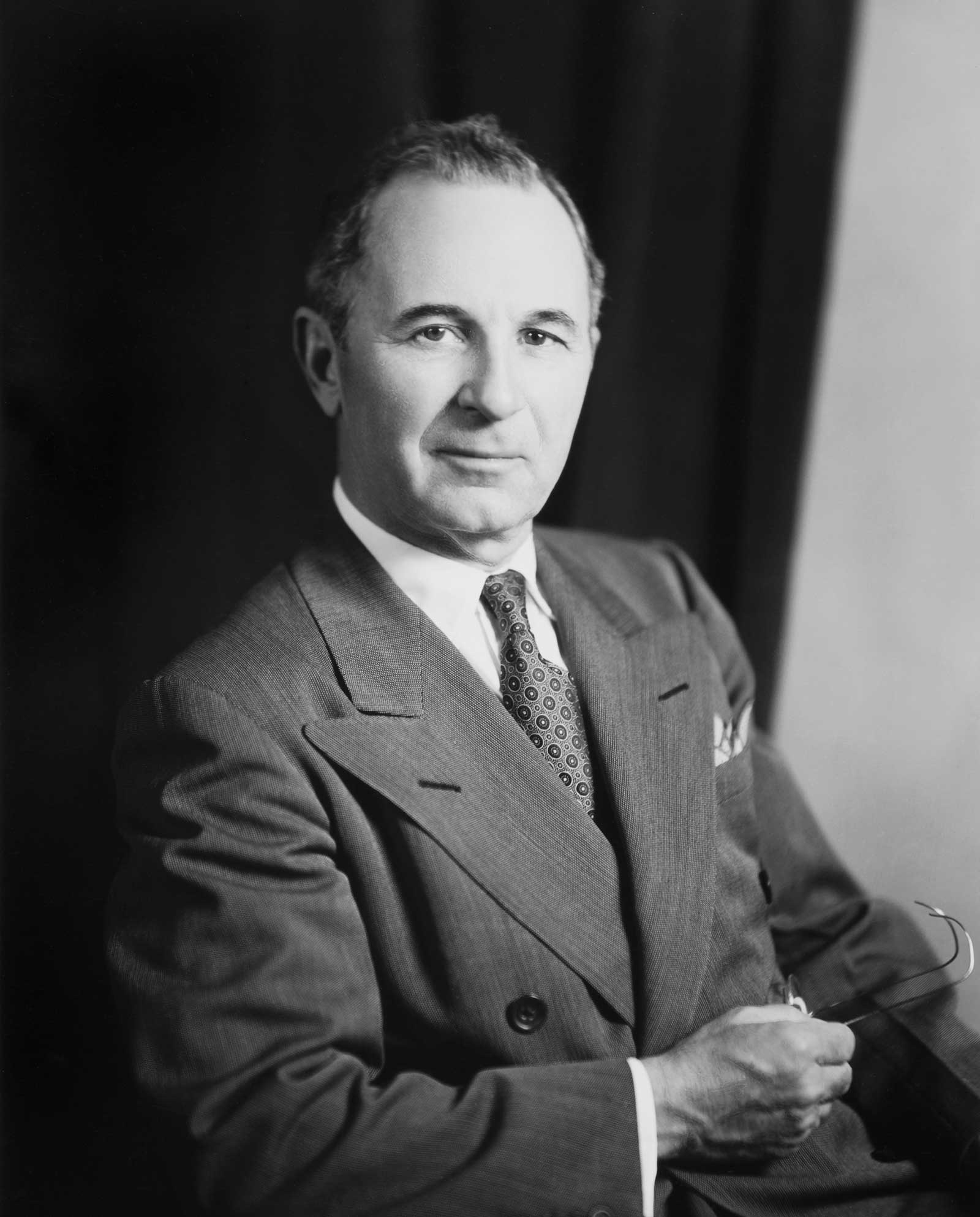 Thomas Gilcrease, photograph. GM 4327.9154. Gilcrease Museum Archives, Tulsa, Oklahoma.
It was hard to know where to look as I made my own way back through the galleries. One work that had stopped me in my tracks on my tour—a work I returned to on my own that afternoon—was Ernest Blumenschein’s 1949 canvas Enchanted Forest, a Taos painting I had only ever seen reproduced in catalogs and online. As is true of most paintings and sculptures, especially a major work, there is no substitute for standing in front of the thing, appraising its textures and true hues and the qualities of light in it as well as how external and ambient light plays over it. Seeing Enchanted Forest for myself for the first time, the painting became a tapestry: a dense throng of singing, dancing figures in the foreground woven into a palisade of tightly packed tall trees surmounted by a densely forested hillside of pines that rises and recedes in brocaded layers. As evidenced by the ceremonial dress of dancers ringing the central figures as well as the figure at far left bearing the carcass of a buck this appears to be the artist’s impression of a Taos Deer Dance. But the rhythm has to be felt in person to be appreciated. It is as if the vibrations of the music have caused the world to quiver into place, to find a provisional order and harmony. Writers have noted that the sunlit break in the trees above the path gives the overall effect a vulvar quality found in Georgia O’Keeffe’s flowers, but if Blumenschein intends to reference birth, it is the birth of light borne out of the ritual, a ritual of retelling. Standing there, taking Enchanted Forest in up-close and from a distance, drinking it in, brought me back to this idea of story, of the tremendous story that the Gilcrease, and Tulsa, have to tell, and the hope that this story will be told and retold and added to, layer upon layer, time and again.—
Powered by Froala Editor